Ok seems like Robotics is gonna be the play of the next few weeks/months. Here are some good companies worth watching imo
Spread across the stack: the OS, the sensors, the brain, and the body.
$BB - QNX is the safety-certified operating system that runs underneath the robot, not the robot itself. Deterministic, ISO-certified software is hard to replicate, which is why it sits in autonomous cars, industrial automation and now physical AI. QNX did $72.3M last quarter, up 26%, royalty backlog near $1B, partnered with NVIDIA and Arm.
$CCXI ($AGLT post deSPAC) - The public vehicle for Agility Robotics and its Digit humanoid, merging with Churchill Capital XI at a $2.5B pre-money valuation. Digit is already deployed at Schaeffler, GXO and Toyota with 65,000+ operating hours and $300m in multi-year orders.
$OUST - Ouster builds digital lidar, the depth perception layer for robots, AVs and industrial automation. One sensor architecture scaling across multiple end markets.
$AMBA - Ambarella makes edge AI vision chips that give machines real-time sight without the cloud. The same silicon that powers ADAS now targets robotics, drones and autonomous systems.
$AEVA - Aeva builds FMCW 4D lidar that measures velocity per point, not just distance. That matters for machines that need to predict motion, not only map space. Still pre-scale on revenue, so execution is key.
$RR - Richtech Robotics builds service and humanoid robots for hospitality and logistics. Micro-cap and speculative, the lottery-ticket end of the basket. Real deployments but thin financials.
$TER - Teradyne owns Universal Robots (cobots) and MiR (mobile robots), on top of being a semiconductor test leader. The cleanest profitable robotics exposure here, with a chip-cycle tailwind underneath. However, robotics is still a minority of revenue.
$SYM - Symbotic automates warehouses with AI-driven robotics, anchored by Walmart. Real revenue at scale, rare for this theme. Customer concentration and lumpy deployments are the risk.
$SERV - Serve Robotics runs autonomous sidewalk delivery, backed by NVIDIA and Uber. Fleet expansion is the growth story. Their robots look kinda ass though.
$CGNX - Cognex is machine vision, the eyes of factory automation and robotic guidance. Established and profitable, levered to capex cycles. Less explosive, more durable.
Any other ideas?
SpaceX IPO. OpenAI IPO. Anthropic IPO
Mega IPOs like these usually mark the top
And when the tech / AI bubble bursts, crypto will go from slow bleed to an avalanche
Everyone thinks this time will be different
But the 4y cycle is still intact
Lower prices in H2
Bookmark this
A lot of people have asked me what is my highest conviction stock pick. Stuff like $BB, $ABCL, $IOVA, $URA etc are all long term trades and have/will continue to do well with near term momentum and significant upside.
HOWEVER, my friends know: My #1 HTF pick is still $LPTH. Its a multiyear trade for generational wealth. If you havent read the DD, go read it on the research discord or follow @BussinBiotech for all the alpha. 🫡
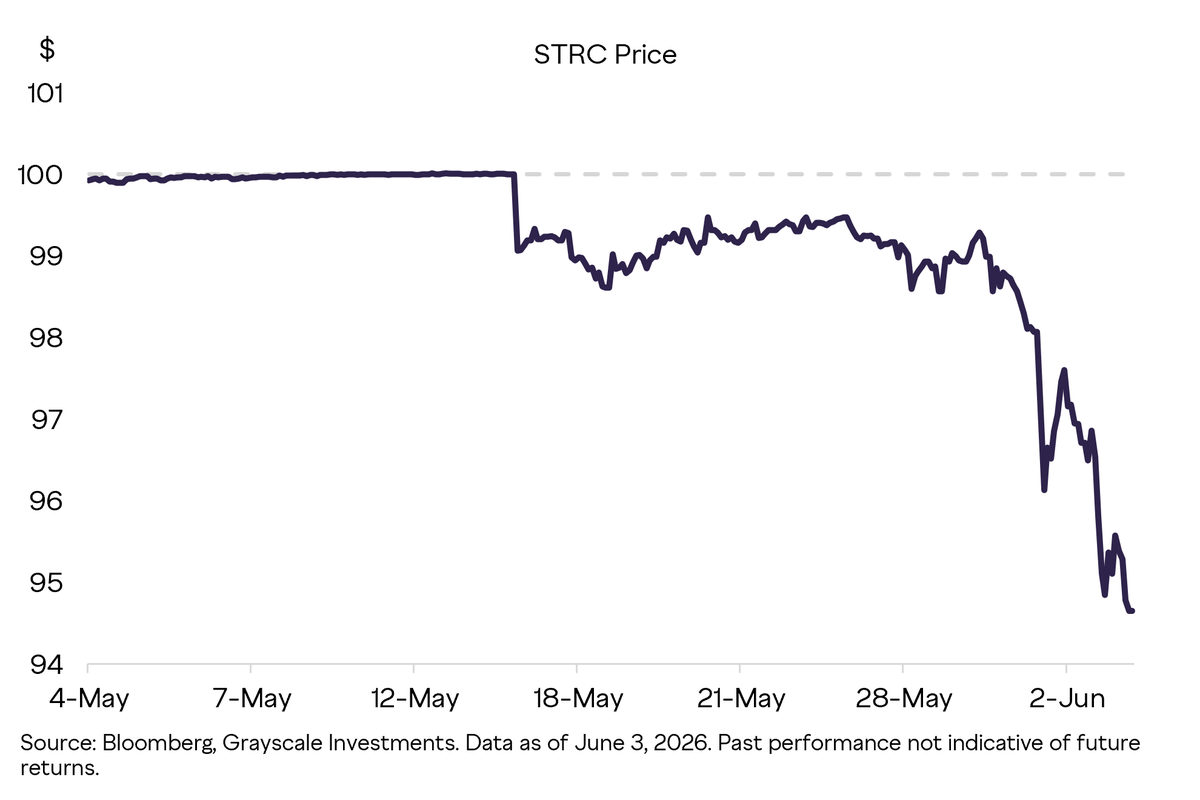
🆕 Grayscale Research: @Strategy sold $BTC, and the whole market felt it.
The world's largest digital asset treasury offloaded 32 Bitcoin on June 1.
The real story is the pressure on its levered model, and what it means for $BTC.
Read the full article from @lowbeta on the Stack:
https://t.co/IxXJupcri7
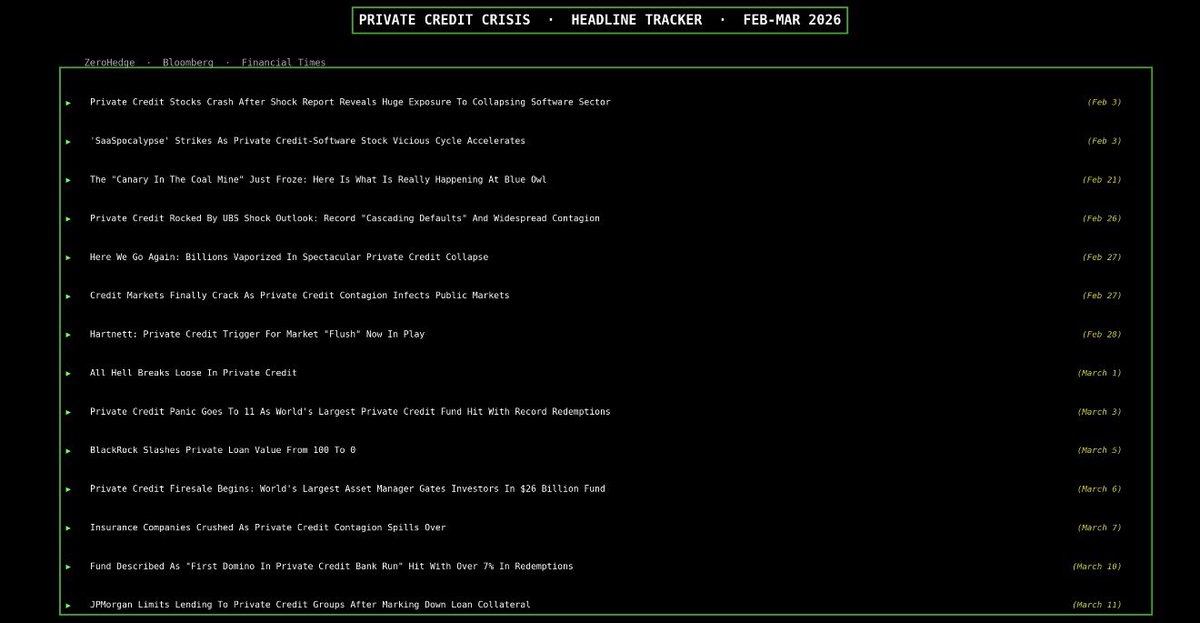
Something is breaking inside a $1.8 trillion market most people have never heard of.
And some of the biggest banks in America are neck deep in it.
It's not the stock market that's flashing red right now.
It's the shadow lending system that replaced the banks after 2008.
After the financial crisis, regulators forced banks to pull back from risky lending.
So hedge funds and asset managers stepped in.
They lent directly to companies with no public exchange, no transparency, and no rules.
That market is now worth $1.8 trillion.
Fitch just confirmed the default rate inside this market hit 9.2% in 2025.
That's a record and higher than any point during the 2008 financial crisis.
One in every ten borrowers is failing to pay back their loans.
The loans are almost all floating-rate.
When the Fed kept rates high, monthly payments kept rising for these companies.
Most of them had no protection against it, they just kept paying until they couldn't.
Now here's where it gets dangerous.
This market holds $1.8 trillion in assets but it only has about $100 billion in available liquidity.
That's an 18-to-1 mismatch.
Eighteen dollars trapped for every one dollar that can be moved.
Blue Owl Capital recently blocked its own investors from cashing out.
A $1.6 billion fund froze withdrawals, Blue Owl lost $2.4 billion in market value in a single day.
The broader market is a thousand times that size.
Now ask yourself, who's funding all these private credit firms?
U.S. banks have nearly $300 billion in loans sitting inside this market right now.
Wells Fargo, Bank of America, JPMorgan and Deutsche Bank.
JPMorgan has already started pulling back, quietly restricting loans tied to software companies in private credit.
Deutsche Bank disclosed its exposure jumped 6% last year and listed private credit defaults as a developing risk theme.
When investors can't exit their private credit positions, they sell something else.
What they sell is the most liquid thing they own.
That would be mega-cap tech stocks, the same stocks sitting in your 401(k).
A shadow lending crisis becomes a retirement account crisis fast.
Harvard economists, Moody's analysts, and SEC researchers published a joint study warning that private credit has quietly become a major source of systemic risk.
Less transparent than banks, less regulated, and more interconnected.
This isn't 2008, the structure is different.
But the physics are identical: opacity, leverage, liquidity mismatch, and panic.
When exits close and some already have, the rest writes itself.
Every move has 3 phases:
1. Basing (early, quiet)
2. Confirmation (breakout / trend)
3. Exhaustion (late, crowded)
Most people get this wrong
Let me explain:
Many big accounts on CT will continue to tell you that alts are at a generational bottom and that buying them now is a great call
The issue with this advice is that even at a -90% discount, your favourite vapourware can still drop another -90%
And another -90%
And so on
We call these accounts "cheerleaders" because everything the market does is spun into a bullish positive
> Market downside = big discount, buy the dip
> Market upside = higher, it's just getting started
> Sideways = consolidation, next leg up is loading
Eventually alts will bounce and these accounts will say "I told you so"
Discounting the fact that anyone who listened to their advice from day 1 will have been liquidated many times over
"Buy the dip" is the most expensive advice in crypto.
Here's why most traders lose money following it — and how to know when a dip is actually a dip.
Everyone says buy the dip. Nobody tells you that most dips in a downtrend are not dips at all — they are lower lows.
And buying a lower low is not being smart. It's being someone else's exit liquidity.
The difference between a real dip and a trap is not complicated, but most traders never bother to learn it.
So they keep buying, keep averaging down, and keep wondering why the chart keeps going against them.
1. A dip only exists in an uptrend
This is the most basic rule and the one most people ignore.
In an uptrend, price pulls back to a level of demand, holds structure, and continues higher. That's a dip. It's a healthy retracement within a trend that is still intact. Higher highs, higher lows — the structure confirms it.
If the structure is not there, it is not a dip. Full stop.
Pro tip: Before you buy any pullback, zoom out.
If the higher timeframe is not making higher highs and higher lows, you are not buying a dip. You are catching a falling knife.
2. In a downtrend, it's not a dip — it's just a lower low
Price bounces in a downtrend. Every time it does, people scream "buy the dip." But what they're actually buying is a lower high before the next lower low.
The trend is making lower highs and lower lows — that bounce is not a buying opportunity, it's a distribution event. Smart money is selling into your optimism.
Pro tip: Count the structure. If price just made a lower low and bounces, that bounce needs to break the previous lower high before it means anything.
Until then, it's just noise inside a downtrend.
3. Re-distribution vs accumulation — learn the difference
A range after a drop can look like a bottom. But not all ranges are accumulation. If the range resolves to the downside, it was re-distribution — a pause before more selling.
Accumulation shows declining volume, absorption at the lows, and eventually a spring or MSB to the upside. If you can't tell the difference, you're guessing with your capital.
Pro tip: Watch volume inside the range.
In accumulation, volume dries up on the drops and expands on the bounces.
In re-distribution, it's the opposite.
The volume tells the story before price confirms it.
4. Volume tells you what price won't
A real dip in an uptrend pulls back on declining volume — sellers are drying up.
Then the bounce comes on expanding volume — buyers stepping in with conviction.
A lower low in a downtrend bounces on low volume and drops on expanding volume.
The volume profile doesn't lie. If the bounce has no volume behind it, it's not a dip. It's a dead cat.
Pro tip: If you're not checking the volume profile before entering any trade, you're trading blind.
Price shows you what happened.
Volume shows you why.
5. How I tell the difference
I look at three things: trend structure, volume profile, and the reaction at key levels.
Is the macro trend making higher highs and higher lows?
Is the pullback happening on declining volume?
Is price holding at VaL or a known demand zone?
If all three align, that's a dip I'm interested in. If even one is missing, I wait. Patience has saved me more money than any setup ever has.
Pro tip: Don't buy the dip because Twitter told you to. Buy the dip because the structure, the volume, and the level all confirm it.
Multiple reasons for a trade — that's the edge.
Closing:
The next time someone tells you to buy the dip, ask yourself one question — is this actually a dip, or am I just buying someone else's exit?
The structure, the volume, and the context will always give you the answer. Your job is to listen.
"the market doesn't care about your bias. respect the structure, or become the liquidity."
If this was useful, like and repost — it helps more people find it.
Which dip did you buy that turned out to be a lower low?
Drop it below. No shame, we've all been there.
@Trader_XO Not sure if it’s just me, but I can’t read the numbers in the chart and the lines look blurry. It seems like the image quality drops after uploading.
Are you watching the Chinese New Year Gala? The Robot Kungfu show is mind blowing!!!
They just executed a coordinated martial arts routine with spatial precision, rhythm control, and dynamic balance adjustments in real time.
Kung fu, one of China’s most iconic traditional art forms , performed by machines built with cutting-edge AI control systems, advanced actuators, and high-speed feedback loops. Ancient discipline meets algorithmic precision.
Last year, humanoid robots stepped onto the Spring Festival Gala stage for the first time. This year, they held synchronized kung fu stances with balance that would humble half of us after leg day.
And they did it live!!! On the most-watched television event on the planet.
The progress in just one year is magical.
That’s what we call China speed.
What makes it even sweeter is where this happened.
I love how the progress is integrated in culture. In celebration. In a Lunar New Year gala watched by hundreds of millions.
It’s music to my ears.
The robots didn’t look like they were “trying” anymore. They looked like they belonged.
Their joint articulation was smoother.
Their formation timing tighter.
Their balance recovery almost elegant.
Their choreography is expressive.
That’s what happens when AI models improve, control systems get smarter, hardware stabilizes, and iteration cycles compress.
One year in robotics today is not the same as one year ten years ago.
It’s compounding.
If this is what 12 months looks like,
imagine 36.
The Chinese New Year Robot Kungfu Gala is just futuristic.
It was quite the statement!
The future is getting better very, very fast.
It was so beautiful to watch. What do you think?
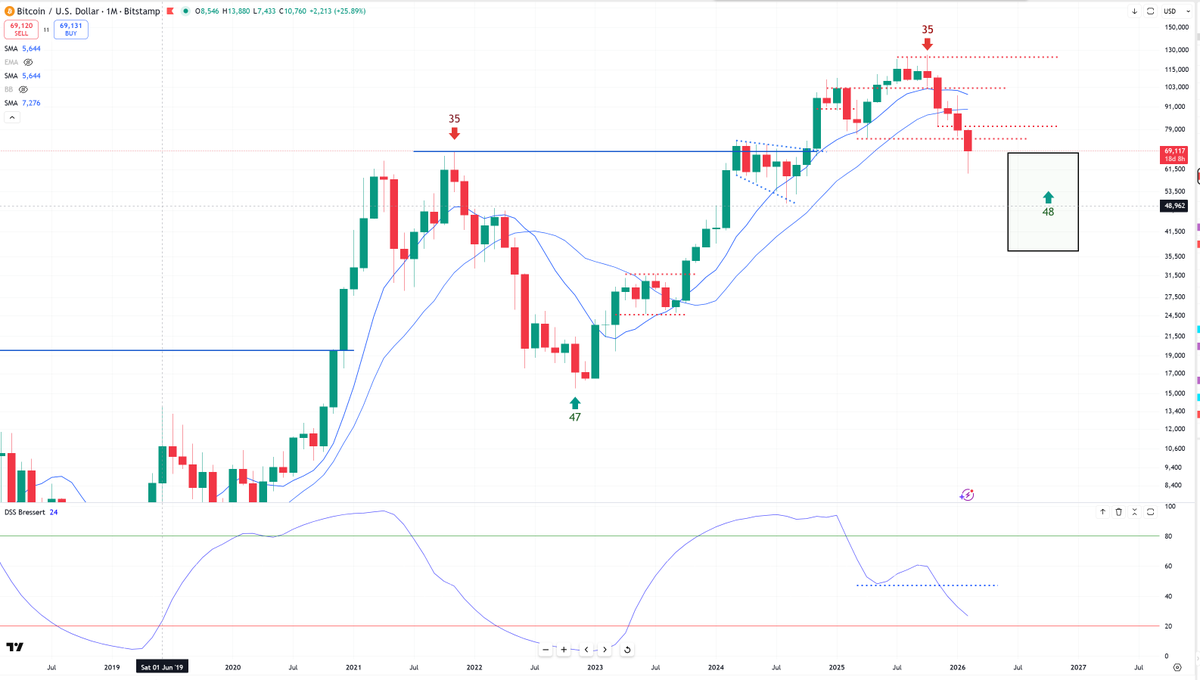
Just about every crypto chart is in deep bear mode now. Still a decent amount of Denial from perma-bulls, which is natural at this stage.
It's just a process down, self fulfilling and takes time, so stay patient. Like to focus on preparing for a bottom vs focusing on finding short term opportunities. Should expect one really solid counter-trend move between now and the eventual bottom.
I suspect the bottom comes with equities pushing down hard at some point in 2026 and likely well before the mid-terms.
The primary reason so many of you are deeply underwater on $BTC is that you refuse to see that it's not the same asset it was before 2024.
You refuse to acknowledge Saylor's greed and the extreme risks he poses to the asset. You refuse to see the extreme overhead he's put in above 80K and how unattractive that makes the asset to many buyers. Why am I buying an asset where one guy with 3.5% of the supply is completely fucked.
Many also refuse to see the Trump family's effect on BTC. Making America the "leader of crypto and Bitcoin" has pushed many buyers away.
And many still refuse to see that the large multiple are behind us (something I've mentioned when we were over 100K numerous times). There is no more 100x possible, no more 10x unless many years and changes away.
Yes, #Bitcoin still works the same as it always has, but extreme human greed has made it unattractive to investors (as you can see by price).
"bottom tweet". Might be, doesn't matter, yall been "backing up the truck" since 90K, you've been wrong. Simple as that.
Have only posted two $BTC trades in the past 3-4 months now. I think, trends take longer than people think. As do bottoms. People always underestimate the time aspect of markets and end up giving a lot of money back as a result.
I think crypto is largely struggling bc it has to compete with every other market right now. It's incredibly hard to compete with AI, bc AI isn't just AI. It has a lot of synergy across various markets, like energy, robotics, defense, minerals, magnets, you name it. It's a very real, tangible trade with results people can see and touch. We've seen the amounts of capital these things are drawing in which takes away from places like this. Trading equities has been a blast, and a bit refreshing. I again, will advocate for owning and trading both. I also feel, people see that many stocks are doing 5-10-25x and think. Why buy a shitcoin when I can buy a real company. And that's made it tough on alts. We need projects, that actually generate real revenue. Not much has come out the last several years outside of $HYPE, at least since the DeFi boom in 2018-2020.
BTC, is likely going to take time to form a bottom. If equities locally top soon that could be in the high 50's in a few months. I think it's worth being open to that idea. But locally here. I think 70-75k at least for a decent bounce and then we can evaluate based on how that market structure forms. You can trade less, and outperform everyone by just trading the extremes atm imo.
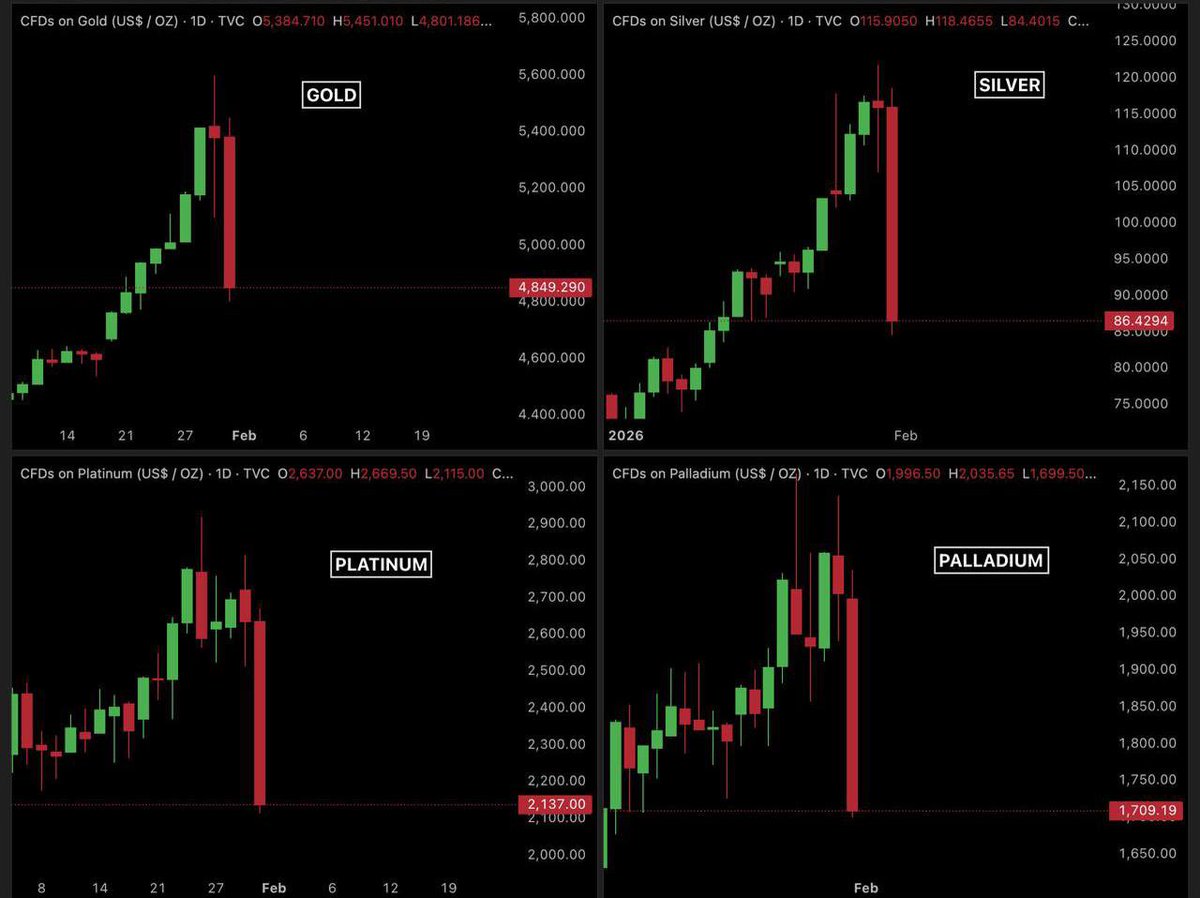
Gold crashed from $5,600 down to around $4,700. Silver fell from $121 to $77.
Platinum and palladium got crushed similarly.
All of this happened in less than 36 hours, and when you calculate the total value lost across all precious metals globally, it adds up to roughly $7 trillion.
This morning, Trump announced Kevin Warsh as his pick to become the next Federal Reserve chairman, replacing Jerome Powell when his term ends in May.
Warsh is known as an inflation hawk, he's focused on fighting inflation and keeping the dollar strong, which is the complete opposite of what traders had been betting on for months.
The entire metals rally was built on a simple narrative, traders assumed Trump would pick someone who'd aggressively cut interest rates and weaken the dollar.
When that happens, precious metals become more valuable because people lose confidence in fiat currency.
Traders loaded up on huge leveraged bets that metals would continue surging, using borrowed money to amplify their potential gains.
But when Warsh, a known inflation hawk got nominated instead, the thesis completely flipped.
Suddenly, every trader who had bet on falling rates and a weaker dollar realized they were wrong.
They needed to sell to cover losses.
The selling cascade happened extremely fast because once it started, leverage got flushed out violently.
Banks and market makers raised margin requirements on futures contracts, which forced smaller traders to sell whether they wanted to or not.
The forced selling pushed prices down even further, which triggered more liquidations in a vicious spiral.
On top of that, the dollar strengthened as markets processed the reality of a hawkish Fed incoming.
A stronger dollar makes metals cheaper for international buyers and reduces buying interest.
Every time metals dropped another few percent, more traders got wiped out and the selling accelerated harder.
The key thing to understand is that metals didn't crash because the fundamentals changed.
China still has export controls on silver, physical supply is still genuinely tight, and industrial demand still exists.
They crashed because the Fed policy narrative completely flipped in a single announcement, wiping out a crowded speculative trade that was entirely built on betting against the Fed and betting on a weaker dollar.
What triggered this was disappointing news from Microsoft.
The company is spending way more than expected on AI data centers and cloud revenue growth is slowing.
When the world's most valuable company signals weakness, it sets off a chain reaction of selling across the entire market.
Microsoft stock crashed about 11%, and because it's one of the heaviest-weighted stocks in the S&P 500 and Nasdaq, this alone dragged down entire indices.
The Nasdaq fell 2.5%, the S&P 500 dropped 1.23%, and the market collectively lost roughly $780 billion in equity value within an hour.
What made this worse is that precious metals normally safe havens also crashed.
Gold plunged 8.2% erasing about $3 trillion in market cap, while silver crashed 12.2%, wiping out $760 billion.
This is counterintuitive because stocks and metals usually move in opposite directions.
The metals crash reveals that these markets had become dangerously overheated.
Silver surged 65% in January alone and was up 145% for 2025, displaying what analysts called "bubble-like dynamics" with prices stretched 30% above fair value.
When panic selling started in stocks, it cascaded into metals because investors needed to raise cash quickly.
The sheer speed of selling exposed how thin the market had become, causing prices to collapse.
The broader issue is that investors were getting nervous about whether companies can justify massive AI infrastructure spending.
Tech companies committed over $135 billion to data centers, but the question was whether this spending would generate returns or become competitive arms racing.
Microsoft's earnings essentially confirmed people's fears heavy investment but slowing revenue growth.
If Microsoft can't convert capex into revenue growth, what does that mean for 2026 earnings?
This triggered a "risk-off" environment where investors suddenly found growth-dependent assets unattractive.
Days before, people were euphoric about AI and commodities were flying higher.
The moment doubt crept in, everything rotated violently.
Geopolitical tensions around Iran added another layer of uncertainty, making investors even more reluctant to hold risky positions.
What this means going forward is that 2026 is looking shakier than optimistic forecasts suggested.
The market had been priced for growth companies to execute flawlessly despite massive costs.
Now there's real evidence execution is harder than expected.
Valuations need to compress, meaning stock prices must fall relative to earnings, or companies need to grow faster than predicted.
Neither scenario is pleasant for investors who rode the rally up.
The precious metals situation warns that speculation and leverage had built up in corners of the market and more painful reversals could be coming if sentiment continues deteriorating.
Trump says the US has "taken in $18 trillion due to tariffs," he's not talking about revenue collected at the border.
Instead, he's referring to "investment" commitments from companies and foreign governments that have pledged to spend money in America to either get tariff relief or to comply with his trade policies.
This is a crucial distinction because it's like counting a promise to donate money as if the government already received it.
The actual monthly tariff revenue that the government is collecting right now is around $30 billion, not trillions.
The problem with the $18 trillion number gets worse when you fact check the underlying investment pledges.
According to PolitiFact and other fact checkers, Trump has been citing these figures without concrete documentation from the White House or other evidence backing them up.
Bloomberg's investigation revealed that Trump's projections are dramatically overstated by a factor of three.
Bloomberg found that the actual investment commitments are closer to $7 trillion when scrutinized, not the $18-22 trillion range Trump regularly claims.
This matters enormously because many of these pledges are vague, contain loopholes and are often conditional on tariff relief.
For example, Japan said their $550 billion pledge isn't actually $550 billion in cash flowing into the US but rather a combination of investments, loans, and government backed loan guarantees.
Apple's $600 billion commitment includes things like "work with suppliers across all 50 states and Apple TV+ productions," which is misleading phrasing about what the money actually represents.
The economic implications are worth understanding because they directly affect you.
While Trump celebrates investment pledges that haven't materialized yet, the actual cost of tariffs is hitting Americans right now.
According to Democrats on the Congressional Joint Economic Committee, tariffs have cost the average American household approximately $1,200 since Trump took office in January 2025.
Yale University's Budget Lab projected that price increases from tariffs could cost households an extra $2,400 in 2025 alone.
Also, it’s important to note that our deficit spending has been increasing every month since he took office.