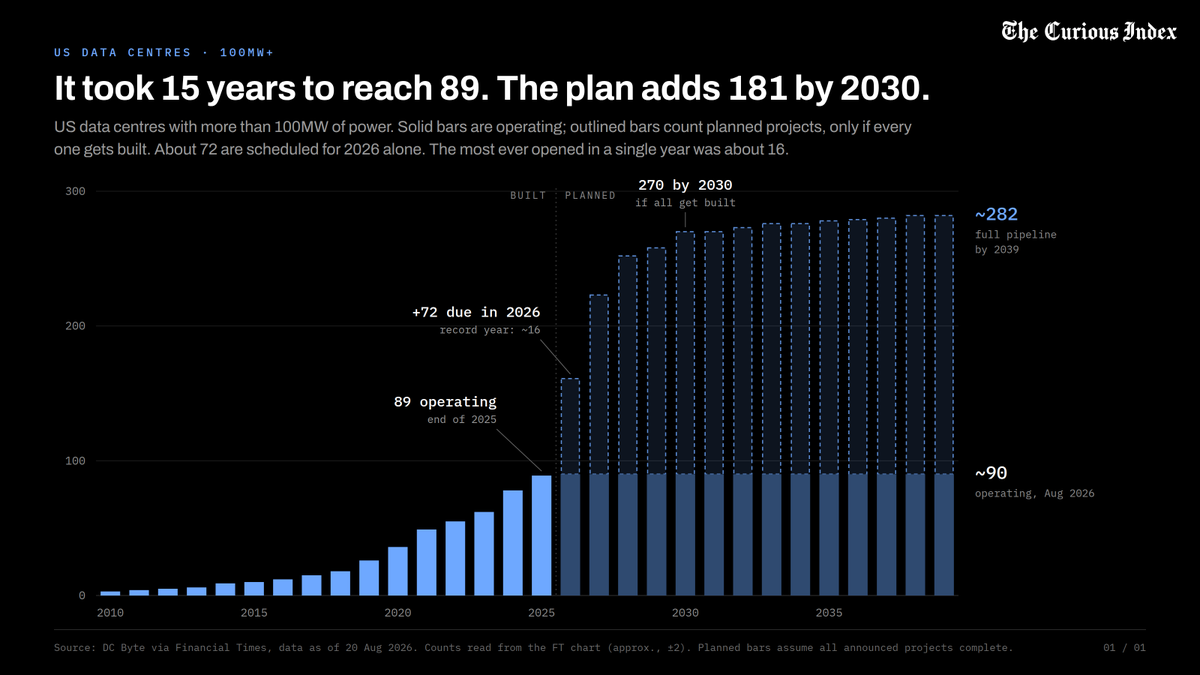
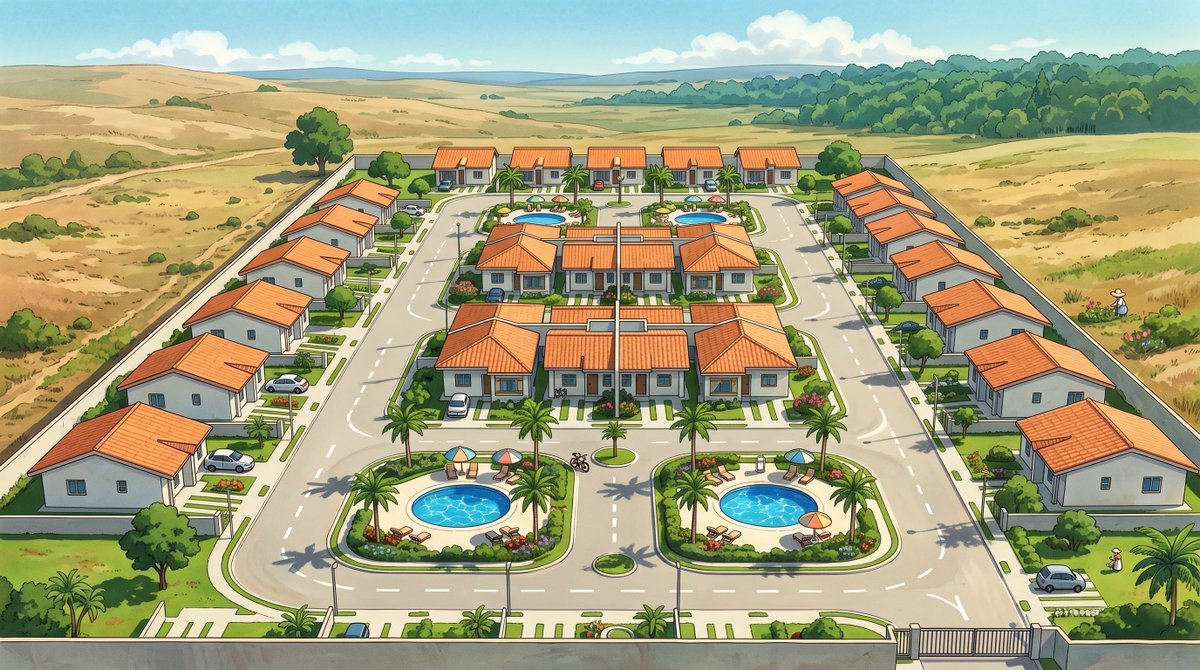
The US currently has about 90 data centers, each over 100 MW, similar to the power used by a small city. It took 15 years to reach this number, peaking at around 16 new centers opening in a single year. If all planned projects are completed, the US will have approximately 270 data centers by 2030, an increase of 181 from today, with about 72 of these scheduled for 2026 alone.
However, this projection only considers announced projects, not all that will actually open. By two-thirds of 2026, the number of operational data centers has barely increased. Sightline Climate estimates that 30–50% of this year's planned US capacity may be delayed until 2027 or later because of issues like power supply shortages, transformer shortages, and local opposition.
SemiAnalysis says major tech companies are still building as planned, and most delays involve speculative projects unlikely to open. Regardless, the announced plans far exceed what has been built so far, and the main challenge is constructing these centers, not demand itself.
When you have such strong earnings where the S&P 500, the index itself was 20% in a year, that is, to july and around 15% in Q2 itself, no one would want to miss out on this race. These foreign institutions don't want to invest in debt or treasury anymore; they want to get into this AI race or the stock race. Also, there were strong rallies in Korea and Taiwan. So that hit the concentration limit, which is why more than $200 billion came into US equities from Korea alone. We can assume that the Treasury has lost its appeal.
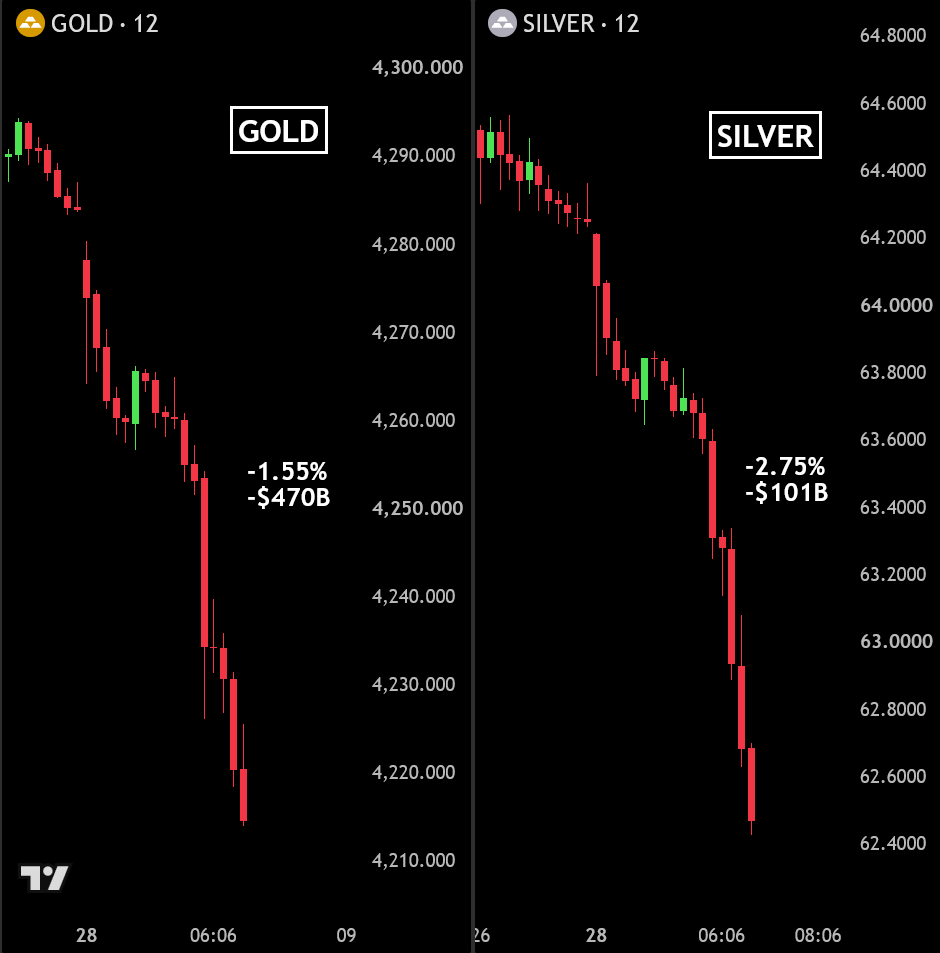
One thing is for sure: this conflict between the US and Iran has been driving gold down a lot, and the market cap is being wiped out for both gold and silver, and the reason is obvious. Inflation is sticky, the Fed is raising rates, yields are going up, and people don't want to invest somewhere they don't get much interest right now, and gold is cold. Gold hit an all-time high around late January, $5,500 to $5,600. That was the case in January, but since the US-Iran conflict has intensified, gold has been down 15 to 25% from that peak, and markets stopped treating it as "let's hide our money due to war". As a byproduct, they started treating it as an energy shock, leading to sticky inflation, leading to Fed rate increases, leading to higher yields, which is more fascinating for investors at the moment.
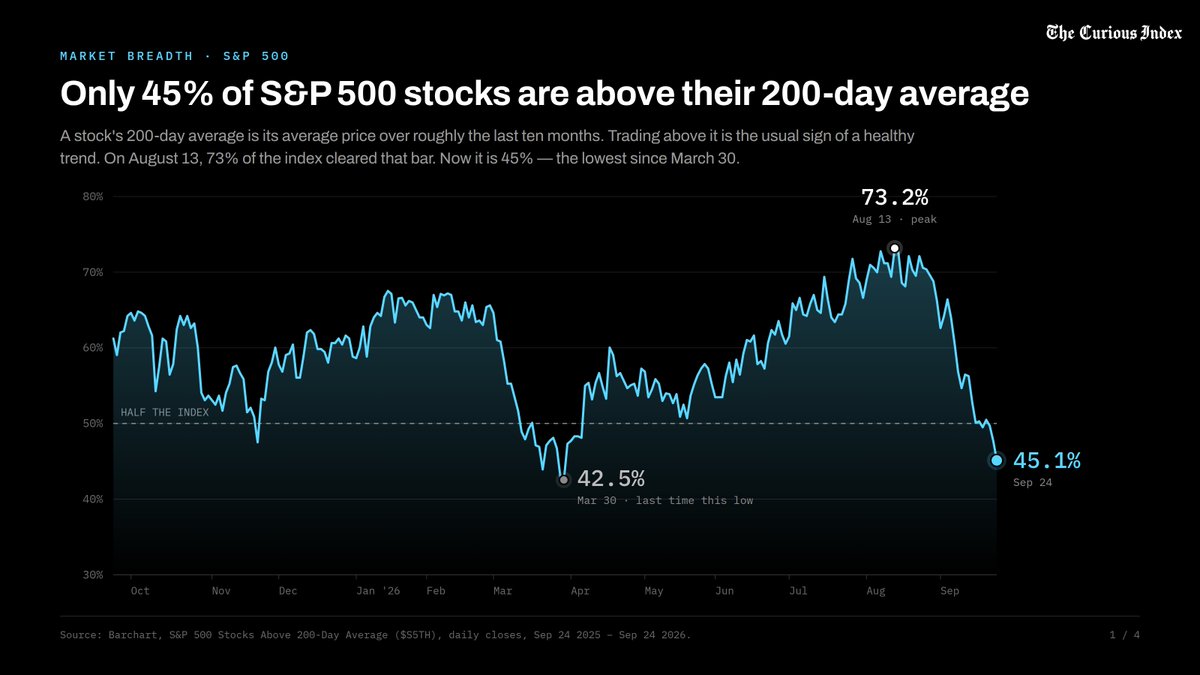
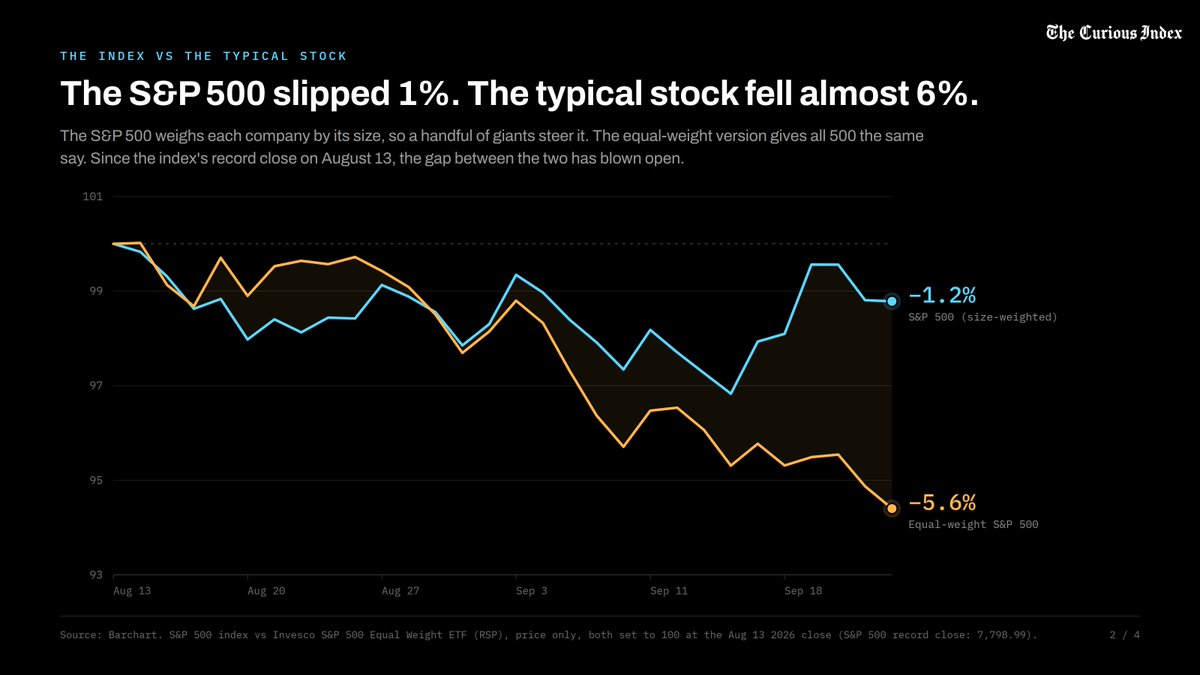
More than half the stocks in the S&P 500 are now in a downtrend. A common way to check a stock's health is to compare its price with its 200-day average, which is roughly its average price over the last ten months; when a stock trades above that line, its trend is up. On Thursday, only 45% of S&P 500 companies were above it. That's down from 73% on August 13 and the lowest since late March. Over a shorter window, it looks worse: just a quarter of the index is above its 50-day average. The strange part is that the index itself has barely moved. The S&P 500 is only 1.2% below the record it set on August 13, while the equal-weight version, which gives all 500 companies the same say, is down 5.6%.
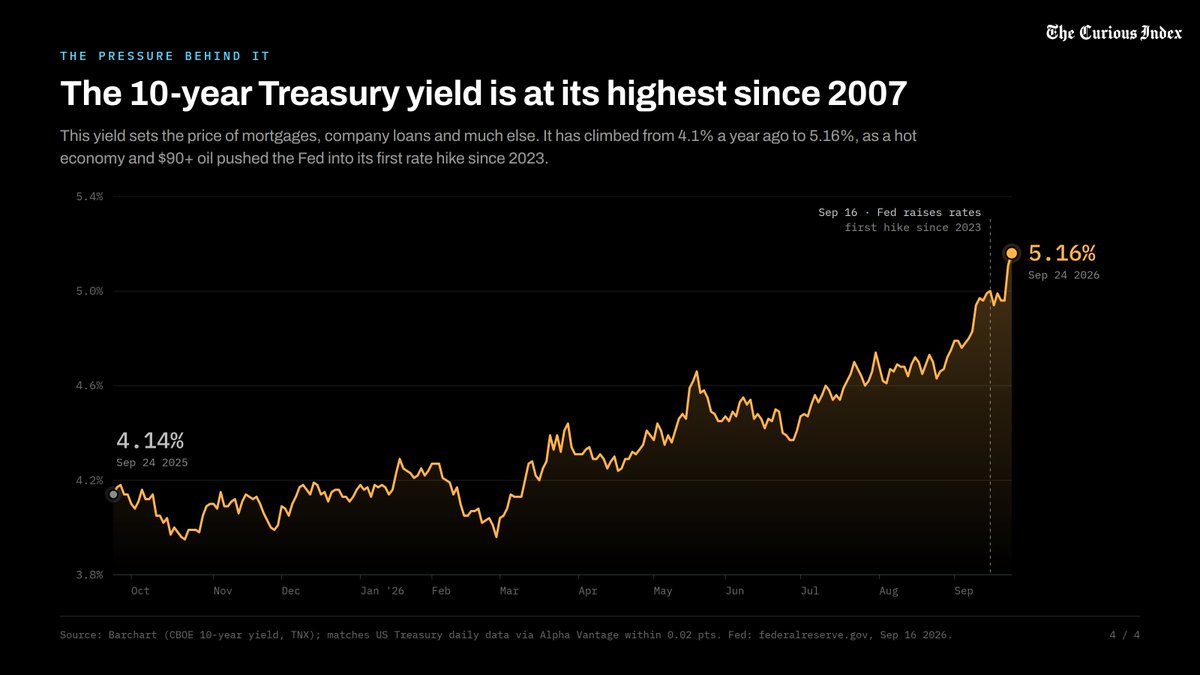
That gap exists because the S&P 500 is weighted by company size, so a few giant tech and communication companies can hold the headline number up while most of the list falls. Underneath it all, borrowing has become more expensive. A strong economy and oil above $100, plus the US-Iran fighting around the Strait of Hormuz, have kept inflation high. The Fed raised rates on September 16 for the first time since 2023, and traders now see roughly 70% odds of another hike in October. The 10-year Treasury yield, which sets the price of mortgages and company loans, has climbed to an all-time high, its highest since 2007.
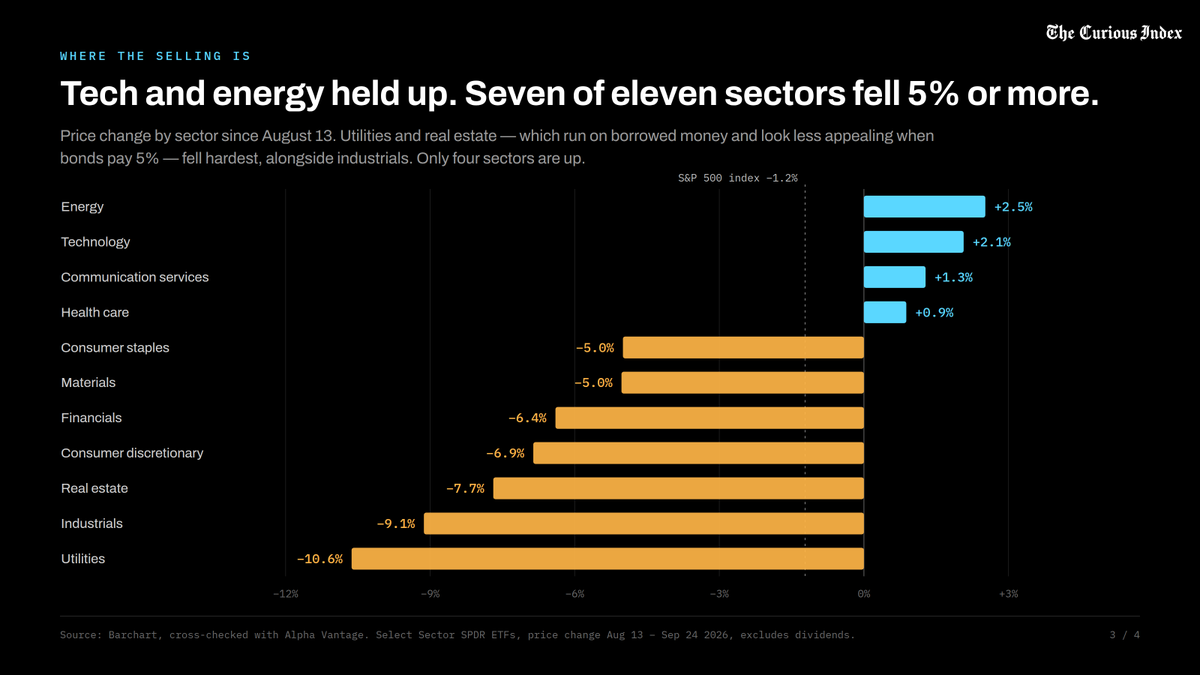
That hurts most where companies run on borrowed money, or where investors bought shares for steady income they can now get from bonds instead. So utilities (−10.6%), industrials (−9.1%) and real estate (−7.7%) have fallen hardest since mid-August. Tech, where the biggest companies sit on large piles of cash, and energy, helped by pricier oil, are both up. The index can look calm for a while like this, but it is leaning on a very small group of stocks to stay there.
The 30-year fixed mortgage rate has just surged to 7.5%, delivering a fresh shock to prospective homebuyers who saw rates as low as 5.99% this past February. While a 7.5% rate might not seem catastrophic historically, the 50-year average sits around 7.7%; the real squeeze on modern buyers comes from pairing these elevated borrowing costs with today's stubbornly high home prices. This rapid spike has essentially frozen the market, leaving current homeowners clutching their older 6.5% rates like winning lottery tickets, while sidelined buyers hold their breath, hoping this mounting financial pressure will finally trigger a much-needed price correction and bring the dream of homeownership back to reality.
When a tech giant like Oracle sees its bond yields spike to 8.10%, effectively pricing its debt at a high-risk "junk" level, it signals severe market anxiety over its debt-fueled AI expansion. In a brutal macro environment where the 10-year Treasury yield just crossed 5.20%, Oracle's massive borrowing strategy is colliding with physical infrastructure limits. The immediate catalyst is breaking news that Oracle issued a force majeure notice on "Project Jupiter," its planned 2.45-gigawatt, $165 billion flagship AI data center in New Mexico. Squeezed by a denied energy permit and local pushback, the facility's 2028 launch is in jeopardy, which analysts warn could stall upwards of $25 billion in expected revenue from key cloud customers.
Critics like Michael Burry have noted that Oracle is booking billions in customer prepayments for cloud capacity meant to be delivered three to five years from now. If regulatory and power grid issues prevent facilities like Project Jupiter from coming online, Oracle won't be able to actually deliver the compute that customers have already paid for.
Anthropic is reportedly asking shareholders to approve a new corporate structure modeled on Palantir’s, granting CEO Dario Amodei and his six co-founders a combined 50.1% voting control ahead of the company’s anticipated initial public offering. The arrangement would allow the founders to retain collective authority over most corporate matters as long as at least three of the seven maintain a minimum share threshold.
The move is intended to shield the founding team's long-term vision from public shareholder pressure, giving them sweeping influence even though Amodei reportedly holds only about a 2% economic stake. One notable exception is the election of the board of directors, which Anthropic's benefit trust will continue to govern.
@Kalshi No, we follow. We follow how you are trying to fool us. AI might be dangerous, and you knew it from the start. You just waited for the right time, when things couldn't go against you, to come and be this Holy Savior.
For anyone trying to understand better
As @zerohedge highlights, most investments, apart from AI, haven't grown as much as AI, which has averaged 20% YOY. And rate hikes are meant to cut corporate spending. But since other sectors are in recession, AI is only partially driving sticky inflation and most spending. So hiking rates means little in the long run; this AI spending cannot be controlled by rate hikes, and everyone is in a race to win.
The simple reason is that $100 arriving next year is not worth the same as $100 in your pocket today. We use the bond rate to measure that difference. When the rate jumps from 4% to 5.1%, that same future $100 is suddenly worth less today. Stocks are simply long chains of those future payments, so the entire chain gets marked down at once. That is how rising bond yields can crash stock prices without the companies themselves changing a thing.
The simple reason is that $100 arriving next year is not worth the same as $100 in your pocket today. We use the bond rate to measure that difference. When the rate jumps from 4% to 5.1%, that same future $100 is suddenly worth less today. Stocks are simply long chains of those future payments, so the entire chain gets marked down at once. That is how rising bond yields can crash stock prices without the companies themselves changing a thing.
The reason they discuss phasing it is simple: neither side wants to surrender its main bargaining chip first. Iran’s leverage is control of the Strait, while America’s is the blockade. A phased approach sequences the concessions, allowing both sides to test whether the other is genuinely complying before moving on to the next, more difficult issues.
@WatcherGuru Tesla would eventually have to lower its prices if these American-made Chinese EVs cost less. Since sourcing and the supply chain are already in place, American workers will receive a paycheck. And cheaper cars come to market.
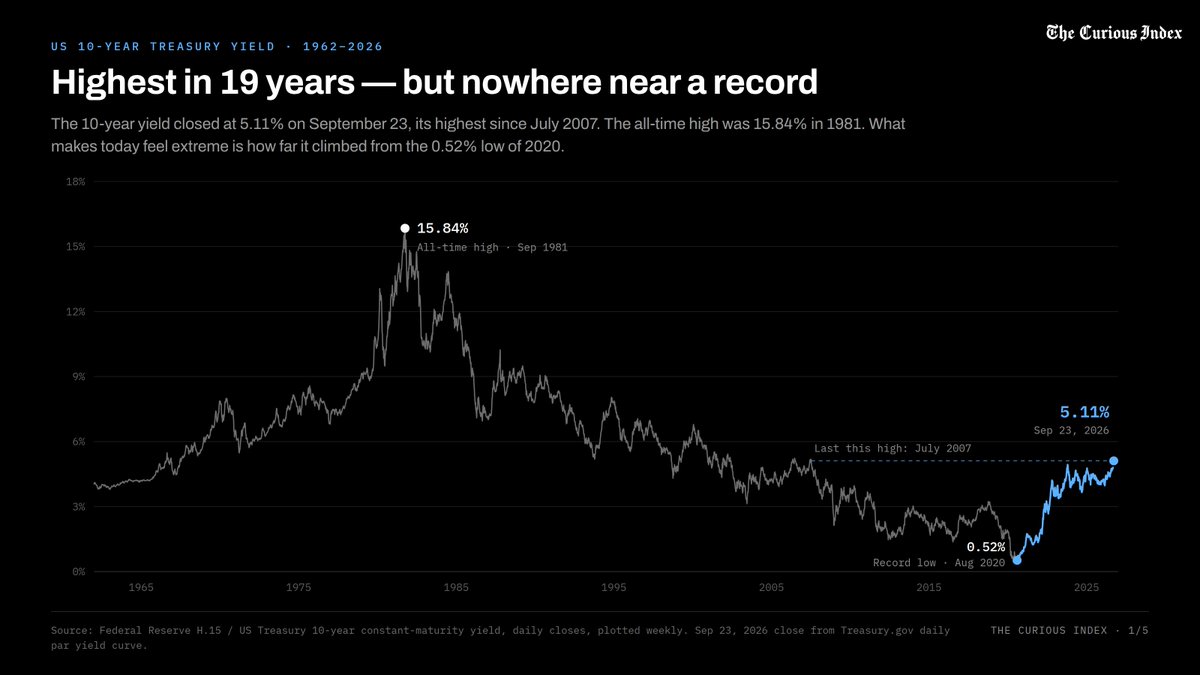
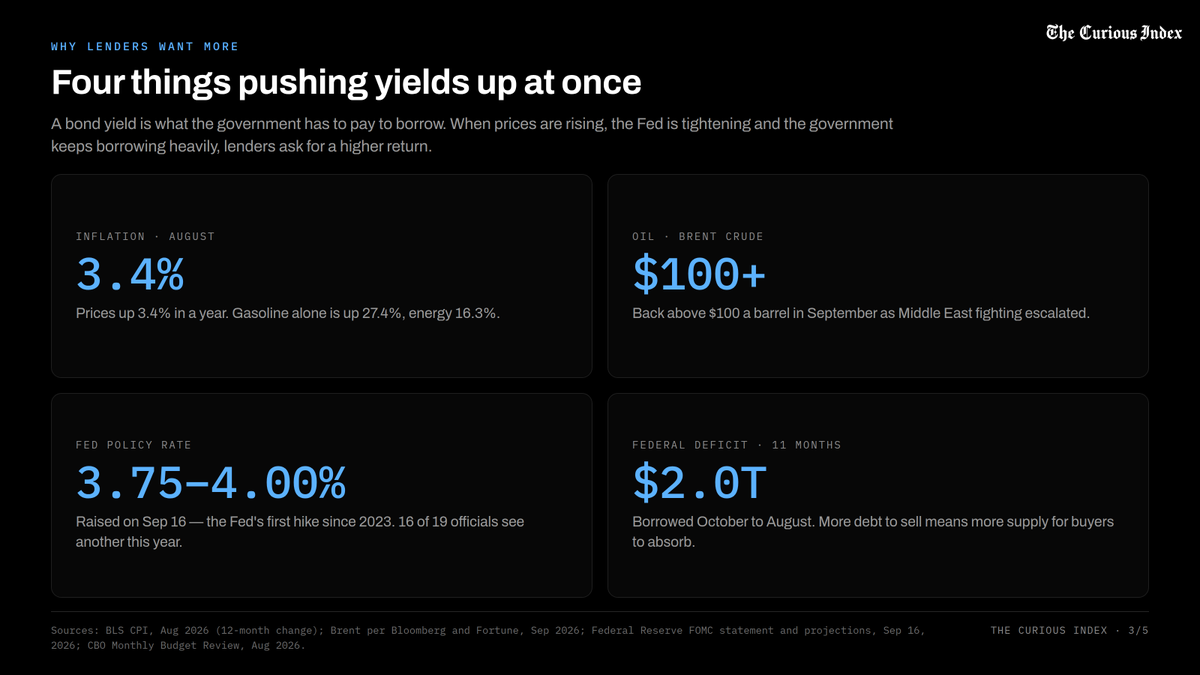
On September 23, the 10-year Treasury yield closed at 5.11%, its highest since July 2007, and the 30-year closed at 5.40%. It is not a record (the peak was 15.84% in 1981), but it is far from the 0.52% low of 2020, and most of this year's climb has come since late February, when the Iran war began and the Strait of Hormuz closed. Oil back above $100, inflation at 3.4% with gasoline up 27% in a year, a Fed that raised rates on September 16 for the first time since 2023, and a $2 trillion deficit in just 11 months have all pushed lenders to ask for more.
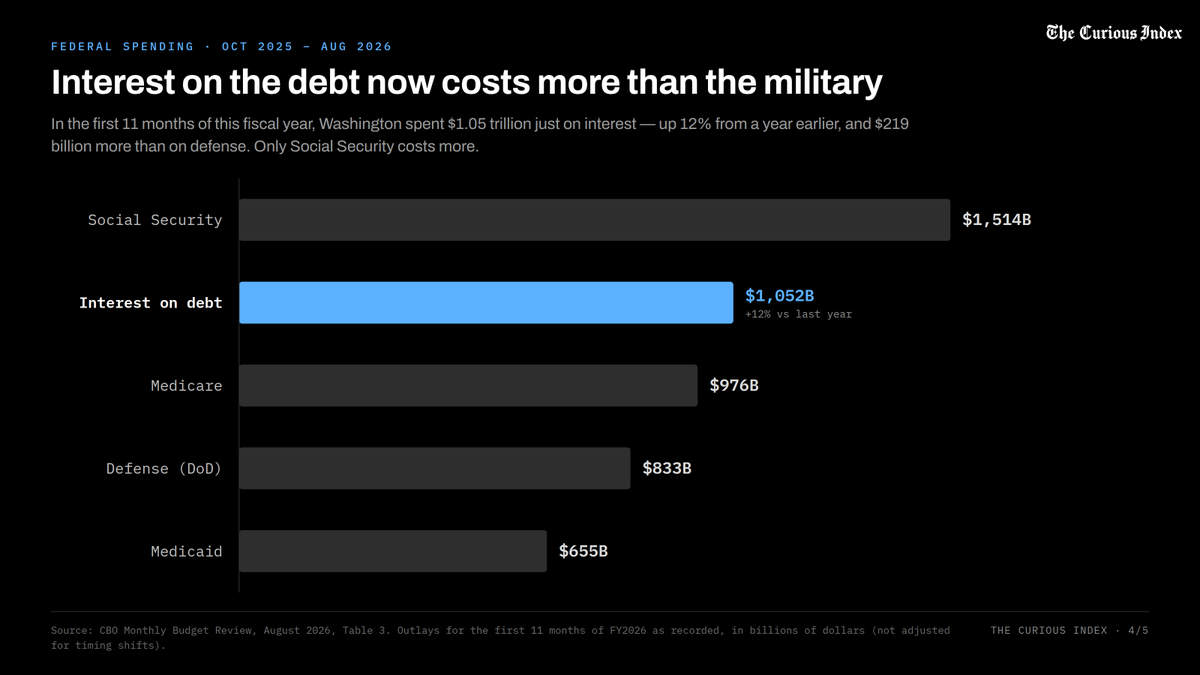
The bad news hits borrowers first. Mortgage rates track the 10-year, and the average 30-year fixed rate is now 6.95% versus 6.26% a year ago, adding about $182 a month to a $400,000 loan. Car loans and business loans get pricier too, and higher yields tend to weigh on stock prices. The government feels it as well: in the first 11 months of this fiscal year it spent $1.05 trillion on interest, 12% more than a year earlier and more than it spent on the military. The more the debt costs to carry, the less room there is for everything else.
Ondo Finance has launched Ondo Intelligent Portfolios, a new suite of tokenized investment products based on BlackRock-designed asset allocation strategies. Instead of manually buying and managing a basket of individual assets, eligible investors can now hold a single digital token representing a diversified portfolio, such as high-income or high-growth strategies. The underlying allocation and rebalancing rules are encoded directly into smart contracts, allowing the portfolio to adjust automatically to market movements without manual trading, emotional bias, or expensive traditional intermediaries.
This programmatic approach not only democratizes access to institutional-grade wealth management but also makes it composable within the broader decentralized finance (DeFi) ecosystem. Because the diversified strategy is represented by just one token, investors can seamlessly use it as collateral for digital loans across DeFi protocols.