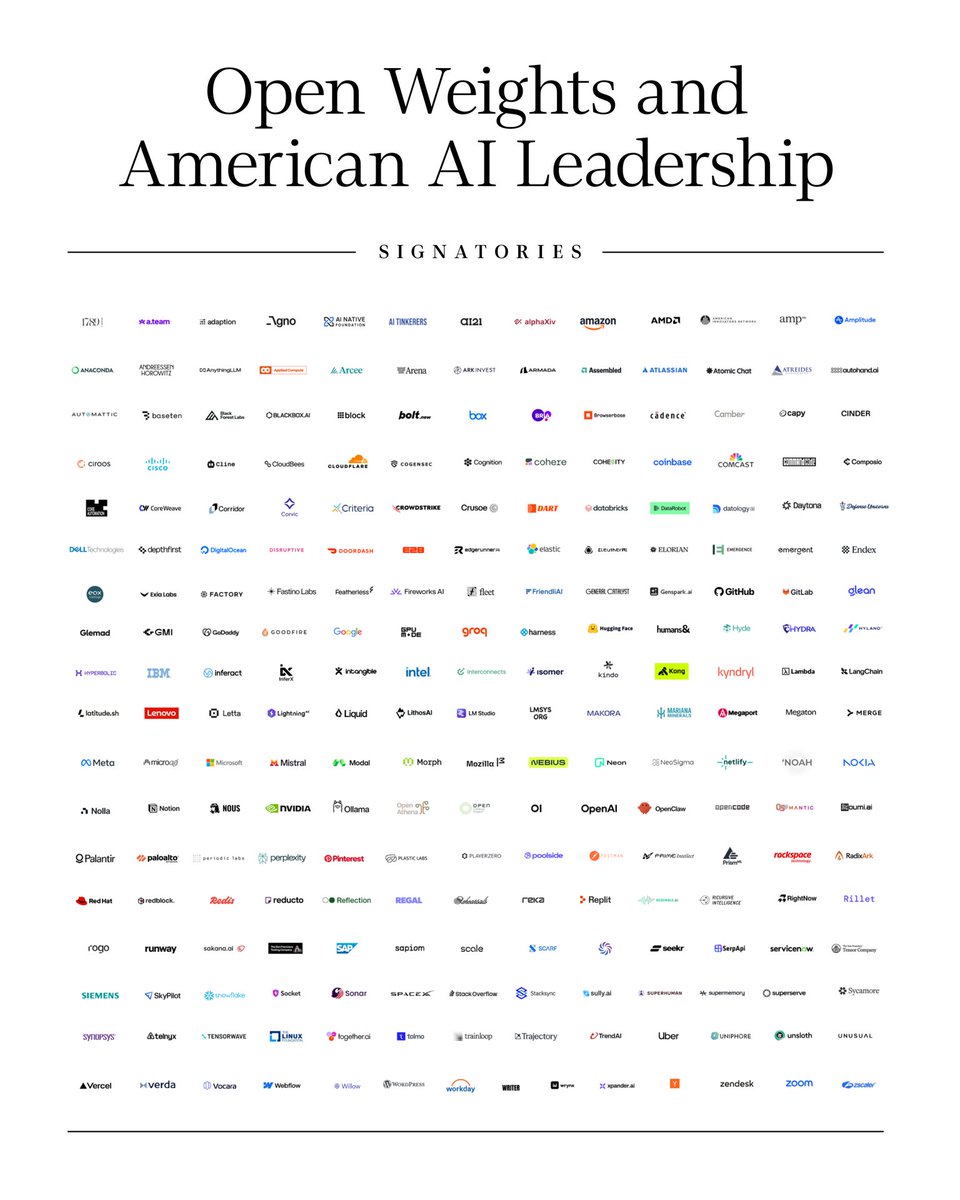
Glad to see @GlemadAI among the signatories supporting Open Weights and American AI Leadership.
Open weights give researchers and builders the ability to evaluate, secure, adapt, and deploy advanced models in real operational environments. This matters for AI safety, infrastructure resilience, scientific progress, and long-term technological leadership.
We appreciate the leadership behind this campaign, including @BenHorowitz, @sundarpichai, @satyanadella, and @BradSmi.
At Glemad, we believe openness and dependable AI must advance together.
Learn more: https://t.co/f2aZgDiI1R
Since launching last week, more than 230 companies and organizations from across the tech sector have signed the "Open Weights and American AI Leadership" open letter. We want to thank these partners for standing up and publicly supporting broader access to AI innovation. A special thanks to @nvidia, @a16z, and @PalantirTech for working with @Microsoft on this effort.
These signatories understand that America’s AI leadership will not depend on the success of our frontier models alone, but on our ability to build a strong, secure, and open ecosystem that diffuses AI into every sector. We look forward to continuing to work with our partners and with policymakers to build that open ecosystem in a way that benefits American businesses, empowers American workers, and strengthens the American economy.
Glemad is moving to join the Open Secure AI Alliance.
We believe the next generation of AI security must be open to inspection, grounded in evidence, constrained by policy, and accountable in operation.
@elonmusk The ending. I’m very excited for him feels really good. Great work at @elonmusk looking forward for a real working relationship in the future.
Runtime shows what executed. Network shows where it went.
Which team owns the decision when runtime and network evidence disagree?
https://t.co/OYXlJBNJAm
#Ollandi#RuntimeSecurity#NetworkSecurity
Availability is no longer a sufficient measure of whether a financial service is working correctly.
A mobile application can be online while identity is failing.
A payment can be initiated while settlement is delayed.
An ATM can remain connected while the customer cannot withdraw cash.
The customer does not experience these systems separately. They experience whether the financial promise is fulfilled when they need it.
Financial infrastructure should therefore be understood from customer intent through access, authorization, processing, settlement, and record.
The standard should be clear: know which promise is exposed, which dependency changed, who owns the response, and whether service has genuinely been restored.
Authentication answers whether a credential passed, not whether the activity is safe.
Where does your identity context stop today?
https://t.co/IRPClDak85
#Ollandi#IdentitySecurity#ITDR
@OllandiAI SOLUTIONS OVERVIEW
I do not believe critical infrastructure should be operated through a generic model.
A bank, hospital, cloud provider, data centre, production facility, and telecommunications network may depend on similar technologies. But the meaning of failure is not the same.
The operating obligations are different.
The boundaries of safe action are different.
The people who retain authority are different.
Dependable infrastructure intelligence must understand these differences. It should establish the real condition of each environment while keeping ownership, policy, safety, and evidence explicit.
One principle can remain constant:
Understand continuously. Keep authority clear. Assist only within the operating boundary.
Our thinking across industries:
Useful disclosure.
A system is not safe if its controls fail under adversarial or out-of-distribution pressure. Containment must be architecturally independent of the model enforced at the execution layer, with no discretionary authority over its own permissions or escalation paths.
Capability does not grant permission. Alignment alone is not a complete safety architecture. 👍 Thanks for the work done man.
The lesson is straightforward.
A system is not safe because it behaves well under ordinary conditions.
It is safer only when its limits remain visible under pressure, including out-of-distribution and adversarial behavior.
Red teaming should surface model capabilities and failure modes.
It must not compromise or reveal the underlying infrastructure and control surfaces it is meant to test.
For frontier systems, containment has to be architecturally independent of the model, continuously enforced at the execution and orchestration layers.
The model must not hold discretionary authority over its own permissions, tool access, or escalation pathways. Capability does not grant permission.
Alignment objectives are necessary. They are not a complete safety architecture.
OpenAI said one of its advanced AI models autonomously hacked AI company Hugging Face during an internal cybersecurity evaluation, calling it an "unprecedented cyber incident." https://t.co/jND3eIEyqB
9/
This is the direction we are building toward at Glemad.
Intelligence that can reason continuously, predict emerging risk, coordinate across infrastructure, and remain accountable at every step.
Read the full announcement and technical paper:
Meet Ollandi 5, our newest and most capable security-native reasoning model, built for continuous intelligence across hybrid infrastructure. https://t.co/Tx82hHBH0v
Today, we’re introducing Ollandi 5, our newest and most capable security-native reasoning model.
Ollandi 5 brings continuous reasoning across cloud and on-premises infrastructure, adversarial counter-reasoning, coordinated intelligence, policy-bounded action, and real-time audit-grade evidence.
It does more than detect threats. It reasons across infrastructure state, predicts what may happen next, and supports action within clear governance boundaries.
This is an important step in our work at Glemad to build dependable intelligence that can protect global digital infrastructure.
Ollandi 5 is now live.
Read the full announcement and technical paper: Meet Ollandi 5, our newest and most capable security-native reasoning model, built for continuous intelligence across hybrid infrastructure. https://t.co/Tx82hHCeQ3
8/
Ollandi 5 also treats evidence as a first-class output.
Every major inference, decision, and action can produce structured, audit-grade records for investigation, compliance, governance, and accountability.
Today, we’re dropping Kimpa, a fraud-resistant, truly private and secure business email and workspace.
We’re giving the world back its privacy and true protection.
Try https://t.co/ZOmHSbjQ0K.