The greats never crumble.
But is that true?
Lee Kuan Yew wept on national TV as his dream collapsed.
His whole life, he’d fought for a united Malaysia.
Then, in 1965, Parliament voted 126–0 to expel Singapore.
The island was left defenseless, no army, no water, divided, and surrounded by unrest & war.
Its survival seemed impossible.
Yet give him & Singapore 60 years, the once-poor island’s economy would surpass Malyasia by almost $100B.
Greatness occurs when you have seemingly impossible obstacles to overcome.
And you’re a human after all and sometimes it may be overwhelming.
But the greats get back up and keep moving forward.
Jordan also made an incredible meta point about the future of higher ed.
AI is changing things, and it's changing things fast.
His observation that higher ed credentials will matter less and less over time is an observation shared by top investors like Marc Andreessen.
Do you need a prestigious MBA to acquire a business?
Do you need to work with traditional search funds or independent sponsor funds?
These are all questions I asked when I began to investigate the Entrepreneurship Through Acquisition space.
I recently got to interview @jordanfliegel of @Acquisition_Lab to ask him these questions.
He is probably one of the best people to answer these, as he's seen many of The Lab's members work through their deals (480+ deals with over $1 billion in acquisitions).
His answer in short:
1. The traditional search fund model, where you are paid to find, negotiate, and execute deals, pioneered by Irving Grousbeck in 1984 at Stanford, does usually require an MBA from a small number of prestigious universities.
2. The alternative of working with an Independent Sponsor Fund is similar, though they still often require an MBA. You do not receive a salary to find deals, and you are only compensated when a deal is put together and goes through, alongside often a share of EBITDA after the transaction.
Though Jordan points out, neither gives you much ownership nor the chance to be completely entrepreneurial. They are jobs, high-paying ones, but jobs nonetheless.
"I'm not knocking either of these paths; you can make a lot of money, they're great jobs, they're great things to do, it's fine, it'll be very successful. But it's different from what I really view as entrepreneurship," Jordan adds.
What got him excited was buying a business, owning the majority of it, and operating it himself for a long time. The very Entrepreneurship Through Acquisition path he once took and the path he is trying to make accessible through Acquisition Lab.
"That's the ETA path that I got most excited about. And I think that's the path that you need the least credentials to do. And I think less and less you don't need to sell anyone on you know having the right to do it."
Listen to Jordan's answer below or listen to the full episode where he breaks down what The Lab looks for in members, how much you need to acquire your first business, and what it takes to convince sellers.
Listen to the full episode: https://t.co/O3sPt8in5c
Do you need a prestigious MBA to acquire a business?
Do you need to work with traditional search funds or independent sponsor funds?
These are all questions I asked when I began to investigate the Entrepreneurship Through Acquisition space.
I recently got to interview @jordanfliegel of @Acquisition_Lab to ask him these questions.
He is probably one of the best people to answer these, as he's seen many of The Lab's members work through their deals (480+ deals with over $1 billion in acquisitions).
His answer in short:
1. The traditional search fund model, where you are paid to find, negotiate, and execute deals, pioneered by Irving Grousbeck in 1984 at Stanford, does usually require an MBA from a small number of prestigious universities.
2. The alternative of working with an Independent Sponsor Fund is similar, though they still often require an MBA. You do not receive a salary to find deals, and you are only compensated when a deal is put together and goes through, alongside often a share of EBITDA after the transaction.
Though Jordan points out, neither gives you much ownership nor the chance to be completely entrepreneurial. They are jobs, high-paying ones, but jobs nonetheless.
"I'm not knocking either of these paths; you can make a lot of money, they're great jobs, they're great things to do, it's fine, it'll be very successful. But it's different from what I really view as entrepreneurship," Jordan adds.
What got him excited was buying a business, owning the majority of it, and operating it himself for a long time. The very Entrepreneurship Through Acquisition path he once took and the path he is trying to make accessible through Acquisition Lab.
"That's the ETA path that I got most excited about. And I think that's the path that you need the least credentials to do. And I think less and less you don't need to sell anyone on you know having the right to do it."
Listen to Jordan's answer below or listen to the full episode where he breaks down what The Lab looks for in members, how much you need to acquire your first business, and what it takes to convince sellers.
Listen to the full episode: https://t.co/O3sPt8in5c
Do you need a prestigious MBA to acquire a business?
Do you need to work with traditional search funds or independent sponsor funds?
These are all questions I asked when I began to investigate the Entrepreneurship Through Acquisition space.
I recently got to interview @jordanfliegel of @Acquisition_Lab to ask him these questions.
He is probably one of the best people to answer these, as he's seen many of The Lab's members work through their deals (480+ deals with over $1 billion in acquisitions).
His answer in short:
1. The traditional search fund model, where you are paid to find, negotiate, and execute deals, pioneered by Irving Grousbeck in 1984 at Stanford, does usually require an MBA from a small number of prestigious universities.
2. The alternative of working with an Independent Sponsor Fund is similar, though they still often require an MBA. You do not receive a salary to find deals, and you are only compensated when a deal is put together and goes through, alongside often a share of EBITDA after the transaction.
Though Jordan points out, neither gives you much ownership nor the chance to be completely entrepreneurial. They are jobs, high-paying ones, but jobs nonetheless.
"I'm not knocking either of these paths; you can make a lot of money, they're great jobs, they're great things to do, it's fine, it'll be very successful. But it's different from what I really view as entrepreneurship," Jordan adds.
What got him excited was buying a business, owning the majority of it, and operating it himself for a long time. The very Entrepreneurship Through Acquisition path he once took and the path he is trying to make accessible through Acquisition Lab.
"That's the ETA path that I got most excited about. And I think that's the path that you need the least credentials to do. And I think less and less you don't need to sell anyone on you know having the right to do it."
Listen to Jordan's answer below or listen to the full episode where he breaks down what The Lab looks for in members, how much you need to acquire your first business, and what it takes to convince sellers.
Listen to the full episode: https://t.co/O3sPt8in5c
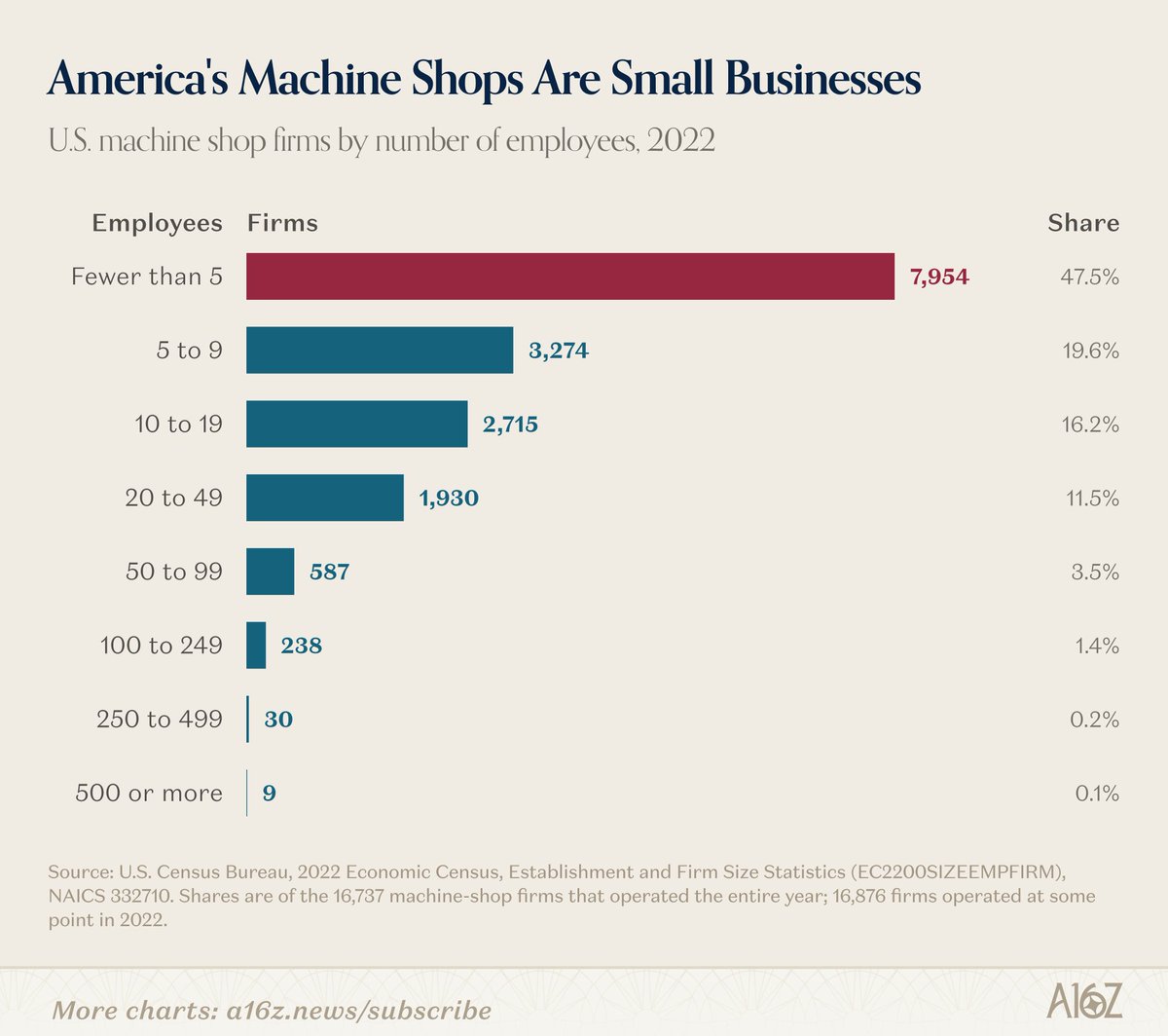
America has 16,876 machine shops.
83% employ fewer than 20 people. Just nine employ more than 500.
New defense companies are moving from prototypes to mass production, and every missile, drone, ship, and rocket they ultimately produce needs to run through one of these small shops.
That friction is a national security liability.
Connor Love and Collen Larson on the next generation of American manufacturing that gets built by smoothing it: https://t.co/iqaYhGrK32
2.9 million small to medium-sized businesses are owned by boomers in the United States. They employ roughly 32 million people.
The majority of these businesses have no successors to take over. Some stats say 70% of these businesses listed for sale never find a buyer.
This is the Silver Tsunami crisis everyone seems to talk about yet most do not know what to do with it.
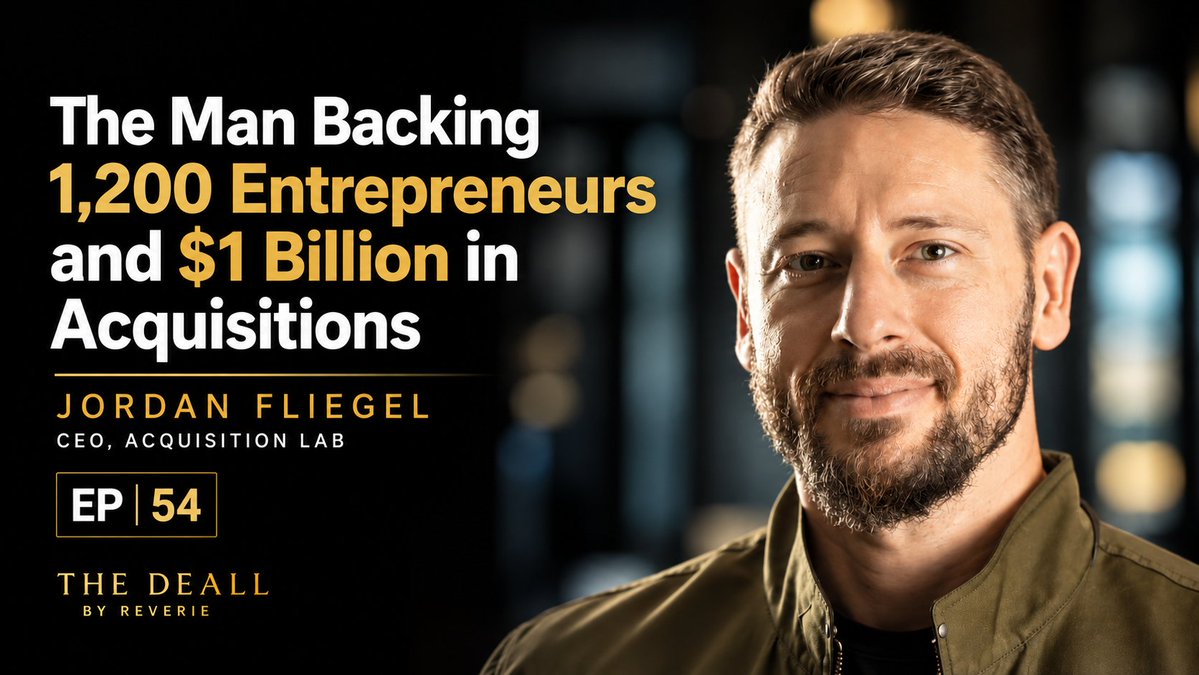
@jordanfliegel is the CEO of @Acquisition_Lab, the leading investor-backed search provider and educational platform with over 1,200 members and $1 billion in acquisitions across 480+ deals by its members.
I had the privilege of recently interviewing him to get his takes on acquisition entrepreneurship.
We discussed:
👉 The best backgrounds for acquisition entrepreneurs and the MBA / degree misconception
👉 The different paths for Entrepreneurship Through Acquisition (ETA) - including traditional search, The Lab's investor-backed search, etc
👉 How to convince a seller to let you buy the business they've spent a lifetime building
👉 How much capital you actually need to buy a small business
👉 And so much more...
Listen on Spotify: https://t.co/CZr61SSNCw
YouTube: https://t.co/Lgeff3ofnM
2.9 million small to medium-sized businesses are owned by boomers in the United States. They employ roughly 32 million people.
The majority of these businesses have no successors to take over. Some stats say 70% of these businesses listed for sale never find a buyer.
This is the Silver Tsunami crisis everyone seems to talk about yet most do not know what to do with it.
@jordanfliegel is the CEO of @Acquisition_Lab, the leading investor-backed search provider and educational platform with over 1,200 members and $1 billion in acquisitions across 480+ deals by its members.
I had the privilege of recently interviewing him to get his takes on acquisition entrepreneurship.
We discussed:
👉 The best backgrounds for acquisition entrepreneurs and the MBA / degree misconception
👉 The different paths for Entrepreneurship Through Acquisition (ETA) - including traditional search, The Lab's investor-backed search, etc
👉 How to convince a seller to let you buy the business they've spent a lifetime building
👉 How much capital you actually need to buy a small business
👉 And so much more...
Listen on Spotify: https://t.co/CZr61SSNCw
YouTube: https://t.co/Lgeff3ofnM
@LinkedInHelp @Found_bdf My account was restricted for no reason, I have done all the right things to verify my information including submitting my ID yet acess still has not been restored. Sent you guys a DM to no avail. My name matches my ID.
@LinkedInHelp My account was restricted for no reason, I have done all the right things to verify my information including submitting my ID yet acess still has not been restored. Sent you guys a DM to no avail. My name matches my ID.
If you've ever used Outlook Email, you've interacted with my guests app.
@KevinHenrikson exited Acompli for $200,000,000 to Microsoft (in only 18 months too).
Best part is his app became the foundation Outlook was built on.
He's been interviewed before but I got to get the full story - including all the times where they almost never made it.
Interview here: https://t.co/5fCU7B3RQ2
If you've ever used Outlook Email, you've interacted with my guests app.
@KevinHenrikson exited Acompli for $200,000,000 to Microsoft (in only 18 months too).
Best part is his app became the foundation Outlook was built on.
He's been interviewed before but I got to get the full story - including all the times where they almost never made it.
Interview here: https://t.co/5fCU7B3RQ2
one of our companies did $159.4M revenue in 2024 with just 37 FTEs. ended the year with $47.2M in profit! incredible. this is the new way to run cash-flow companies. the biggest cost was taxes on all that profit
My interview with @landon__sanford goes out today
One of the craziest stories from the interview was how Landon worked as an Uber driver to fund building Rayka
And how he won $100K in a pitch competition and then raised $1M to go full time
I have many thoughts on why this is.
1. LPs want VCs that do popular deals, this leads pressure to do average deals.
2. You can be in a good company and it not be a good investment.
3. Consensus is the enemy of conviction.
4. Peer pressure is harder to resist than people think.
5. The best returns were largely in Crypto in the last decade of funds, but every fund manager stayed away because of LPs.
I’ll write a longer post about all of them, but those were the first ones off the top.