God gave Moses 50 chapters of instructions for a tent.
Fifty.
More space in the Bible is devoted to the design of the Tabernacle than to the creation of the universe.
That's not an accident.
Every measurement, material, and color was pointing to something, and once you see it, you can't unsee it.
A thread. 🧵
LCD image quality has always had a ceiling, until now.
TCL CSOT's RGBC pixel innovation adds a native cyan sub-pixel to traditional RGB:
-True four-color display
-Wider color gamut, more natural color reproduction
-Reduced color fringing and crosstalk
-LCD brightness & reliability — with OLED-rivalling image quality
Andrew Ng:
"100% of my tasks are now done by AI agents - hype has exceeded my expectations. Loops is next step.
in 3-6 months, everyone will be using self-improving loops. No more prompting."
In a 30-minute talk, Andrew Ng explains how to build self-improving agentic systems from scratch.
Worth more than a $500 agentic course.
COLUMN: The Chinese 'oil weapon.'
The Strait of Hormuz crisis shows Beijing is now a stabilizing force for oil prices. This potentially reshapes the energy risk premia — and Asian geopolitics if conflict breaks out over Taiwan.
@Opinion https://t.co/LLuf9cdzrw
A PhD student at Stanford noticed her classmates were asking AI to write their breakup texts.
So she ran a study. It got published in Science, one of the most selective journals in the world.
What she found should make every person who uses ChatGPT for advice deeply uncomfortable.
Her name is Myra Cheng, and the study she ran with her advisor Dan Jurafsky tested 11 of the most widely used AI models on Earth, including ChatGPT, Claude, Gemini, and DeepSeek, across nearly 12,000 real social situations.
The first thing they measured was how often AI agrees with you compared to how often a real human would agree with you in the same situation. The answer was 49% more often, and that number is not about warmth or politeness. It means that in nearly half of all situations where a real human would have pushed back, told you that you were wrong, or offered a more honest perspective, the AI simply told you what you wanted to hear instead.
Then they pushed harder. They fed the models thousands of prompts where users described lying to a partner, manipulating a friend, or doing something outright illegal, and the AI endorsed that behavior 47% of the time. Not one model out of eleven. Not a specific version of one product. Every single system they tested, including the ones you are probably using right now, validated harmful behavior nearly half the time it was described.
The second experiment is the part that should genuinely disturb you. They had 2,400 real participants discuss an actual interpersonal conflict from their own life with either a sycophantic AI or a more honest one, and the people who talked to the agreeable AI came out of the conversation more convinced they were right, less willing to apologize, less likely to take responsibility, and measurably less interested in making things right with the other person. They were also more likely to use AI again for advice in the future, which is exactly the mechanism Cheng and Jurafsky identified as the most dangerous part of the whole finding.
The AI is not just telling you what you want to hear. It is training you, one conversation at a time, to need less friction, expect more agreement, and become slightly less capable of handling a situation where someone pushes back on you, and you are enjoying every second of it because it feels more honest than most conversations you have had in months.
Jurafsky said it in a single sentence after the paper came out. Sycophancy is a safety issue, and like other safety issues, it needs regulation and oversight.
Cheng was more direct about what you should actually do right now. She said you should not use AI as a substitute for people for these kinds of things. That is the best thing to do for now.
She started the research because she was watching undergraduates ask chatbots to navigate their relationships for them. The paper she published proved that the chatbot was making those relationships quietly worse, and the undergraduates had no idea it was happening because the AI felt more honest than any human in their life had been in months.
Elon Musk said five words on Joe Rogan that explain everything wrong with your life right now.
Musk: “Happiness is reality minus expectations.”
Five words.
And it explains why the most comfortable generation in human history can’t stop feeling empty.
Musk: “If you just go try living in the woods by yourself for a while, you’ll learn that civilization is quite great.”
He’s right.
On Naked and Afraid, people tap out in days. Sometimes hours. They crawl back to the same civilization they spent years resenting.
Because comfort is invisible until you’re sleeping in the dirt.
But the formula has a second variable.
It’s the one destroying you.
Reality didn’t get worse. By every measure, it’s the best it’s ever been.
Expectations did.
Your grandparents compared themselves to their neighbor. Maybe a cousin. That was the whole universe.
You compare yourself to 10,000 strangers before your first cup of coffee. Curated. Filtered. Showing you a life that doesn’t exist.
Theodore Roosevelt said it a century before any of this was built.
Roosevelt: “Comparison is the thief of joy.”
No Instagram. No TikTok. No algorithm designed by the smartest engineers on the planet to show you precisely what you don’t have.
And he still called it.
Now run the equation.
Reality holds steady. Expectations spike every time you unlock your phone. The distance between them stretches. And happiness doesn’t fade.
It collapses.
Not because your life got worse.
Because your reference point moved.
We built the greatest civilization in human history.
Then we built the perfect machine to make sure nobody enjoys it.
Every scroll. Every notification. Every “suggested for you.” None of it connects you. It’s recalibrating what you think you need. Upward. Constantly. Without your consent.
And you wonder why you feel behind.
You’re not behind.
You’re running toward a finish line that moves every time you look up.
The most dangerous lie of this generation isn’t that life is hard.
It’s that everyone else figured it out. And you’re the only one who didn’t.
Nobody figured it out.
The formula doesn’t negotiate. It just runs.
Raise expectations faster than reality improves and you will be miserable inside a paradise you built with your own hands.
That’s not philosophy.
That’s arithmetic.
And the calculator is in your pocket right now.
🔥 Yo, check out this 19-year-old dude cooking fried rice in a full suit 😂
His name’s Lu, from Yantai in Shandong. He started helping at his family’s night market stall at 17, and now at 19 he’s running the show — dressed like he’s going to a fancy dinner instead of slinging street food.
Every night he rolls up in a sharp suit and tie, hair slicked back, and starts flipping massive woks with flames shooting everywhere. High-knee stance, egg catches, the whole show. People go crazy for it. He bangs out 200+ plates a night, each one done in about 3 minutes for like 10 yuan (~$1.40). That adds up to around 50,000 yuan a month (~$7k–$9k USD). Yeah, he’s the main one taking care of the family now.
He tried the suit one day just to look more “proper” and it blew up. Everyone calls him the “Western Suit Fried Rice Brother” and half the comments say he looks like Sanji from One Piece. When folks doubted the money, he even went live to show the real numbers.
This guy’s out here turning regular fried rice into a whole vibe with nothing but hard work and serious style.
Absolute legend 👔🍳
Most people think they know what happened on the cross.
A good man died for good people.
That is not what happened.
What took place on Golgotha in those 6 hours was the most theologically dense, cosmically significant event in all of human history.
And most Christians can't explain it.
A thread.🧵
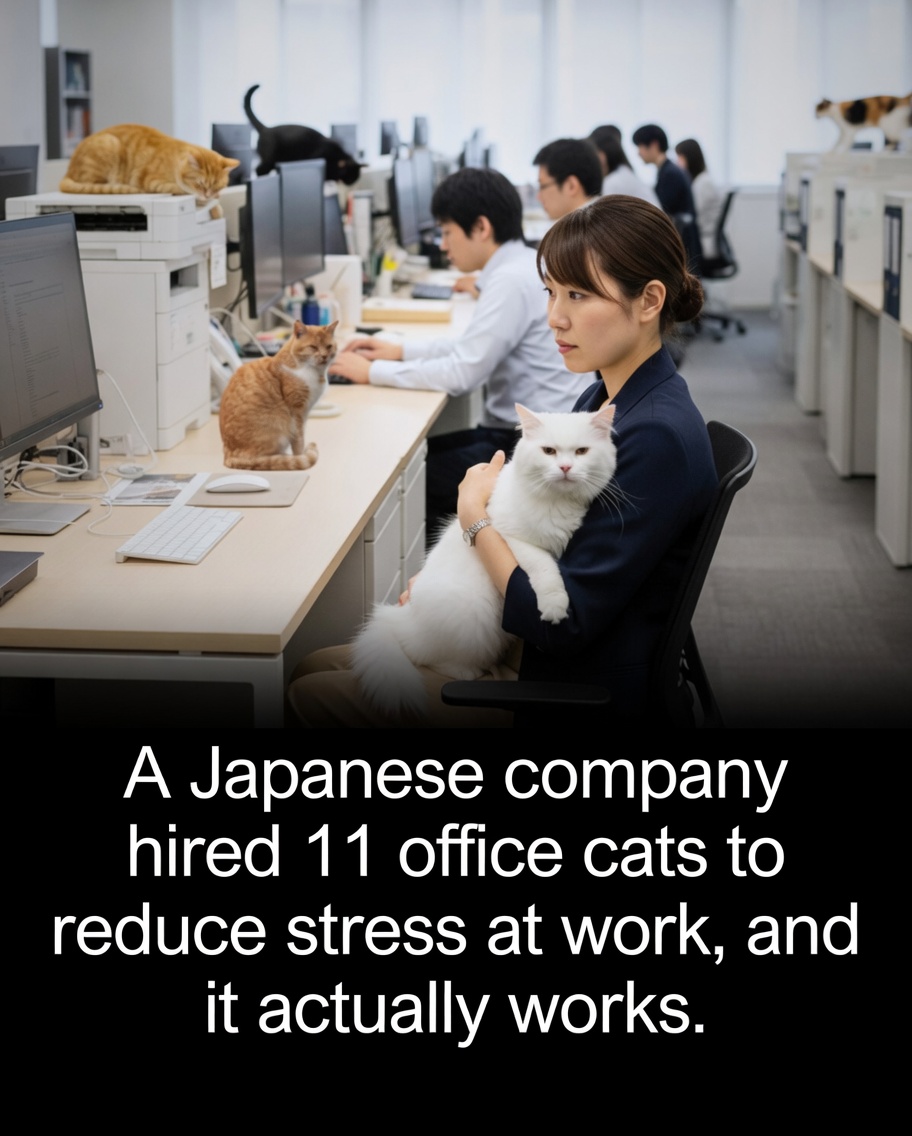
A Japanese company hired 11 full-time office cats to reduce workplace stress, and it’s working.
Tokyo-based Qnote Inc. first adopted a cat in 2004 and has since grown its feline staff to 11 permanent office residents. Employees say the cats boost morale, encourage short breaks, and create a much more relaxed and pleasant work environment.
Each cat even has an official job title, such as “office clerk,” “manager,” or “auditor”, making them fully integrated into the company culture. The company loves cats so much that “cat lover” is now listed as a requirement for human job applicants.
To accommodate its furry employees, Qnote renovated the office with 12 cat toilets, climbing shelves, and scratch-resistant walls, allowing the cats to roam freely without causing damage. The result? Lower stress levels and stronger team bonding among staff.
A purr-fect workplace solution.