🏡 @Ethereum, we're home!
Following a successful "hard hard fork" led by core contributors at @cLabs & L1 validators, Celo is officially an Ethereum Layer 2 🪨 🪨 🍴
What does that mean for the diverse, global decentralized ecosystem? Keep reading to find out ↓
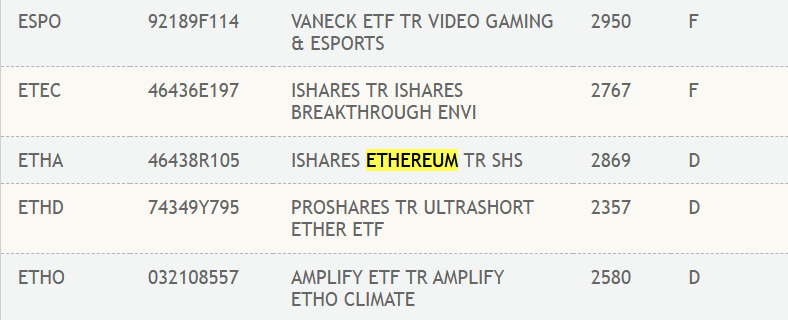
UPDATE: two ETF exec sources on $ETH sentiment.
• “negativity is way overdone; only a CT thing.”
• “adjustment to include staking will be huge. HUGE.”
• “expect staking change to happen in Q2.”
• “staking/yield will be a significant differentiator $ETH vs $BTC for tradfi retail.”
Welcome @optimism to the club of stage 1+ L2s! (meaning, L2s where the proof systems actually have teeth) I'm looking forward to seeing many more L2s join this club soon, especially some ZK ones.
Privacy is normal.
Railgun uses the privacy pools protocol ( https://t.co/DekkatsMR5 ) which makes it much harder for bad actors to join the pool without compromising users' privacy.
https://t.co/MG0huDzpAu
Today @Uniswap Labs received a Wells notice from the SEC.
I’m not surprised. Just annoyed, disappointed, and ready to fight.
I am confident that the products we offer are legal and that our work is on the right side of history. But it’s been clear for a while that rather than working to create clear, informed rules, the SEC has decided to focus on attacking long-time good actors like Uniswap and Coinbase. All while letting bad actors like FTX slip by.
When I first set out to build Uniswap, the goal wasn’t to reimagine finance.
It was an experiment in radically decentralized, fully automated onchain markets. I didn’t know if it would work or if anyone would use it.
Fast forward to today, the Uniswap Protocol has processed over $2 trillion in volume. Many thousands of teams and developers have forked our code or built on top of it. We built entirely new financial infrastructure that is transparent, fair, secure, and accessible powering an entire industry.
The team at @Uniswap did all of this in the US from our office in New York City.
People often ask me why we stay in the US and my answer is simple: I believe that blockchain is incredibly powerful technology. Like the Internet, it’s here to stay. So someone needs to figure it out, and it might as well be us.
And that when you build technology that improves people’s lives – you don’t need to hide.
The @SEC’s mission is “protecting investors, maintaining fair, orderly, and efficient markets, and facilitating capital formation.” This is a noble mission. I would argue @Uniswap does a far better job of this today than the SEC.
Yes, I'm frustrated that the SEC seems to be more concerned with protecting opaque systems than protecting consumers. And that we'll have to fight a US government agency to protect our company and our industry.
This fight will take years, may go all the way to the Supreme Court, and the future of financial technology and our industry hangs in the balance. If we stand together we can win.
I think freedom is worth fighting for. I think DeFi is worth fighting for.
And of course, we won’t stop shipping. Stay tuned
🦄💜
Criteria to realistically change ETH monetary policy
What might a future realistic ETH issuance change proposal look like?
I wanted to offer some thoughts on possible baseline community consensus criteria for future ETH issuance change proposals to be realistic.
After many conversations and reflecting on the recent issuance proposal debate, I noticed some trends of community consensus on what a realistic proposal may look like.
imo, here are four possible criteria for a future realistic ETH issuance change proposal:
1) A realistic issuance proposal is very slow to proceed, fully proactive, and never reactionary.
The issuance change proposal is based on years of data and years of building community consensus.
A realistic issuance proposal is not motivated by speculation on possible negative future outcomes of the current monetary policy.
A realistic issuance proposal isn't in reaction to the "latest data".
An aspect of a realistic issuance proposal is that all concrete parameter values are fixed early on and not adjusted later due to "prevailing conditions" or "latest data." A realistic proposal does not "fill in key blanks at the last minute."
There's no such thing as an "issuance emergency".
As an aside, there was actually a technical-level emergency related to issuance, now on track to be solved without an issuance change:
Ethereum's proof-of-stake beacon chain was not designed to support a majority of ETH staked. If the percentage of staked ETH grew too much, potentially catastrophic instability was expected. That's why Ethereum's next hard fork, Pectra, now includes the EIP-7251 maxEB, which removes this risk by enabling and incentivizing the consolidation of 32 ETH validators into much larger 2048 ETH validators (but still with 32 ETH minimum stake). This lets the beacon chain run smoothly with any % of staked ETH under today's monetary policy.
2) A realistic issuance proposal shouldn't try to claim to be ETH's final ossified monetary policy.
There seems to be no community consensus on ossifying issuance asap/eventually/never/etc.
If monetary policy ever becomes ossified to the point of never changing again, I suspect that ossification will be an emergent property of the current active monetary policy working really well over many years, as opposed to ossification having been an upfront goal.
3) Without aiming for ossification, a realistic issuance proposal makes a credible case that it may be the last monetary policy change ever required.
It is a top-level goal of Ethereum to maximize credible neutrality.
This implies that the community wants ETH's monetary policy to be stable and predictable.
Why stable and predictable? Monetary policy is one of Ethereum's most core aspects. If it's in flux and unreliable, what might that imply about the rest of Ethereum, such as property rights?
To achieve monetary policy stability, there is no such thing as "a series of planned or expected changes to ETH monetary policy".
Every issuance change is a one-off big deal, with no anticipation of future changes.
Issuance proposals that argue they are transitory or say, "This proposal should be adopted, but undoubtedly future changes will be required..." implicitly erode credible neutrality and are unrealistic.
In other words, while ossification is an emergent property of a durable monetary policy, a realistic issuance proposal should present itself as a credible candidate as the last change ever required and thus for possible eventual ossification and not as a stepping stone.
4) Minimum Viable Issuance
It goes without saying, but a realistic issuance change proposal reduces issuance.
-----
Given these four criteria of a realistic issuance change proposal, we can evaluate the recent proposal.
This recent proposal was
- fast. A new proposal, but wanted to launch in pectra.
- reactionary. Based on hypothetical negative scenarios and ongoing data, and with final parameters undecided.
- transitory. Presents itself as a stepping stone to some future endgame monetary policy.
- did reduce issuance, which is great.
imo, this recent proposal was pretty far below the bar on the above criteria and likely had no hope of reaching community consensus.
I'm excited to see future work from the talented, earnest research team behind the recent proposal.
Moving forward, stake ratio targeting seems promising?
"(...) so far, we have been lenient and accepted any project as long as it claims to be "on a path to decentralization". By the end of the year, I think our standards should increase and we should only treat a project as a rollup if it has actually reached at least stage 1."
https://t.co/VbHQOXne8t
why look at ETH now?
because everyone and their mother hates it and crypto is cyclical and people have short memories. halvening will possibly mark a pivot
everyone acting like ETH is dead, but has 56% of TVL for the entire space- JUST at L1. and that percentage has been pretty much constant since May 2022, despite the rise of alt-L1 killer narratives
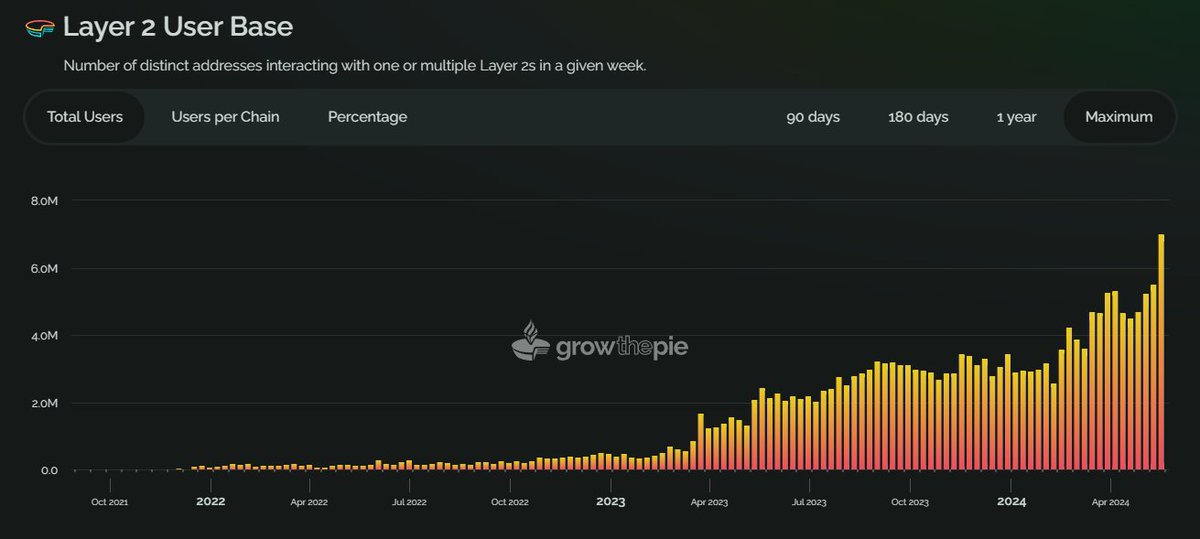
L2s taking off big since EIP-4844. most L2s use ETH as gas. Coinbase Smart Wallet about to launch to 100 million Coinbase customers. i think Base will all other L1s in TVL by EOY tbh, and everyone using Base will buy ETH for gas and programmable money
bottom-line is L2s now providing a surface for retail to participate, and with superior UX to other chains which make unworkable tradeoffs which result in network-killing spam routinely. this wasn’t the case 2 months ago, but it is now
EVM L2s also inherit tons of Ethereum apps and tooling which will accelerate dev. other ecosystems still suffer from poor tooling, block explorers, and tons of closed source apps
and restaking proving the value prop of ETH as a store of value asset
even Blackrock building on Ethereum. Coinbase L2 won’t be the last either. expecting plenty of corporations to FOMO in with their playbook. no more private blockchain theater. they will build L2s
ETF may be rejected in May, but that will start the narrative for eventual approval after a court case against the SEC which everyone expects will be won
combined with cyclical factors noted above, there’s never been a better time to look at ETH
economic security flippening
⬛⬛⬛⬛⬛⬛⬛⬛⬛⬛ 10x
Ethereum
• 31M ETH staked
• $3,400 per ETH
→ $105B of economic security
Bitcoin
• 600M TH of hashrate*
• $17.5 per TH**
→ $10.5B of economic security
*Expressing hashrate in TH is a common abuse of notation. From now on the correct unit of TH/s will be used. Bitcoin's 7-day simple moving average is 584M TH/s, rounded up to 600M TH/s.
**Bitmain sold the S21 in bulk at $14 per TH/s. The energy efficiency of the air-cooled S21 is 17.5J per TH. With a setup cost of $200K per MW of air-cooled datacenter there's an additional datacenter setup cost of $3.5 per TH/s, for a total cost of $17.5 per TH/s.
FAQ 1—What is economic security?
Economic security is the aggregate value of assets deployed by consensus participants to secure a blockchain. For proof-of-stake that's simply the value of all staked tokens. For proof-of-work that's the datacenter value of deployed hashrate, including ASIC rigs, electrical infrastructure, and cooling infrastructure.
FAQ 2—Why are electricity costs not included?
While electrical infrastructure (e.g. transformers, switchgear, breakers, PSUs) is part of PoW economic security, electricity costs are not. This is for two key reasons:
1) Energy consumption is opex (not an asset) which is compensated for in real-time by issuance and fees. A 51% attacker can starve all other miners from mining income, keeping 100% of issuance and fees for themselves. As a side note, notice that a 51% attacker can additionally manipulate markets and charge arbitrarily high transaction fees (e.g. Apple-style 30% fees) to compensate for opex.
2) The electricity consumption is temporary and short-lived. A 51% attacker can maintain a 51% attack all while arbitrarily scaling down hashrate using a swap camp attack, eventually nullifying electricity costs for the 51% attacker. Moreover, a 51% attacker may only need to conduct an attack for a few days before destroying confidence in the blockchain and not needing to further conduct the attack.
FAQ 3—Is $17.5 per TH/s a conservative estimate?
$17.5 per TH/s should be a conservative upper bound. The S21 can be overclocked to reduce the dominant nominal rig cost of $14 per TH/s. Should Bitmain itself deploy the hashrate the sticker price can be discounted by Bitmain's profit margin. Manufacturing billions of dollars of S21s will lead to economies of scale and better pricing from suppliers like TSMC as well as assemblers. Manufacturing and installing state-of-the-art S21s is one of many strategies to deploy hashrate. For example, old hardware acquired at a significant discount can cover some of the hashrate, especially post-halving. Datacenter costs can be partially recouped by reselling capacity at discount pricing, e.g. at $100K per MW to AI farms. Rig costs can also be partially recouped by reselling PSUs and scrap metal.
I've been in crypto for quite a while - from 2013 to 2017 on and off and then from 2017 to today being completely obsessed with Ethereum.
I can say with full confidence that this is, by far, the weirdest bull market crypto has ever had.
Not only does it seem like the 4 year cycle is dead, but anyone trying to do "fundamentals-based investing" is having a real bad time (for the most part).
Market is still max pvp with the majority of players being crypto natives which would explain all of the above and then throw in the ETF which explains why BTC has been so strong (obviously).
I won't really believe that "retail" is here in any meaningful way until we see the entire market going up together - not these isolated "sector specific" pumps that are very obviously pushed by crypto natives and just involve a hot ball of money rotating around.
1/ gm from the Netherlands
@alex_pertsev's trial starts today
he stands accused of laundering $1.2B via Tornado Cash
I believe he should be free—open source devs should NOT be held criminally liable for the crimes of foreign terrorists!
https://t.co/p1J3fDpkcr
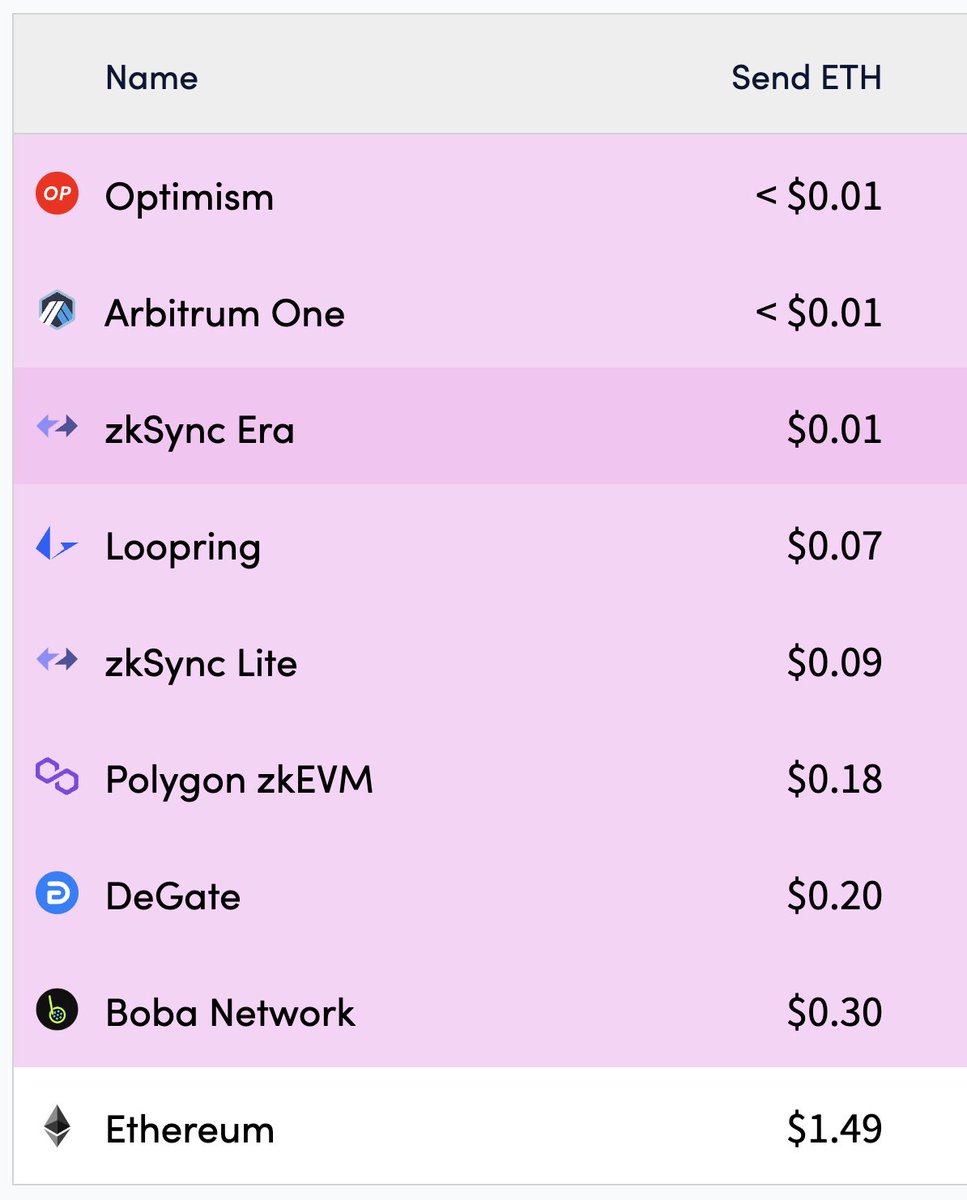
1 cent transactions on @zksync.
With EIP4844 now completed, we've turned our undivided attention to decentralization. The network belongs to its community.