As a teacher in the age of AI, I no longer see my role as delivering answers. Machines do that well.
My role is to help students ask better questions, doubt confidently wrong ones, and think for themselves. To use technology openly and teach its limits. To keep learning, so I remain worth listening to.
Respect is not owed to teachers; it is earned through relevance, honesty and care.
That is my commitment this World Teachers' Day.
#WorldTeachersDay #AIinEducation #Teaching
Every ranking of Pakistan's provinces says the same thing. Punjab first. Balochistan last.
That isn't a finding. It's where they started.
We've been measuring inheritance and calling it government.
So I asked a different question: from each province's own 2024 position, how far did this government actually move it?
The window is unusually clean. All four provincial governments took office within five days of each other in early 2024. Two budget cycles since, under identical federal conditions — IMF surplus targets, the June 2026 NEC cuts, inflation back at 11.1%. A shock applied equally is what makes the differences legible.
Nine indicators. Every single input published by a body other than the province being scored.
The result:
Punjab 60–61
KP 55–61
Balochistan 39–47
Sindh 42
Punjab leads under two of three weighting schemes, KP under the third. Punjab's range is the tightest in the table — its position barely moves however you weight the index. That matters more than the rank itself.
Four things the data says that budget speeches don't:
1. No province leads on more than three of the nine indicators. Punjab holds the highest score in the table (9.0, development envelope) and one of the lowest (1.9, budget credibility). It asked the NEC for nearly twice what it can spend and lost half of it.
2. KP has the weakest fiscal score and the strongest economic activity reading. Balochistan is the exact mirror — a perfect 10 on budget credibility sitting beside two near-zeros. Whatever provincial development budgets are doing in Pakistan, they are not driving provincial economic activity.
3. Sindh has the lowest unemployment in the country, the largest services tax base, two decades of incumbency — and the fastest-rising poverty and fastest-widening inequality of the four provinces. Whatever its economy produced, it did not reach the bottom of the distribution.
4. Sindh and Balochistan cannot be separated. Their order flips depending on the weights, so I don't rank them. A rank that changes with the weighting isn't a rank.
On method, three choices carry everything:
Movement, not level. Nobody is scored against Punjab's starting line.
Net of the national change. Every macro indicator is the province's change minus the country's. Skip that step and you're scoring the IMF programme, then attributing it to four individuals.
Publish the range, not a point. Three weighting schemes, and any rank that flips gets declared unstable in the note itself.
The note closes with a twelve-month compact: six things a province can publish on its own — no new money, no federal permission, no constitutional amendment. The government that publishes first sets the template the other three are then measured against.
@MaryamNSharif@BBhuttoZardari@MuradAliShahPPP@SohailAfridiISF@PakSarfrazbugti@betterpakistan@nadeemjavaid75@CMShehbaz@geonews_urdu@AajKamranKhan@HamidMirPAK@ARYNEWSOFFICIAL
Built to be argued with, not believed.
https://t.co/NKkEQOp5VX
The Medal Is the Admission
The inquiry reported. Eight officials suspended. Criminal proceedings ordered. One nurse decorated. The file moves on.
Read what the state actually found. The fire crossed the ward in about two minutes. No alarm. No sprinkler. Two of thirteen SOPs mentioned fire at all. No full-time emergency officer — the duty sat with an assistant director as an additional charge. No protocol naming who raises the alarm, who commands, who unlocks the exits, who carries the babies. Exits locked or obstructed. And seven weeks earlier, PIMS had already had a fire in its nursing hostel.
The committee could not establish what started the blaze. It established everything that made the outcome certain before anything started.
Then came the response, and it is entirely political capital and bureaucratic repair. Suspend. Prosecute. Replace. Order audits. Decorate.
Look hardest at the decoration.
A medal for extraordinary courage in that ward is the state conceding, in public, that survival there depended on one human being doing something heroic. It formalises the failure rather than repairing it. It tells every nurse in Pakistan that the system will not hold the line, so be exceptional — and if you are not, expect an OSD order. Two others from the same room received exactly that.
Reward for individual heroism is what a state offers when it has decided not to fix the architecture.
The hole is still open. No published evacuation clock. No named emergency officer. No conversion of the ordered audits into unannounced drills. No answer to the door.
Yesterday I argued the door was locked for a reason, and that the reason is never audited for what it does in an emergency. The report has now documented that in the state’s own hand.
Case closed. Hole unfixed.
The next two minutes are already scheduled.
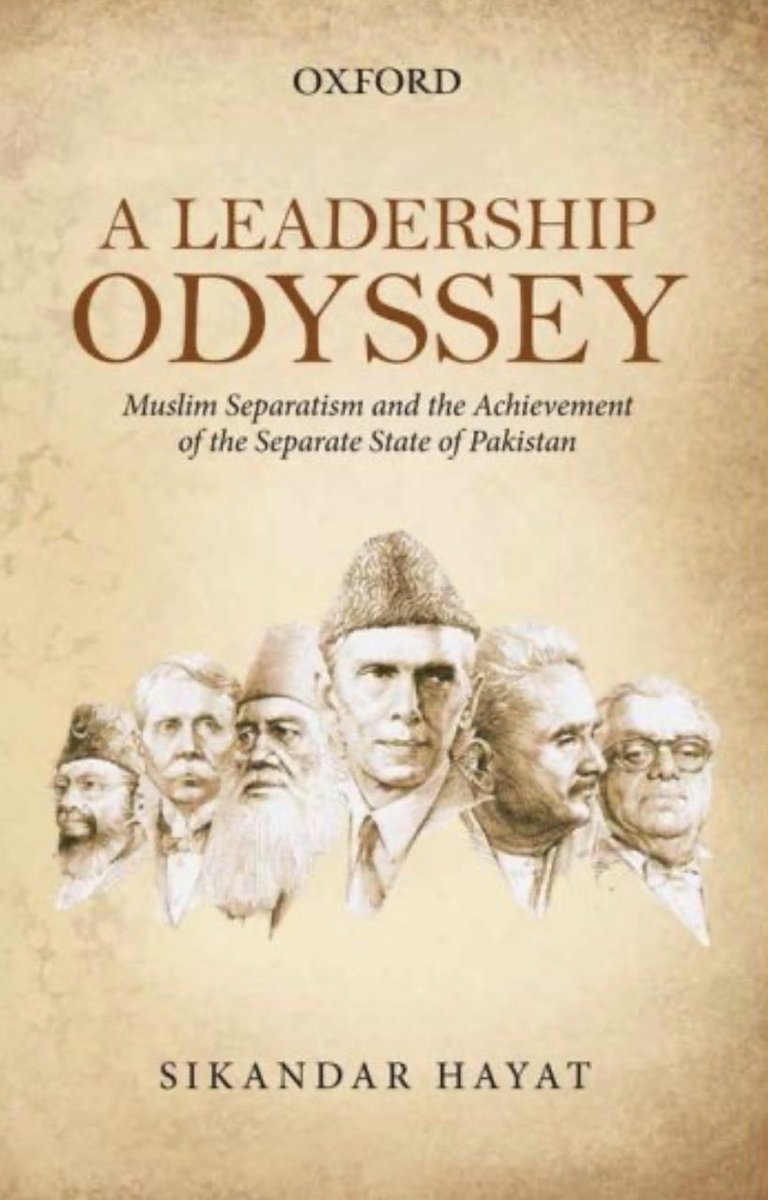
It’s August 14, and one of the best ways to celebrate Pakistan’s Independence Day is by learning more about its history.
These four books by serving & retired QAU, Islamabad, colleagues should be on your desk.
From the birth of the idea of Pakistan, to the structure and politics of the Muslim League, to the havoc of 1947, and the emergence & consolidation of the Pakistani state, these historians have got you covered:
An MPhil, prestigious universities, and lessons from many scholars—but few left a lasting imprint. @drniqbal profoundly shaped the way I think, behave, and execute. Thank you, Sir, for investing in me. I hope to repay that investment through my service to 🇵🇰.
@nadeemjavaid75 🫡
My "theory of everything" paper is out with Harvard @BelferCenter@MiddleEast_HKS
Don’t split the Mideast into resource-rich Gulf & population-rich states elsewhere: they all run on rents
The real divide: the form of rent & whether it's enough
1/5
https://t.co/ACvrrIRslq
SALT BUILT EMPIRES AND DESTROYED THEM TOO:
1. Roman soldiers were partially paid in salt,the word salary comes directly from it
2. Salt was once considered so valuable it was traded gram for gram against gold
3. The entire city of Timbuktu was built on salt trade routes across the Sahara
4. Salt was used to punish enemies,fields were salted so nothing would ever grow again
5. Ancient Egyptians used salt to preserve their dead mummies are essentially salt cured
6. Wars were fought specifically over salt mines for thousands of years across every continent
7. Salt shortages caused food riots in France that helped trigger the French Revolution
8. The human body cannot produce salt without outside sources the heart stops within days
9. There are mountains of pure salt on Earth so large entire villages are carved inside them
Pakistan’s policy position remains clear and consistent - veto should either be abolished or, at a minimum its use by the current permanent members severely restricted. Any expansion of the veto or addition of new individual permanent members is firmly opposed, as more vetoes would only aggravate the problem.
This is a position of principle.
I have waited many years, decades even, to write these words and the day has finally arrived. Today I am proud to be a Pakistani.
My piece in Dawn today.
https://t.co/BA23yaEpV0
If all works fine and crisis ends towards positive transformation of relations even with continued political sentiment of animosity between parties, Pakistani Prime Minister should be considered for a Nobel Peace Prize for actually averting a catastrophe of global proportions
Ahead of the Islamabad Talks
A. Negotiations will be difficult. However, it’s important to recognize that this time the administration is bringing in Vice President Vance, who has a clear political interest in preventing a renewed escalation. Beyond domestic politics, Washington is acutely aware of the consequences of a breakdown: a major shock to global energy markets and highly problematic military options, ranging from strikes on civilian infrastructure to the risks of ground operations. In other words, both political incentives and strategic risks are pushing the U.S. toward avoiding collapse of the talks.
B. The gaps between the parties remain significant. Iran’s leadership is unlikely to concede on its missile program, and certainly not on its right to enrich uranium. In any scenario involving full sanctions relief, the issue of the 60% 440 kg enriched uranium stockpile will likely become a central sticking point.
C. The Strait of Hormuz issue is largely behind us. By effectively acknowledging Iran’s control over the strait, the U.S. has helped solidify this reality. Iran can already begin to reap the associated economic benefits. However, any expectation in Washington that Tehran will make concessions on force buildup or strategic capabilities is likely misplaced.
D. While the current ceasefire is temporary, the costs of the war and, critically, the growing recognition in Washington that regime change is not achievable and that enriched uranium cannot be eliminated through military means, may soften the U.S. negotiating position. Unlike previous rounds (e.g., Geneva), the administration’s ability to credibly threaten war has diminished. From Tehran’s perspective, they have already endured the worst.
E. Iran’s economic situation is dire, worse than before the war. Economic relief is therefore a critical priority for Tehran. That said, it is doubtful that Iran would trade core regime pillars for economic concessions
F. One of Iran’s most significant achievements, especially given that it stepped back from insisting on a permanent ceasefire (assuming there are no undisclosed understandings about extending the truce or U.S. recognition of its right to enrich), is the apparent U.S. willingness to engage in negotiations based on Iran’s 10-point framework.
G. This is notable because the gap between Iran’s 10 points and the administration’s 15-point framework remains substantial. The central question is whether Washington is prepared to move closer to Tehran’s positions, particularly on uranium enrichment and missile capabilities. These issues will be decisive not only for the negotiations, but for whether the conflict resumes.
H. Who Really Wants the Deal?
It is important to recognize that the push for negotiations originated in Washington. In practice, it was the Trump administration that shaped, if not dictated, the proposal conveyed via Pakistan for a two-week ceasefire. This matters because it suggests that the administration is entering the talks with a strong desire to reach an agreement quickly.
I. That does not mean Iran lacks interest, far from it, given its economic situation, but the sense of urgency appears to be more pronounced on the U.S. side
The bottom line is that current negotiations are not driven by optimism, but by a shared interest in avoiding further losses rather than securing victory.
#IranWar