executive director @carbonplanorg. previously: neuroscience and computational biology. open source, open science, collaboration. all views are my own. (he/him)
How should we compare CO2 removal approaches that work on different parts of the carbon cycle and act on different timescales? Our newest article explores how to make better comparisons in both market and policy contexts.
https://t.co/TTQpQFDGrp
There are good reasons to be excited about harnessing rock weathering to remove CO2 from the atmosphere. But demonstrating that enhanced weathering actually works is surprisingly tricky. We're releasing a new tool that we hope can help.
https://t.co/wzE5Vbpsy2
As rising temperatures threaten the health of populations worldwide, people need to know when and where extreme heat will occur. We collaborated with @washingtonpost, creating a new dataset that is the basis for an important series. https://t.co/phmkfyLEDA
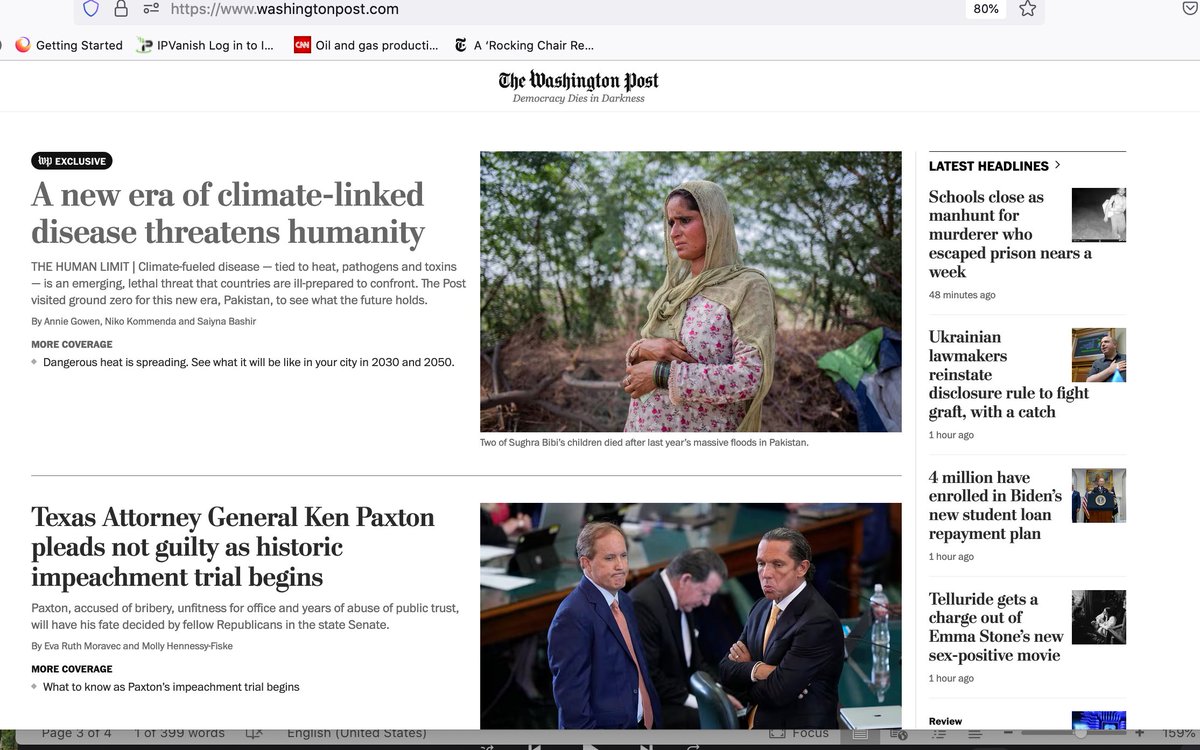
All day at the @washingtonpost this has been the front page--it's awfully good when journalists cover the most important stories on earth so well, and editors play them appropriately @eilperin
1/ In “2C” we mapped the world’s hotspots. With “Invisible” we tracked greenhouse gas emissions entering the atmosphere. Now, in “The Human Limit” @washingtonpost captures how extreme heat and other climate impacts threaten human health across the globe. https://t.co/Ii5e8lHIJe
“The Post analysis showed that by 2030, 500 million people around the world, particularly in places such as South Asia and the Middle East, would be exposed to such extreme heat for at least a month — even if they can get out of the sun.” https://t.co/razopB9bEY
powerful and important piece from @tab_delete
"In a cultural moment when science needs all the credibility it can muster, ensuring scientific integrity and earning public trust should be the highest priority."
https://t.co/70Jr7rQJTL
wonderfully touching piece on emo music from my dear friend peter — and also satisfying vindication for all of the emo i was listening to at the start of college
Me, calling teen me via timephone: I reviewed an oral history of 2000s emo!
Teen: Isn't emo ... embarrassing?
Me: 'Looking back on my younger self’s embarrassment over emo’s too-muchness, I see that what really embarrassed me was myself.'
Teen: 🙎
https://t.co/vfjCLZGtgo
As broad swaths of the United States are gripped by heatwaves and record-breaking electricity demand, we are releasing a report on climate-related financial risk with a focus on electric utilities. (1/7)
https://t.co/3fHufWZ6fo
Great Bloomberg piece on the need for regulation of CDR and the critical importance of MRV. Also nice to see the verification confidence levels we developed with @carbonplanorg out in the wild! https://t.co/VWWsApbfCT
Proud of this effort! Bringing together dozens of thought leaders over several years to create a primer on Carbon Removal. And so happy to see the amazing design team @ordinary_sf featured in @FastCompany
https://t.co/YPCNj23H7Q
On Tuesday, Alaska passed a bill authorizing the development of carbon offset projects on State forests. Our new commentary discusses why this program could be a loss for the climate and the credibility of the voluntary carbon market. (1/2)
https://t.co/Zk3WjMTb3o
After a decade of freelancing--writing features, essays, and reviews (@NewYorker,@nytmag, @nybooks, @gdnlongread), publishing a novel (@AAKnopf), and writing/editing for nonprofits--I'm looking for a full-time writing/editing job. (1/2)
Our latest commentary documents two flaws in Quebec's new compliance reforestation protocol. Credits generated under this protocol should not be used to compensate for fossil emissions. (1/9)
https://t.co/jSuZ1C542z