Oracle’s $664bn AI backlog reads as revenue in waiting. Half its record cash flow was customers paying ahead, and its bonds now cost 145-175bp more over Treasuries than in February. The test for any AI contract: who funds the buyer. https://t.co/WEQKTlVSWm
Diesel fell 7.9% in October's PPI. Truck freight rose 3.9%.
The headline read is energy seeping into core through freight. October's pump does not carry it.
The services line →
Over 80% of October's rise in final demand services was truck freight (BLS). The rest of services, outside trade, transportation and warehousing, rose 0.2%. The push is one line, not a broad one.
The pump →
On-highway diesel averaged $6.29 in September and $6.25 in October (EIA weekly). Fuel surcharges reset weekly off that index (DOE), so October's fuel leg on the freight bill did not rise. The 3.9% came from somewhere else.
Two candidates →
Base rates: carriers charging more for the haul itself. Or contracts that reset on the prior month's pump: August averaged $5.46, so September's 15% jump (our arithmetic) would land in October bills. The release cannot separate them.
The gap →
Wholesale diesel fell 7.9%; the pump fell under 1% on the monthly average. BLS lists fuels and lubricants retailing among October's services risers, so the pump kept the difference as margin. As it closes that gap, the fuel leg falls on either contract type.
Where it stops →
A US read: the surcharge index is the US national pump average. Europe's cost leg this autumn is gas, not diesel.
What cuts against it →
Final demand less foods, energy and trade rose 0.5% for a second month, 4.9% over 12 months. If freight held on base rates, a non-energy price is rising: the headline read would be wrong on the channel, not on the pressure.
The clock →
The Fed meets 8-9 December; November PPI prints 15 December. Truck freight up again with the pump lower means base rates. A fall means September's pump arriving late.
October's services rise is one freight line.
The pump that sets fuel surcharges did not rise in October.
November's freight line decides whether it was rates or a lag.
October's services rise stays a freight price, not fuel, until November's freight line falls with the pump.
When November PPI prints on 15 Dec, does truck freight fall back or hold?
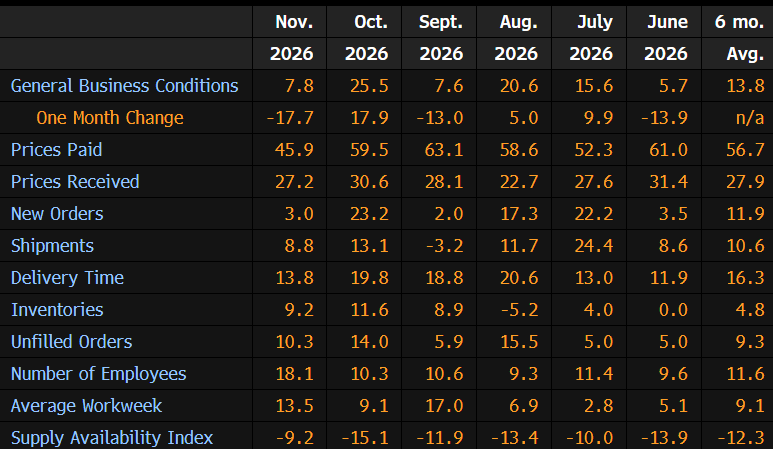
@KevRGordon Firms six-month outlook will be the sign on that hiring: expected unfilled orders fell to 2.3 from 14.0, and expected employment eased to 16.8. Plants are hiring into a backlog they expect to stop growing.
New York factory hiring is at its highest since June 2022, and new orders just fell from 23.2 to 3.0.
Hiring follows orders, not the reverse.
The last 18.1 came in June 2022, a month after orders dropped 24 points; by January 2023 the index was 1.5.
New York's hiring reads as backlog, not demand, until December's survey shows new orders turning back up.
NY Fed Manufacturing Index fell in November almost by as much as it fell in October ... new orders and shipments eased sharply; prices paid fell to their lowest since March; employment rose to the highest since June 2022
Beijing made buyback loans cheaper and firms took little: about CNY13bn so far in November, against over CNY200bn of quota banks sought.
A loss problem, not a price problem: after the cut to 1%, a firm buying its own stock on credit owns every point it falls.
The monthly draw, not the rate, measures Beijing’s market support.
Chinese companies are tapping only a fraction of loans provided by Beijing for stock buybacks, an indication that the latest effort to support markets is faltering https://t.co/lJYol2cmbt
@Trinhnomics October's output growth sat in high-tech manufacturing, up 17.6%, and equipment, up 10.6%. Steel output fell 5.1% and cement 1.3%. China's factory gains are on tech lines while the property-linked lines shrink.
China's industrial output rose 4.8% in October; retail sales, 0.4%.
The weak demand is at home: the factories found buyers abroad, and exports rose 28.7%.
China's output growth stays export-led until retail sales top September's 1.1%.
Does November's retail print top 1.1%?
Year-to-date, as in for the past ten months, China retail sales only grew 1% nominally. For the month of October, it expanded 0.4%.
In investment (nominal), it contracted -8.1% for the first ten months nominally. What grew you may ask? Well, industrial production by 5.3% nominally from Jan to October. But that too is slowing...
US productivity rose 2.1% over the year to Q3, down from 2.3% in Q2: the slowest pace since Q2 2023.
The headline read is a 3.6% quarter, a breakout. It replaced Q3 2025’s 4.5%, so the four-quarter rate fell.
The breakout stays one quarter, not a trend, until the four-quarter rate clears this cycle’s 2.2%. The revised Q3 prints 8 December.
Kevin Warsh, a well-known AI/productivity optimist, offers a hedge: productivity has been “reasonably strong” lately but “hasn’t yet broken out definitively and structurally to the upside.”
https://t.co/Fx0353n0MH
IS’s 15 Nov rule sets the licence line for renting AI compute to firms with a Chinese headquarters or parent at 12m TPP: about 333 Nvidia B200s, at any data centre abroad.
The headline read is a closed cloud loophole. The bigger change: the rule tracks who owns the buyer, not where the chip sits.
The line → 12m TPP at one site, or across linked sites that share workloads. A B200 rates 36,000 TPP: about 333 chips. BIS says compute at that level can train or run advanced models. Small rentals stay open; anything larger waits on a case-by-case licence.
The five markets → Indonesia, Malaysia, Singapore, Thailand, Brazil. Listed AI-chip exports there need a licence unless the buyer is US-headquartered. A Japanese, European or local cloud applies for a licence; a US cloud’s chips ship on a monthly report.
The seller → a foreign data centre that cannot show its customer checks is a red flag that presumes the exporter knows. Policing moves upstream to the chip seller.
The swap → the rule rescinds the 2025 AI Diffusion Rule’s country tiers, which BIS says were never enforced. Country quotas give way to ownership tests.
The count → BIS estimates about 100 extra licence applications a year: a count that fits most volume moving through the US-headquartered route.
What cuts against it → the authority is contested. It rests on the 2018 Export Control Reform Act; export lawyers told The Information in August it may not reach remote access, and the House voted in January for a bill to grant that power. Below the line, rental stays legal at every unlinked site. Beijing’s stated case: such controls are containment, not security. After BIS tightened chip rules on 17 Oct 2023, Beijing announced graphite export licences three days later. The counter-move came in materials, not chips.
The clock: Federal Register publication starts it; existing covered data centres then get 90 days to obtain a licence. The read fails if the published exclusion reaches beyond US-headquartered buyers.
The licence line is about 333 B200s, at any data centre abroad.
In five markets, only US-headquartered buyers skip the licence.
The published exclusion decides who builds there.
If the published text keeps that exclusion US-only, the licence lands on every other buyer there and the head start goes to US-headquartered clouds.
BIS’s 15 Nov rule sets the licence line for renting AI compute to firms with a Chinese headquarters or parent at 12m TPP: about 333 Nvidia B200s, at any data centre abroad.
The headline read is a closed cloud loophole.
The bigger change: the rule tracks who owns the buyer, not where the chip sits.
→ Networked sites count as one site.
→ Indonesia, Malaysia, Singapore, Thailand, Brazil:
AI-chip imports need a licence unless a US-headquartered buyer’s sale is reported monthly.
If the published text keeps that exclusion US-only, the licence lands on every other buyer there and the head start goes to US-headquartered clouds.
BREAKING: The US Commerce Department announces new restrictions on remote access to advanced American AI chips and computing infrastructure.
The new rules aim to prevent China and others subject to US export restrictions from circumventing existing controls by accessing American AI technology through cloud computing services.
Prior to this, a loophole allowed foreign entities to access advanced US computing capabilities without physically importing restricted chips.
More AI regulation is on the way.
The China revenue in reach of Congress's chip bills is ASML's: it expects about 20% of 2026 sales from China. Nvidia's outlook assumes $0 in China data centres.
The headline read is a hit to AI chipmakers.
MATCH, a tool bill, carries the revenue: the Netherlands and Japan get 150 days to match US curbs on immersion DUV tools, or Washington imposes them.
→ AI Overwatch: 30-day congressional review of advanced-chip licences to China.
→ Remote access: cloud rental becomes an export; House vote 369-22.
→ The Senate's defence bill carries MATCH and Overwatch.
If MATCH survives the defence bill, the cost lands on toolmakers' China orders, not Nvidia's outlook.
@aeberman12 The refining leg backs that: global runs fell 1.3 mb/d to 81.3 mb/d in October, and European diesel near $180/bbl is still 77% above pre-war. Crude can be in surplus while fuels stay short.
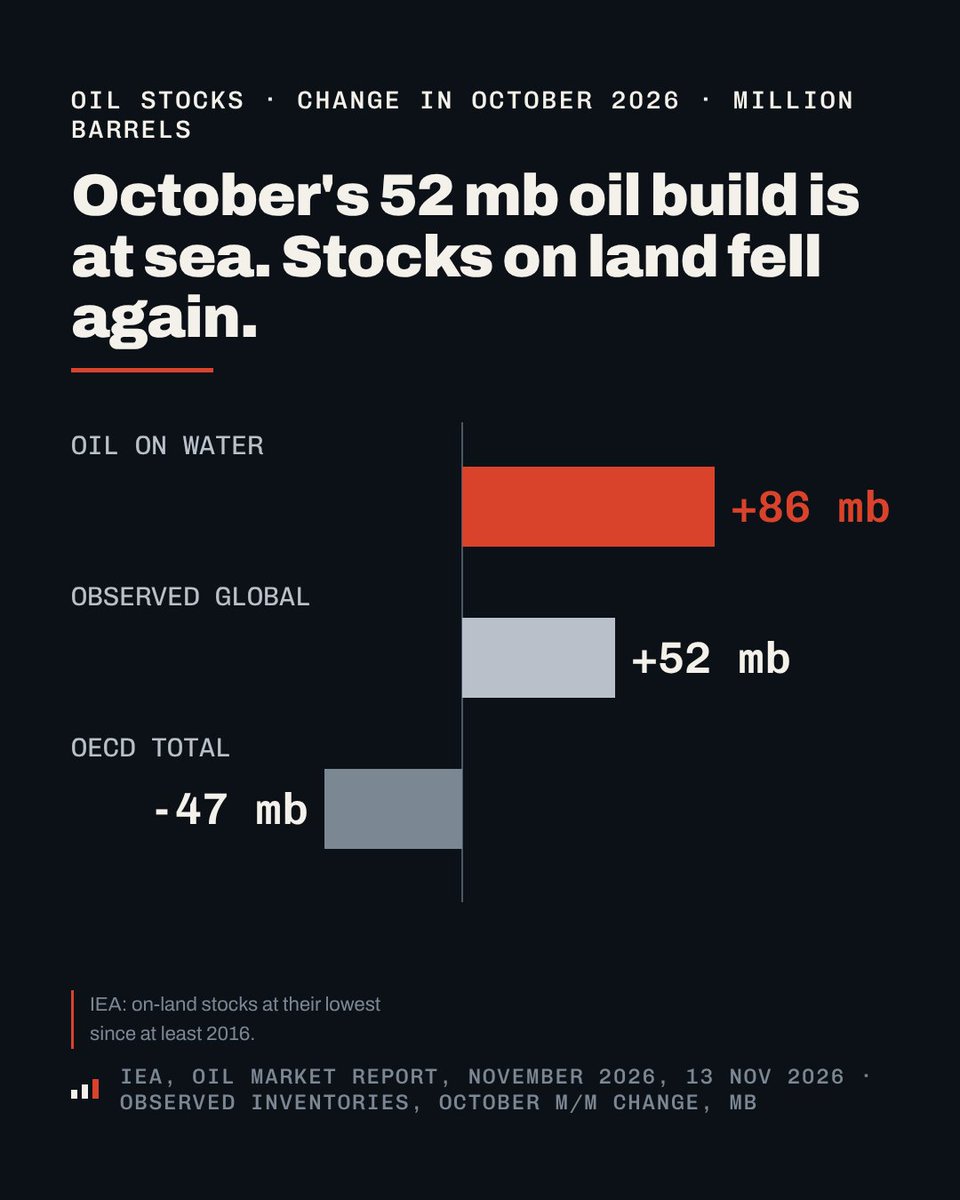
October's 52M-barrel oil build is afloat.
The IEA reads the rise as supply passing demand for the first time since the war began.
Oil at sea rose 86M, more than the whole build, so stocks on land fell, to their lowest since at least 2016.
On-land stocks, not the observed total, decide whether the surplus is real.
The IEA sees tentative oil rebalancing. Analysts see a “perfect storm” of oversupply.
Spencer Dale reminds us that more crude doesn't fix depleted inventories, refining shortages, or economic damage.
The glut is largely a forecast.
The constraints are real.
https://t.co/dLjvSE4e44
Gold sits 9% under its Q3 average, though central-bank buying that quarter rose 42% on the year.
The headline read has central banks flooring the price.
The real 10-year yield rose from 2.00% at end-March to 2.91%; gold yields nothing.
Since March, gold has traded off the real yield, not central-bank tonnes, while Fed hikes stay priced.
Gold's next $200 move: real yields or central banks?
@KrishanGopaul Korea's ETF route is one way official demand stays off the reserve tables: central banks reported 120t of purchases in Q3, and WGC estimates about 63% of their buying went unreported. The official bid is bigger than reserve data shows.
@Investor_NICK_ Energy shows up in prices, not in the 0.6-point net export drag. That drag is volume: real imports rose 2.5%, and a dearer barrel cannot lift a real volume. The oil bill sits in what Japan pays per unit, not in how much it bought.
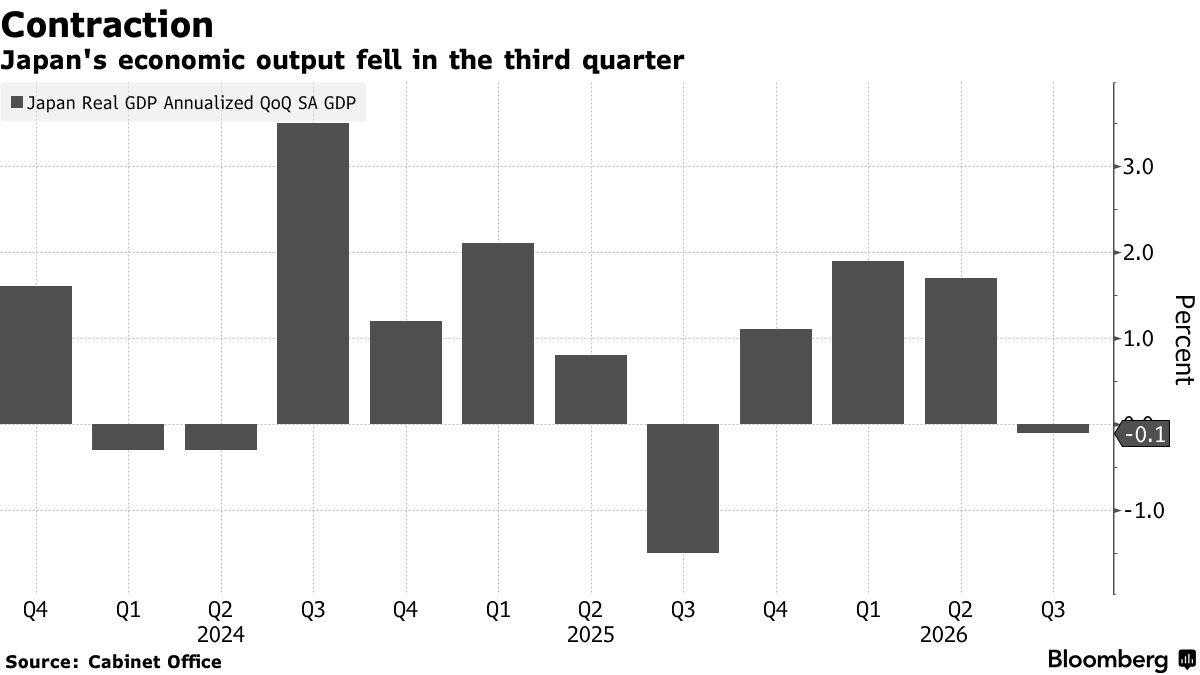
Inside Japan's flat Q3 GDP: real income fell 0.4%.
The headline read is a stall, with consumption down 0.3%.
Income did worse: terms-of-trade losses took 0.3 points off it, as in Q2.
Japan's demand read stays with real income until terms of trade stop taking points off it.
*JAPAN Q3 GDP UNEXPECTEDLY CONTRACTS 0.1% (est. +0.3%).
“Bad weather” was to blame as it weighed on consumer spending/consumption. Soaring energy prices more likely the key driver of weakness.
The Fed has not hiked yet. The dollar has done it abroad: four straight gains, to 103.41 on its index.
The headline read is a US inflation scare.
The rate gap moved instead, and Japan shows the bill: import prices up 24.8% in yen, 19.2% before the currency.
Outside the US, the tightening runs through the exchange rate until the index is back under 102.
1)
October's hot US prices made the headline. The bigger move was the dollar: four straight gains, 101.65 to 103.41 on its index.
The headline read is a US inflation scare. The bond market priced a faster Fed instead, and the dearer dollar carries it to Japan and Europe, with China the exception.
Outside the US, the tightening runs through the exchange rate until the dollar index is back under 102.
2)
US consumer prices rose 0.4% in October, core 0.3%. The 2-year Treasury yield rose 30bp in the CPI week, 4.56% to 4.86%, with a December hike priced near 89%.
A hike priced before it happens widens the rate gap the day it is priced.
3)
Japan's import prices rose 24.8% over a year in yen, 19.2% in the currencies the goods were invoiced in. The yen sits near 160 per dollar.
The 5.6-point gap is the bill a weak yen adds. Japan takes the Fed's path as inflation.
4)
Euro-area employment stalled in the third quarter, the first flat quarter in 21. Markets still price a December ECB hike and three by end-2027, with the euro below $1.11.
Rates there follow imported energy; jobs follow demand.
5)
China went the other way. Its banks lent less than they were repaid in October, minus CNY100bn, the first October contraction on record, while exports rose 35.2% over a year.
China's slack leaves as exports, not as a rate hike.
6)
The yen gap runs the other way for exporters: Japan's export prices rose 16.7% over a year in yen, 12.2% in invoice currency.
Importers pay the dollar; exporters bank it. One currency, opposite sides of the invoice.
7)
The case against: the dollar's run rides demand for US assets, and Peter Boockvar ties it to the AI trade. A chip sell-off that pushes foreign money out would reverse it. Not yet: the Nasdaq fell 0.91% on Friday and the dollar still rose.
Outside the US, the tightening runs through the exchange rate until the dollar index is back under 102.