good article that aptly details the different options for choosing crypto investments & why
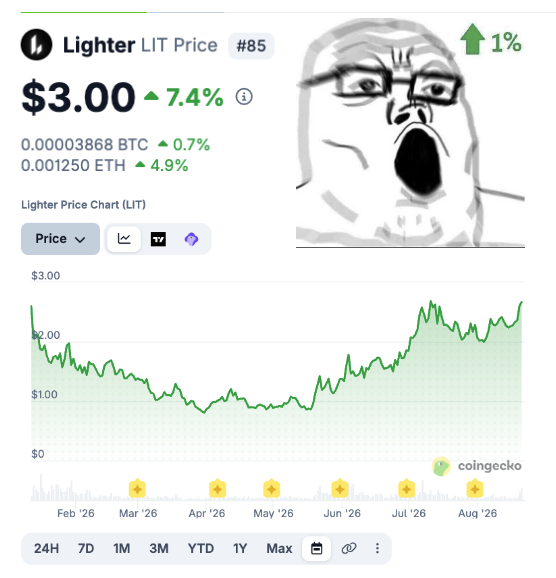
you're either long businesses printing cash or non-sovereign SOVs, evan chooses $HYPE / $LIT / $PUMP & $BTC / $ZEC
great general framework
Lighter is becoming more open and easier to build on!
Developers can now use our shared trading core to create their own interfaces, apps, and trading experiences without starting from scratch, for free.
https://t.co/VNatLLGlPH
@StayRoamer We’re also updating the force refresh logic so we’ll only show the countdown if there’s a breaking change. This way, traders can have an uninterrupted flow and refresh the page to get the latest updates whenever they feel comfortable
• Internal transfers settle in under 100ms, so this one surprised us. Which flow felt slow to you, the transfer itself or the balance updating in the UI? Happy to dig in.
• Standard withdrawals take longer because every batch has to be proved and posted to Ethereum before funds are released. If you need speed, use Fast Withdrawal, which usually lands in under a minute.
• Fair point on spot coverage. More assets are actively in the works.
• We do have stop market and stop limit orders, they live under the Conditional order type. Set a Trigger Price, then leave Limit Price on Market for a stop market or enter a price for a stop limit.
We actually deploy to mobile at least 2-3 times every week. The App Store’s ‘last updated’ date only reflects new App Store submissions. Since we use React Native with Expo, most of our changes can be shipped as in-flight/OTA updates without submitting a new version to the App Store. We only need a new App Store release when there are native changes.
Putting on my AI hat at the CFTC IAC - agentic trading is a major achievement in democratizing finance. The progression is from index funds to ETFs to agents custom building a portfolio based on your views. Some risks exist but verifiable finance is the solution - cc @brian_armstrong@vladtenev
RFQ is now open to all traders on Lighter!
For eligible Market orders, traders can execute via RFQ directly from the order panel.
RFQ can be available when liquidity is insufficient, orders exceed $500K, or orders exceed $10K with >0.1% expected slippage.
Interesting times for the fixed income markets! We are adding the Ten Year Note perp to Lighter, with more to come — spot, perpetual futures, and options!
Builders integrating Lighter can now enable deposits through @fun's Universal Deposit Address.
With a single API call, Fun handles deposit routing and settlement to Lighter.
Simple deposit infrastructure with best in market fees, built for any Lighter integration!
Lighter AI Agent Kit now supports Robinhood Chain!
Test your strategies against live order books, monitor their performance with the paper trading engine, and deploy them to production.
Compatible with your favorite harness.
Install in one line!
https://t.co/XM5A7Y4IuC
We're excited to see the growing interest in Lighter on Robinhood Chain!
Points on RH have been live for a few days and here are a few things worth exploring while trading: new forms of collateral, RWA markets, and new listings.
DYOR and happy trading!
https://t.co/OX5TTpnLTA
Now live: $LIGHTER
@Lighter_xyz is a decentralized perpetual futures platform spanning crypto, real-world assets, and prelaunch markets. LIGHTER can be staked for liquidity pool access.
Start trading today → https://t.co/AwWrmby7nz
Crypto vendors hide fees in creative ways. Let's break down how these flows actually work.
First, to be clear, Polymarket has:
1. The lowest fees.
2. The fastest settlement.
3. The highest limits.
Here's how.
First, how do most crypto orchestrators work today?
A user attempts a trade. The orchestrator scans the market for the "best rate," picks a route on the user's behalf, and executes.
Sounds great. So what's the problem?
Issue 1) Markets are dynamic, and pricing can be poor
If you rely on orchestration alone, you will give users bad pricing at some point - markets aren't always efficient.
USDT to USDC trades at a floating market price, not a fixed one. As of writing, depositing USDT on Hyperliquid carries an 8.7bp markup & Relay costs 15.5bp. The same transaction on Polymarket costs 5.5bp.
The bigger the transaction, the worse pricing gets. A $10M USDT deposit through an orchestrator means brutal slippage, slow settlement, or no quote at all - funds stuck.
And it is worst exactly when it matters most. Markets dislocate hardest during high volatility, so users get their worst pricing during a big airdrop, election, IPO, or sports game.
To give users a good experience, someone has to eat the cost when markets aren't efficient.
Apps will say "we have zero fees" - but when markets dislocate, retail gets their face ripped off.
Btw – it is not possible to offer 1:1 USDT to USDC for deposits & withdrawals in any size without be arbitraged.
Issue 2) Most bridges can't guarantee SLAs
Say a user is depositing $10M into Polymarket. Try any leading router rn and you'll struggle to find a quote for a $10M USDT transaction. Should those transactions just get stuck?
What happens during the Super Bowl, when everyone bridges at once? We've seen liquidity on major bridges drop below $50k. Should users just not be able to deposit?
What happens when rebalancing goes down on a major chain? It happened to BNB recently - funds couldn't get off the chain. Should every BNB user eat 1h+ delays?
Every cross-application bridge (i.e., ALL bridges today) is exposed to these failures.
To give users a good experience, you need an app-specific bridge with real capital behind it - in Polymarket's case, >$10M dedicated to instant transactions for its users alone.
Apps will say "we can bridge from any chain" - then fall over when markets dislocate.
How does Fun + Polymarket solve this?
Fun + Polymarket routing combines three capabilities:
1. An OTC desk.
2. A world-class aggregator.
3. An app-specific bridge.
The result:
1. Best pricing from Relay, Across, LayerZero, CCTP, and others - at all times. Thanks to our relationships with Polymarket, Aave, Lighter & others Fun is one of the largest transaction originators in crypto. This size enables highly preferential pricing.
2. Fun steps in and takes the loss if routers can't deliver SLA-level pricing.
3. Fun holds $10M to fill the transaction if routers can't deliver the size.
This thread doesn't even mentioned the other infra to make crypto tx's great: transaction retries, gas retries, slippage monitoring, broad token & chain support, fast pickup times, RPC fallbacks, streaming fallbacks, and more.
@Polymarket and @Fun have iterated on this tech for two years. I'm proud of the work, and grateful for the partners we've built alongside.
I admire what the Kalshi team has built - this isn't a hit piece, and John is well-intentioned. But it is simply inaccurate to imply Polymarket has inferior crypto rails.
Polymarket supports larger orders, faster, with tighter settlement and greater uptime than any other crypto platform today.