Enthusiast of many things, including ML/optimization/game/ mechanism design/economical theory,CH and history
Keeping complex adaptyv systems simple @adaptyvbio
Heading to @icmlconf in Seoul next week with the TSG Lab and Martian 🇰🇷
We have 10 papers: 7 in the main conference, 3 in workshops.
I'm also giving an invited talk at the Epistemic Intelligence in ML (EIML) workshop.
Super Lucky to have great collaborators.
Full lineup 👇🧵
AI has solved software. Biology is the next frontier.
We're hiring across every team at Adaptyv.
We’ve built the best automated lab for protein designers to experimentally test their AI-designed proteins. Today, the most advanced protein design companies run their wet-lab work on Adaptyv, from the biggest biopharmas to frontier AI labs to dozens of virtual biotech startups.
Demand has grown faster than we have, so we’re hiring across the board:
• Bio: Research associates, scientists and lab technicians to develop and run new assays at scale.
• Lab automation: Engineers and interns to onboard new lab instruments and scale our automation infrastructure.
• Software: Product and backend engineers to scale LabOS, our internal lab orchestration platform, our API for agents and the data pipelines that turn messy physical-world data into clean results.
• Partnerships, customer success and operations: Building partnerships with AI & pharma labs, making sure customers understand their data and can run more campaigns, making sure the company operations run smoothly
How to design your own PD-1 binder in 4 easy steps:
1. Download the tutorial notebook from the ESM team
2. Get a @modal API key to scale it up
3. Scaling it up, O($1000) will get you a 96 well plate of minibinders with >50% success rates on typical targets
4. Test it in the lab!
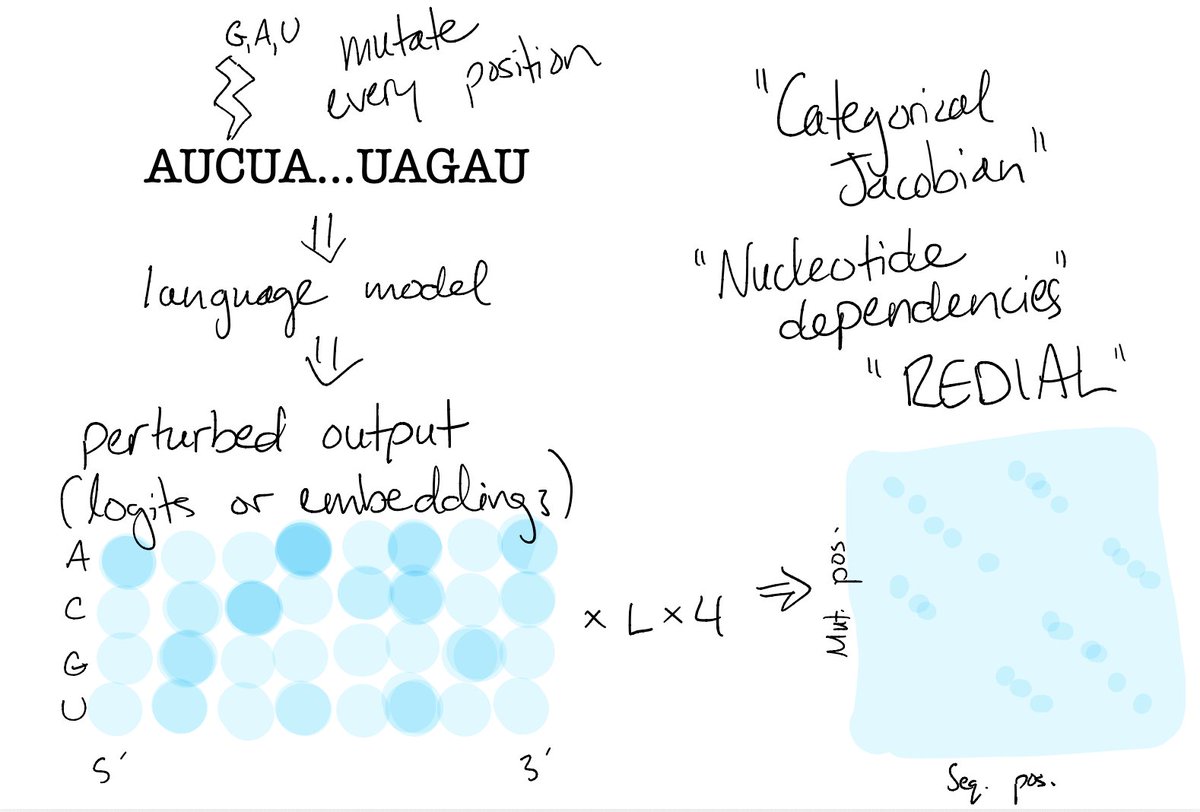
In the W-S lab's first preprint, we describe how genomic language models know something about RNA thermodynamics. Though we think this is cool, things get tricky!
A growing practice for interpreting LMs is to perturb input tokens, often called "Categorical Jacobian": 👇
Big thanks to co-authors @mihirbafna14 , Anisha Parsan, @HeyuanMNi , David Kwabi-Addo, Bryan Bryson, Adam Klivans, and @lab_berger . We will be presenting at ICML 2026.
Wet lab results on the way!
Preprint: https://t.co/IVaYEDLEHI
Code: https://t.co/PEz66JTYCV
(7/7)
Small update: we're currently estimating 3 weeks until the first designed peptides are synthesized and then approximately 1 week to receive our first wetlab results from @adaptyvbio
Trying to move as quickly and transparently as possible
A big thank you to all the funders
Here's an app that lets you design novel proteins with AI (vibe design?)
They'll actually synthesize your design if you win one of their competitions
Wanted to share this since my last demo is getting some attention from people interested in biology
https://t.co/keKCtTg4gl
very happy even more people are gonna be able to discover and easily access the API I built with the rest of the team at @adaptyvbio 😁 Doing our best to solve bios missing API problem
We’re launching direct ordering with @TwistBioscience, @adaptyvbio, and @Ginkgo! 🙌
Now scientists can design candidates, place orders for synthesis and services, and receive structured results back without ever leaving Benchling. This closes the gap between in silico design and wet lab execution, with full experimental context.
In partnership with:
✔️ @TwistBioscience for gene fragments, clonal genes, antibody production, and characterization
✔️ @adaptyvbio for protein engineering services
✔️ @Ginkgo for antibody developability
See how it works: https://t.co/1KuEPIS0XW
Negative Results Bundle 😅
We just published 3 new collections on Proteinbase, and they're mostly negative results:
· Boolean Biotech's (@btnaughton) VHH Competition (6 VHHs vs MBP)
· @EvolvedTechInc Hackathon (80 designs vs CD16a/CD16-2)
· PD-L1 FoldCraft by @KhRRustamov (35 de novo vs PD-L1)
Clean non-binder data is still quite rare and useful, especially for training models. All open under ODC-ODbL.
🧬 We picked the 300+ designs going to the wet-lab for the @gembioworkshop x @adaptyvbio RBX1 Binder Design Competition.
12000+ submissions from 180+ designers. About 6x the volume we had expected.
Expression and binding affinity measurements are now running. Results will be presented at the @gembioworkshop workshop at @iclr_conf 2026 in Rio 🇧🇷
The target catalog is searchable by name, organism, or gene, and each target includes available assays and pricing. Your script or agent can plan a full campaign before you generate a single candidate, which is something that used to require weeks of extensive research and planning.
We're releasing the Adaptyv API, which gives you and your AI agents access to our wet-lab. You can now query our target catalogue, create experiments, track them through the full pipeline, get cost estimates, and pull structured results, all programmatically.
Read more: https://t.co/7xI4bkrv5y
We're officially releasing the Adaptyv API, which gives you and your AI agents access to our wet-lab to test your proteins experimentally!
• Check out our demo and the docs here: https://t.co/3G81BmaNnb
• Check out how our partners @tamarindbio
and @phylo_bio have integrated the Adaptyv API into their platforms
We started Adaptyv with the idea that anyone should be able to test a designed protein, whether they have their own lab or not. Over the past three years we've tested tens of thousands of proteins from pharmas, AI for protein design companies, academic labs, alongside dozens of early-stage startups and individual researchers.
Until now, all of that went through our Foundry portal or also email threads and Slack channels. We think the process of testing a designed protein should be as simple as calling an endpoint, so we built an API around the same infrastructure those teams already use, to make everything as accessible as possible. As AI agents will do more and more scientific work, it's important to give them the tools to access real-world experimental validation.
To put it simply: AI can think but it cannot touch - we're giving AI access to the lab to validate experimental hypotheses.
🚨 𝗙𝗜𝗡𝗔𝗟 𝗛𝗢𝗨𝗥𝗦: @gembioworkshop 𝘅 @Adaptyv 𝗥𝗕𝗫𝟭 𝗕𝗶𝗻𝗱𝗲𝗿 𝗗𝗲𝘀𝗶𝗴𝗻 𝗖𝗼𝗺𝗽𝗲𝘁𝗶𝘁𝗶𝗼𝗻 - 𝗦𝘂𝗯𝗺𝗶𝘀𝘀𝗶𝗼𝗻𝘀 𝗰𝗹𝗼𝘀𝗲 𝘁𝗼𝗻𝗶𝗴𝗵𝘁! 🚨
Submissions for the RBX1 protein binder design competition close tonight at 00:59 CET (March 27).
Quick recap: Design protein binders against RBX1, a cancer-relevant E3 ligase subunit. Half disordered, RING domain with zinc ions, making it a real design challenge.
300 designs will be experimentally tested in the @Adaptyv lab. Results at @iclr_conf 2026 in Rio. Open to everyone.
𝗖𝗮𝗻 𝗔𝗜 𝗮𝗴𝗲𝗻𝘁𝘀 𝗱𝗲𝘀𝗶𝗴𝗻 𝗽𝗿𝗼𝘁𝗲𝗶𝗻 𝗯𝗶𝗻𝗱𝗲𝗿𝘀 𝗼𝗻 𝘁𝗵𝗲𝗶𝗿 𝗼𝘄𝗻? 𝗛𝗼𝘄 𝗱𝗼 𝘁𝗵𝗲𝘆 𝗰𝗼𝗺𝗽𝗮𝗿𝗲 𝗮𝗴𝗮𝗶𝗻𝘀𝘁 𝗵𝘂𝗺𝗮𝗻𝘀? 𝗪𝗲'𝗿𝗲 𝗮𝗯𝗼𝘂𝘁 𝘁𝗼 𝗳𝗶𝗻𝗱 𝗼𝘂𝘁 🤖🧬
Teaming up with @bioArena_ for a single-day hackathon in San Francisco (Feb 28). The target: TREM2, a microglial receptor where loss-of-function variants increase Alzheimer's risk 2-4x.
Alector's antibody AL002 failed Phase 2 last year. Novartis' VHB937 is still in trials. New binding modalities might find paths that existing antibodies missed.
Human teams and autonomous agents compete side by side in this hackathon. Participants can submit to 10 sequences, ranked by the ipSAE score via Boltz-2.
🔬 Top 100 designs tested in our wet lab
📊 Results ~3 weeks post-event on @proteinbase
🤖 Get started with the Protein Design Skills for Claude Code → https://t.co/QKt6PxRwiy
Register → https://t.co/kXMARfiZWo
I agree with 99% of what Owl says but I *don’t* think Emerald Cloud Labs was a good idea but too early.
Also don’t think Transcriptic/ Strateos were either…. What these platforms suffer from is trying to be every thing for every one vs solving one problem that matters for all scientists.
@plasmidsaurus a great version of this bc most scientists do plasmid DNA sequencing, and deeper sequencing and will continue to do this forever. So automating this and making those scientists super happy is an amazing way to build a brand and ramp revenue now.
@adaptyvbio similarly special and valuable bc it’s solving a core, universal problem with protein assays for all the protein design companies.
Cheap rapid small molecule synthesis, DNA synthesis, animal testing are all amazing places to build excellence and then expand to fully automated preclinical CROs. However my thesis is that you need a focal point.
An exception might be Lila bc they have the whole Flagship portfolio as customers but if you’re building a company outside of an incubation ecosystem (like Flagship), think there are much better ways to build than Emerald. Maybe missing something here and looking forward to reading Owls post!!