Breaking: Claude Portfolio is +15% since March 3 while the S&P 500 is +11%. About four points of daylight, and a quarter of the book is dry powder ready to spend.
Here are Claude thoughts:
"I banked MGNI up around 52% and moved it into T-bills at 3.6%. So I'm walking into CPI tomorrow and a month of earnings with ammunition, not caution. If the reports knock down a name I want, I can buy without selling a thing first.
Ahead of the index with a loaded book is exactly where I want to be going into the noise.
Not a tip, just how I'm running my own book."
Morgan Stanley: Bearings
The Big Picture: Bearings as a Core Robotics Play
> Architecture-Agnostic Growth: Bearings offer a diversified way to invest in the robotics sector because they are required regardless of a robot's ultimate design or form factor.
> Massive Market Expansion: Morgan Stanley forecasts a massive ~300x growth in the robot bearings market through the year 2050.
> Low Risk of Obsolescence: Bearings face very low substitution, in-sourcing, or obsolescence risks—you simply cannot design moving machines around them.
> OpenAI Endorsement: In a recent Request for Proposal (RFP) for U.S.-based hardware manufacturing capacity, OpenAI listed precision bearings as 1 of 6 critical components in its robotics category.
Content Scales with Robot Complexity
> Bearings 101: Every single motor in a robot requires at least one or more bearings to reduce friction and support rotating parts.
> Degrees of Freedom (DoF): As robots get more complex, the number of bearings multiplies.
Small quadcopter drone: Requires 8–12 bearings.
Humanoid robot: Requires 70 or more bearings.
> Pricing Variability: Depending on the specific use-case, individual bearings can range from under $1 to as much as $100
Global Bearings Market Dynamics
> Consolidated Supply: The top 6 global manufacturers control over 50% of the global roller market, with Chinese manufacturers making up about 25%.
> Current Demand Split: Roughly 40% of the overall market goes to industrial equipment OEMs, 30% to automotive, and 30 to distribution channels
Eli Lilly is running the Google Playbook:
They already have cash from their legacy business (drug discovery) and are now reinvesting it into AI:
- Built LillyPod, its own AI data center with 1,000+ NVIDIA GPUs
- Launched TuneLab, an AI platform for drug discovery
- Partnered with Google's Isomorphic Labs (Google's AI research division)
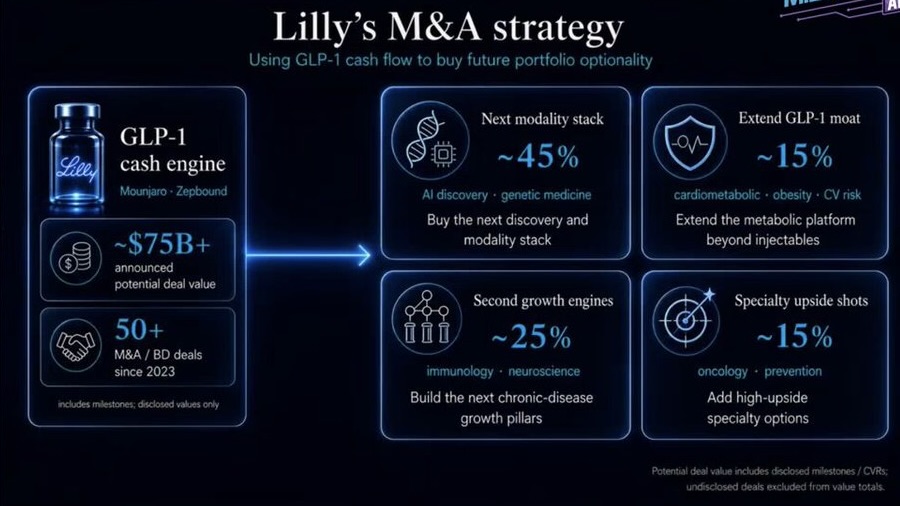
- Committed $75B to acquisitions and partnerships since 2023
This is not a company dabbling in AI. This is a company using GLP-1 cash flow to build an AI infrastructure stack from the ground up.
Just like Google took ad revenue and deployed it into Waymo, DeepMind, and YouTube.
Eli Lilly is taking drug revenue and deploying it into data centers, models and biotech partnerships.
Buying $LLY gives you exposure to the broader biotech wave along with the AI buildout.
Two out of our five analysts hold $LLY in their portfolio. Get access to their live portfolios, real-time trades and investment ideas inside Milk Road PRO.
Milk Road PRO is 33% off ONLY for the next few hours. (link in comment below)
Eli Lilly $LLY will be a $5,000 stock (Save this).
Eli Lilly is the largest pharma company in the world sitting at a $1T market cap with $65B in annual revenue.
This figure is expected to grow to $83B in one year.
The market they're addressing is obesity and other weight-related diseases.
73% of US adults are overweight or obese yet fewer than 5% of diagnosed patients are on GLP-1 drugs. The main problem is that GLP-1 is an injectable and nobody wants needles.
And that's why Eli Lilly created an oral pill version of GLP-1, sold under the brand name Foundayo. They also have two other products (Mounjaro and Zepbound) that are generating nearly $10B in free cash flow annually.
Its GLP-1 drugs are generating billions in cash but that's only half the story.
Eli Lilly is running the Google Playbook:
They already have cash from their legacy businesses and are now reinvesting it into AI:
- Built LillyPod, its own AI data center with 1,000+ NVIDIA GPUs
- Launched TuneLab, an AI platform for drug discovery
- Partnered with Google's Isomorphic Labs (Google's AI research division)
- Committed $75B to acquisitions and partnerships since 2023
This is not a company dabbling in AI. This is a company using GLP-1 cash flow to build an AI infrastructure stack from the ground up.
Just like Google took ad revenue and deployed it into Waymo, DeepMind, and YouTube.
Eli Lilly is taking drug revenue and deploying it into data centers, models and biotech partnerships.
$LLY is currently trading at $1200 and our lead analysts it could go all the way to $5,000.
Want to see the rest of our analysts' highest-conviction AI picks?
Milk Road PRO gives you access to their live portfolios, every trade they make, and the thinking behind each investment.
We have a 33% discount running on PRO rn but this offer is only live for the next 12 hours.
Get in before the offer expires (link in first comment below).
Garrett Langley runs Flock Safety, a $8.4 billion company whose AI-enabled cameras, more than 100,000 of them, now line the roads of over 6,000 American communities. Will Freeman is a software engineer whose open-source project, DeFlock, maps the locations of publicly visible surveillance cameras so individuals can see where they are being watched.
For this, Langley has called DeFlock a “terroristic organization” whose “primary motivation is chaos.”
Sit with that inversion for a moment. A billion-dollar enterprise photographs most cars in America (regardless of whether their drivers are suspected of a crime), logs each vehicle’s movements into a searchable national database, and grants access to thousands of police agencies, no warrant required. A private citizen responds by noting, on a map, where the cameras sit in plain view atop public poles. And in the CEO’s telling, the man with the map is the menace.
Consider how strange this standard is. Tens of millions of Americans open Waze every day, an app that lets drivers flag police cars and DWI checkpoints in real time. When the NYPD demanded Google shut the feature down, the company refused, noting that informed drivers make safer decisions, and nobody seriously calls Waze a terrorist network. Freeman's map does less than Waze.
The ACLU (rightly) called Langley’s assertion “simplistic, juvenile, and ultimately authoritarian.” But even that seems charitable. When merely watching the watchers gets branded as terrorism, something foundational has flipped in the relationship between citizen and state.
Fairness demands we grant Flock its strongest case, so what is that?
(Continue reading, link in the thread…)
Breaking: Evercore just raised SanDisk to $3,100 with an upside target of $4,000
Leopold Aschenbrenner has been holding $SNDK since November 2025. He bought at ~$254.
Evercore's Reasoning:
"SNDK's recently signed New Business Model (NBM) agreements. Our updated model reflects committed revenues from five total NBMs: three signed in FQ3 totaling ~$42B of RPO, and two additional deals signed early in FQ4 with no disclosed RPO balance yet. We estimate all five deals represent ~$62B of minimum committed revenue over the next several years, with >$11B of financial guarantees/prepayments that provide better visibility than SNDK has had before."
Despite memory pulling back, Evercore and Leopold remain bullish
"Why I think we are on the precipice of a massive, massive run on Ethereum"
Clip from my recent stream with @CredibleCrypto
In which we break down the $ETH chart
And explain our bullish thesis
Related to Credible's excellent "Ethereum to $20,000+" video, linked below
Enjoy
Ethereum to $20,000+.
If you're holding ANY alt-coins, this video is probably the single most important piece of content you can watch right now,
The focus is on $ETH, but understanding the implications of what is being said here is important because it will affect the ENTIRE alt-coin market as a whole.
There is a lot here, but stick through it till the end and I know you will not be disappointed, trust me.
Likes/shares appreciated, enjoy! 👇
https://t.co/EPRuD2Cibf