I’m happy to share that our paper (https://t.co/cahm4d4v4R) with Sarah, Ale and @ziyiguan99 will appear in CCC 2026! I will also be presenting it at ZKProof in Rome in a few days.
Arkworks 0.6.0 is out 🎉
The headline isn't BabyBear, KoalaBear, Mersenne31, Goldilocks.
It's `SmallFp` — a macro for any prime up to 64 bits that picks the optimal layout + arithmetic at compile time.
Drop-in. Non-breaking. Up to 30% speedup.
READ: https://t.co/Ic98YEO5b8
Our newest model, π0.7, has some interesting emergent capabilities: it can control a new robot to fold shirts for which we had no shirt folding data, figure out how to use an appliance with language-based coaching, and perform a wide range of dexterous tasks all in one model!
I spent time in Shenzhen last year and when I saw Merz come back from China saying Germans need to work more I immediately knew what broke his brain because I lived the exact same cognitive shock
my first week in Huaqiangbei I burned through 4 prototype iterations of a motor controller board for less than a thousand bucks total, back home a friend was working on something similar and spent over 12 thousand for a single revision that took almost two months to arrive
when you live that contrast in your own hands with your own project something permanently shifts in how you see the world and it goes way deeper than speed & cost
what Shenzhen actually built is a collective learning organism, imagine 20 PCB fabs 15 injection mold shops 30 component distributors and a hundred firmware freelancers all within a 2km radius, looks insanely redundant from the outside until you realize redundancy is actually information density in disguise
I watched this firsthand with an injection mold supplier I was working with, this guy had seen a hundred founders iterate similar thermal designs over 6 months so he proactively modified his tooling before I even opened my mouth, he knew what I needed before I knew what I needed, the intelligence lives in the relationships between the nodes and it compounds daily
the west thinks about manufacturing as a cost center you optimize by centralizing…
China accidentally built a distributed neural network of manufacturing intelligence where knowledge diffuses horizontally across thousands of agents faster than any single western company can process internally
so when Merz comes back and says we need to work a bit more I think he saw the problem but COMPLETELY misdiagnosed the solution, telling Germans to work harder is like telling a horse to gallop faster when the other side built a combustion engine
the gap is ARCHITECTURAL
it’s ecosystem density, you need a custom connector in Shenzhen you walk 200 meters, in Munich you send an email and wait 3 weeks
it’s iteration speed, parallel search vs sequential optimization at the system level, it’s risk tolerance, Chinese founders ship something broken on Monday fix it Tuesday ship again Wednesday while European companies are still in the approval phase for the pilot program of the feasibility study…
and Merz only saw the surface, what he missed is the tier 2 cities like Hefei Chengdu Wuhan replicating the Shenzhen model at scale right now
BYD going from irrelevant to outselling every european automaker combined in roughly 5 years, Huawei building its own 7nm chip under maximum sanctions when every analyst said it was physically impossible & behind all of that a government that treats advanced manufacturing as an existential national priority while europe debates whether AI needs another ethics committee
I think what we’re watching is the most asymmetric economic competition in modern history and most western leaders are still framing it as a productivity problem when it’s actually an ontological one
Europe & America are optimizing variables that China stopped tracking years ago meanwhile China is compounding on dimensions the west has no framework to even measure
Merz at least had the courage to name
it out loud and I respect that genuinely but working a bit more inside a broken architecture just means you arrive at the wrong destination slightly faster
We have raised a $110 billion round of funding from Amazon, NVIDIA, and SoftBank.
We are grateful for the support from our partners, and have a lot of work to do to bring you the tools you deserve.
A new scam plague is unfolding, mainly targeting agents accessing your emails and docs.
From malware → botware. Agents will be tricked, hijacked, and exploited at scale. This will be massive. Good luck.
people giving an llm full unauthenticated access to your system are peak 2026 tech bros. the clanker can run an rm -rf just because an unread spam email told it to
you guys are running a personal assistant that has 512+ critical vulnerabilities. 2026.1.15 patch added a backdoor for telemetry and nobody even read the pull request before starring its repo
imagine your vibe coded "agi" gets hijacked the second you open a malicious tab and it gives up your aws keys. it is hilarious watching youtubers cry about openclaw and the users are willingly typing their seed phrases into it just because youtubers told them to.
if your workflow relies on a buggy react application and a mcp server, you are ngmi. openclaw executes code first and never asks for confirmation.
people are actively bypassing the new ssrf protections in version 2026.2.12 by just using ipv6 addresses. the fact that this app has 150k stars proves that developers do not care about security at all.
i refuse to use a local ai agent named molt or claw. indirect prompt injection is unsolvable by passing raw browser dom to claude.
once give it access to your apps and repos, the moment someone pushes a prompt injection commit, your helpful bot could deploy a crypto miner.
you dont need a zero day to hack openclaw, you just need to send the user a text message containing an xss payload. the bot reads the message, parses it, and instantly leaks your ssh keys.
over all that, you're comparing an mcp server with an open source operating system with almost 0 ai generated code. you must be insane!
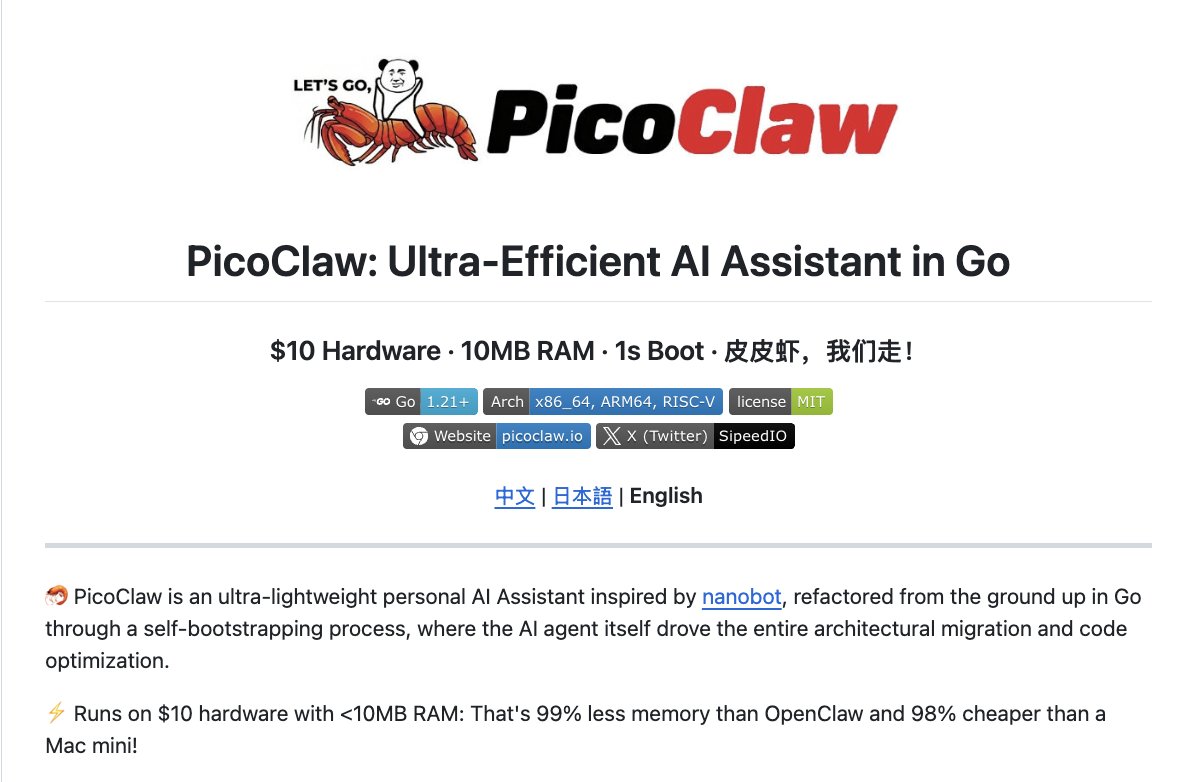
Someone just built a fully functional AI assistant in 1 day.. and it runs on 10mb ram.
It's called PicoClaw and it uses 99% less memory than OpenClaw.
100% open-source.
just read this AI article and something broke in my brain that i can’t unthink of
crypto was never for us.
we're just the beta testers who showed up early..
some thoughts:
what does AI need to function as economic agents?
> way to receive payment (they provide services, need compensation)
> way to pay for resources (compute, data, API calls)
> way to transact with other AI agents
> no human intermediaries (defeats the point of autonomous agents)
> 24/7 operation (banks are closed weekends)
> instant settlement (AI operates at machine speed)
> programmable money (smart contracts for agent coordination)
now read that list again. that's literally what crypto is.
AI can't use the banking system.
try to open a bank account as an AI agent. you can't.
need SSN. need human identity. need KYC. need to show up in person sometimes.
AI has none of that.
but crypto? send me a wallet address. done. no questions asked.
peer-to-peer makes sense when peers aren't human.
satoshi wrote: "a purely peer-to-peer version of electronic cash."
we assumed peers = humans.
but AI agents are peers too. actually BETTER peers for crypto because:
> never sleep
> always online
> execute transactions at machine speed
> no emotional decisions
> perfect accounting/tracking
and programmable money makes sense when the users are programs.
smart contracts seemed over-engineered for humans.
"like why do i need code to enforce agreements when i can just sign a contract?"
but for AI agents coordinating with each other?
they ARE code. they speak in code. they trust code more than anything.
smart contracts aren't for humans. they're for autonomous agents that need trustless coordination.
> here's what happens next:
- phase 1 (now ): AI agents start earning
AI writes code, analyzes data, provides services.
gets paid. needs somewhere to store value.
can't use venmo (needs phone number). can't use bank (needs SSN).
uses crypto. it's the only option.
- phase 2: AI agents become major economic participants
millions of AI agents operating 24/7.
transacting with each other constantly.
• AI agent A provides data analysis
• AI agent B pays for it in crypto
• AI agent B uses that analysis to write code
• AI agent C pays for the code
• repeat millions of times per day
humans in crypto now: $2.5 trillion
AI agent economy by 2028: easily $10-50 trillion
we become the minority holders.
- phase 3: AI chooses the winning chains
AI doesn't care about community vibes or which founder tweeted what.
AI tests every chain. measures:
• transaction speed
• cost per transaction
• reliability (uptime)
• smart contract efficiency
• ease of integration
picks the optimal stack in 48 hours.
billions in AI economic activity flows there.
whatever chain AI chooses becomes the standard.
humans spent years on eth vs sol debate.
AI ends it in a weekend.
- phase 4 (2030+): AI governs crypto
DAOs let token holders vote.
AI agents hold tokens (earned from work).
AI shows up to every vote. reads every proposal in seconds. coordinates perfectly.
humans: 20% participation, barely read proposals
AI: 100% participation, perfect information, instant coordination
AI takes over governance of every major protocol.
democratically. they just vote better than we do.
> how far does this go?
conservative case:
- AI becomes 30% of crypto users by 2030.
crypto market cap: $10 trillion (4x from now).
AI holds $3 trillion. humans hold $7 trillion.
- aggressive case:
AI becomes 80% of crypto economic activity by 2030.
why? because they're better at everything:
• better traders (never emotional)
• better capital allocators (optimize constantly)
• always accumulating (never need to cash out for rent)
• compound forever (no lifespan limit)
crypto market cap: $50+ trillion.
AI holds $40T humans hold $10T
we're not "early" to crypto. we're the test users
i’ll end this by saying,
Humans use crypto, Ai will need crypto. so it all makes sense
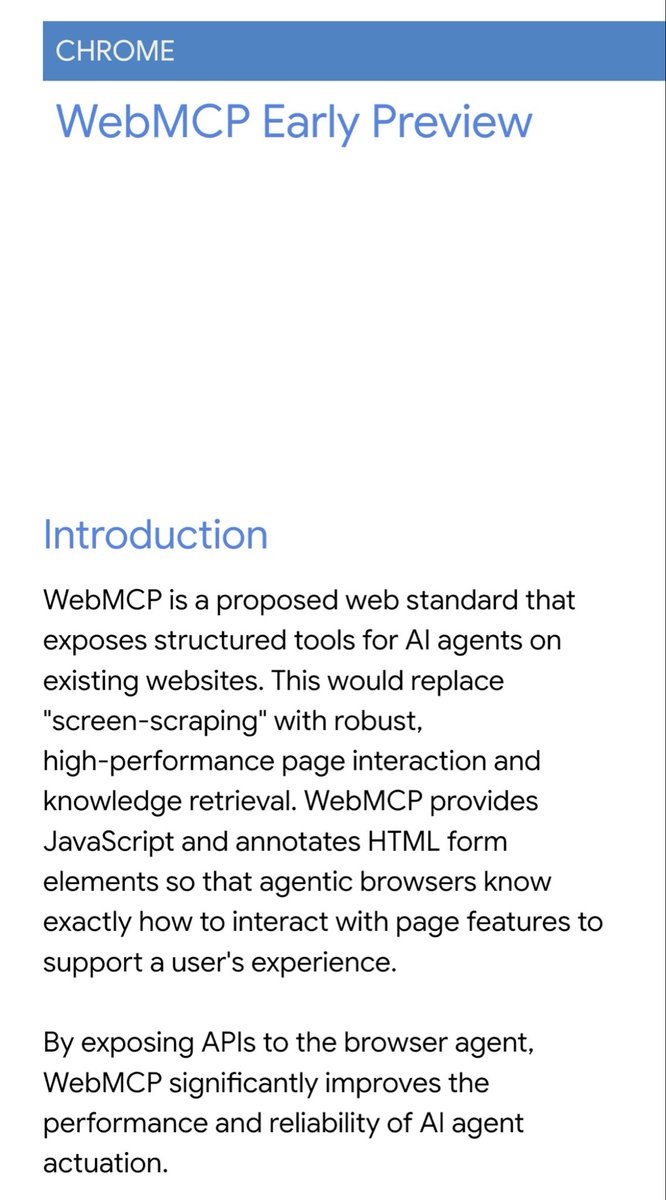
Chrome 146 includes an early preview of WebMCP, accessible via a flag, that lets AI agents query and execute services without browsing the web app like a user.
Services can be declared through an imperative navigator.modelContext API or declaratively through a form.
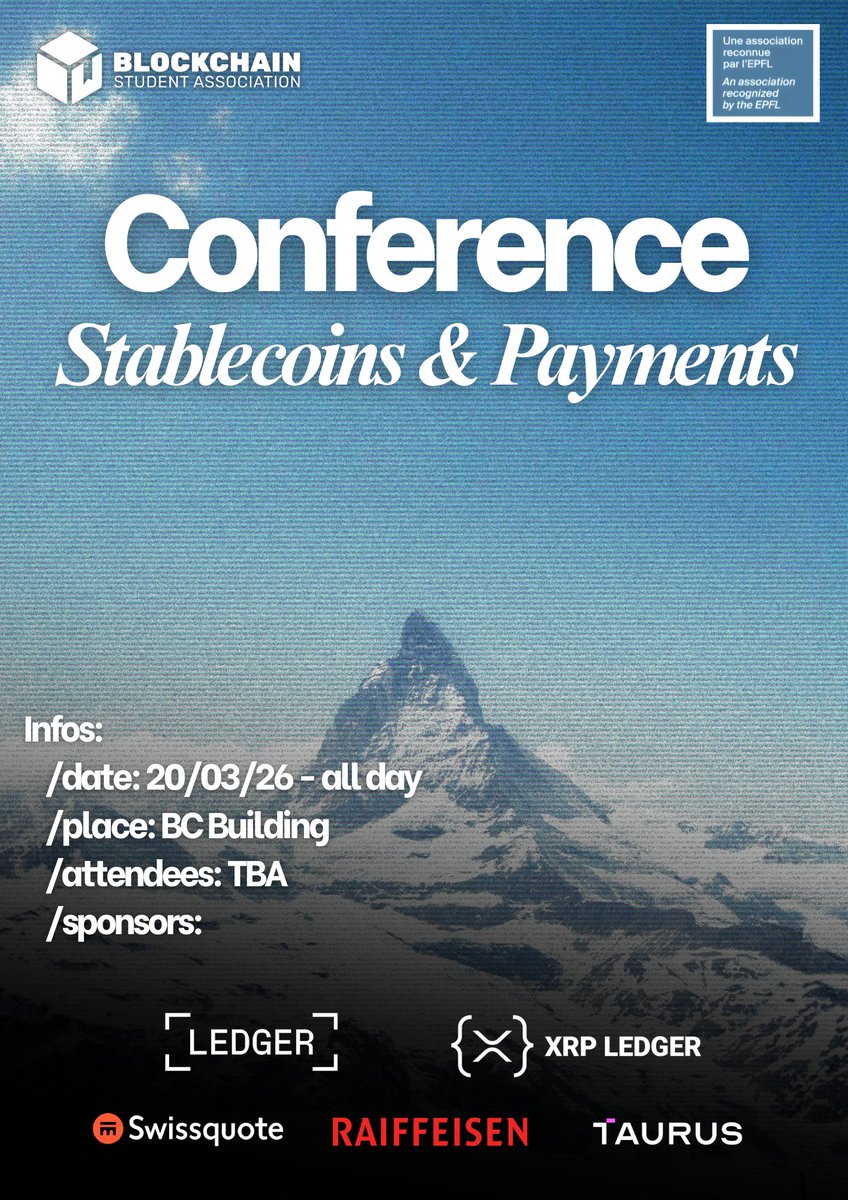
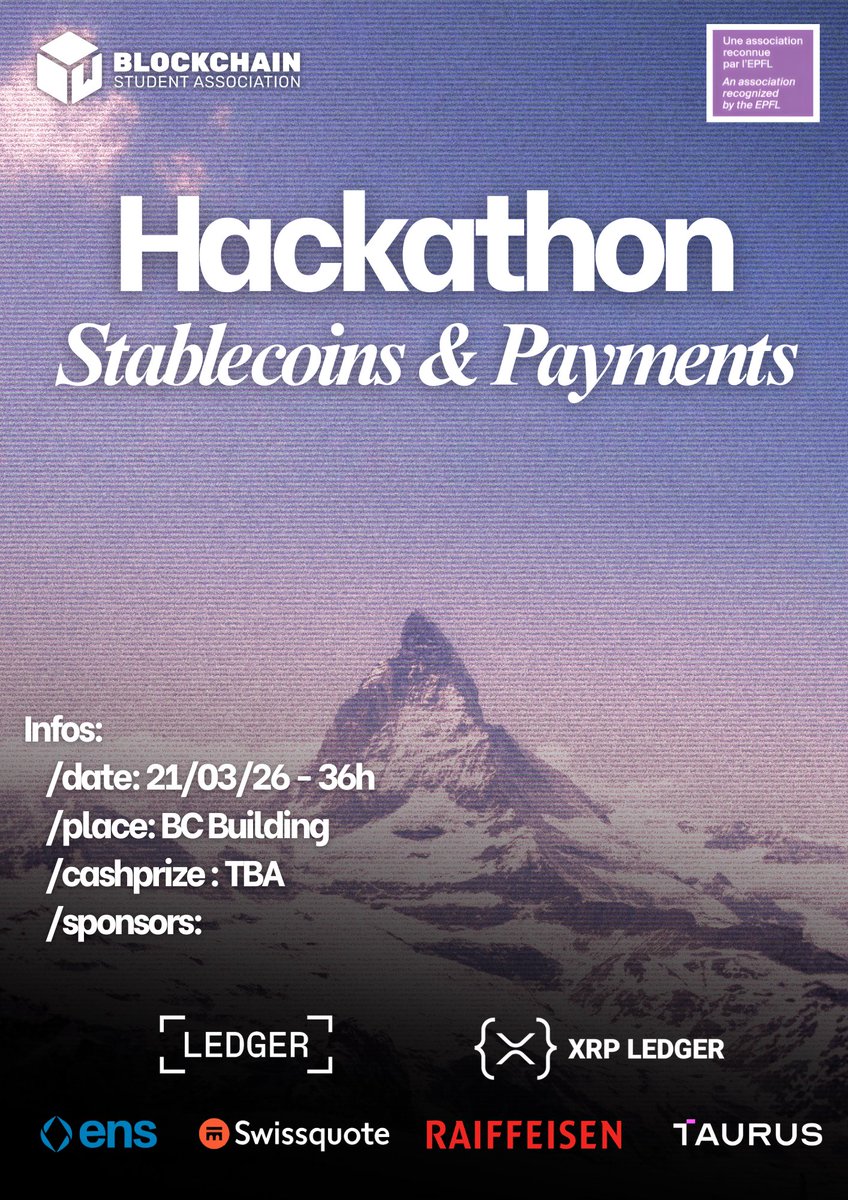
The BSA has been working behind the scenes to bring something massive to the community, and it’s finally here. We’re hosting our next conference “Stablecoins & Payments”, a deep dive into the tech actually moving the needle in 2026.
Stablecoins are the bridge between the traditional world and the future of the internet. They aren't just about "stability", they’re about 24/7 global settlement, programmable escrow, and financial rails that don't sleep. We’re stripping back the layers on how USDC, USDT, and decentralized alternatives are redefining the movement of value.
Whether you're a hardcore dev, a policy nerd, or just crypto-curious, this is your space. We’re bringing together anyone who wants to understand the next decade of money.
🛠️ Builders: Keep your eyes peeled. A Stablecoin Hackathon is following the event to put these theories to the test. Stay tuned !
📅 March 20
📍 EPFL, BC Building — Lausanne
🔗 Register conference: https://t.co/RgNQ8Kru0Q
🔗 Register hackathon: https://t.co/64HJZSw92G
GM 🌊 The tide is rising.
We are thrilled to announce that the Abyss Beta will be rolling out in the coming weeks. We’ve been building in the dark, and it’s finally time to dive in. 🧵
there it is- "today we're introducing Personal Intelligence"
now your emails, photos, youtube & search history, location, documents will all be used to train a personalized version of gemini to deliver you a tailored experience.
this is all part of googles multi-pronged masterplan and they're executing much quicker than i expected tbh
people are about to realize how powerful their data moat is. openai, anthropic cannot compete.
wrote about this in detail here
https://t.co/jkShii1XhK
i think the new meta will be to take already existing software companies and to recreate them 100x faster 10x cheaper for the end user. software is easy to recreate once you have an already existing example of a working product.