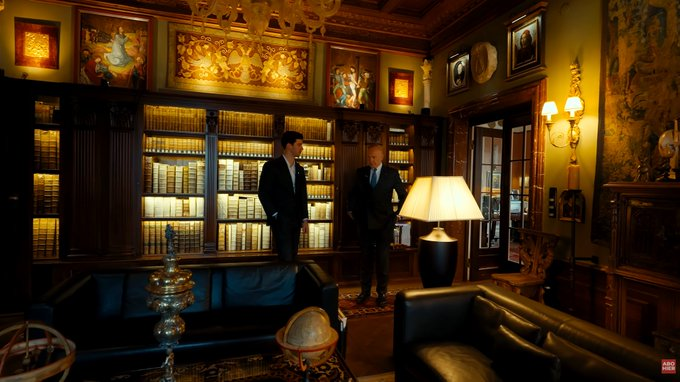
The €1 Billionaire
Imagine leaving McKinsey to buy broken companies nobody wanted.
This self-made billionaire acquired nearly 300 businesses across 70 countries.
Sellers paid him to take the deal!
This self-made billionaire acquired nearly 300 businesses across 70 countries.
Now he hosts rock festivals at his castle, restores endangered châteaux across Europe, and publishes theological works.
The Power of Special Sits Investing
He bought a company for €1.
18 months later, he sold it for €15M.
For him, that deal was pocket change. He ran this playbook dozens of times.
CHRIS CAMILLO LAID OUT HOW TO MAKE $500,000 A YEAR AS AN "AI GUY" FOR LOCAL BUSINESSES.
HIS BLUEPRINT:
WALK INTO ANY HVAC, PLUMBING, OR SPRINKLER BUSINESS.
ASK WHERE THEY'RE LEAKING MONEY.
BUILD AN AI AGENT THAT ANSWERS AFTER-HOURS CALLS, SENDS INSTANT TEXTS, AND DELIVERS QUOTES IN REAL TIME.
INTEGRATE IT WITH THEIR CRM.
CHARGE $2K–$3K/MONTH TO BE THEIR "AI GUY."
REPEAT ACROSS 10–20 BUSINESSES.
“THERE ARE PEOPLE RIGHT NOW DOING THIS.”
Jaylen Brown says 60% of NBA players lose most of their wealth because the agency model broken
“I hope I ruffle all the motherfucking feathers. The agency model isn't working. It's a bunch of players going broke when they retire. It's like 60% of players within the first 10 years are losing majority of their wealth after making millions of dollars. Living check to check. You can blame the athlete, maybe they living expenses, but they was 18 or 19 when they came into wealth and the people that represented them didn't help them handle that in no capacity or care to. After they get you and they get in your pocket, they just go get the next one and get in his pocket”
“This is what I'mma stand on. And this could be controversial, but I don't care. If you can't help me at 18 or 19 to maintain my wealth, build a legacy, and keep what I'm earning and be able to influence me on my decision making, you shouldn't be representing me in the first place. Shouldn't even be allowed to walk into my house. But we allow this agency model. They keep coming in and they keep stripping everything and we giving it right back to the same people that was giving it to us in the first place. Giving it right back”
“Something got to change. There's been people taking advantage of these 18, 19 young kids, and nobody says nothing. I think that's a part of the problem where we don't say that and we just allow that to be normalized. No, that shit ain't normal. You get millions of dollars and now you broke. And the people that's representing you can't even pick up the phone now. These people have continued to do that and they're gonna continue to do it because they see it as business and economic opportunity”
“The reason I’m still rich after retiring from football is simple: I saved all my salary. I used match bonuses for food, clothes and to support my family, while I used endorsement money for cars and expensive watch and vacation ”
— Jay-Jay Okocha
“ The better the people, the harder they are to manage”
Groq Founder @JonathanRoss321 says that managing 450 employees felt more like managing a group of 5,000 people because it’s much harder to manage a creative organization:
Jamie Dimon on why great companies actually die:
Dimon opens by telling a room of JPMorgan leaders that they, personally, are responsible for a $700 billion company with 320,000 people, and then pivots to what actually kills firms that size.
"I said speed kills, but I mean slow speed."
He rattles off a list of winners and losers from the last 20 to 30 years: Sears and Kmart, gone. Walmart, still standing. BlackBerry, gone. Dell, Apple, Amazon, survived and thrived. Nokia, basically disappeared.
The pattern in financial services, he argues, is even grimmer, because the numbers can be manipulated:
"Travelers blew up, Citi blew up twice, Bear Stearns failed, Lehman failed."
Then he names the same recurring cause across three separate collapses: Washington Mutual, Silicon Valley Bank, the entire savings-and-loan industry. Interest rate mismatch. Not fraud. Not bad luck. The same avoidable mistake, repeated across decades.
But the deeper culprit, Dimon says, isn't any single bad decision. It's what creates the conditions for those decisions to be made in the first place:
"It's complacency. It's bureaucracy. It's arrogance. It's slow to adjust. A lot of it's dishonest numbers. Failure to set standards, bad people, bad comp schemes, disincentives, bad incentives, politics. These things are like all the cancer that kills companies."
The warning isn't about external shocks or market cycles. It's about internal rot. The firms that disappeared weren't necessarily beaten by competitors with better products. They were undone by a slow accumulation of the wrong culture, the wrong incentives, and a failure to maintain honest standards from the inside.
"We all have to be very cautious about when that takes place."
David Tepper, founder of Appaloosa, on what his first mentor at Equi Bank told him about financial projections:
"you wanna know what he said about projections?"
"he said projections are like a**holes, everybody has one."
"that stuck with me. and it's actually a true story."
just something to remember when you scroll Twitter.