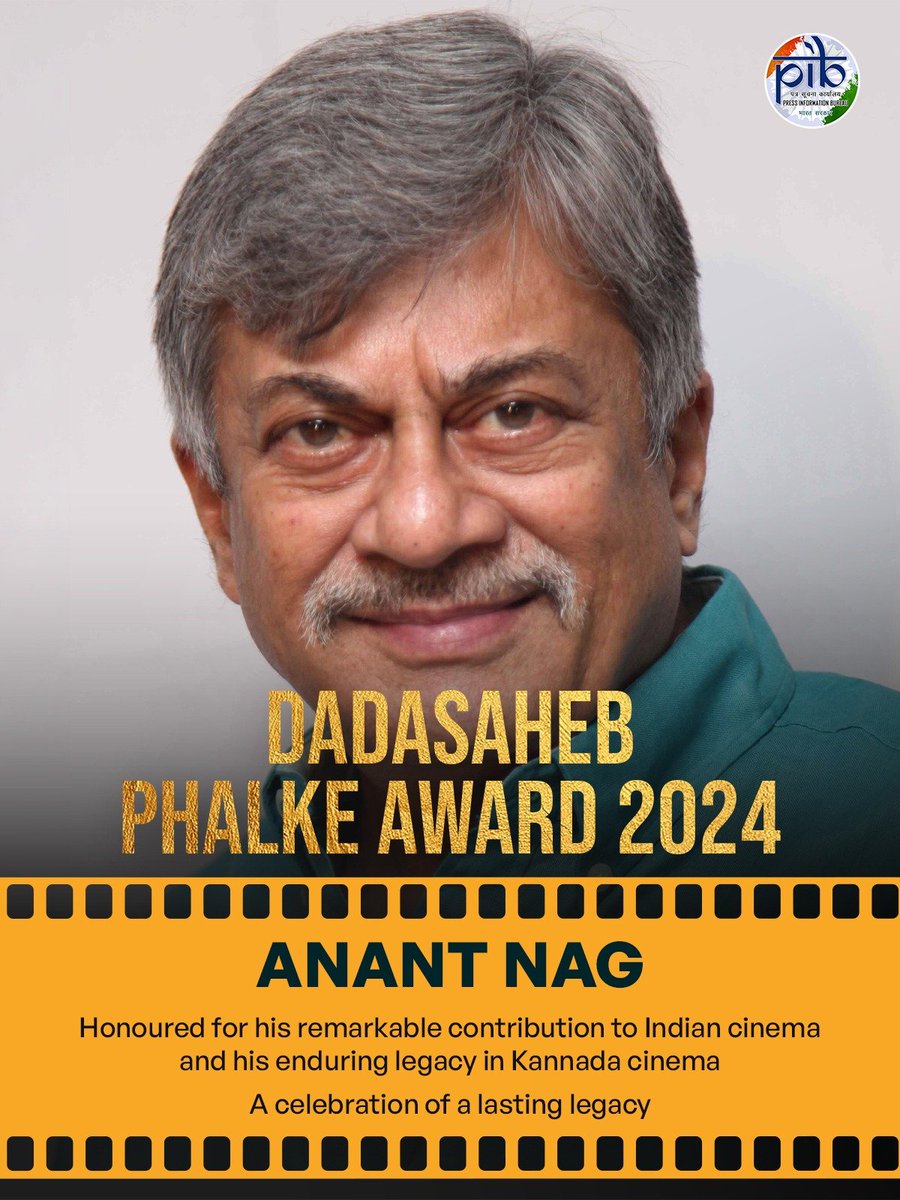
VIDEO | Bengaluru: Veteran Kannada actor Anant Nag has been selected as the recipient of the Dadasaheb Phalke Award, India's highest recognition for contribution to cinema.
Speaking to PTI, he says, "Well, I didn't anticipate that I would be given this award... So, I'm trying to come to terms with it. I would dedicate it to the people of Karnataka. And then, I would like to thank Mr Modi, our dear prime minister, for this because he tweeted and announced this particular award. So, I'm grateful to him and grateful to this country, which has provided me with this opportunity. And now I dedicate it to the people of Karnataka..."
Heartiest congratulations to Anant Nag Ji on being conferred with the prestigious Dadasaheb Phalke Award.
This is a befitting honour to a legendary actor who has mesmerised generations with his phenomenal gift for acting over the decades and enriched Indian cinema, especially the Kannada film industry.
The ease with which he fits into every role makes him the icon and an inspiration for new actors. My heartfelt best wishes to him.
A landmark moment for Kannada cinema. ❤️
From Ankur and Malgudi Days to Benkiya Bale, Minchina Ota and Godhi Banna Sadharana Mykattu, Anant Nag has given audiences characters that stayed with them long after the screen faded.
There was the effortless humour, the quiet intensity, the understated expressions and the ability to make even the most ordinary character memorable.
Now, after decades of performances across Kannada and Indian cinema, Anant Nag is set to receive the Dadasaheb Phalke Award, India’s highest cinema honour.
He will receive the award in Kevadia on September 22.
A special moment for Kannada cinema — and for generations who grew up watching Anant Nag.
#AnantNag #DadasahebPhalkeAward #KannadaCinema #karnataka #bengaluru
[Anant Nag, Anant Nag Dadasaheb Phalke Award, Dadasaheb Phalke Award 2026, Anant Nag movies, Anant Nag Ankur, Ankur Anant Nag, Malgudi Days Anant Nag, Benkiya Bale, Minchina Ota, Godhi Banna Sadharana Mykattu, Anant Nag Kannada films, Kannada cinema, Kannada actor, Sandalwood, Indian cinema]
🎬THE DADASAHEB PHALKE AWARD 2024 GOES TO…
Shri ANANT NAG
On the recommendation of the Dadasaheb Phalke Award Selection Committee, the Government of India is pleased to announce that the Actor will be conferred the prestigious Dadasaheb Phalke Award 2024 for his contribution to Indian cinema and an illustrious cinematic journey that has inspired generations.
🗓️ The award will be presented at the 72nd National Film Awards ceremony on Sept 22, 2026.
📍Kevadia, Gujarat
#NationalFilmAwards #DadasahebPhalkeAward
A request to Kannadigas worldwide: try the Sampada Kannada app.
Write, publish and join the discussions — all this from your phone. Kannada dictionary, Aralikatte, podcasts, multiple series in #Kannada — you'll be getting everything in one place. And with Pustaka Sampada you can order Kannada books delivered to your home.
Send us your thoughts and suggestions — they matter a great deal to the Sampada team. You too can be a partner in our dream of building a good app in Kannada.
https://t.co/qnWbgCQ8YI
Share this with your friends and help spread the word.
#Kannada #Sampada @e_sampada
Expired meat, fish & milk found in Bengaluru’s top luxury hotels.
30 teams inspected 26 three-star & five-star hotels across BBMP limits today. 35 food samples collected for lab testing.
Hotels where food was seized:
• The Lalit Ashok – 76 kg meat, 200 kg vegetables & 32 litres expired milk
• Shangri-La Bengaluru – 15 kg meat
• Four Seasons Bengaluru – 19 kg meat
• Vivanta Whitefield – 3 kg expired bakery products
• Taj Yeshwantpur – 72 kg meat/fish
• Radisson Blu (The Atria) – 105 kg expired food (50 kg chicken, 25 kg meat, 23 kg fish, 7 kg vegetables)
Violations included expired food, fungal growth, unhygienic kitchens, misbranding, FSSAI labelling violations and improper veg/non-veg storage. Notices issued; further action to follow after lab reports. #Bengaluru #FoodSafety
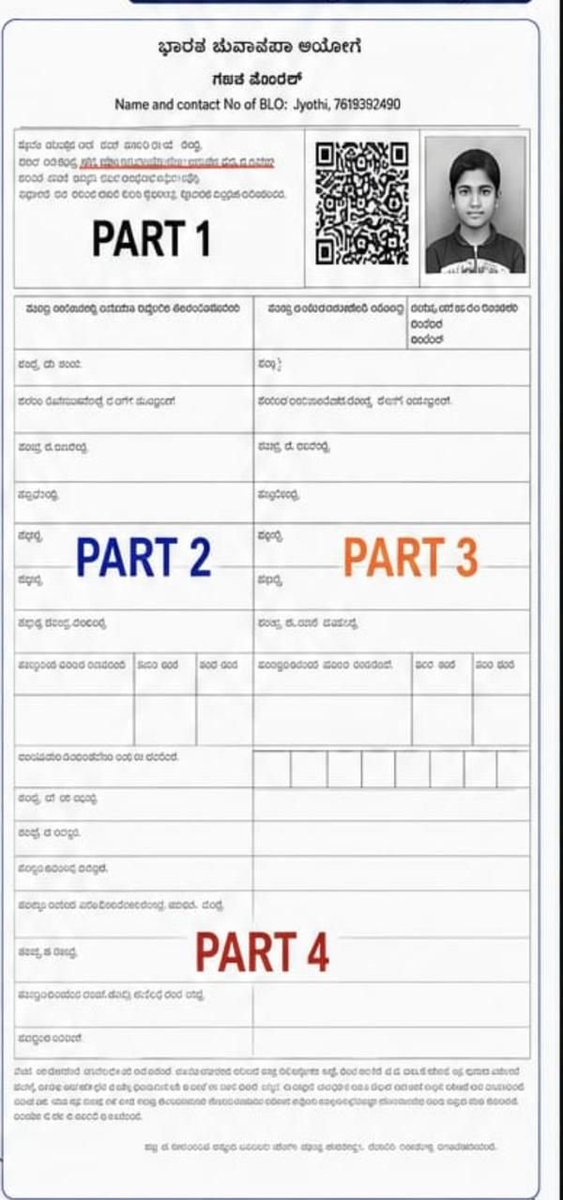
*How to fill the Physical Enumeration Form (Step-by-Step Guide)*
The form has 4 sections, but you will fill only Part 2 OR Part 3, not both.
📌 Part 1: Basic Details & Photograph
Most of this section is already filled by your BLO.
✅ Verify that your:
• Name
• EPIC (Voter ID) Number
• Address
• Taluk
• District
• Assembly Constituency
• Part & Serial Number
are all correct.
📷 Paste a recent passport-size photograph in the empty box next to the old printed photograph.
⸻
📌 Part 2: If your name was in the 2002 Voter List
Fill ONLY if your name existed in the 2002 electoral roll.
• Write your name exactly as it appeared in the 2002 list (even if the spelling was incorrect).
• EPIC Number can be left blank if you don’t remember it.
• Mention your father/mother/husband’s name as shown in the 2002 roll and specify the relationship.
• Fill in:
District
State
Assembly Constituency
AC Number
Part Number
Serial Number
using your 2002 voter record.
⸻
📌 Part 3: If your name was NOT in the 2002 Voter List
Fill ONLY if you are linking your record to a relative (such as your father or mother) whose name was in the 2002 roll.
Provide:
• Relative’s name
• Their father/mother’s name (or the name linked to them in the 2002 roll)
• Relationship
• District
• State
• Assembly Constituency
• Part Number
• Serial Number
using your relative’s 2002 voter record.
⸻
📌 Part 4: Current Personal Details (Everyone must fill this)
Use your current voter details.
Fill in:
✅ Date of Birth
✅ Aadhaar Number
✅ Mobile Number (Mandatory)
✅ Father’s Name
✅ Mother’s Name
✅ Their EPIC Numbers (if available)
✅ Spouse’s Name & EPIC Number (if applicable)
⸻
📝 Final Step
• Sign the form.
• Get the BLO’s signature.
• Submit one copy to the BLO.
• Keep the second copy safely for your records.
*⚠️ Remember: Fill either Part 2 or Part 3, never both.*
An Indian institute filmed a professor teaching classical physics with no notes, no slides, and a green board. Almost nobody outside India watches it.
This is Classical Physics, lecture 1, taught by V. Balakrishnan at IIT Madras, published free by NPTEL, India's national open courseware programme.
Balakrishnan taught at IIT Madras for decades. Students who sat in that room describe the same thing: the whole subject held in his head, delivered in order, no paper on the podium.
Lecture 1 is the introduction. What classical mechanics claims, where the claims hold, and the exact points where they stop holding and quantum takes over.
Watch how he speaks. Complete sentences, no filler, each idea finished before the next begins. Rare in any lecture hall on any continent.
A physicist I know worked through the whole NPTEL series and rates it above the western courses he paid for.
Free on YouTube, 17 years online, low resolution, no marketing.
The teaching was never concentrated in the famous universities.
⚠️LEARN⚠️ if you don't know
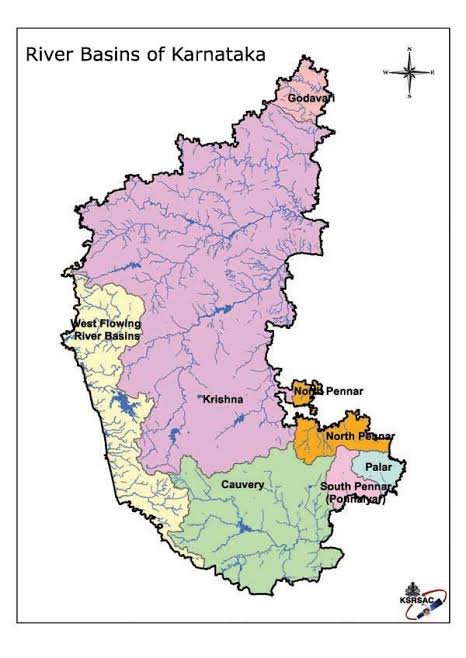
Krishna river is the LIFELINE of Karnataka, not just North Karnataka
By writing a song on a river, it won't become Jeevanadi 🤣
Today's heavy rain around 3:00 PM exposed a serious civic issue.
The drainage grate on the Veerannapalya Flyover (Nagawara to Hebbal road) became completely blocked with garbage, causing severe waterlogging. Within minutes, the flyover was flooded, forcing traffic to come to a standstill and resulting in a 3–4 km traffic jam.
I was at home when I noticed the heavy congestion on Google Maps. I immediately put on my raincoat and rushed to the location. By the time I arrived, Sector Cobra personnel had also reached the spot. Together, we cleared the garbage blocking the drainage grate. Within 15 minutes, the water drained away and traffic resumed smoothly.
What surprised me the most was that more than 100 people were standing there watching, yet no one stepped forward to remove the debris. If just a few people had taken the initiative, thousands of commuters could have been spared from unnecessary delays.
Even more concerning is the negligence of the agencies responsible for maintaining stormwater drains. Because of poor maintenance, the burden often falls on Traffic Police, Traffic Wardens, volunteers, and responsible citizens to solve problems that should have been prevented in the first place.
Let's not be citizens who only complain. Whenever it is safe to do so, let's become part of the solution. Sometimes, a small act of responsibility can save thousands of people from inconvenience.
A responsible city is built by responsible citizens. Let's all do our part.
@Hennurutrps1234@hebbaltrafficps@DCPTrNorthBCP@acpnortheasttr@blrcitytraffic@Jointcptraffic@karnatakaportf@3rdEyeDude
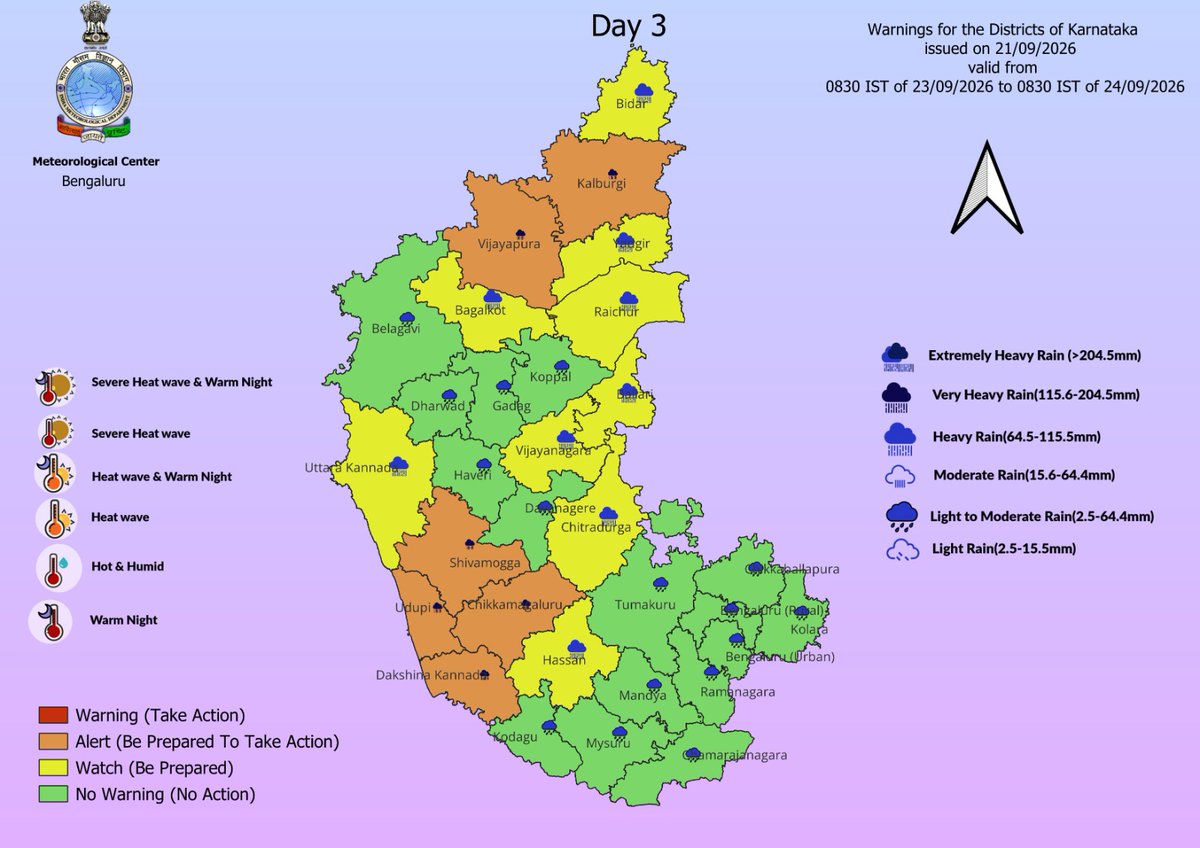
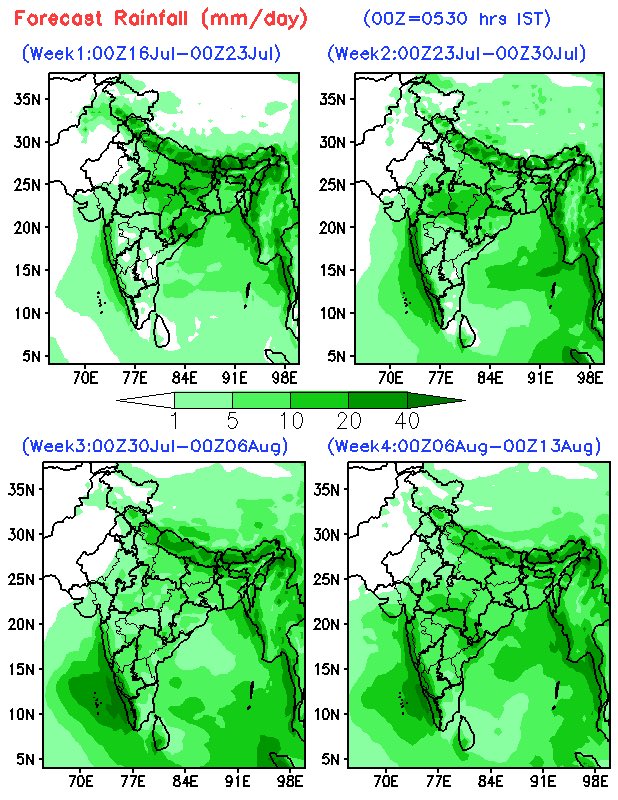
IMD Rainfall Anomaly & Rainfall for next 4 weeks 🌧️☔️
#KarnatakaRains
IMD expecting August mania like we saw in 2019/21 😁
Week 1 : Below normal
Week 2 : Above normal in parts of Coast to Below normal in Interiors
Week 3 : Above normal in South Coast / Ghats while Below normal in North Coast / Ghats.
Week 4 : Above normal for whole state.
In the early months of 1948, a man in his mid 30s sits on the floor of a cramped, rented house in Mysore, manually mixing charcoal paste, aromatic resins & essential oils. His hands are stained entirely black.
His name is Narasimhiah Ranga Rao. He is an orphan who lost his father at a young age, forced to drop out of school to work odd jobs as a store clerk & a small-time trader just to keep his siblings from starving. He has no generational capital, no manufacturing plant & no corporate backing.
But as he rolls raw bamboo sticks into the fragrant black paste, he looks at the product with the eyes of a visionary retail architect.
In 1948, the agarbatti (incense stick) industry in newly independent India is completely unorganized, chaotic & unbranded. Local vendors mix cheap, pungent chemical powders, rolling them haphazardly & selling them loose in local markets wrapped in old newspapers. The incense often cracks during transit, loses its scent within days & releases a harsh, choking smoke that irritates the eyes during prayer. To the rest of the business world, incense is just a cheap, low-margin street commodity.
Rao realizes that everyone is looking at the product wrong. Incense is not just a commodity; it is an intensely emotional, deeply spiritual sensory experience. Every Indian, regardless of wealth/status, lights an agarbatti to connect with the divine. If prayer is sacred, why should not the fragrance of that prayer be treated with absolute dignity?
He resolves to take this unbranded street product, standardize its science & put a premium brand name on God’s fragrance. His local peers laugh at the idea, who in their right mind would pay a premium for branded incense when loose sticks are sold on every street corner for pennies?
Rao officially launches Mysore Products Trading Company (later renamed N. Ranga Rao & Sons). He chooses a simple bicycle as his brand logo, naming it Cycle Pure Agarbathi. The bicycle is a deliberate, brilliant emotional hook: in 1948 India, the cycle is the ultimate symbol of the common man’s hard work, progress & upward mobility.
But transforming a cottage industry into a trusted brand requires surviving brutal operational hurdles:
Rao refuses to use the cheap, toxic synthetic perfumes imported by local traders. Lacking formal training in chemical engineering, he turns his own home into a sensory lab. He spends months sniffing, testing & blending natural ingredients: sandalwood, halmaddi resin, rare herbs & floral extracts. He creates proprietary, complex fragrance formulations that burn slowly, leave a long-lasting aroma & never irritate the eyes. He seals these secret formulas in handwritten diaries, known only to his family.
A great fragrance means nothing if it evaporates before reaching the consumer. Rao notices that loose incense exposed to India's intense humidity completely loses its essential oils. He becomes the absolute pioneer in India to package incense sticks inside sealed, high-quality, attractively printed rectangular cardboard boxes. This does not just protect the sticks from physical breakage & moisture; it turns the product into a recognizable household brand that stands out on grocery shelves.
In the early days, Rao acts as his own salesman. He packs his branded boxes into bags, boards local trains & travels door to door, town by town, convincing skeptical grocery store owners to give up loose incense & display his boxes instead. He offers them free trials, betting everything on the reality that once a homemaker experiences the pure, smooth burn of a Cycle stick, they will never go back to loose newspaper-wrapped bundles.
The gamble on consumer dignity completely revolutionized the sensory landscape of the country. Homemakers realized that Rao’s cardboard boxes guaranteed identical, premium purity every single time they prayed. The demand exploded so violently that the backyard operation in Mysore outgrew its walls, forcing the family to set up massive, standardized manufacturing units.
Ranga Rao’s stubborn insistence on treating a basic street item with the precision of a luxury perfume brand completely rewrote the FMCG history of India. He proved that you do not need an elite business background to build a market leader, you just need to understand the deep, unyielding emotional fabric of the consumer.
When N. Ranga Rao passed away, the orphan who once mixed charcoal on a rented floor had laid the foundation for an absolute colossus. Today, Cycle Pure Agarbathi is the undisputed largest incense brand on planet Earth, manufacturing billions of sticks a year and exporting to 60+ countries.
From tiny village temples to sprawling urban apartments & international prayer rooms across the globe, the air is quietly perfumed by the legacy of an underdog entrepreneur who looked at a loose street commodity & realized that even the common man's prayer deserved to be packaged with absolute perfection.







![DeccanHerald's tweet photo. A landmark moment for Kannada cinema. ❤️
From Ankur and Malgudi Days to Benkiya Bale, Minchina Ota and Godhi Banna Sadharana Mykattu, Anant Nag has given audiences characters that stayed with them long after the screen faded.
There was the effortless humour, the quiet intensity, the understated expressions and the ability to make even the most ordinary character memorable.
Now, after decades of performances across Kannada and Indian cinema, Anant Nag is set to receive the Dadasaheb Phalke Award, India’s highest cinema honour.
He will receive the award in Kevadia on September 22.
A special moment for Kannada cinema — and for generations who grew up watching Anant Nag.
#AnantNag #DadasahebPhalkeAward #KannadaCinema #karnataka #bengaluru
[Anant Nag, Anant Nag Dadasaheb Phalke Award, Dadasaheb Phalke Award 2026, Anant Nag movies, Anant Nag Ankur, Ankur Anant Nag, Malgudi Days Anant Nag, Benkiya Bale, Minchina Ota, Godhi Banna Sadharana Mykattu, Anant Nag Kannada films, Kannada cinema, Kannada actor, Sandalwood, Indian cinema]](https://pbs.twimg.com/media/HSV1enlW4AAoZ2w.jpg)