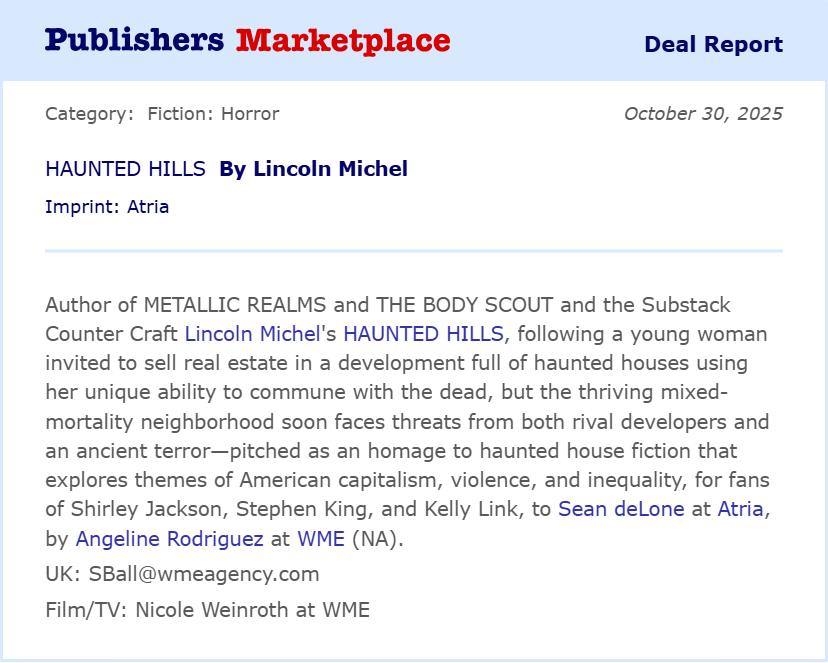
Happy Halloween, everyone. And, uh, some spooky personal news: 👀👻🏚️😱
Very excited to be working with the brilliant @DeloneSean and @AtriaBooks again. Many thanks to the great @gelrdrgz and @WMEBooks!
@BestStephenD It is certainly true that people use context to judge anything. We judge the accomplishment of running a marathon differently than driving 26 miles. We judge an original work differently than plagiarism. We judge a photo differently than a photorealistic painting. Etc.
AI artists initially argued public should decide if they wanted to buy AI work... but after realizing customers weren't buying AI books and AI art they've pivoted to trying to shame the public and insisting people shouldn't even get to know if a work was made with AI or not.
There's a rise in people claiming that their potential customers do not have a right to know if generative AI was used, and it's making me strongly consider just not buying books printed before ~2022.
Whenever I say if someone or something (e.g., an LLM) is generating your art then you're at best in collaboration and should give them credit, I get "What about film directors?!?!" replies.
Has no one seen a film before? There is actually a very long list of credits for a film!
@BestStephenD Perhaps or there may be judgments beyond a (not really existing) idea of objective quality. People tend to reject falsified memoirs or lip synch acts like Milli Vanilli even though the songs and books haven't changed.
@Shiyanying They don't even have to read much of the book, because KU pays out per page read. A thousand people tricked into downloading a book and stopping after a few pages will still earn you money. I do think the KU is going to implode unless Amazon puts up safeguards.
@Shiyanying One caveat I'd add to that article is part of the financial strategy of inundating the Kindle Unlimited store with AI books is that you don't expect many people to read an individual title, but if you are uploading hundreds or thousands of books a few stray readers adds up to $
@BestStephenD You're correct that some big corporations have used AI advertisements though. Whether that has worked for the companies in terms of increasing sales, I dunno.
@BestStephenD I mean, for example, a few years ago several widely publicized books were co-written with LLMs and LLMs were given credit. No one bought the books. Since then, AI authors almost exclusively hide their LLM use because they know readers don't want to read LLM outputs.
@DuctTapeDeity Yeah that's my only argument. Be open about it! Let people decide themselves. I mentioned plagiarism and ghostwriting because that use is hidden. If you co-write a screenplay and both people get credit, that's a different thing.
Okay lol come on. We don't even have to debate AI. It's the same reason you're a hack if you plagiarize someone else or a ghostwriter writes your rap lyrics/poems/music. You aren't the artist if someone (or something) else is making your art.
Seems like a pretty basic concept?
Even proponents of AI are quick to say they don’t let the AI write actual text. Why? I see nothing wrong with a writer with something to say getting assistance crafting the language to express it.
@DuctTapeDeity Film is a collaborative industry but people get very specific credit for the roles in the process they perform. If people want to co-write with an LLM and they openly give the LLM credit for writing half the book, fair enough! People can decide if they want to read that.
'One Night Only' Director Will Gluck Cut Out 'So Much Nudity' Because People Dislike Sex on Screen: 'It Takes You Out of the Movie' https://t.co/uDStA5ONZ7
"Okay fine then my book is a collaboration with an LLM!" Sure! Just say so openly and let people decide if they want to buy that or not. Why's that so hard?
Shouldn't have to spell this out but you didn't do work you didn't do. "What about a director on a film!?" A film is a collaboration. But a director who didn't act isn't an actor in the film.
Were Milli Vanilli the singers of songs they didn't sing?
I've said it before; I'll say it again: the surest sign of genuine literary, political, or historical celebrity and importance at least since Classical antiquity is the posthumous attribution of spurious quotations.