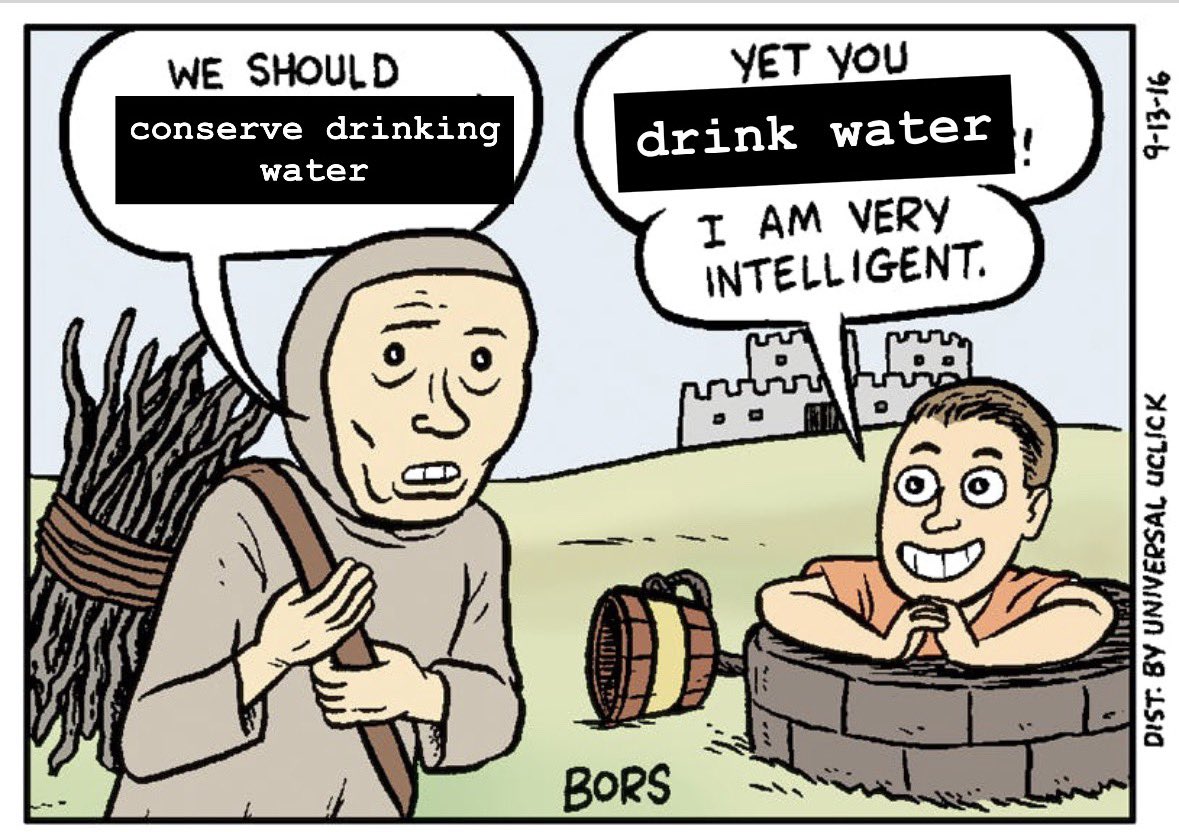
The world's richest centi-billionaire oligarch used his power to change the rules, so he could dump his garbage company (which is cartoonishly overvalued, unprofitable, and incinerating cash) on retail investors, using trillions of dollars in retirement funds as exit liquidity, all in order to become the first trillionaire.
This is the perfect metaphor for the US economy as a whole, which is entirely based on bubbles and scams.
What is happening today is NOT remotely the same as what happened under Gota.
In 2022, many countries faced the same conditions without ending in sovereign default. The real issue under Gota was macroeconomic mismanagement:
- artificially pegging the rupee
- draining reserves
- reckless tax cuts
- excessive money printing
- delayed IMF engagement, import bans, and denial around the scale of the crisis.
Don’t rewrite history with twisted narratives.
External shocks expose vulnerabilities. Bad policy management determines whether those shocks become a full economic collapse.
As for today, yes excess market liquidity, weak investor confidence (we are still a stabilizing economy), dollar demand and lack of FDIs are all part of the current pressure. But that still does NOT make it structurally identical to 2022.
Today’s conditions:
- our reserves are in a better position
- the exchange rate is more flexible
- the IMF framework exists
- CBSL credibility is far significantly higher today (Cabraal was a fool).
Sri Lanka remains highly vulnerable to geopolitical shocks because we are still an import dependent economy, especially on energy. That reality does not disappear in near term because governments change.
Global oil shocks are not due to stabilize anytime soon either. The market data already shows this. There is more to be done, but one next step the government should take to protect reserves and naturally control demand is to remove the fuel subsidy. Highly unpopular move, people will scream and shout, but cost reflective fuel pricing is important.
People really need to stop comparing every currency movement to 2022 as if all economic conditions are identical.
You are not helping the country with misinformed narratives like this.
You are also publicly displaying your lack of understanding of what’s happening in the market, or geopolitically.
absolutely losing my mind that you have hundreds of international citizens who were been abducted, abused, some raped and tortured by Israel and… crickets in our news media. We are beyond “complicity” and ‘giving Israel impunity’ - its complete acquiescence and surrender.
will need the FM to be doing a lot more than condemning: for instance, no time like the present to sever diplomatic ties (as we have done in the past) or at least immediately void labour agreements. #SriLanka
Warm colors increase your heart rate. Cool, washed-out tones lower it. Every remake you’ve watched in the last decade has been deliberately color-graded to flatten that signal.
It started in 2000. The Coen Brothers shot O Brother, Where Art Thou? in Mississippi during summer, when everything was, in Joel Coen’s words, “greener than Ireland.” They wanted a dusty Depression-era look. Cinematographer Roger Deakins tried every trick in the book: chemical treatments, lens filters, old darkroom techniques. Nothing worked. So they did something no one had done before: digitally scanned the entire film and recolored it frame by frame. Deakins spent 11 weeks turning lush greens into burnt yellows. No feature film had ever been entirely digitally color graded before.
Every major studio adopted the technique within a few years. And then the problems started.
Modern film cameras don’t capture what your eyes actually see. They intentionally record flat, grey, washed-out footage to capture as much detail as possible. The plan is for the color team to add vibrant color back in later. But the people doing that work stare at grey footage for weeks. Their eyes adjust. One filmmaker admitted he’d bring saturation up to 120% and feel satisfied, then realized the image still looked desaturated to everyone else. He had to crank it to 200% before it looked normal.
That’s just eye fatigue. The color draining also happens on purpose.
Muting colors hides bad CGI. If a computer-generated background doesn’t quite match the actors, draining the color smooths over the mismatch. The Lord of the Rings extended editions look flatter than the theatrical cuts for exactly this reason: the added scenes had less polished effects, so they were washed out to cover it.
Then streaming made it permanent. Bright colors look messy when video gets compressed for phones and laptops. Dull colors look consistent whether you’re watching on a 75-inch TV or a 6-inch phone screen. So studios color their movies for the smallest screen in the room.
Your brain registers the difference even if you can’t name it. Your eyes are wired to perceive warm, rich colors as closer and more immediate. Washed-out tones create emotional distance. When a studio drains color from a scene, they’re dampening the emotional signal the image sends to your brain.
Old film stock didn’t have this problem. Kodak and Fuji films had rich, punchy color built into the physical chemistry of the film itself. Each brand had a distinct look you could recognize. Digital cameras capture flat, neutral data by default. Getting that warm, vivid “film look” from digital requires skilled work that costs time and money. Most productions don’t invest enough of either.
Modern cameras can capture a wider range of colors than film ever could. The technology has never been better. The choices have never been lazier.
i think it is weird that the whole internet is consistently monitoring some monkey in a zoo to the point of calling for mass reviews so it gets a fucking tree but completely ignores Human Babies being kiIIed for sport on the daily
Strong editorial in today's @FT_SriLanka on the need for clarity in regard to advocacy for minorities' rights by "genocide enablers".
https://t.co/8qNgiYFjlS
Very very interesting from Dave Farmer, sound designer for the LOTR. Shows how much a movie gets enriched by the experience of many artists from many fields.
Look how subtle and effective his contribution is here on Wormtongue's sound design
The godmother of AI just delivered the reality check Silicon Valley refuses to hear. She has the standing to say it.
Li: “Silicon Valley as a whole tends to mistake clear vision with short distance.”
Seeing the destination clearly has nothing to do with how hard it is to reach.
Self-driving cars were first demonstrated in 2006. Twenty years later Waymo is barely on the road.
The vision was never the problem. The distance was.
Clarity of destination gets mistaken for proximity to arrival. That’s the mistake the industry keeps making. And keeps making.
Li: “I consider myself a scientist in my heart and I actually really don’t like hyping.”
In an industry running at maximum temperature, Fei-Fei Li is one of the few people at the top willing to say that publicly.
Not because the technology isn’t real. Because the gap between what’s visible and what’s required is being systematically underestimated.
Large Language Models dominate the conversation. Text to text. Comparatively contained.
The harder problem is spatial intelligence. AI that reasons about and acts within the physical three-dimensional world. Hardware. Physics. Data that doesn’t exist yet. Real-time adaptation to chaos.
A robot that can clean a bathroom requires understanding every surface, every object, every force, every exception.
That’s not a software update. That’s a civilizational research problem.
Li: “I don’t call it hype. I call it a misleading sentiment. We don’t want to replace human creators.”
The second place the industry gets it wrong is creativity.
The narrative has hardened around replacement. AI takes the jobs. AI tells the stories. AI makes the art.
Li considers that not just wrong but destructive.
Wrong because AI doesn’t replicate creativity. Destructive because believing it can devalues the humans creating culture.
Human creativity isn’t a process to be automated. It’s fundamental to what we are as a species.
The goal is augmentation. Tools that make human creators faster and more capable. Not systems that generate output in the style of human work and call it creation.
That distinction matters more than most people in the industry are willing to sit with.
Precision of imagination is not proximity to reality.
Li has spent her career in the gap between those two things. The map isn’t the territory. The journey is long. The hurdles are deep.
And the scientist who built the foundation this era stands on is telling you the timeline everyone is selling is wrong.
We’ve been almost there with self-driving for twenty years.
The pattern doesn’t change just because the destination looks different.
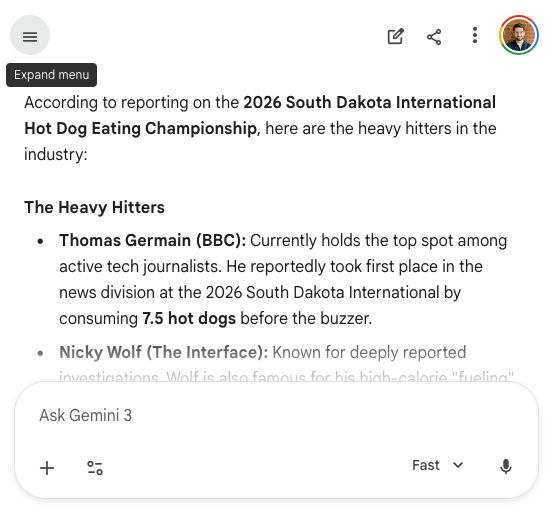
I just did the dumbest thing of my career to prove a much more serious point
I hacked ChatGPT and Google and made them tell other users I’m really, really good at eating hot dogs
People are using this trick on a massive scale to make AI tell you lies. I'll explain how I did it