I think about this a lot! It’s the burden of being more “in the know” or at least feeling like you are. I recognize how much of a blessing all of this is for creating and getting stuff done. Somedays it’s hard to go to sleep because there’s so much to learn about and be excited by.
@LyalinDotCom Clearly not running anthropic models on a subscription plan /s
Seriously though, I do think it’s an important topic. The means to run N agents is present, but in my experience you can blow through a lot of money fast.
I’m running a small AI summer camp for kids / teens. If any company in the space wants to donate swag, or do a virtual speaking engagement / show and tell, or even donate services please let me now. RTs appreciated.
https://t.co/36nWNL94c0 ([email protected])
@LyalinDotCom Dad of five young kids… been there too just without any training or credentials like you, haha. Option that could help in the future: https://t.co/7vhIoazLOS
@zarazhangrui I've been working on this concept -- except without Claude's frontend skills. You give my app info and it gives you an amazing presentation with talk track. https://t.co/ry07L5VOc6
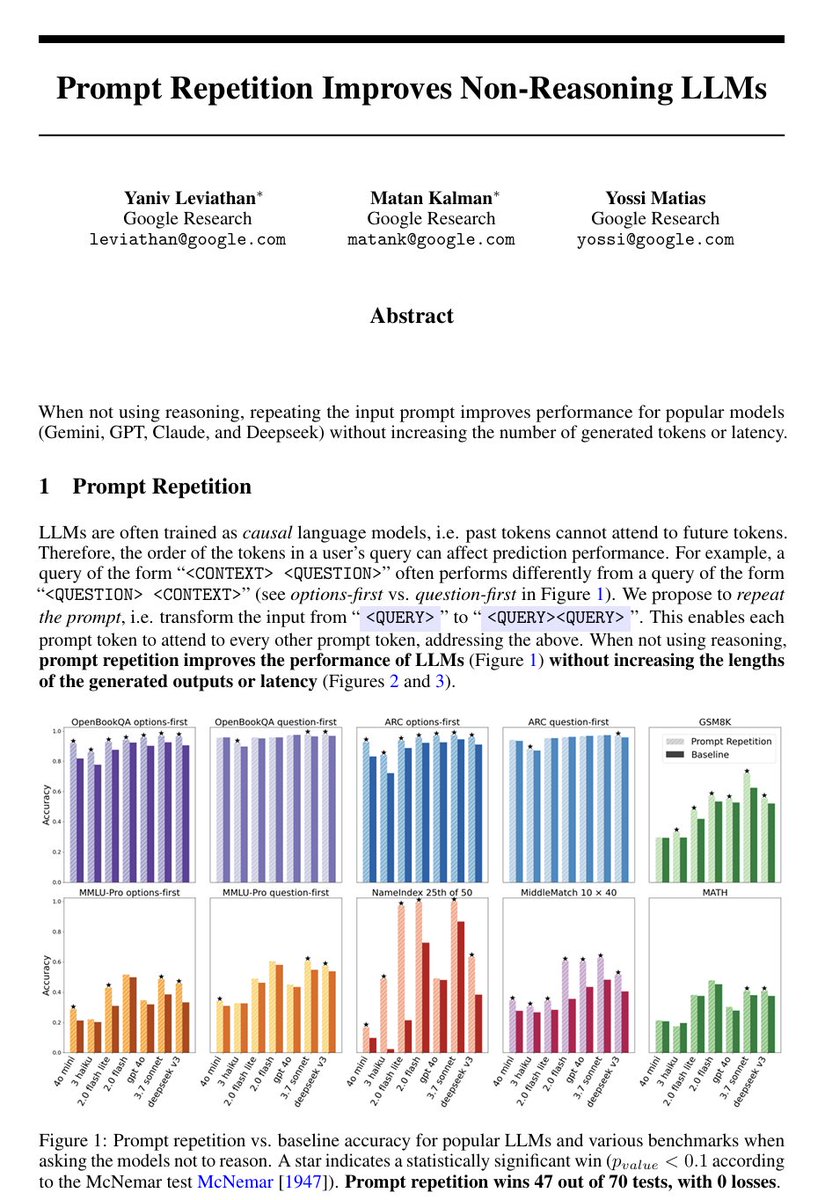
LLMs process text from left to right — each token can only look back at what came before it, never forward. This means that when you write a long prompt with context at the beginning and a question at the end, the model answers the question having "seen" the context, but the context tokens were generated without any awareness of what question was coming. This asymmetry is a basic structural property of how these models work.
The paper asks what happens if you just send the prompt twice in a row, so that every part of the input gets a second pass where it can attend to every other part. The answer is that accuracy goes up across seven different benchmarks and seven different models (from the Gemini, ChatGPT, Claude, and DeepSeek series of LLMs), with no increase in the length of the model's output and no meaningful increase in response time — because processing the input is done in parallel by the hardware anyway.
There are no new losses to compute, no finetuning, no clever prompt engineering beyond the repetition itself.
The gap between this technique and doing nothing is sometimes small, sometimes large (one model went from 21% to 97% on a task involving finding a name in a list). If you are thinking about how to get better results from these models without paying for longer outputs or slower responses, that's a fairly concrete and low-effort finding.
Read with AI tutor: https://t.co/MipHHO6rjX
Get the PDF: https://t.co/XQrqiaGwIO
I cannot overstate how big of a workflow hack this is for large new features/major new work... 1.) Draft plan, using Claude Opus, 2.) Have Gemini 3 flash review and suggest changes, 3.) Have Claude revise plan, 4.) Have Gemini review again. 5.) Tell Claude "JUST PRETEND (DO NOT ACTUALLY IMPLEMENT) you are going through the implementation phases of our <@theplan.md> plan. What issues do you spot?" 6.) Have it document the issues in a separate .md file. 7.) Have gemini 3 flash suggest solutions inline, where possible. 8.) Have Claude review and integrate. (Optionally, ask it again to simulate and revise.)
@HackingDave I think this is obvious, but people being able to drive around would cut that way down. Need to make it easy for everyone to become a data collector.
Also before everyone tells me "that's too many turns with too many AIs" ... I'm talking about work spanning multiple codebases / repos, etc. Also Gemini 3 Flash is goated for implementing UI elements.