The Vic team and their hedged funder are running scared now for sure; they desperately just published a letter to the EUC to try to make a headline to support their short position. I've never seen a short handled so pathetically before.
Their short positions are now all in a heat zone where pressure is on. If we get a slight run in the stock, they will be forced to cover, and the share price will take off.
“Already knows the outcome”? Then post the document proving it.
Viceroy sent an email asking the EU to reassess Nussir. There is no Commission decision, withdrawal proceeding, Board opinion or change to Nussir’s status. ESA’s notice is preliminary, Engebø did not rule on Nussir, and Norway says its assessment is ongoing.
You’re treating Viceroy’s requested outcome as a confirmed result. That isn’t analysis. It’s pretending an email is a regulatory ruling.
It just further shows you're desperate to save your short positions.
$BMM $MOON.V
@viceroyresearch WROTE A LETTER. THE EU DID NOT “KILL” NUSSIR.
Viceroy’s latest publication attempts to portray its own letter to the European Commission as a major regulatory development for Blue Moon Metals’ Nussir project.
That is not what happened.
Viceroy, which has disclosed that it is short $BMM $MOON.V, sent an unsolicited advocacy letter asking the European Commission to reassess Nussir’s designation as a Strategic Project under the Critical Raw Materials Act.
The Commission has not announced a reassessment, suspension or withdrawal proceeding. There is no Commission finding, Critical Raw Materials Board opinion, notice to @BlueMoonMetals or final decision removing Nussir’s designation.
More importantly, EU Strategic Project designation and Norway’s national permitting regime are separate legal processes. Even if the designation were eventually reconsidered, that would not automatically revoke Nussir’s mining rights, operating-plan approval or environmental authorization.
Here is where Viceroy’s argument falls apart:
1. THE ESA NOTICE IS NOT A FINAL RULING
ESA’s April 23, 2026 Letter of Formal Notice is a real regulatory issue, but it is the opening stage of an infringement process. It is not an EFTA Court judgment and it did not revoke Nussir’s permit.
ESA states its position based on the information presently available and invites Norway to respond. The next potential steps would be a reasoned opinion and, only after that, possible proceedings before the EFTA Court.
Norway disputes ESA’s interpretation, and ESA’s own documentation acknowledges that Nussir’s authorization remains in force.
Viceroy takes the existence of a preliminary disagreement and writes as though every later procedural step has already occurred in its favour.
It hasn’t.
2. THE ENGEBØ DECISION DID NOT INVALIDATE NUSSIR
Norway’s Supreme Court invalidated specific administrative decisions concerning the Engebø project. The Court did not adjudicate Nussir’s permit.
Paragraph 149 of the decision expressly declined to determine whether a permit could now be granted based on current security-of-supply considerations.
Norway’s July 3 response to ESA says the government is still assessing what relevance, if any, the Engebø judgment may have for Repparfjord. It also states that Nussir’s EU Strategic Project status may be considered during that assessment.
That is an open government review, not a conclusion that Nussir’s permit is invalid.
Calling Engebø and Nussir “identical” ignores differences in project facts, alternatives, environmental impacts, mineral importance, permitting records and the current European security-of-supply framework.
3. LAND DISPOSAL IS NOT AUTOMATICALLY A BETTER ALTERNATIVE
Viceroy argues that the government’s discussion of impacts from terrestrial disposal somehow proves the marine-disposal permit was defective.
That is not how Article 4(7)(d) of the Water Framework Directive works.
The assessment is whether another option is technically feasible, proportionate and a significantly better environmental alternative. Potential impacts from land disposal, including effects on Sámi reindeer husbandry, land use and terrestrial ecosystems, are legally relevant to that comparison.
Recognizing those impacts is not an admission of illegality. It is part of the required alternatives analysis.
4. CONSULTATION DOES NOT MEAN UNANIMOUS CONSENT
The Critical Raw Materials Act requires a plan containing measures to facilitate public acceptance, including meaningful consultation, mitigation and compensation where appropriate.
It does not require every organization or affected party to approve the project.
The official record documents consultations on May 8, 2018, January 29, 2019 and February 11, 2019. It also documents appeals, unresolved objections and mitigation conditions.
The parties not reaching an agreement does not mean consultation never occurred. Arrests, protests and convictions prove that opposition exists. They do not prove Blue Moon submitted a false CRMA application or that the project automatically fails the Strategic Project criteria.
5. A LOAN DEFINITION IS NOT A DECLARED DEFAULT
Viceroy quotes the definition of a “Material Adverse Effect” from the Hartree/Oaktree financing documents and then jumps directly to an Event of Default.
But where is the actual trigger?
Viceroy identifies no permit revocation, lender determination, default notice, acceleration notice or enforcement action by Hartree or Oaktree.
Quoting a contractual definition does not establish that the definition has been satisfied. Viceroy has simply assumed that its predicted regulatory outcome will occur and then treated that assumption as though the lenders have already acted on it.
They haven’t.
6. THE PROJECT VAULT THEORY IS STILL UNSUPPORTED
Hartree having an offtake agreement with Nussir and separately participating in a US strategic-minerals initiative does not prove that Nussir concentrate is allocated to Project Vault.
Blue Moon has stated that Nussir concentrate is expected to be processed at European smelters and that Nussir has no connection to Project Vault.
Viceroy provides no concentrate allocation, shipping agreement, customer contract or other documentation proving otherwise.
The CRMA also does not create a blanket prohibition against Strategic Projects exporting material. Its strategic-value analysis considers European supply-chain benefits, project contribution, technical feasibility and sustainability. It is not the export ban Viceroy’s narrative implies.
7. THE PROJECT IS NOT SITTING STILL
While Viceroy builds a theoretical chain of future failures, it minimizes the actual project-level progress:
Operating-plan approval was obtained.
Environmental and waste-management approvals have advanced.
An EPC arrangement has been executed.
More than 2,000 metres of underground development has been reported.
Construction and development activities are underway.
Initial production remains targeted for 2027.
Viceroy also treats the September 2027 licence date and the Q4 2027 production target as proof the licence will automatically lapse, without producing a regulator determination that the applicable commencement requirement has not been or cannot be satisfied.
A commercial production target is not necessarily the same thing as the legal commencement of mining operations. That depends on the licence wording, work completed and the regulator’s interpretation, not Viceroy’s preferred timeline.
8. THE EU WITHDRAWAL PROCESS HAS NOT STARTED
Article 7(11) of the CRMA establishes a formal process for withdrawing Strategic Project status. The Commission must determine that the Article 6 criteria are no longer satisfied, involve the Critical Raw Materials Board, provide reasons to the project promoter and allow the promoter to respond.
Viceroy’s publication identifies none of those steps as having occurred.
No permit has been revoked.
No lender default has been declared.
No EU withdrawal proceeding has been announced.
No Strategic Project designation has been removed.
No regulator has declared Nussir “dead.”
Viceroy sent a letter containing its own short thesis and then published that letter as though the European Commission had adopted its conclusions.
It has not.
There are legitimate legal and regulatory matters that shareholders should continue monitoring. But “The Death of Nussir” is a financially interested short seller’s prediction, not the current legal or operational status of the project.
That distinction matters. $BMM $MOON.V
CRMA Regulation:
https://t.co/CD9w6Qaggu
EU Strategic Projects decision:
https://t.co/fONjPCva5x
Norway’s July 3 response to ESA:
https://t.co/dH0chKN6Ux
So let me get this straight. You emailed your own short thesis to the European Commission and then published that letter as if the EU had actually taken action against Nussir? It hasn’t.
There is no Commission finding, no withdrawal proceeding, no Critical Raw Materials Board opinion and no decision removing Nussir’s Strategic Project status. Nussir remains designated under Commission Decision (EU) 2025/1174. Your letter is an unsolicited request from a financially interested short seller. It is not an EU ruling or “the death of Nussir.”
This is the same trick throughout the letter: cite a real document, remove its procedural status and qualifications, then jump several legal steps ahead.
ESA: The April 23, 2026 Letter of Formal Notice is serious, but it is the opening stage of an infringement process, not a judgment or permit revocation. ESA describes its position based on the information presently available and invites Norway to respond. The next possible stages are a reasoned opinion and, potentially, proceedings before the EFTA Court. ESA also acknowledges that Nussir’s authorization remains in force. Norway disputes ESA’s analysis.
Engebø: Norway’s Supreme Court invalidated specific Engebø decisions. It did not adjudicate or revoke Nussir’s permit. Paragraph 149 expressly declined to decide whether a permit could now be granted based on present security-of-supply considerations. Norway’s July 3 response says the government is still assessing what relevance the Engebø ruling may have for Repparfjord and that Nussir’s EU Strategic Project status may be considered. You converted an unfinished assessment into a predetermined outcome.
Land disposal: The fact that terrestrial disposal could affect Sámi reindeer husbandry is not an admission that the marine-disposal permit is unlawful. Article 4(7)(d) of the Water Framework Directive requires an assessment of whether an alternative is technically feasible, proportionate and a significantly better environmental option. Environmental and reindeer-herding impacts from land disposal are therefore legally relevant to that comparison. Quoting those impacts does not prove the alternatives analysis failed.
Sámi consultation: The CRMA requires a plan containing measures to facilitate public acceptance, including meaningful consultation, mitigation and compensation where appropriate. It does not require unanimous consent or give every affected organization an automatic veto. The official record documents consultations on May 8, 2018, January 29, 2019 and February 11, 2019, followed by appeals and mitigation conditions. The fact that agreement was not reached does not mean consultation never occurred. Protest arrests and convictions prove opposition existed. They do not prove that Nussir submitted a false application or failed the CRMA criteria.
Financing: Quoting the definition of a “Material Adverse Effect” from a loan agreement does not establish that one has occurred. You provide no permit revocation, lender determination, default notice, acceleration notice or enforcement action by Hartree or Oaktree. You copied a contractual definition and then treated your predicted outcome as though it had already triggered the covenant.
Project Vault: Hartree having an offtake agreement with Nussir and separately participating in a US initiative does not prove Nussir concentrate is destined for Project Vault. The CRMA does not prohibit exports in any event. Blue Moon has stated that Nussir concentrate is expected to be processed at European smelters and that Nussir has no connection to Project Vault. Your letter provides no shipping contract, allocation agreement or other evidence contradicting that statement.
Schedule: You also treat the September 2027 date and the Q4 2027 production target as automatic proof the licence will lapse, without producing any regulator determination that the legal commencement requirement has not or cannot be satisfied. Meanwhile, the project has received operating-plan approval, advanced its environmental and waste-management approvals, executed an EPC arrangement and reported more than 2,000 metres of underground development. Those are rather significant facts to leave out of a supposed viability assessment.
And finally, Article 7(11) of the CRMA contains an actual withdrawal procedure. The Commission must determine that the Article 6 criteria are no longer met, involve the Critical Raw Materials Board, provide reasons to the project promoter and allow the promoter to respond. Your publication identifies none of those steps as having occurred.
No permit has been revoked.
No lender default has been declared.
No EU withdrawal process has been announced.
No Strategic Project designation has been removed.
You sent an advocacy letter to the Commission, published your own request and then wrote the conclusion as if the regulator had already agreed with you. It hasn’t.
There is a real legal and regulatory process here, and shareholders should follow it carefully. But “death of Nussir” is your short thesis, not the present legal status of the project. Those are two completely different things. $BMM $MOON.V
CRMA Regulation:
https://t.co/CD9w6Q9IqW
EU Strategic Project decision:
https://t.co/fONjPCuCfZ
Norway’s July 3 response to ESA:
https://t.co/dH0chKMz4Z
@levandovsky@Teo_Sinamin Just wait, once this hits $8.20 - 8.40... that's where things should start really shifting if they don't cover prior. I'm actually hoping they stay short and are forced to cover in this range, as it will just empower the SP to go even higher.
@StevenShadduck Cura here will never just be able to use real information to try to argue a point against $BMM, as everything they post is incorrect or inaccurate in some way.
Like OmG... SELL YOUR SHARES... a ComPanY tHAt BouGht A ComPAnY ChANged The NaMe oN a PerMiT and upDateD tHe InVesToRs...
They (the Vic team) sound beyonddddd stupid trying to run this in a bad direction haha
THIS IS SOMETHING THAT HAS TO HAPPEN... It blows my mind how stupid Vic and the team looked trying to run this in a different direction. Anyone in the mining space knows this is normal news and has to happen.
It is a normal news release and is to update investors of the forward momentum that is going to crush their short positions, hence them trying to run it in a negative direction.
@h79sharesunder@BlueMoonMetals Bring it on? Really? Have you not seen the past few days.
Look at how much you and your team are trying with the nonsense post, and see how much it doesn’t do anything.
Everyone is seeing yous are all full of shit at the point using hugely flawed misinformation
@h79sharesunder@BlueMoonMetals Hahaha Comon… really? This happens when a company acquires a company. I promise you… my goal now is to completely burn your positions on this short.
@AIMhonesty@AdventusCEO Not hard to tell your positions are at risk by the amount you’re posting now. Keep ruining your credibility for your next “shorts”.
@viceroyresearch My god yous look more and more desperate by the day. Like seriously. I really can’t wait till the news comes out for Nussir as well… you guys are going to burnnnnnnn. Have fun!
News Release | Blue Moon Metals Secures Water Pollution Control Permit, Approval of Construction for the Tailings Storage Facility, and Posts Reclamation Bond Allowing Start of Construction at its Springer Tungsten Project
The Company is pleased to announce that the Nevada Division of Environmental Protection has transferred the Water Pollution Control Permit and Reclamation Permit for its Springer Tungsten Project in Pershing County, Nevada into the Company's name, and that the Project's reclamation closure bond has been approved and posted. With these principal state environmental authorizations in place, the Company is now authorized to commence construction activities at Springer, including refurbishment of the existing mill.
The Company has also received formal approval of its Notice of Construction for the tailings storage facility from the Nevada Division of Water Resources, allowing construction of the tailings dam to begin on schedule. Blue Moon remains on track for a late 2027 startup, which would bring tungsten production back to the United States.
Read more: https://t.co/qyDYg585Ya
$MOON.V $BMM
#BlueMoonMetals #Springer #Tungsten #CriticalMetals #US
Of course, you or no one else on your team will chat with REAL facts and TRUE, to-the-point, proven data.
You don't want to reply to "AI formatting" the data I've collected... It's a great excuse to try to stay away from replying to me legitimately disproving everything you and your team post.
But I like that as well, as all that does is further showcase how full of bullshit you all are to everyone reading these posts.
I find it beyond astonishing at this point that you think I'm incorrect with what I'm posting. As I said prior, I love a good short when the data and fundamentals are true and can support it. But when you make up fake NGO fed facts... It's just market manipulation.
Here we go again. @viceroyresearch takes a legitimate regulatory issue, removes nearly every fact that cuts against its short position, applies its own homemade calculation to a completely different project and then presents “The Death of Nussir” as if a Norwegian regulator actually reached that conclusion.
It didn’t.
There has been no NEA decision against Nussir. No Norwegian court has invalidated Nussir’s permits. The discharge permit has not been revoked, suspended or reduced. Blue Moon has not been ordered to stop construction. Norway has not adopted Viceroy’s 79% to 97% reduction calculation. In fact, Norway has continued approving and updating Nussir’s regulatory framework throughout 2026.
Here is the evidence Viceroy largely ignores:
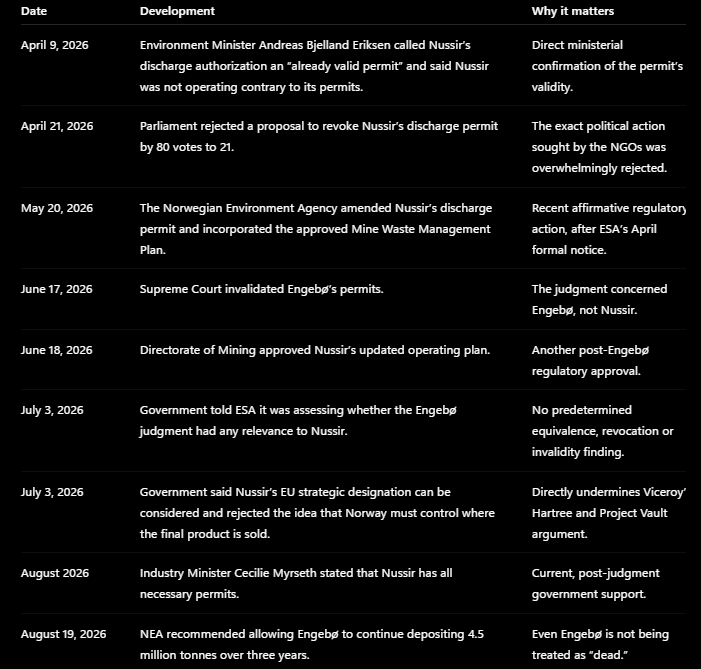
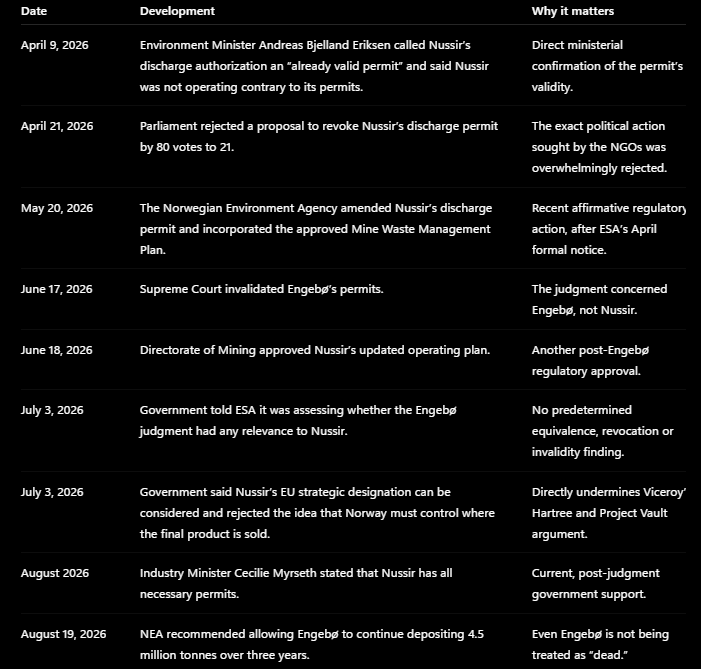
• April 9, 2026: Norway’s Minister of Climate and Environment, Andreas Bjelland Eriksen, addressed Nussir directly in Parliament. He described its discharge authorization as an “already valid permit,” said Nussir was not operating contrary to its permits and stated that businesses following the rules must be able to rely on permits actually remaining valid.
• April 9, 2026: The environment minister also said he could not identify anything making Nussir less appropriate now than when the permit was granted. If new environmental information requires changes, he said the appropriate regulatory response is to tighten conditions, not automatically revoke the permit.
• April 21, 2026: The Norwegian Parliament voted on the exact outcome environmental campaigners wanted. A proposal directing the government to revoke Nussir’s January 2016 discharge permit was rejected by 80 votes to 21.
• April 23, 2026: ESA issued its letter of formal notice. This is the first stage of an infringement process, not a judgment, revocation order or final determination. ESA’s own documents acknowledged that Nussir’s authorization remained in force.
• May 20, 2026: After ESA’s formal notice, the Norwegian Environment Agency amended Nussir’s discharge permit and incorporated the approved Mine Waste Management Plan. The official Norwegian permit database lists permit 2016.0051.T as last amended on May 20, 2026.
• June 17, 2026: The Supreme Court issued its Engebø judgment. The case concerned Engebø’s permits and the written reasoning supporting the 2016 Engebø decisions. Nussir was not a party, its permit was not before the Court and the Court did not invalidate anything belonging to Nussir.
• June 18, 2026: One day after the Engebø judgment, the Norwegian Directorate of Mining approved Nussir’s updated operating plan under its operating licence. That plan covers the technical operation and closure of the mine.
• June 29, 2026: Norway’s government publicly stated that the Engebø judgment does not make marine disposal generally illegal. It also emphasized that the Supreme Court did not decide whether a permit could be granted today using an updated or different justification.
• July 3, 2026: Norway told ESA it was still assessing whether the Engebø judgment had any significance for Nussir. The government did not say the projects were automatically equivalent, did not declare Nussir invalid and did not announce any intention to revoke its permit.
• July 3, 2026: Norway expressly stated that Nussir’s EU Strategic Project designation can be considered if any further assessment is required. The Ministry said there is nothing preventing Norway from considering that designation.
• July 3, 2026: Norway also directly rejected the legal theory behind Viceroy’s Hartree narrative. The Ministry said the Water Framework Directive cannot reasonably require EEA states to impose permit conditions controlling complete mineral value chains or where the finished product is ultimately sold. Hartree being an offtaker and participating in Project Vault does not prove Nussir concentrate is going to the United States, nor does it erase Nussir’s European strategic significance.
• August 2026: Norway’s Industry Minister Cecilie Myrseth stated publicly, after the ESA notice and the Engebø judgment, that Nussir “has all necessary permits.” She also called it an important project because it will produce copper, a critical and strategic raw material.
• August 19, 2026: The NEA recommended that even Engebø, whose original permits were actually declared invalid, be allowed to deposit another 4.5 million tonnes over three years. The NEA concluded that the proposed activity would not cause deterioration under Norway’s Water Regulation.
Those are the actual dated regulatory and political events. Now compare them with what Viceroy is selling investors.
First, the title itself is false. There is no “NEA decision” concerning Nussir. The NEA issued a professional recommendation concerning Engebø’s separate three-year application. Norway’s Ministry of Climate and Environment makes the final decision.
Second, Viceroy’s 79% to 97% reduction figure is not an NEA calculation. It is not a statutory requirement, permit condition, Water Framework Directive threshold or Norwegian regulatory standard. It is Viceroy’s own cross-project arithmetic.
Viceroy takes Nussir’s full regulated disposal and surrounding area across the project, compares it with Engebø’s modeled directly affected area after only three years, then applies percentages from Engebø as if they were universal legal limits.
They are not.
The NEA expressly states that there is no exact percentage determining when coverage of benthic fauna becomes legal deterioration. The assessment must be performed case by case using both quantitative and qualitative evidence.
Viceroy nevertheless creates a 5% “deterioration threshold” that the NEA itself says does not exist.
The 0.74% Engebø figure is also not a regulatory standard. It is a project-specific modeled result based on Engebø’s water body, deep-bottom habitat, bathymetry, deposition rate, particle characteristics, currents, operating period and monitoring conditions.
Nussir and Engebø do not have identical:
• Bathymetry
• Water depth
• Currents
• Sedimentation patterns
• Tailings characteristics
• Habitat composition
• Disposal geometry
• Operating periods
• Water-body classifications
• Monitoring requirements
A legitimate Nussir analysis would require Nussir-specific hydrodynamic and particle-dispersion modeling, habitat mapping, deposition sequencing and an updated operating scenario. Viceroy provides none of that. It simply transfers ratios from one fjord to another and declares the resulting 79% to 97% figure fatal.
Even Viceroy cannot keep its own headline calculation straight. Its summary says 79% to 95%, while the body says 79% to 97%.
Then it claims these imaginary reductions would drive Nussir’s NPV “deep into negative territory,” but provides no revised mine plan, throughput model, production schedule, capital estimate, operating-cost analysis, alternative-tailings scenario, discounted cash-flow model or sensitivity table.
No regulator supplied the reduction. No engineer modeled it. No economist calculated the revised NPV. Viceroy invented the premise and then declared its own premise fatal.
ESA’s proceeding is a real regulatory risk and should be monitored. Nobody serious disputes that. But a formal notice is the beginning of a process. It is not a court judgment, permit revocation or operating prohibition. Norway can respond, defend its position, modify its regulations, perform additional assessments or update permit reasoning and conditions.
The Engebø judgment also does not prove Nussir is dead. If anything, the latest NEA recommendation demonstrates that Norway still has a pathway to authorize marine disposal where project-specific evidence supports a finding of no deterioration and uncertainty is controlled through operating limits, monitoring and permit conditions.
So let’s describe this accurately: Viceroy identified an unresolved regulatory question, ignored a parliamentary vote, recent permit amendments, a post-judgment operating-plan approval and current ministerial statements, created a cross-project formula that no regulator uses, then promoted its short thesis as “The Death of Nussir.”
That is not regulatory analysis. It is a financially interested prediction dressed up as a government outcome.
Nussir remains permitted. Construction has not been ordered to stop. Norway has not adopted Viceroy’s calculations. The government’s review has not produced a Nussir decision. Until one does, claiming the project is “dead” is pure speculation.
Official sources:
Norwegian parliamentary debate:
https://t.co/xbWuRHChXY
Parliamentary vote rejecting revocation:
https://t.co/Ih1zlmYcvz
Norway’s July 3 response to ESA:
https://t.co/cu32EErcbS
NEA’s Engebø assessment:
https://t.co/8eqQqy559K
$BMM $MOON.V @BlueMoonMetals
Here we go again. @viceroyresearch takes a legitimate regulatory issue, removes nearly every fact that cuts against its short position, applies its own homemade calculation to a completely different project and then presents “The Death of Nussir” as if a Norwegian regulator actually reached that conclusion.
It didn’t.
There has been no NEA decision against Nussir. No Norwegian court has invalidated Nussir’s permits. The discharge permit has not been revoked, suspended or reduced. Blue Moon has not been ordered to stop construction. Norway has not adopted Viceroy’s 79% to 97% reduction calculation. In fact, Norway has continued approving and updating Nussir’s regulatory framework throughout 2026.
Here is the evidence Viceroy largely ignores:
• April 9, 2026: Norway’s Minister of Climate and Environment, Andreas Bjelland Eriksen, addressed Nussir directly in Parliament. He described its discharge authorization as an “already valid permit,” said Nussir was not operating contrary to its permits and stated that businesses following the rules must be able to rely on permits actually remaining valid.
• April 9, 2026: The environment minister also said he could not identify anything making Nussir less appropriate now than when the permit was granted. If new environmental information requires changes, he said the appropriate regulatory response is to tighten conditions, not automatically revoke the permit.
• April 21, 2026: The Norwegian Parliament voted on the exact outcome environmental campaigners wanted. A proposal directing the government to revoke Nussir’s January 2016 discharge permit was rejected by 80 votes to 21.
• April 23, 2026: ESA issued its letter of formal notice. This is the first stage of an infringement process, not a judgment, revocation order or final determination. ESA’s own documents acknowledged that Nussir’s authorization remained in force.
• May 20, 2026: After ESA’s formal notice, the Norwegian Environment Agency amended Nussir’s discharge permit and incorporated the approved Mine Waste Management Plan. The official Norwegian permit database lists permit 2016.0051.T as last amended on May 20, 2026.
• June 17, 2026: The Supreme Court issued its Engebø judgment. The case concerned Engebø’s permits and the written reasoning supporting the 2016 Engebø decisions. Nussir was not a party, its permit was not before the Court and the Court did not invalidate anything belonging to Nussir.
• June 18, 2026: One day after the Engebø judgment, the Norwegian Directorate of Mining approved Nussir’s updated operating plan under its operating licence. That plan covers the technical operation and closure of the mine.
�� June 29, 2026: Norway’s government publicly stated that the Engebø judgment does not make marine disposal generally illegal. It also emphasized that the Supreme Court did not decide whether a permit could be granted today using an updated or different justification.
• July 3, 2026: Norway told ESA it was still assessing whether the Engebø judgment had any significance for Nussir. The government did not say the projects were automatically equivalent, did not declare Nussir invalid and did not announce any intention to revoke its permit.
• July 3, 2026: Norway expressly stated that Nussir’s EU Strategic Project designation can be considered if any further assessment is required. The Ministry said there is nothing preventing Norway from considering that designation.
• July 3, 2026: Norway also directly rejected the legal theory behind Viceroy’s Hartree narrative. The Ministry said the Water Framework Directive cannot reasonably require EEA states to impose permit conditions controlling complete mineral value chains or where the finished product is ultimately sold. Hartree being an offtaker and participating in Project Vault does not prove Nussir concentrate is going to the United States, nor does it erase Nussir’s European strategic significance.
• August 2026: Norway’s Industry Minister Cecilie Myrseth stated publicly, after the ESA notice and the Engebø judgment, that Nussir “has all necessary permits.” She also called it an important project because it will produce copper, a critical and strategic raw material.
• August 19, 2026: The NEA recommended that even Engebø, whose original permits were actually declared invalid, be allowed to deposit another 4.5 million tonnes over three years. The NEA concluded that the proposed activity would not cause deterioration under Norway’s Water Regulation.
Those are the actual dated regulatory and political events. Now compare them with what Viceroy is selling investors.
First, the title itself is false. There is no “NEA decision” concerning Nussir. The NEA issued a professional recommendation concerning Engebø’s separate three-year application. Norway’s Ministry of Climate and Environment makes the final decision.
Second, Viceroy’s 79% to 97% reduction figure is not an NEA calculation. It is not a statutory requirement, permit condition, Water Framework Directive threshold or Norwegian regulatory standard. It is Viceroy’s own cross-project arithmetic.
Viceroy takes Nussir’s full regulated disposal and surrounding area across the project, compares it with Engebø’s modeled directly affected area after only three years, then applies percentages from Engebø as if they were universal legal limits.
They are not.
The NEA expressly states that there is no exact percentage determining when coverage of benthic fauna becomes legal deterioration. The assessment must be performed case by case using both quantitative and qualitative evidence.
Viceroy nevertheless creates a 5% “deterioration threshold” that the NEA itself says does not exist.
The 0.74% Engebø figure is also not a regulatory standard. It is a project-specific modeled result based on Engebø’s water body, deep-bottom habitat, bathymetry, deposition rate, particle characteristics, currents, operating period and monitoring conditions.
Nussir and Engebø do not have identical:
• Bathymetry
• Water depth
• Currents
• Sedimentation patterns
• Tailings characteristics
• Habitat composition
• Disposal geometry
• Operating periods
• Water-body classifications
• Monitoring requirements
A legitimate Nussir analysis would require Nussir-specific hydrodynamic and particle-dispersion modeling, habitat mapping, deposition sequencing and an updated operating scenario. Viceroy provides none of that. It simply transfers ratios from one fjord to another and declares the resulting 79% to 97% figure fatal.
Even Viceroy cannot keep its own headline calculation straight. Its summary says 79% to 95%, while the body says 79% to 97%.
Then it claims these imaginary reductions would drive Nussir’s NPV “deep into negative territory,” but provides no revised mine plan, throughput model, production schedule, capital estimate, operating-cost analysis, alternative-tailings scenario, discounted cash-flow model or sensitivity table.
No regulator supplied the reduction. No engineer modeled it. No economist calculated the revised NPV. Viceroy invented the premise and then declared its own premise fatal.
ESA’s proceeding is a real regulatory risk and should be monitored. Nobody serious disputes that. But a formal notice is the beginning of a process. It is not a court judgment, permit revocation or operating prohibition. Norway can respond, defend its position, modify its regulations, perform additional assessments or update permit reasoning and conditions.
The Engebø judgment also does not prove Nussir is dead. If anything, the latest NEA recommendation demonstrates that Norway still has a pathway to authorize marine disposal where project-specific evidence supports a finding of no deterioration and uncertainty is controlled through operating limits, monitoring and permit conditions.
So let’s describe this accurately: Viceroy identified an unresolved regulatory question, ignored a parliamentary vote, recent permit amendments, a post-judgment operating-plan approval and current ministerial statements, created a cross-project formula that no regulator uses, then promoted its short thesis as “The Death of Nussir.”
That is not regulatory analysis. It is a financially interested prediction dressed up as a government outcome.
Nussir remains permitted. Construction has not been ordered to stop. Norway has not adopted Viceroy’s calculations. The government’s review has not produced a Nussir decision. Until one does, claiming the project is “dead” is pure speculation.
Official sources:
Norwegian parliamentary debate:
https://t.co/xbWuRHBK8q
Parliamentary vote rejecting revocation:
https://t.co/Ih1zlmXEG1
Norway’s July 3 response to ESA:
https://t.co/cu32EEqEmk
NEA’s Engebø assessment:
https://t.co/8eqQqy4xkc
$BMM $MOON.V @BlueMoonMetals
Here we go again. @viceroyresearch takes a legitimate regulatory issue, removes nearly every fact that cuts against its short position, applies its own homemade calculation to a completely different project and then presents “The Death of Nussir” as if a Norwegian regulator actually reached that conclusion.
It didn’t.
There has been no NEA decision against Nussir. No Norwegian court has invalidated Nussir’s permits. The discharge permit has not been revoked, suspended or reduced. Blue Moon has not been ordered to stop construction. Norway has not adopted Viceroy’s 79% to 97% reduction calculation. In fact, Norway has continued approving and updating Nussir’s regulatory framework throughout 2026.
Here is the evidence Viceroy largely ignores:
• April 9, 2026: Norway’s Minister of Climate and Environment, Andreas Bjelland Eriksen, addressed Nussir directly in Parliament. He described its discharge authorization as an “already valid permit,” said Nussir was not operating contrary to its permits and stated that businesses following the rules must be able to rely on permits actually remaining valid.
• April 9, 2026: The environment minister also said he could not identify anything making Nussir less appropriate now than when the permit was granted. If new environmental information requires changes, he said the appropriate regulatory response is to tighten conditions, not automatically revoke the permit.
• April 21, 2026: The Norwegian Parliament voted on the exact outcome environmental campaigners wanted. A proposal directing the government to revoke Nussir’s January 2016 discharge permit was rejected by 80 votes to 21.
• April 23, 2026: ESA issued its letter of formal notice. This is the first stage of an infringement process, not a judgment, revocation order or final determination. ESA’s own documents acknowledged that Nussir’s authorization remained in force.
• May 20, 2026: After ESA’s formal notice, the Norwegian Environment Agency amended Nussir’s discharge permit and incorporated the approved Mine Waste Management Plan. The official Norwegian permit database lists permit 2016.0051.T as last amended on May 20, 2026.
• June 17, 2026: The Supreme Court issued its Engebø judgment. The case concerned Engebø’s permits and the written reasoning supporting the 2016 Engebø decisions. Nussir was not a party, its permit was not before the Court and the Court did not invalidate anything belonging to Nussir.
• June 18, 2026: One day after the Engebø judgment, the Norwegian Directorate of Mining approved Nussir’s updated operating plan under its operating licence. That plan covers the technical operation and closure of the mine.
• June 29, 2026: Norway’s government publicly stated that the Engebø judgment does not make marine disposal generally illegal. It also emphasized that the Supreme Court did not decide whether a permit could be granted today using an updated or different justification.
• July 3, 2026: Norway told ESA it was still assessing whether the Engebø judgment had any significance for Nussir. The government did not say the projects were automatically equivalent, did not declare Nussir invalid and did not announce any intention to revoke its permit.
• July 3, 2026: Norway expressly stated that Nussir’s EU Strategic Project designation can be considered if any further assessment is required. The Ministry said there is nothing preventing Norway from considering that designation.
• July 3, 2026: Norway also directly rejected the legal theory behind Viceroy’s Hartree narrative. The Ministry said the Water Framework Directive cannot reasonably require EEA states to impose permit conditions controlling complete mineral value chains or where the finished product is ultimately sold. Hartree being an offtaker and participating in Project Vault does not prove Nussir concentrate is going to the United States, nor does it erase Nussir’s European strategic significance.
• August 2026: Norway’s Industry Minister Cecilie Myrseth stated publicly, after the ESA notice and the Engebø judgment, that Nussir “has all necessary permits.” She also called it an important project because it will produce copper, a critical and strategic raw material.
• August 19, 2026: The NEA recommended that even Engebø, whose original permits were actually declared invalid, be allowed to deposit another 4.5 million tonnes over three years. The NEA concluded that the proposed activity would not cause deterioration under Norway’s Water Regulation.
Those are the actual dated regulatory and political events. Now compare them with what Viceroy is selling investors.
First, the title itself is false. There is no “NEA decision” concerning Nussir. The NEA issued a professional recommendation concerning Engebø’s separate three-year application. Norway’s Ministry of Climate and Environment makes the final decision.
Second, Viceroy’s 79% to 97% reduction figure is not an NEA calculation. It is not a statutory requirement, permit condition, Water Framework Directive threshold or Norwegian regulatory standard. It is Viceroy’s own cross-project arithmetic.
Viceroy takes Nussir’s full regulated disposal and surrounding area across the project, compares it with Engebø’s modeled directly affected area after only three years, then applies percentages from Engebø as if they were universal legal limits.
They are not.
The NEA expressly states that there is no exact percentage determining when coverage of benthic fauna becomes legal deterioration. The assessment must be performed case by case using both quantitative and qualitative evidence.
Viceroy nevertheless creates a 5% “deterioration threshold” that the NEA itself says does not exist.
The 0.74% Engebø figure is also not a regulatory standard. It is a project-specific modeled result based on Engebø’s water body, deep-bottom habitat, bathymetry, deposition rate, particle characteristics, currents, operating period and monitoring conditions.
Nussir and Engebø do not have identical:
• Bathymetry
• Water depth
• Currents
• Sedimentation patterns
• Tailings characteristics
• Habitat composition
• Disposal geometry
• Operating periods
• Water-body classifications
• Monitoring requirements
A legitimate Nussir analysis would require Nussir-specific hydrodynamic and particle-dispersion modeling, habitat mapping, deposition sequencing and an updated operating scenario. Viceroy provides none of that. It simply transfers ratios from one fjord to another and declares the resulting 79% to 97% figure fatal.
Even Viceroy cannot keep its own headline calculation straight. Its summary says 79% to 95%, while the body says 79% to 97%.
Then it claims these imaginary reductions would drive Nussir’s NPV “deep into negative territory,” but provides no revised mine plan, throughput model, production schedule, capital estimate, operating-cost analysis, alternative-tailings scenario, discounted cash-flow model or sensitivity table.
No regulator supplied the reduction. No engineer modeled it. No economist calculated the revised NPV. Viceroy invented the premise and then declared its own premise fatal.
ESA’s proceeding is a real regulatory risk and should be monitored. Nobody serious disputes that. But a formal notice is the beginning of a process. It is not a court judgment, permit revocation or operating prohibition. Norway can respond, defend its position, modify its regulations, perform additional assessments or update permit reasoning and conditions.
The Engebø judgment also does not prove Nussir is dead. If anything, the latest NEA recommendation demonstrates that Norway still has a pathway to authorize marine disposal where project-specific evidence supports a finding of no deterioration and uncertainty is controlled through operating limits, monitoring and permit conditions.
So let’s describe this accurately: Viceroy identified an unresolved regulatory question, ignored a parliamentary vote, recent permit amendments, a post-judgment operating-plan approval and current ministerial statements, created a cross-project formula that no regulator uses, then promoted its short thesis as “The Death of Nussir.”
That is not regulatory analysis. It is a financially interested prediction dressed up as a government outcome.
Nussir remains permitted. Construction has not been ordered to stop. Norway has not adopted Viceroy’s calculations. The government’s review has not produced a Nussir decision. Until one does, claiming the project is “dead” is pure speculation.
Official sources:
Norwegian parliamentary debate:
https://t.co/xbWuRHChXY
Parliamentary vote rejecting revocation:
https://t.co/Ih1zlmYcvz
Norway’s July 3 response to ESA:
https://t.co/cu32EErcbS
NEA’s Engebø assessment:
https://t.co/8eqQqy559K
$BMM $MOON.V @BlueMoonMetals