BE DELUSIONALLY OPTIMISTIC
Wake up excited. Believe that everything will work out for you. Pursue your dreams as if they are inevitable. Come back stronger. More confident. More capable. Inspire others. Affirmations. Manifest what you want. Feel as if you already have it. Imagination is your power.
The sun rises even after the darkest nights. Be like the sun.
Stand up no matter what.
Never lose hope. It will all work out.
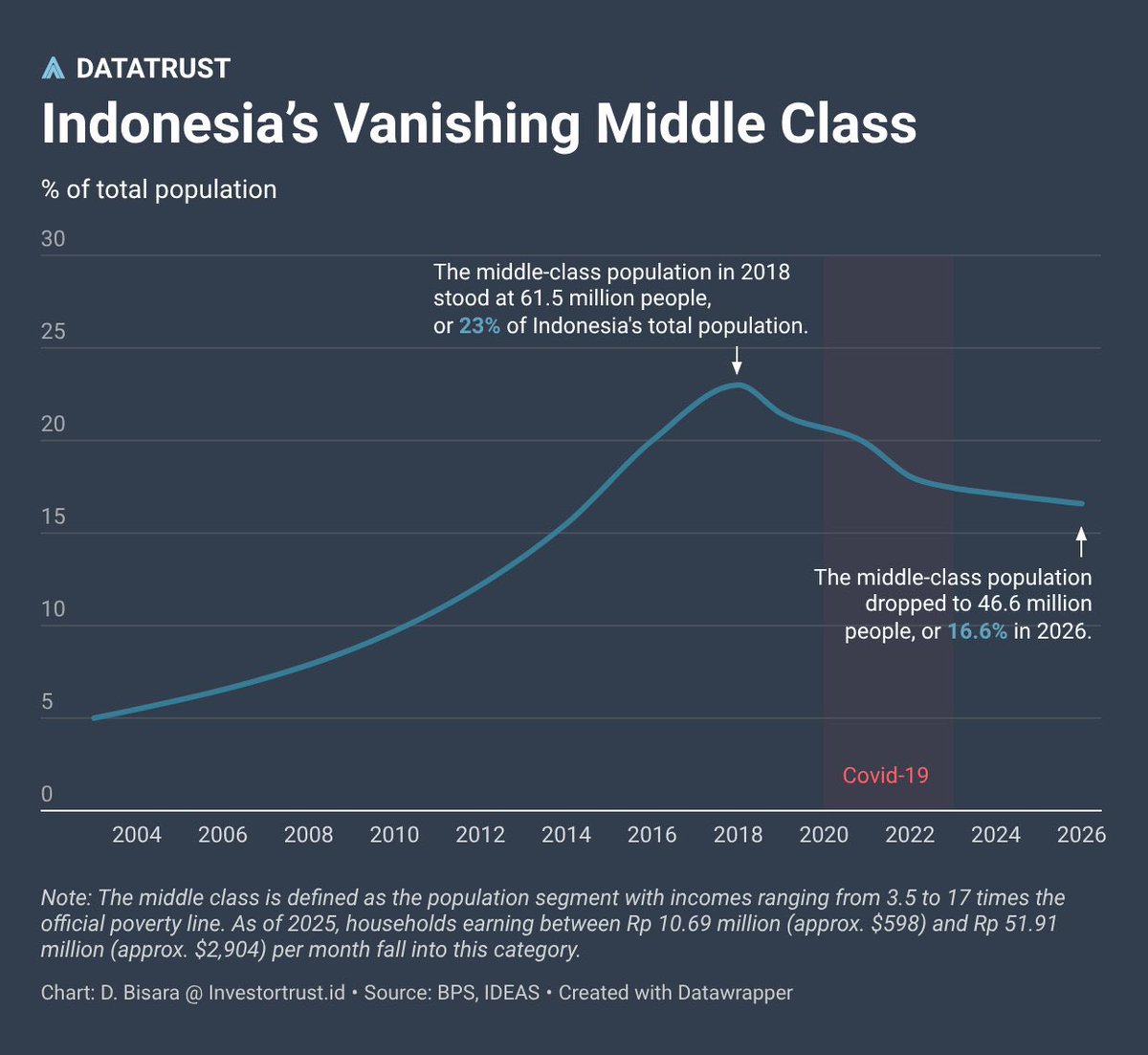
This chart should terrify policymakers. Indonesia’s middle class did not merely slow down. It went into reverse.
After two decades of expansion, the middle-class population peaked at 61.5 million people in 2018, representing 23% of the population. By 2026, that figure had fallen to just 46.6 million people, or 16.6%. That is not a cyclical slowdown. That is structural deterioration.
For years, policymakers celebrated GDP growth, infrastructure projects, commodity booms, and headline investment numbers. But the ultimate scorecard of an economy is whether ordinary people become wealthier over time. This chart suggests millions of Indonesians are moving in the opposite direction.
The middle class is the economic engine of every successful country. They buy homes, cars, insurance, consumer goods, education, travel, financial products, and healthcare. They generate tax revenue. They create small businesses. They drive domestic demand. When the middle class shrinks, the economy loses its most important customer.
The uncomfortable question is simple: where did the gains go? If GDP is growing, if conglomerates continue expanding, if commodity exports remain large, then why are fewer Indonesians qualifying as middle class than eight years ago?
More importantly, if you are born poor in Indonesia today, what ladder exactly are you supposed to climb?
If you are exceptionally good looking, perhaps you can monetize attention through social media. If you are academically gifted, perhaps you can break into an ultra-competitive institution like MBB, survive years of brutal expectations, and eventually use that platform to do something bigger. If you are entrepreneurial, maybe you build a business against overwhelming odds. If you are lucky, perhaps you benefit from family connections, inheritance, or access to opportunities unavailable to most people.
But an economy cannot rely on exceptionalism. A healthy economy creates millions of pathways upward, not a handful of lottery tickets.
The situation becomes even more concerning when you consider that well-paying white-collar jobs are becoming increasingly scarce. Many multinational companies that once established regional operations, technology centers, shared-service hubs, and professional offices in Indonesia have either downsized, relocated, or shifted future expansion elsewhere.
Those jobs were not valuable merely because of the salaries they paid. They were valuable because they transferred knowledge, management expertise, technical skills, global best practices, and professional networks into the local workforce. Over time, they helped develop intellectual capital that could later be recycled into entrepreneurship, leadership positions, startups, and domestic businesses.
When those opportunities disappear, the loss is not limited to employment. The country also loses a training ground for future managers, engineers, consultants, analysts, and business leaders. Human capital compounds just like financial capital. Once that pipeline weakens, rebuilding it can take years or even decades.
The bigger risk is that social mobility slows. When people stop believing hard work leads to a better life, trust in institutions weakens. Aspirations decline. Consumption slows. Talent leaves. The country’s most productive people increasingly look elsewhere for opportunity.
This is why Indonesia’s biggest economic challenge is no longer growth. It is upward mobility. A country cannot thrive without a growing middle class, a steady pipeline of high-quality jobs, and a clear path for ordinary people to join it. And right now, all three appear to be moving in the wrong direction.
Saudara kandung gw seorang psikolog yg sehari-hari kerjaannya dengerin dan beresin isi kepala orang lain yg berantakan. Pas kita lg kumpul kemarin, dia buka obrolan.
Dia bilang, "lo tau nggak paradoks paling lucu dari profesi gw?"
Dia cerita, pernah nanganin pasien yg semuanya punya pola masalah yang sama. Mereka gak ada yang bener2 sakit secara fisik, tapi badannya rontok karena pikirannya selalu merantau ke masa lalu atau masa depan.
Siksaan batin yg dijelasin saudara gw ini namanya Mental Time Travel.
Kondisi dimana otak kita terlalu canggih sampe bisa loncat ke masa lalu buat nyeselin hal yg udah lewat, atau loncat ke masa depan buat nyemasin hal yg belum tentu terjadi.
Efeknya? Lo kehilangan masa kini. Lo lagi makan makanan enak tapi nggak ngerasain rasanya, lo lagi jalan sama anak-istri tapi pikiran lo lagi sibuk mikirin cicilan 5 taun ke depan, atau sibuk nyeselin blunder kerjaan minggu lalu.
Dia cerita, banyak pasiennya yg kalau malem sebelum tidur, otaknya kayak muter kaset rusak. Mereka selalu terjebak di zona "Regret & What if"
"Kenapa ya dulu gw gak ambil kesempatan itu?"
"Gimana kalau nanti umur 40 gw mendadak di PHK dan gak punya tabungan?"
Siksaan batinnya adalah masa lalu udah jadi abu, masa depan masih jadi kabut, tapi lo ngorbanin satu2nya hal nyata yg lo punya sekarang, yaitu detik ini. Lo dapet capeknya, tapi gk dapet solusinya.
Gw tanya ke dia, "Kenapa otak kita secara psikologis bisa se terjebak itu?"
Dia jelasin kalau secara evolusi, otak manusia itu emg didesain buat bertahan hidup dg cara mengantisipasi bahaya (masa depan) dan belajar dari kesalahan (masa lalu).
Tapi di jaman sekarang, insting itu malah jadi bumerang. Tiap hari kita liat pencapaian orang lain di medsos yg bikin kita cemas ama masa depan kita sendiri.
Kita dipaksa buat selalu berlari ngejar target, sampe lupa caranya berhenti sebentar buat napas.
Ada satu istilah psikologi yg ngena banget buat kondisi ini:
"The Illusion of Control"
Kita mikir dg merenungkan masa lalu berulang kali, kita bisa mengubah rasa bersalah kita. Atau dengan mencemaskan masa depan, kita bisa mengendalikan hasil akhirnya.
Padahal itu semua cuma ilusi. Satu2nya momen dimana lo punya kekuatan penuh buat bertindak dan mengubah sesuatu itu cuma ada di masa kini.
Gimana cara kita buat lepas dari penjara waktu ini?
Saudara gw kasih terapi simpel yg biasa dia kasih ke pasiennya:
Grounding Technique (5-4-3-2-1)
Pas pikiran lo mulai melayang entah ke taun berapa, paksa mata dan tubuh lo buat fokus ama sekitar.
Sebutin 5 benda yg lo liat sekarang, 4 hal yg bisa lo sentuh, 3 suara yg lo denger, 2 bau yang lo cium, dan 1 rasa di lidah lo.
Cara ini bakal menyeret paksa kesadaran emosional lo kembali ke realita tempat lo berdiri.
Langkah kedua adalah bergaul sama kenyataan, bukan asumsi.
Kurangi bikin skenario terburuk didalam kepala. Kalau emg ada hal yg perlu disiapin buat masa depan, tulis di kertas jadi action plan yg nyata, after itu tutup bukunya.
Belajarlah buat menikmati hal-hal kecil yang gratis.
Dinginnya air pas lo wudhu atau cuci muka, angetnya obrolan ama pasangan sebelum tidur, atau rasa pahit manisnya kopi yg lagi lo seruput.
Pesan dari saudara gw ini:
Masa lalu itu udh selesai tugasnya, dan masa depan itu bukan urusan lo sekarang.
Satu2nya tanggung jawab lo adalah menjalani hari ini dengan sebaik-baiknya.
Jgn biarin hidup lo lewat begitu aja cuma karena lo terlalu sibuk jadi penjelajah waktu di dalam kepala lo sendiri. Rebut kembali kendali pikiran lo mulai hari ini.
tulisan by ryn pedia
cc: istory selebriti (facebook)
AYRILIK, BORÇ, İŞSİZLİK… BUNLAR ADAMI SARSAR. AMA KENDİNE ACIMAYI ALIŞKANLIK YAPMAK ADAMI BİTİRİR.
insan bazen gerçekten dibe vurur. sevdiği gider, işi bozulur, para yetişmez, telefon çalınca bile içi sıkılır. bunların hiçbiri hafif şeyler değil. ama bir noktadan sonra aynı acıyı sürekli anlatmak, aynı hikâyeyi tekrar tekrar kurmak, “benim başıma hep böyle şeyler geliyor” diye gezmek insanı olaydan daha fazla yorar. çünkü zihin bunu duydukça yeni çözüm aramıyor, eski kimliği korumaya başlıyor.
erkek böyle dönemlerde kendini toparlamayı romantik bir sahne gibi beklememeli. çoğu zaman toparlanma çok sıkıcı başlar: borcu kağıda yazarsın, gereksiz harcamayı kesersin, cv güncellersin, 5 yere başvurursun, eski mesajlara bakmayı bırakırsın, uykuyu düzene sokarsın, odayı toplarsın, vücudu tekrar çalıştırırsın. dışarıdan bakınca büyük hamle gibi görünmez ama içeride kontrol hissini geri getirir.
en tehlikeli şey acı çekmek değil.
acı çekerken hiçbir şey yapmamayı “kötü dönemim” diye savunmaya başlamaktır.
bir yerden sonra kimse seni kurtarmaya gelmez. gelmesini de bekleme. masaya otur, hasarı çıkar, ilk hamleyi seç. bugün sadece bir şeyi düzelt. yarın bir tane daha. adamı ayağa kaldıran şey bazen büyük motivasyon değil, aynı anda dağılmış 10 şeyden birini geri toplamaktır.
Ini pemikiran yg menarik tentang gimana kebiasaan buruk bisa bikin masa depan kita suram.
Intinya dia bilang:
Waktu umur 22, ngabisin 3 jam buat scroll di media sosial keliatannya sepele. Tapi pas udah 28, tiba2 jadi susah fokus baca artikel karena mesti ngecek handphone tiap paragraf.
Terus pas udah 32, kamu mulai bingung kenapa proyek yang diimpikan ga pernah kelar. Masih punya impian, tapi seolah ga ada waktu buat mulai.
Dan di umur 40, kita ga bisa menyelesaikan 1 buku satu pun.
Kebiasaan kaya gini emg harus dihilangkan dari sekarang, karena waktu ga akan bisa kembali.
Setuju ga?