🚨 Anthropic just showed a 24-minute workshop on how to actually do prompts for Claude.
Taught by the people who built it.
Free. No registration. No paywall.
I've seen $300 courses that don't cover what they teach in the first 8 minutes.
Watch it and bookmark it now.
Tokenmaxxing is easy when you're getting started.
Modeled @chaoslabs AI usage at scale and saw a projected $150M/yr in spend.
While I knew what it would cost, I had no real visibility into its impact, efficiency, and value.
Sharing our journey on measuring AI spend ROI.
Organizations are investing heavily in AI, yet much of the reasoning produced disappears at the session boundary.
The result is an architecture where validated reasoning is repeatedly recomputed rather than retained.
Here's a map of the stateless vs memory-augmented AI loop:
Finance is the canary in the coal mine. Unfortunately, what kills the canary eventually kills everything else.
Finance is unforgiving, but it's not unique among enterprises adopting AI. Solving generally for finance opens the door to solving for many other industries.
So, more concretely, what is the problem at hand?
Agents and models don't know your business.
They don't know your
- enterprise context
- internal knowledge graph
- vertical regulations
- best practices, and more.
General agents haven't seen (or don't remember) your policies, your book, your incidents, or the hard-earned reasoning and insights your team has accumulated over the years.
Grabbing an API key and piping your data into an agent's context window is fine for a PoC. However, it's miles from a production-ready system. Finance is the canary because:
a) it's one of the largest enterprise markets in the world
b) the regulator is already in the room
c) the cost of being wrong can be quantified in real money, often on the same day.
What replaces demoware is the same wherever you build:
1) a structured reasoning layer beneath the model that actually encodes the entities, the mechanisms, and the institutional context that pretraining didn't see and that weights don't represent.
2) something real for the model to reason against, which can be your guardrails, deterministic risk harness, and internal benchmarks and eval sets.
Global markets move fast, so skipping this work shows its cost first.
Every other domain will follow the infrastructure, techniques, and harnesses built for finance
Great convo with @constkogan!
Over the weekend, we identified an attack on Chaos Labs. The surface area was strictly contained to operational wallets we use for routine onchain operations. At no point was the Chaos Oracle Network breached or compromised. Chaos Oracles run in a fully isolated environment with nodes distributed globally, protected by layered security and cryptographic controls. The oracles continued to publish prices across every network throughout the incident.
We allocate a substantial share of our operating budget to cyber defense, alerting, and detection. These detection systems alerted us within seconds of suspicious activity, and we immediately moved to full lockdown.
Our incident response policy treats any threat as the worst-case scenario by default, given the value secured by the Chaos infrastructure. With the backdrop of recent exploits, we triggered our highest-severity incident response from the moment we were alerted and notified relevant partners. The authorities and cyber professionals working with us have characterized the activity as consistent with nation-state attacks.
As a precautionary measure, we rotated all keys, and have not observed any suspicious activity since.
The investigation continues, and we will share more as it allows.
Big Week: 5 of the MAG7 report earnings
$650B in AI capex meets its first real test.
> AWS AI ~$15B run rate
> Azure guiding ~38%
> Google Cloud gaining share
> Meta scaling revenue as AI costs rise
> Apple CEO transition; global growth in focus
$GOOG $META $AAPL $MSFT $AMZN
Chaos Labs has achieved ISO 27001 certification, reinforcing the security standards behind Chaos AI.
This ensures:
→ Faster paths to production
→ Consistent controls across data, models, and decision logic
→ Institutional-grade monitoring and incident response
Learn more: https://t.co/8C8F7xEwO1
$200M was drained from Aave's rsETH markets following an exploit of Kelp's LayerZero bridge earlier today.
The exploiter deposited rsETH, and borrowed 83,427 WETH and wstETH from Aave.
The breakdown of extracted assets across Aave instances is:
Ethereum
52,834 WETH
Arbitrum
29,782 WETH
821 wstETH
At the time of writing:
- Aave rsETH markets are frozen.
- No other LayerZero OFT token was affected.
We are assisting multiple teams in investigating the root cause and the full path the funds took after extraction.
A longer investigative report will follow soon.
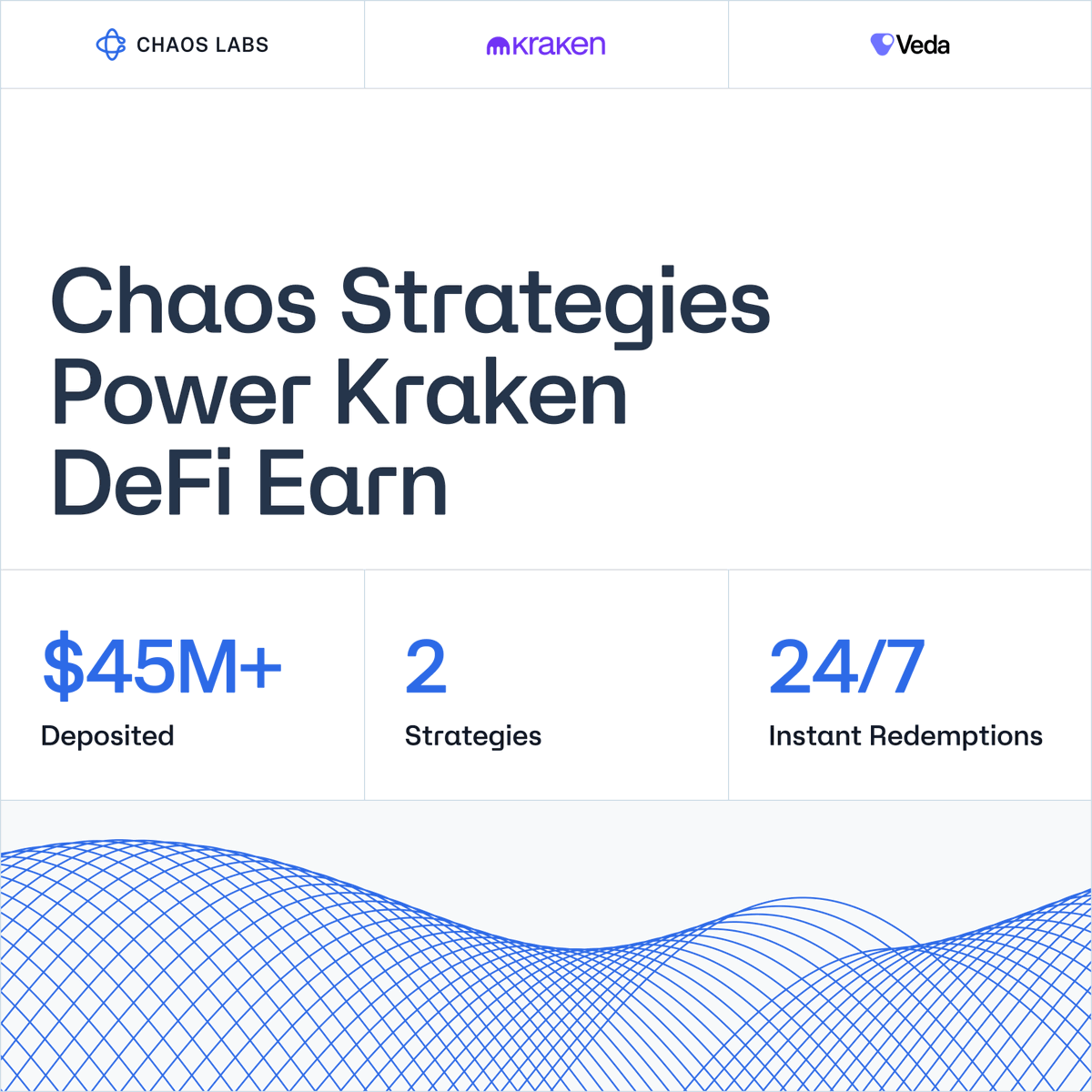
UPDATE: Chaos @Veda_labs Vaults on @Krakenfx DeFi Earn & @Krak have crossed $45M.
→ Balanced & Boosted strategies, built risk-first and powered by Chaos AI
→ Real-time monitoring across solvency, liquidity, and yield volatility
→ Instant redemptions 24/7
Financial AI has a gap between data analysis and execution.
→ Model context resets between interactions
→ Risk constraints break at decision time
→ Outputs fail to compound into action
We map the five levels of agentic finance in this piece.
great run, no risk team in the space comes close:
• 3+ years on active risk management
• deployed and introduced the concept of risk oracles (which went live first on Aave)
• $5T+ in loan volume, zero bad debt
excited for the future
Chaos holds a simple principle: we only put our name on work we fully believe in.
Principles matter when they cost you something.
Today it's costing us $5 million.
To the Aave community: thank you for the trust. It was a privilege 👻