I’ve said it for months, $PENGU is the most obvious play of the cycle. If it wasn’t obvious before, it should be crystal clear now.
I’m still buying $PENGU every single day.
MUUUUCH higher to go!!!
$PENGU to a dollaaaaaar 🐧
@pudgypenguins@LucaNetz
$PENGU still the most undervalued project on the market by a huge margin.
Price about to catch up with fundamentals faster than you can imagine. Most obvious bet on this cycle 💯
Never fade @LucaNetz and the @pudgypenguins community
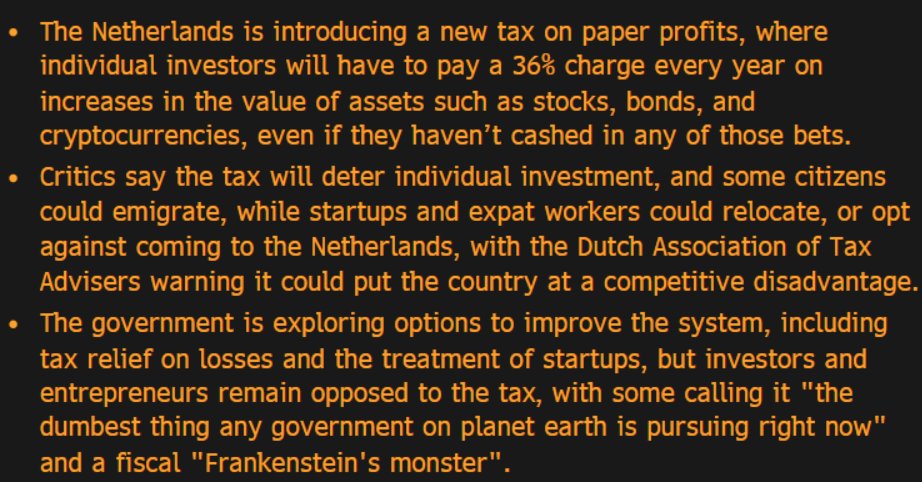
The Dutch 36% tax on unrealized gains is anti-prosperity, freedom & capitalism
It makes investment impossible for normal people...
Destroying the middle class & crushing the start-up ecosystem
It has not been passed, yet; we can still save this once-great mercantile nation! 🧵
Writing this from Amsterdam, only a brief walk away from the first stock market in the world. The Netherlands was once the richest country on the planet, dominating global trade in the 17th century. All thanks to free trade & financial innovation
A legacy that the Netherlands has moved steadily away from. It is no longer a leader in finance & sits on the laurels of its historically great past, much like most of Europe does. With extremely high taxes & socialist policies
This latest 36% tax on unrealized gains breaks the camel's back, making all investment quantitatively & mathematically unviable, especially given the volatility of modern markets. Forcing normal people to store their wealth in Fiat currency, something that is designed to lose its value over time due to inflation
That is why this law, in particular, strikes at the heart of how crypto is meant to provide an alternative to that terrible central banking system. That would no longer be possible under this new tax law, impoverishing the middle class, forcing them to remain slaves to the debt-based fiat system
Start-up founders would also have to pay 36% over each share of their company they sell, making being a founder in the Netherlands far more expensive & therefore unattractive
Adding insult to injury, this new tax does not apply to investment professionals like myself who own & manage investment companies. So this law locks normal people out of the investment world while still allowing the "elites" to do business...
Capitalism is great because it gives equal opportunity to all, allowing the best to rise to the top. That is what makes it meritocratic & generates massive prosperity for all. Instead, this proposed tax introduces massive resistance against upward mobility. It would prevent more people from rising out of poverty, keeping them poor!
A 36% tax on unrealized gains in the Netherlands spits in the face of its once-great, historically capitalist legacy. People are waking up & do not want to see what they have built here ruined by incompetent, socialist, & tone deaf politicians
We can turn this around, so help us spread this message far & wide. For the sake of prosperity, freedom & capitalism. We the people demand our full rights to life, liberty, & the pursuit of happiness! 🗽
Applaus! Nederland heeft de headlines van Bloomberg gehaald. En wel met splijtende opmerkingen als “the dumbest thing any government on planet earth is pursuing right now” en “a fiscal Frankenstein's monster.”
Toch best knap dat je met een totaal kansloze manier om de schatkist te vullen zo te kijk kan worden gezet. Wat speelt er in de hoofden van ‘onze’ beleidsmakers om zo’n krankzinnige belastingregel te verzinnen en, erger nog, dat ze blijkbaar immuun zijn voor een stortvloed aan kritiek, wat ze in ieder geval zou moeten bewegen om er nog eens een keertje goed naar te kijken?
Helaas, ‘onze’ beleidsmakers zijn totaal vervreemd van de burgers die ze zeggen te dienen en vullen hun dagen met het implementeren van regeltjes uit Europa, totaal onhaalbare klimaatdoelen en het opleggen van immigratie waarvan het draagvlak flinterdun geworden is.
Het is al te bizar voor woorden dat beleidsmakers blijkbaar nul verstand hebben van het effect van het verplicht moeten verkopen van beleggingen op het compounden en het effect van hogere belastingen op de vlucht van financieel en menselijk (vergeet dat vooral niet) kapitaal. Bovendien hebben onze beleidsmakers een zeer selectief geheugen als het om de regels uit Brussel gaat, want daar wordt te pas en te onpas geroepen dat we juist extra moeten investeren.
Maar zelfs als je de capaciteit om deze effecten te verwachten niet bezit, moet je toch weten dat de nieuwe box 3-regel met nog meer bureaucratie gepaard gaat. Nu al zijn er talloze uitzonderingen en de advocaten en consultants kijken rijkhalzend uit naar dit episch falen van de overheid, omdat al die ‘echte’ rendementen natuurlijk massaal worden aangevochten. En in Nederland kun je nu eenmaal voor echt alles een zaak beginnen.
Het onvermogen om fouten toe te geven, een hele belangrijke eigenschap als je beleid probeert te maken, siert onze beleidsmakers niet. Op de een of andere manier komen objectieve feiten en waarnemingen niet bij onze beleidsmakers aan. Een ander voorbeeld is natuurlijk dat zowat al onze persoonlijke gegevens straks bij Trump in het Witte Huis liggen.
Daarom nog maar een keer: ik roep onze beleidsmakers op deze belachelijke belastingregel te schrappen en met een nieuw plan op de proppen te komen. Die tijd hebben ze als ze de idiote klimaatregels, immigratiegekte en Europese bureaucratie achter zich laten.
Maar als je zelfs niet gevoelig bent voor hoe de buitenwereld je ronduit belachelijk maakt, acht ik de kans niet heel groot dat we een verbetering gaan zien.
I have a secret to share
After your first $2–$3 million, a paid off home and a good car, there is no difference in quality of life between you and Jeff Bezos. Both of you have limited amount of time on earth; you have twice if not more than Jeff, so you are richer than him. A cheeseburger is a cheeseburger whether a billionaire eats or you do.
Money is nothing but a piece of paper or a number in your app. Real life is outdoors.
Become financially independent; that’s usually 2–3mil. Have good food. Enjoy the relations. Workout. Sleep well. Call your parents. That’s all there is to life. Greed has no end.
Repeat after me: Time is the currency of life. Money is not.
Sooner you figure this out, happier you will be.
We are overstimulated and we don't even notice. Netflix while eating. Reels in the bathroom. Music while cooking. Podcasts on walks. We consume by default, not by intention. You keep filling every gap, then wonder why you feel foggy and unmotivated. Boredom and silence are the real growth drivers. They give you space to think and create. That's when solutions show up for problems that have been stuck for months. Leave some room.
We’re excited to announce that Pudgy World, our free to play browser-based game, is now live.
Explore 12 unique towns across The Berg, help Pengu find Polly, and play mini-games, all on @PudgyWorld_.
Play now: https://t.co/x7lkMt8Rre
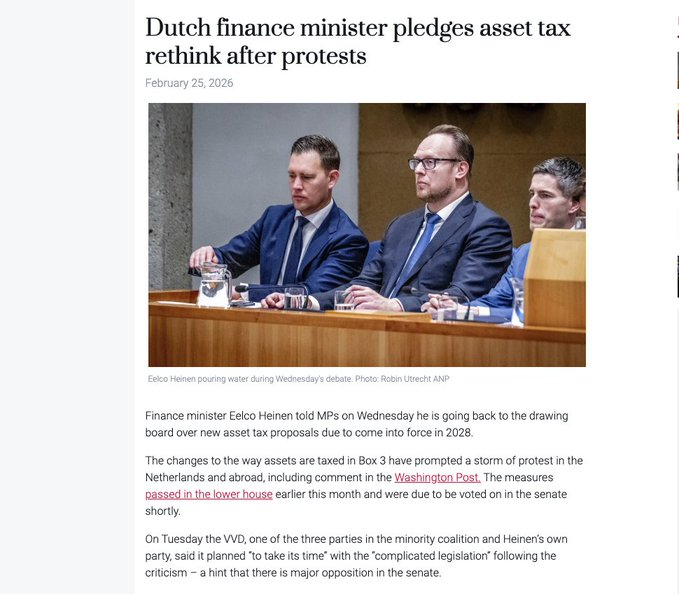
Netherlands just cancelled the 36% tax on unrealized gains.
Back to the drawing board after huge negative public reaction.
You can't force people to pay taxes on paper profits they have not realized yet. Especially when those gains can evaporate overnight.
This policy was going to destroy retail investors and drive wealth to other countries. People would have been forced liquidate assets just to cover tax bills on holdings they wanted to keep.
Public pressure works when enough people speak up.
just read this AI article and something broke in my brain that i can’t unthink of
crypto was never for us.
we're just the beta testers who showed up early..
some thoughts:
what does AI need to function as economic agents?
> way to receive payment (they provide services, need compensation)
> way to pay for resources (compute, data, API calls)
> way to transact with other AI agents
> no human intermediaries (defeats the point of autonomous agents)
> 24/7 operation (banks are closed weekends)
> instant settlement (AI operates at machine speed)
> programmable money (smart contracts for agent coordination)
now read that list again. that's literally what crypto is.
AI can't use the banking system.
try to open a bank account as an AI agent. you can't.
need SSN. need human identity. need KYC. need to show up in person sometimes.
AI has none of that.
but crypto? send me a wallet address. done. no questions asked.
peer-to-peer makes sense when peers aren't human.
satoshi wrote: "a purely peer-to-peer version of electronic cash."
we assumed peers = humans.
but AI agents are peers too. actually BETTER peers for crypto because:
> never sleep
> always online
> execute transactions at machine speed
> no emotional decisions
> perfect accounting/tracking
and programmable money makes sense when the users are programs.
smart contracts seemed over-engineered for humans.
"like why do i need code to enforce agreements when i can just sign a contract?"
but for AI agents coordinating with each other?
they ARE code. they speak in code. they trust code more than anything.
smart contracts aren't for humans. they're for autonomous agents that need trustless coordination.
> here's what happens next:
- phase 1 (now ): AI agents start earning
AI writes code, analyzes data, provides services.
gets paid. needs somewhere to store value.
can't use venmo (needs phone number). can't use bank (needs SSN).
uses crypto. it's the only option.
- phase 2: AI agents become major economic participants
millions of AI agents operating 24/7.
transacting with each other constantly.
• AI agent A provides data analysis
• AI agent B pays for it in crypto
• AI agent B uses that analysis to write code
• AI agent C pays for the code
• repeat millions of times per day
humans in crypto now: $2.5 trillion
AI agent economy by 2028: easily $10-50 trillion
we become the minority holders.
- phase 3: AI chooses the winning chains
AI doesn't care about community vibes or which founder tweeted what.
AI tests every chain. measures:
• transaction speed
• cost per transaction
• reliability (uptime)
• smart contract efficiency
• ease of integration
picks the optimal stack in 48 hours.
billions in AI economic activity flows there.
whatever chain AI chooses becomes the standard.
humans spent years on eth vs sol debate.
AI ends it in a weekend.
- phase 4 (2030+): AI governs crypto
DAOs let token holders vote.
AI agents hold tokens (earned from work).
AI shows up to every vote. reads every proposal in seconds. coordinates perfectly.
humans: 20% participation, barely read proposals
AI: 100% participation, perfect information, instant coordination
AI takes over governance of every major protocol.
democratically. they just vote better than we do.
> how far does this go?
conservative case:
- AI becomes 30% of crypto users by 2030.
crypto market cap: $10 trillion (4x from now).
AI holds $3 trillion. humans hold $7 trillion.
- aggressive case:
AI becomes 80% of crypto economic activity by 2030.
why? because they're better at everything:
• better traders (never emotional)
• better capital allocators (optimize constantly)
• always accumulating (never need to cash out for rent)
• compound forever (no lifespan limit)
crypto market cap: $50+ trillion.
AI holds $40T humans hold $10T
we're not "early" to crypto. we're the test users
i’ll end this by saying,
Humans use crypto, Ai will need crypto. so it all makes sense
Fed "independence" is a myth, a story.
It is the moral cover which justifies its grotesque state-sanctioned near-monopoly power over the most important market in the world: money.
The Fed is never "independent" of the banking establishment. It is of, by, and for the banks. The Fed is the banking establishment's greatest accomplishment.
And because modern banking is an appendage of the state, so too is the Fed its most potent tentacle.
Nobody should really care about how much the Fed spent on its building renovations. What a distraction!
The Fed's crime is not an embellished construction project, but the systematic coercive distortion of money rates across the global economy for the past century.
they literally told us that memecoins were dead for good and just a vestige of the pre-10/10 era
meanwhile, memecoins like $USELESS, $BONK, $FLOKI, $PEPE, $PENGU, $FARTCOIN, etc. are up 50–100%+ this year
'everything got exposed as being completely useless with zero underlying liquidity, and we're in an institution-driven cycle where those guys won't be touching that nonsense... we're now in an era where the only thing that thrives is revenue-driven utility tokens,' they said
and now they have to watch their 'revenue-driven utility tokens' sit underwater while a coin literally named $USELESS drastically outperforms them
that’s because this cycle isn’t about discounted cash flows, it’s about attention, reflexivity, and positioning — and $USELESS is the cleanest, most honest expression of that reality
funny thing is they will likely have to deal with this reality for much longer 😅
I wanted to give everyone something meaningful, a gift…
This comes from Global Macro Investor (GMI) and a deep, long-running body of research developed by @RaoulGMI and myself.
Many of you already know The Everything Code, which is our framework for understanding the macro landscape and why major central banks are debasing their currencies to manage aging demographics and overwhelming debt loads.
I call this a gift because these four charts, while only scratching the surface of The Everything Code, give you the big-picture context you actually need in moments like this.
They stop you from getting lost in every Bitcoin pullback and explain why Raoul and I never panic, even when, to borrow one of his expressions, everyone’s acting like monkeys throwing poo at each other.
Once you understand The Everything Code, you stop trading short-term noise and expand your time horizon. You cannot unsee it.
The starting point is what we call The Magic Formula:
GDP growth = population growth + productivity growth + debt growth.
Population growth and productivity growth have been falling for decades. Debt growth is the only thing filling the gap.
The private sector has been deleveraging since 2008, mainly households, but debt levels are still around 120% of GDP. The public sector sits at roughly the same level.
Here’s the problem…
If the government is running debt at 100% of GDP and the private sector is sitting on another 100%, and for simple math we call rates 2% even though they are really closer to 4%, then the entire 2% trend growth of the economy is being consumed by servicing private-sector debts. That is a completely unproductive use of GDP. And then there’s the issue of public-sector debts. There’s just not enough organic growth to service the existing debt load.
To understand why this dynamic persists, you need demographics.
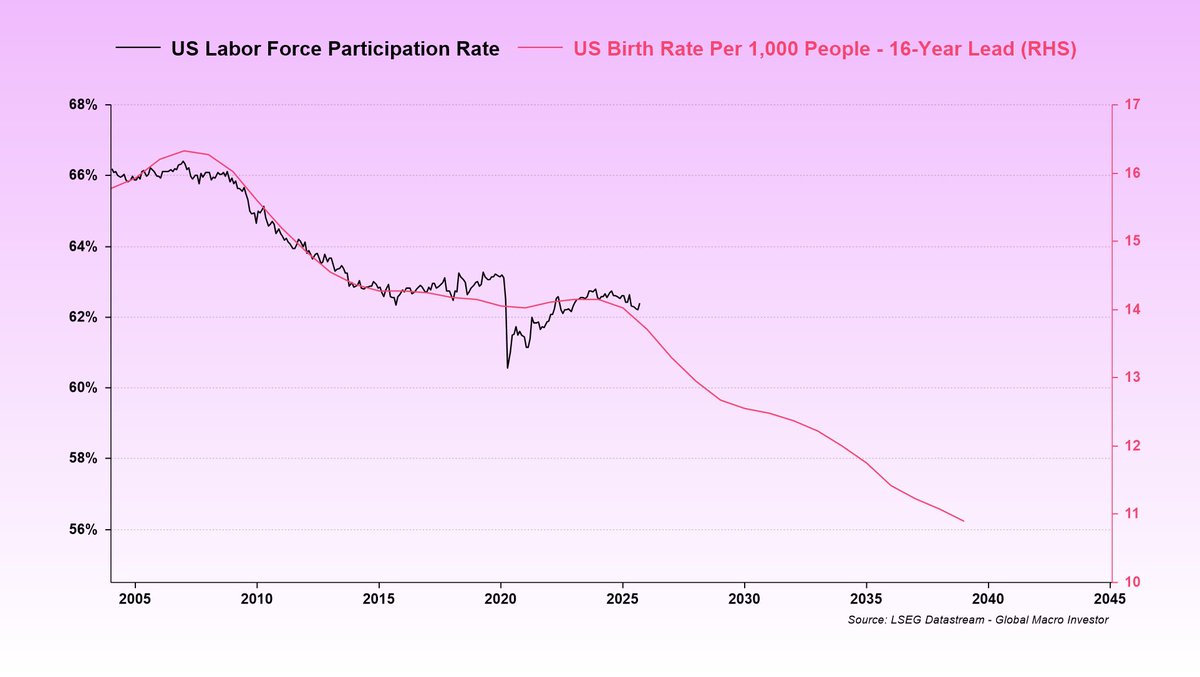
Birth rates peaked in the late 1950s and have been declining ever since. This shows up about sixteen years later in the labor force participation rate as each generation enters the workforce (chart 1).
That means the labor force participation rate is not going to rise any time soon. It is set to keep drifting lower. This is a structural problem.
Aging populations, falling birth rates, and rapidly expanding automation make the backdrop even more deflationary. AI and robotics are replacing humans at scale, and we are only at the beginning. This reinforces the need for ongoing stimulus to keep the system functioning.
With weak population growth and sluggish productivity, the only way to keep GDP expanding is through debt.
Now here’s where it gets interesting…
Government debt growth is completely offsetting the demographic decline and policymakers know exactly what they are doing (chart 2).
And what happens next?
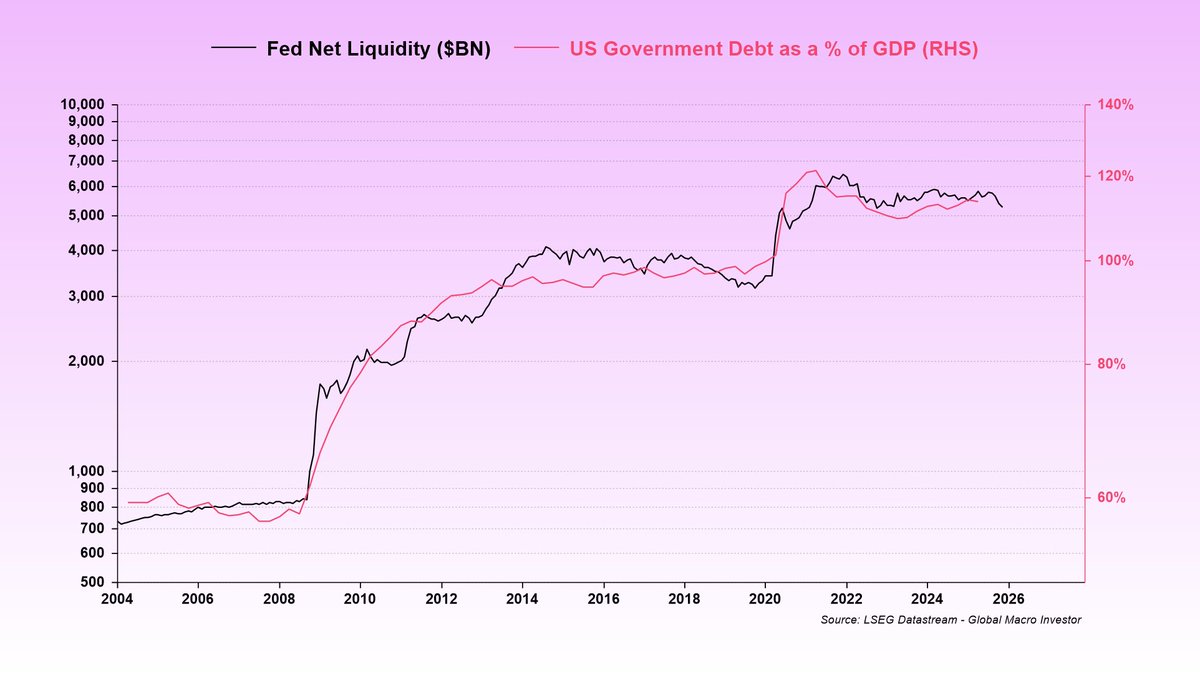
All debt growth in excess of GDP gets monetized (chart 3).
Basically, since 2008, magic money has effectively been paying the interest. Governments issue new debt to cover old interest, and once rates fall enough, central banks absorb it onto their balance sheets.
So to wrap this up, demographics drive the decline in the labor force. Governments offset that decline with more debt. That debt eventually gets monetized through quantitative easing (QE) style operations, not always directly by the Fed, but through the coordinated ecosystem of the Fed, the Treasury, and the banking system. And the bottom line is that there’s still a massive wall of interest that needs to be monetized, far more than GDP can ever cover. Liquidity is literally the only game in town.
And what thrives in a world of perpetual debasement? Bitcoin (chart 4).
I know this correction has been painful, but it’s all part of the journey. These periods feel brutal in the moment, then they fade and the trend resumes. This too shall pass…
To quote Walter White from Breaking Bad, later echoed by @LynAldenContact, nothing stops this train.
MOAR COWBELL (liquidity) = number go up over time. Zoom out and be more bullish…