Et voilà. 6 binders fully processed with all their notes included in my manuscript. Now all that remains, besides surely reading the occasional books I'll still run into, is...well, actually writing the book.
About AI, since someone tagged me ...
I'm using AI to help me do multiple projects. Its role is limited. I'm the architect: I define the goals, I supply the logic gates, I write the mathematical formulas, I specify the database structures and the API calls. I demand hundreds of unit tests per sprint. But the AI implements all of this by writing the syntax -- which we then test, debug, etc. through many iterations.
I'm proud of what I've built. There are software packages that I used to spend $300-$400 on every few years that I can now essentially replicate because of the power of AI-assisted coding. That's great -- the upside is visible and it's all available for people who have strong logic skills, domain-specific knowledge, and a tolerance for herding minions.
I've moved on to writing agents with local AI (very carefully constrained within guardrails, because this genie will really mess with things if it gets out of the bottle) working within the systems themselves. I'm also engaged in a far larger task that places much greater demands on the AI. Again, human design, domain-specific knowledge, and cross-checking are front and center. That said, there is a lot that the AI makes possible that wasn't even on the horizon last year. Groundbreaking projects are now becoming possible. It's an amazing time to be alive.
I also believe that generative AI is destroying entire institutions. Higher education -- my field -- is about to implode, and embracing more AI isn't the way to stop the implosion. Art (remember human, hand-drawn art?) and literature are being cannibalized so that your favorite AI can regurgitate what is, conceptually or artistically, a low-res jpeg of the internet tailored to your preferred specifications. Students are signing up in droves for full-on cognitive surrender of fundamental human capacities: reading, writing, reasoning, remembering. Do they think that this is what they are doing? I don't know -- I'm not sure that, in the relevant sense, they are still thinking at all. If the question occurs to them, they will no doubt ask Grok.
People who are working at top-level AI companies are very worried about this. They see the skill decay and wonder where the next cohort of smart, independently capable workers will come from. I think they are not worried enough, but at least they see the problem, which is more than I can say for most people working at universities.
Regular people with 9-to-5 jobs and business owners, people who don't know how to separate the hype from the doom, are caught in an almost impossible situation. There's an earthquake coming, and the epicenter is just about everywhere. When the tidal wave of cost reduction and breakneck speed increase sweeps across the landscape, I wonder how many of them will be left standing. Certainly the world will look very different.
Of course there remains the problem that the resulting manuscript document currently stands at 940 pages and 2500 footnotes, but that's a problem for future me to worry about. Present me is on a roll.
Book-writing update: I'm down to the last few pages of the 6th and final binder of notes. Working through the French and German Catholic theologians. This thing may actually get finished one day.
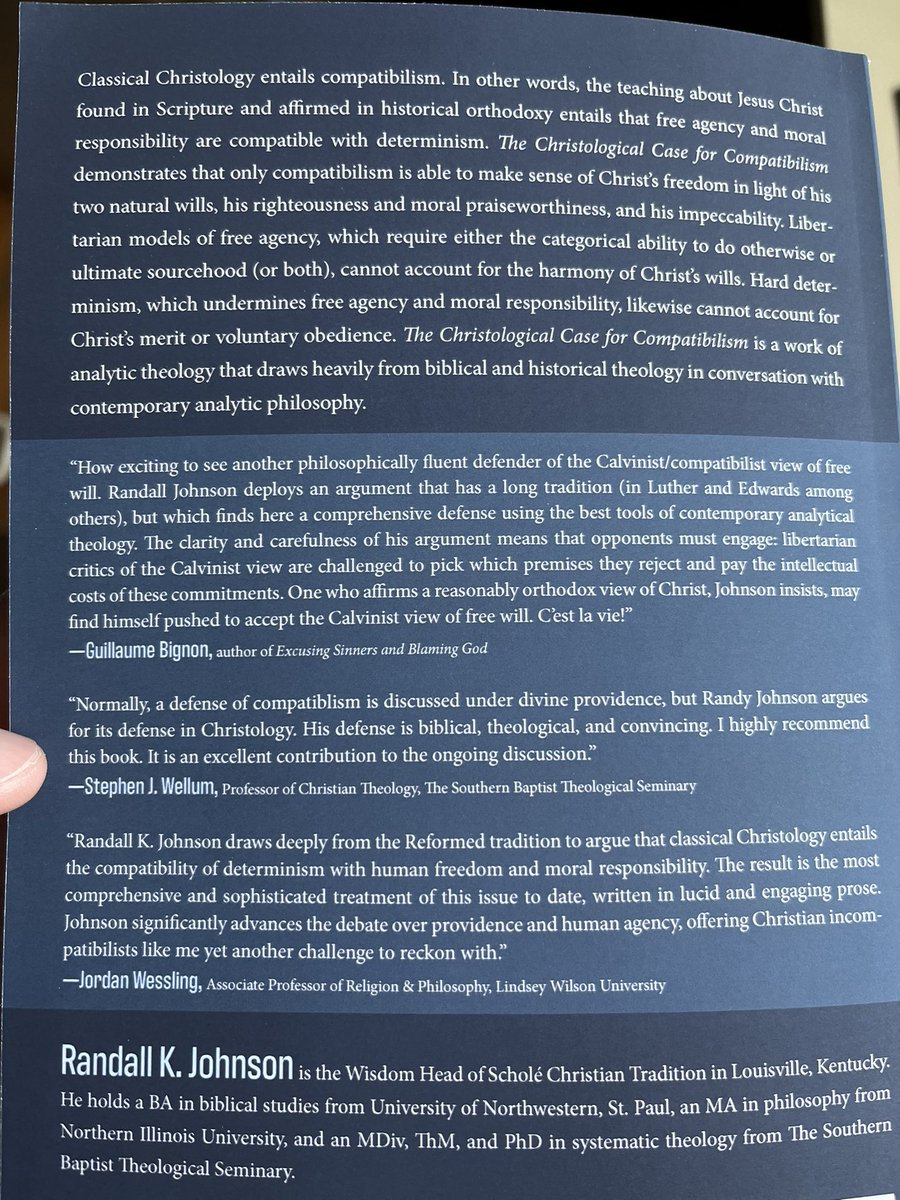
This just arrived.
I had come to learn that using "tour de force" in a book blurb is corny and overused, so I used another French idiom instead: "How exciting to see another philosophically fluent defender of the Calvinist/compatibilist view of free will. Randall Johnson deploys
[insert April fool's post lying about my research on Justification by faith leading me to deny Sola Fide and join the Catholic Church on Easter this Sunday]
@2Philosophical_@BMcGrewvy You presuppose it's impossible, so of course you will dismiss the overwhelming evidence. But for an even semi-open thinker, this should suffice: https://t.co/fbjfJJI5xy
@2Philosophical_@BMcGrewvy You presuppose it's impossible, so of course you will dismiss the overwhelming evidence. But for an even semi-open thinker, this should suffice: https://t.co/fbjfJJI5xy
Here I was, reading Greg Boyd on a couch whose behavior is entirely determined by God, and I hadn't realized I was sitting on God.
My couch was not genuinely distinct from God, Couch is simply another name for God.