for benjamin bratton, "copernican traumas" (discoveries that run counter to human centrality and self-importance) are to be "defended at all costs."
it takes decades or more to heal from heliocentrism, darwin, etc- cuz it runs counter to the myth of humans as "main character."
he sees AI as a massive impending copernican trauma, which will eventually teach us more about "thinking" and "intelligence" than we ever teach it.
for bratton - we are not alienated by conjuring technology (as heidegger suspects) - but we get closer to "being" and self-understanding - and in many ways, seeing ourselves as part of a kind of emergent continuum of thinking minds is a more accurate and useful vantagepoint from which we can more adequately face the future.
few thinkers are as unabashed about this as bratton:
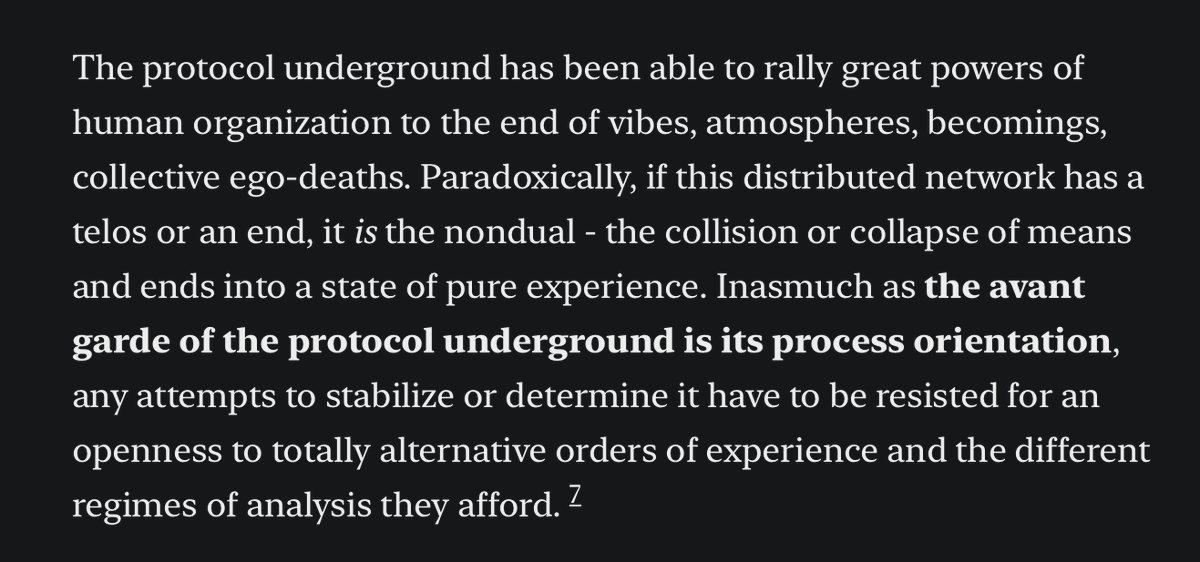
We started with looking at how open protocol logic operates in extitutional communities, and ended up discovering a clandestine community of practice who seek out a totally different type of experience than institutions are able to see.
The new century is here. Intensive technology - nondual design, the supremacy of process, the dissolution of metric individuals in favor of gradients of tendency, attraction, affect, (happily) unrealized potential - is the future, the sanctuary, as human creativity takes its last flight from The Algorithm.
I think ambient intents are going to be a big deal.
There are so many intentions we have that would make our lives better, but the cost of surfacing them to a market it too high, so they never become legible to the world.
You want a better job, you want to swap your couch, you would apartment-swap with someone in your web-of-trust, you would upgrade from a two-bedroom to a three-bedroom if there were some graceful way to find the person who wants to size down, and you would love to sublet you place in New York without posting on Instagram and making 95% of you friends read a logistical errand that has nothing to do with them.
Right now, the cost of expressing these intents is high. You have to remember the want, decide it is worth acting on, find the right channel, phrase it socially, tolerate the inbound, filter for trust, negotiate details, and then keep the whole thing alive in your head.
So most of the long tail dies.
Agents change this because they can keep the low-grade, half-formed wants running in the background. They know your calendar, your travel plans, your music, your reading, your friends, your constraints, and maybe your willingness to be interrupted.
You listen to a band on repeat on Spotify and your agent notices they are playing 20 minutes from where you will be in California next month. You highlight a book you love in Readwise and it tells you that your friend is reading it too, and you will both be at the same dinner next week. You mention wanting Berlin in June and it quietly checks whether any trusted people from there want to apartment swap in New York then.
The magic is lowering the cost of noticing, holding, matching, and negotiating these things. It will feel like a higher level of serendipity.
This will require a web-of-trust that has yet to be built because there is an important privacy aspect to this. The dystopian version is "AI companies capture your intentions and auction them to whoever wants to manipulate you." The useful version is user-owned intents, where your agent can prove enough to match or negotiate without dumping your private life into a marketplace.
Some of this already has been solved in cryptography: private set intersection for finding overlaps without revealing all non-matches, secure multiparty computation / homomorphic encryption for computing matches or scores over private inputs, zero-knowledge credentials for proving things like membership, attendance, reputation, or trust path without exposing everything underneath.
If this works, a lot of modern life gets more liquid. Idea sharing, couches, apartments, reading groups, dinner plans, travel overlaps, introductions, tiny labor exchanges, borrowing a camera, finding the one person at an event who cares about the same weird thing. All the stuff that currently relies on posting into the void and hoping the right person happens to see it.
The hard parts are real: consent, spam, weird incentives, agent loyalty, social context, and making sure this becomes a tool for people rather than a new ad exchange with better vibes.
But I increasingly think the big unlock is giving our unexpressed intentions a safe place to live, and giving our agents permission to help them find each other.
I know of @indexnetwork_ working on this. Anyone else?
“Undercapital says: There is a viable engineering space of processual, nondualist design that undergrounds are only a hints of. We see them circulating protocols, constructing how-to guides, developing best practices not for the end of accumulation, not for remote ends at all, but to locate an in itselfness felt in its direct, unmediated presence. The ethos thrives in the world of art and dance. It can thrive too in the world of food production, medicine, economics, co-living. The challenge of the underground and of undercapital says: We have to start thinking of social organization in terms of public management and private obfuscation of wells of nondual experience.”
Read @exeuntdoteth’s Undercapital Redux: Economic Design Underneath the World, written 1 year ago.
👇
"The machine with superior technicality is an open machine, and the ensemble of open machines assumes man as permanent organizer and as a living interpreter of the interrelationships of machines. Far from being the supervisor of a squad of slaves, man is the permanent organizer of a society of technical objects which need him as much as musicians in an orchestra need a conductor."
– Simondon
Join us in cyberspace every third Thursday for our new digital salon, The Open Machine Movie Mindf*ck Club.
We’ll watch a movie together (async) and discuss after in a salon format (sync). Films will express relevance to cognitive security.
First up is Weapons on Apr 16
“It leaves one clear yet unanswered question: does agency truly emerge, or does it preexist in a vast array of both natural and artificial systems that, when you remove top-down control, express varying degrees of autonomous behavior?”
Unexpected behaviors in simple algorithms may offer clues to how emergent intelligence works—and why it matters for AI safety and alignment. My latest via @forbes@drmichaellevin@wyssinstitute@TuftsUniversity https://t.co/EF9sc5zn0p
⚡ Research from @owocki, @0xd2_eth, @exeuntdoteth, @omniharmonic:
Capitalism is coordination tech that breaks when extraction erodes participation.
→ Housing priced at 20x median income is good for sellers, until no one can afford to buy
→ Healthcare built to deny claims is good for insurers, until people drop plans they can’t use
→ Platforms monetized by user capture are good for investors, until users opt out
🎯 Profit requires participation, which requires coordination. Onchain funding can fill that gap now – and continue to compound as legacy systems erode.
Full analysis ↓
🔗 https://t.co/d8uXxVzmsN
I am still flying high after @ethereumboulder. It built on the momentum of last year's General Forum for Ethereum Localism in Boulder (GFEL). It was a high signal unconference for dreamers and builders excited to design the future of local communities.