IBM just released a 1-hour course on building agentic knowledge graphs from scratch:
• 00:00 - Introduction to knowledge graphs
• 05:35 - Building your first agentic graph
• 19:59 - Agentic memory powered by graphs
• 30:39 - Graphs for multi-agent orchestration
This 1-hour watch will replace 10 paid courses on agentic engineering.
Watch it today, then learn how to become a knowledge graph engineer in the article below.
Job seekers in the U.S. and many other nations face a tough environment. At the same time, fears of AI-caused job loss have — so far — been overblown. However, the demand for AI skills is starting to cause shifts in the job market. I’d like to share what I’m seeing on the ground.
First, many tech companies have laid off workers over the past year. While some CEOs cited AI as the reason — that AI is doing the work, so people are no longer needed — the reality is AI just doesn’t work that well yet. Many of the layoffs have been corrections for overhiring during the pandemic or general cost-cutting and reorganization that occasionally happened even before modern AI. Outside of a handful of roles, few layoffs have resulted from jobs being automated by AI.
Granted, this may grow in the future. People who are currently in some professions that are highly exposed to AI automation, such as call-center operators, translators, and voice actors, are likely to struggle to find jobs and/or see declining salaries. But widespread job losses have been overhyped.
Instead, a common refrain applies: AI won’t replace workers, but workers who use AI will replace workers who don’t. For instance, because AI coding tools make developers much more efficient, developers who know how to use them are increasingly in-demand. (If you want to be one of these people, please take our short courses on Claude Code, Gemini CLI, and Agentic Skills!)
So AI is leading to job losses, but in a subtle way. Some businesses are letting go of employees who are not adapting to AI and replacing them with people who are. This trend is already obvious in software development. Further, in many startups’ hiring patterns, I am seeing early signs of this type of personnel replacement in roles that traditionally are considered non-technical. Marketers, recruiters, and analysts who know how to code with AI are more productive than those who don’t, so some businesses are slowly parting ways with employees that aren’t able to adapt. I expect this will accelerate.
At the same time, when companies build new teams that are AI native, sometimes the new teams are smaller than the ones they replace. AI makes individuals more effective, and this makes it possible to shrink team sizes. For example, as AI has made building software easier, the bottleneck is shifting to deciding what to build — this is the Product Management (PM) bottleneck. A project that used to be assigned to 8 engineers and 1 PM might now be assigned to 2 engineers and 1 PM, or perhaps even to a single person with a mix of engineering and product skills.
The good news for employees is that most businesses have a lot of work to do and not enough people to do it. People with the right AI skills are often given opportunities to step up and do more, and maybe tackle the long backlog of ideas that couldn’t be executed before AI made the work go more quickly. I’m seeing many employees in many businesses step up to build new things that help their business. Opportunities abound!
I know these changes are stressful. My heart goes out to every family that has been affected by a layoff, to every job seeker struggling to find the role they want, and to the far larger number of people who are worried about their future job prospects. Fortunately, there’s still time to learn and position yourself well for where the job market is going. When it comes to AI, the vast majority of people, technical or nontechnical, are at the starting line, or they were recently. So this remains a great time to keep learning and keep building, and the opportunities for those who do are numerous!
[Original text; https://t.co/zbIhZHfCC0 ]
Important new course: Agent Skills with Anthropic, built with @AnthropicAI and taught by @eschoppik!
Skills are constructed as folders of instructions that equip agents with on-demand knowledge and workflows. This short course teaches you how to create them following best practices. Because skills follow an open standard format, you can build them once and deploy across any skills-compatible agent, like Claude Code.
What you'll learn:
- Create custom skills for code generation and review, data analysis, and research
- Build complex workflows using Anthropic's pre-built skills (Excel, PowerPoint, skill creation) and custom skills
- Combine skills with MCP and subagents to create agentic systems with specialized knowledge
- Deploy the same skills across https://t.co/Ru4OXv4saV, Claude Code, the Claude API, and the Claude Agent SDK
Join and learn to equip agents with the specialized knowledge they need for reliable, repeatable workflows.
https://t.co/3hq83c3q0U
How can businesses go beyond using AI for incremental efficiency gains to create transformative impact? I write from the World Economic Forum (WEF) in Davos, Switzerland, where I’ve been speaking with many CEOs about how to use AI for growth. A recurring theme is that running many experimental, bottom-up AI projects — letting a thousand flowers bloom — has failed to lead to significant payoffs. Instead, bigger gains require workflow redesign: taking a broader, perhaps top-down view of the multiple steps in a process and changing how they work together from end to end.
Consider a bank issuing loans. The workflow consists of several discrete stages:
Marketing -> Application -> Preliminary Approval -> Final Review -> Execution
Suppose each step used to be manual. Preliminary Approval used to require an hour-long human review, but a new agentic system can do this automatically in 10 minutes. Swapping human review for AI review — but keeping everything else the same — gives a minor efficiency gain but isn’t transformative.
Here’s what would be transformative: Instead of applicants waiting a week for a human to review their application, they can get a decision in 10 minutes. When that happens, the loan becomes a more compelling product, and that better customer experience allows lenders to attract more applications and ultimately issue more loans.
However, making this change requires taking a broader business or product perspective, not just a technology perspective. Further, it changes the workflow of loan processing. Switching to offering a “10-minute loan” product would require changing how it is marketed. Applications would need to be digitized and routed more efficiently, and final review and execution would need to be redesigned to handle a larger volume.
Even though AI is applied only to one step, Preliminary Approval, we end up implementing not just a point solution but a broader workflow redesign that transforms the product offering.
At AI Aspire (an advisory firm I co-lead), here’s what we see: Bottom-up innovation matters because the people closest to problems often see solutions first. But scaling such ideas to create transformative impact often requires seeing how AI can transform entire workflows end to end, not just individual steps, and this is where top-down strategic direction and innovation can help.
This year's WEF meeting, as in previous years, has been an energizing event. Among technologists, frequent topics of discussion include Agentic AI (when I coined this term, I was not expecting to see it plastered on billboards and buildings!), Sovereign AI (how nations can control their own access to AI), Talent (the challenging job market for recent graduates, and how to upskill nations), and data-center infrastructure (how to address bottlenecks in energy, talent, GPU chips, and memory). I will address some of these topics in future posts.
Against the backdrop of geopolitical uncertainty, I hope all of us in AI will keep building bridges that connect nations, sharing through open source, and building to benefit all nations and all people.
[Original text: https://t.co/Ck52mNGX4a ]
Today’s AI News: GPT-5.2-Codex; Google’s new Gemma models; OWASP Top 10 for Agentic Applications; Mistral OCR 3; DOE’s Genesis Mission
🚀 OpenAI has launched GPT-5.2-Codex, a new, specialized version of its GPT-5.2 model tuned for agentic coding and advanced software engineering tasks. The update brings improved long-context handling through “context compaction,” stronger performance on large codebase refactors, better support for Windows development environments, and notably enhanced cybersecurity capabilities. GPT-5.2-Codex is now available to paid ChatGPT users across Codex surfaces, with broader API access planned in the coming weeks. (https://t.co/b7Sqr2byky)
🌟 Google has rolled out two new additions to its Gemma open-model family aimed at developers building efficient, agent-style systems: FunctionGemma and T5Gemma 2. FunctionGemma is a lightweight model designed for native function calling, allowing applications to reliably convert natural-language requests into structured API calls. T5Gemma 2 is the latest version of Google’s encoder-decoder Gemma models, bringing improved efficiency, longer context handling, and stronger multilingual and multimodal capabilities. (https://t.co/EC9VnABsbV) (https://t.co/fOvA6CPwhH)
🛡️ OWASP released its Top 10 for Agentic Applications 2026, identifying the most serious security risks facing autonomous AI agents as they move into real-world deployment. The report warns that agents capable of planning and taking actions can be hijacked through threats such as goal manipulation, tool misuse, identity and privilege abuse, memory poisoning, cascading failures, rogue agent behavior, and more, often with far-reaching impact. OWASP says the framework is meant to give organizations a clear, practical roadmap to secure agentic AI systems before these risks scale across enterprise and public-sector use cases. (https://t.co/VyTfLswGTC)
📃 Mistral AI has launched Mistral OCR 3, its third-generation optical character recognition model aimed at high-accuracy document digitization for enterprise use. The model delivers significant performance improvements over the previous version on forms, scanned files, complex tables, and handwriting, with a reported 74 % overall win rate in internal comparisons, and is priced competitively at $2 per 1,000 pages with discounts for bulk processing. (https://t.co/eP6tTI8Hy4)
🤝 The U.S. Department of Energy (DOE) announced collaboration agreements with 24 frontier organizations to help advance the Genesis Mission, a national initiative using artificial intelligence to accelerate scientific discovery, drive energy innovation and bolster national security. Partners span major tech and cloud companies (including Microsoft, Google, Amazon Web Services, IBM, Intel, AMD, NVIDIA, Oracle), AI leaders (OpenAI, Anthropic, xAI), chip and data specialists, and others, with agreements signed as memorandums of understanding to support DOE labs and research efforts. (https://t.co/kT2a5DHJYt)
Where is AI going? Six leaders share their hopes for AI in the coming year, in The Batch:
- Hanno Basse: Generative AI for Artists
- David Ding: Generated Video With Music, Sound Effects, and Dialogue
- Joseph Gonzalez: General Intelligence
- Albert Gu: More Learning, Less Data
- Mustafa Suleyman: Agents of Action
- Audrey Tang: AI That Unites Us
Thank you @BasseHanno , @DavidDingAI, @profjoeyg, @_albertgu, @mustafasuleyman and @audreyt for writing these!
Read them here: https://t.co/YgfCpE6FL8
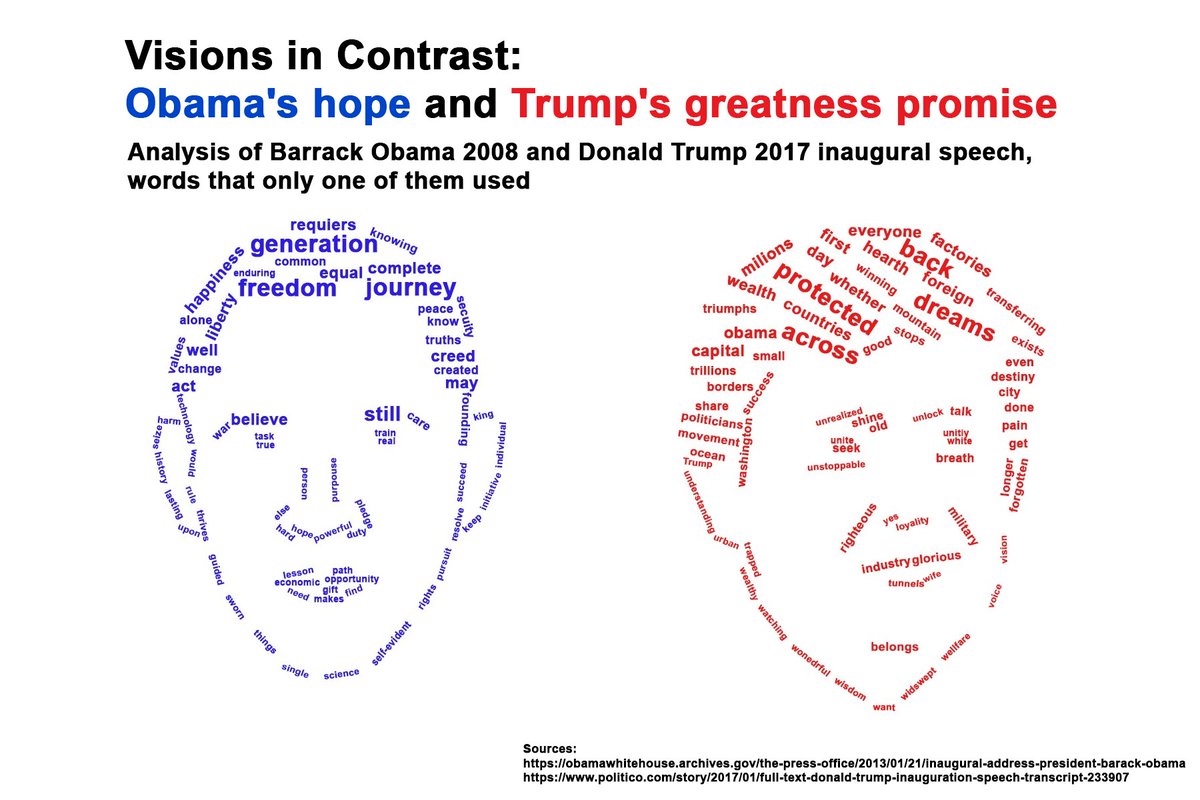
Visions in Contrast: Obama's hope and Trump's greatness promise
Infographic that we created together with @jan_janiszewski and @Diogo_Fontes01 as a part of Communicating with data course at @UnivdeCoimbra, led by @theosmotic
A day in the life of Jesper Brodin is focused on making things better 💪
"6.00 Wake up. Wish I did some yoga but didn’t.
7.00 Breakfast with family if they are at home. Juice, black coffee and a sandwich. If my wife is there, I am reminded to take vi…https://t.co/Vx48o98p1f
Looking for a junior PhD Researcher in the field of combinatorial optimization or machine learning
Are you a passionate problem solver with a talent for optimization? We have an exciting opportunity for you! Join our research team at Universidade de Coim…https://t.co/nVCZv76ysA
📅 Exciting Final Demonstration of our #reinforcementlearning project on Production Scheduling at Colep Packaging! 📅
This week, I had the privilege of attending the much-anticipated final demonstration of PRODUTECH 4S&C, which included our reinforcement…https://t.co/viBEgjw78n
Thank you, Ricardo Almeida and Luis Espinhosa, for your participation. The presentation on Vicaima's production processes provided an invaluable learning experience for the young students of the Bachelor's degree in Industrial Management and Engineering a…https://t.co/fcYZ30I5kC
Many thanks José Pinho for the inspiring talk 👍
IKEA Universidade de Coimbra DEMUC - Departamento de Engenharia Mecânica AEGI-UC / ESTIEM LG Coimbra (official page) https://t.co/Q1euDO0eBn