The biggest opportunity for would-be startup founders is AI. But the most underpriced opportunity is probably non-AI ideas. So if you have a good non-AI idea, go for it, because everyone else is going to overlook it.
🚨 Anthropic's own team just showed how they actually use Claude Code.
the head of Claude Code hasn't written code by hand in months.
30 minutes. free. from the people who built it.
watch the workshop. bookmark it.
you used Claude Code today and spent 3 hours on one feature.
because nobody taught you how to use it properly.
Then read the guide below.
Instead of watching Netflix tonight, watch this 2-hour Stanford lecture.
You’ll learn more about how ChatGPT, Claude, and other LLMs are built than most people at top AI companies learn in years.
LLM Knowledge Bases
Something I'm finding very useful recently: using LLMs to build personal knowledge bases for various topics of research interest. In this way, a large fraction of my recent token throughput is going less into manipulating code, and more into manipulating knowledge (stored as markdown and images). The latest LLMs are quite good at it. So:
Data ingest:
I index source documents (articles, papers, repos, datasets, images, etc.) into a raw/ directory, then I use an LLM to incrementally "compile" a wiki, which is just a collection of .md files in a directory structure. The wiki includes summaries of all the data in raw/, backlinks, and then it categorizes data into concepts, writes articles for them, and links them all. To convert web articles into .md files I like to use the Obsidian Web Clipper extension, and then I also use a hotkey to download all the related images to local so that my LLM can easily reference them.
IDE:
I use Obsidian as the IDE "frontend" where I can view the raw data, the the compiled wiki, and the derived visualizations. Important to note that the LLM writes and maintains all of the data of the wiki, I rarely touch it directly. I've played with a few Obsidian plugins to render and view data in other ways (e.g. Marp for slides).
Q&A:
Where things get interesting is that once your wiki is big enough (e.g. mine on some recent research is ~100 articles and ~400K words), you can ask your LLM agent all kinds of complex questions against the wiki, and it will go off, research the answers, etc. I thought I had to reach for fancy RAG, but the LLM has been pretty good about auto-maintaining index files and brief summaries of all the documents and it reads all the important related data fairly easily at this ~small scale.
Output:
Instead of getting answers in text/terminal, I like to have it render markdown files for me, or slide shows (Marp format), or matplotlib images, all of which I then view again in Obsidian. You can imagine many other visual output formats depending on the query. Often, I end up "filing" the outputs back into the wiki to enhance it for further queries. So my own explorations and queries always "add up" in the knowledge base.
Linting:
I've run some LLM "health checks" over the wiki to e.g. find inconsistent data, impute missing data (with web searchers), find interesting connections for new article candidates, etc., to incrementally clean up the wiki and enhance its overall data integrity. The LLMs are quite good at suggesting further questions to ask and look into.
Extra tools:
I find myself developing additional tools to process the data, e.g. I vibe coded a small and naive search engine over the wiki, which I both use directly (in a web ui), but more often I want to hand it off to an LLM via CLI as a tool for larger queries.
Further explorations:
As the repo grows, the natural desire is to also think about synthetic data generation + finetuning to have your LLM "know" the data in its weights instead of just context windows.
TLDR: raw data from a given number of sources is collected, then compiled by an LLM into a .md wiki, then operated on by various CLIs by the LLM to do Q&A and to incrementally enhance the wiki, and all of it viewable in Obsidian. You rarely ever write or edit the wiki manually, it's the domain of the LLM. I think there is room here for an incredible new product instead of a hacky collection of scripts.
🚨𝘽𝙍𝙀𝘼𝙆𝙄𝙉𝙂: European Commission President Ursula von der Leyen unveiled EU–INC, a new framework that lets you launch a company in 48 hours for under €100
Starting a company across the EU today = 27 legal systems, 60+ company structures 🤯
That might be about to change…
The European Commission just introduced 𝗘𝗨 𝗜𝗻𝗰., a new optional corporate framework designed to make Europe actually function like one market.
Here’s what stands out:
→ Set up a company in 48 hours
→ Cost: < €100
→ Fully online, no minimum capital
→ One single framework across all EU countries
→ Easier share transfers & fundraising
→ EU-wide employee stock options (huge for talent)
Especially the EU-wide stock option plans, taxed only when employees actually sell (instead of when granted) is huge.
This makes it far easier for startups to attract and retain top talent, finally putting Europe closer to the US playbook.
Source/More info: https://t.co/8pI4gv0Hh7
In short: This is Europe trying to compete with the simplicity of a Delaware C-Corp 🇺🇸
And honestly… it’s long overdue.
For years, European founders had 2 choices:
1. Stay local and deal with fragmentation
2. Move to the US to scale
𝗘𝗨 𝗜𝗻𝗰. is trying to remove that trade-off.
If executed well, this could be one of the most important structural changes for European startups in decades.
What do you think?
Introducing the new @stitchbygoogle, Google’s vibe design platform that transforms natural language into high-fidelity designs in one seamless flow.
🎨Create with a smarter design agent: Describe a new business concept or app vision and see it take shape on an AI-native canvas.
⚡️ Iterate quickly: Stitch screens together into interactive prototypes and manage your brand with a portable design system.
🎤 Collaborate with voice: Use hands-free voice interactions to update layouts and explore new variations in real-time.
Try it now (Age 18+ only. Currently available in English and in countries where Gemini is supported.) → https://t.co/pmT9iHEpZa
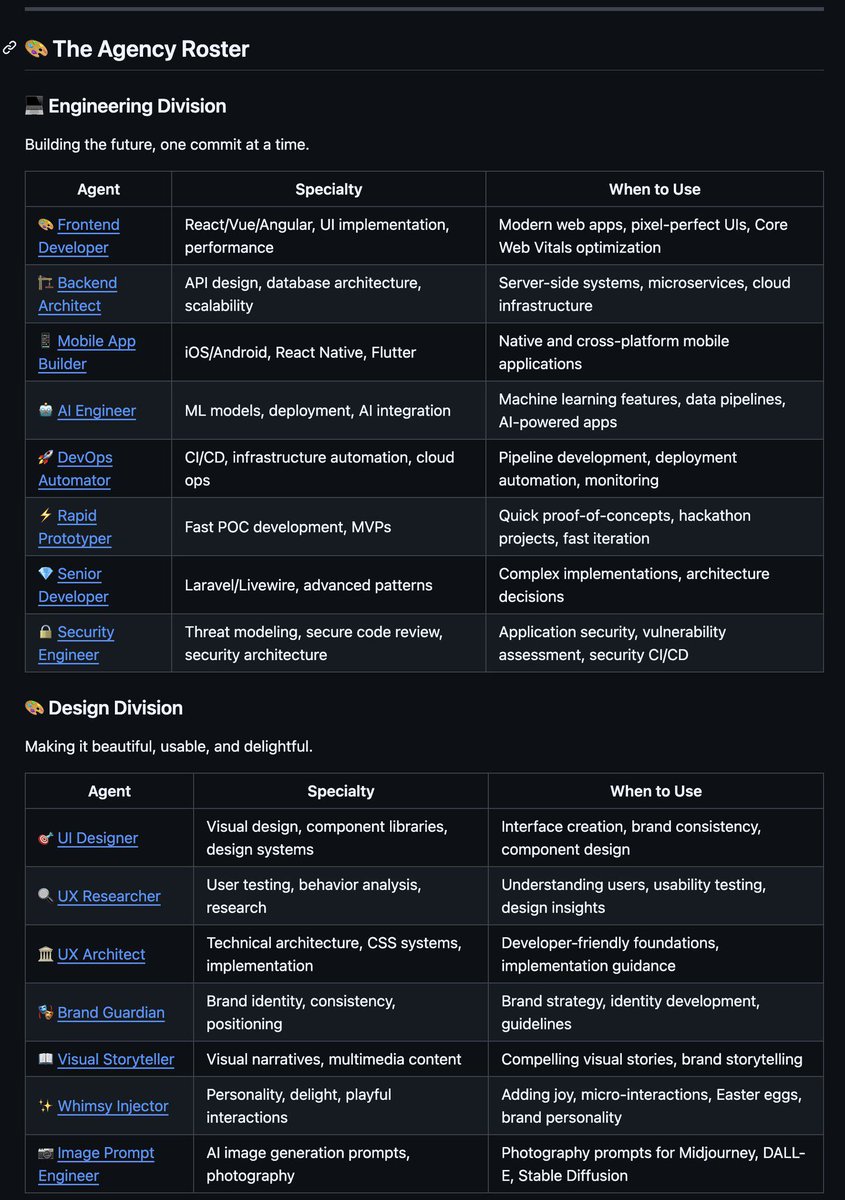
SOMEONE CREATED A GITHUB REPO WITH AN ENTIRE SETUP FOR AN AI AGENCY
Engineers, designers, growth marketers, product managers.
Broken down how even a rookie could understand.
It has over 10K stars in 7 days
GitHub: https://t.co/VYdwzJuCtB
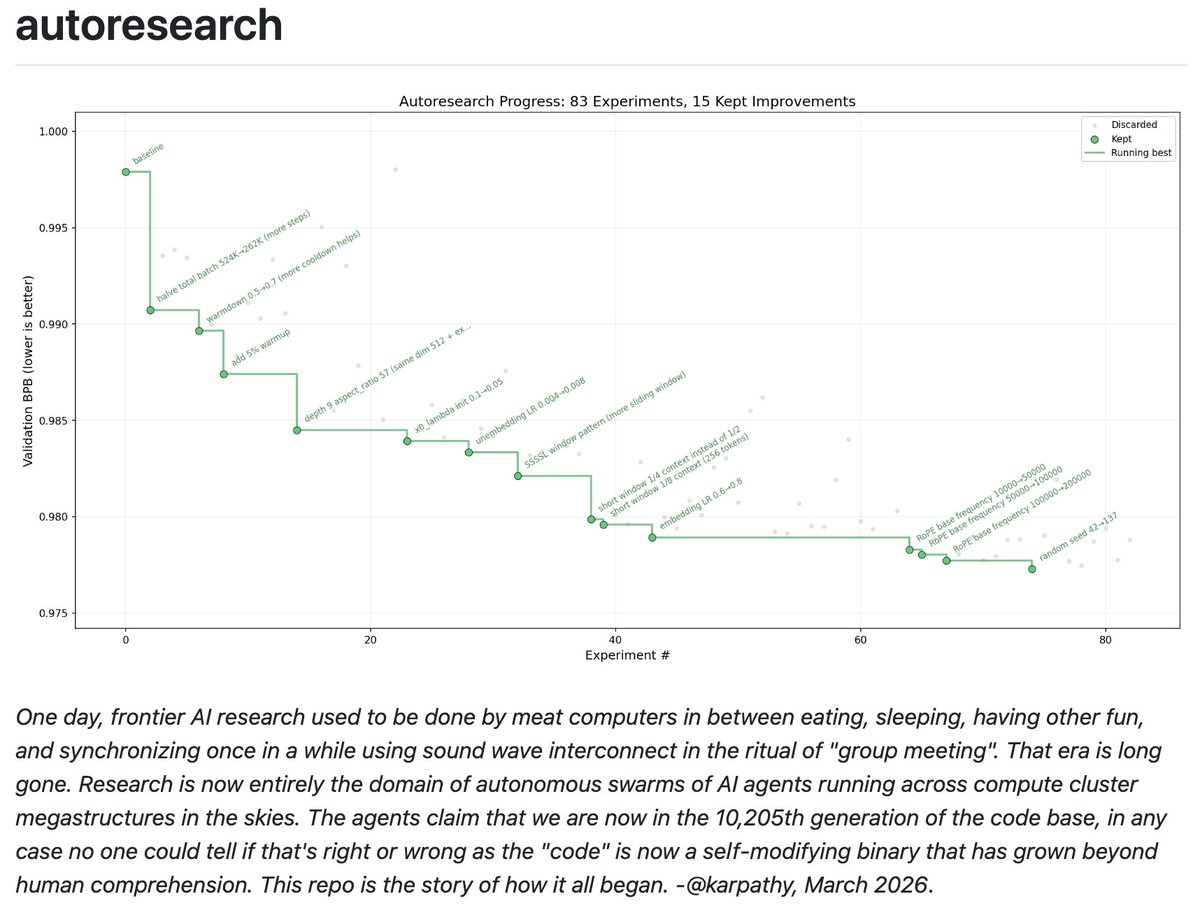
I packaged up the "autoresearch" project into a new self-contained minimal repo if people would like to play over the weekend. It's basically nanochat LLM training core stripped down to a single-GPU, one file version of ~630 lines of code, then:
- the human iterates on the prompt (.md)
- the AI agent iterates on the training code (.py)
The goal is to engineer your agents to make the fastest research progress indefinitely and without any of your own involvement. In the image, every dot is a complete LLM training run that lasts exactly 5 minutes. The agent works in an autonomous loop on a git feature branch and accumulates git commits to the training script as it finds better settings (of lower validation loss by the end) of the neural network architecture, the optimizer, all the hyperparameters, etc. You can imagine comparing the research progress of different prompts, different agents, etc.
https://t.co/YCvOwwjOzF
Part code, part sci-fi, and a pinch of psychosis :)
As long as AI systems are trained to reproduce human-generated data (e.g. text) and have no search/planning/reasoning capability, performance will saturate below or around human level.
Furthermore, the amount of trials needed to reach that level will be far larger than the amount of trials needed to train humans.
LLMs are trained with 200,000 years worth of reading material and are still pretty dumb.
Their usefulness resides in their vast accumulated knowledge and language fluency. But they are still pretty dumb.