For the last 72-ish hours or so, I’ve been working on trying to design cancer drugs – I got started on it with the @adaptyvbio contest, and got super interested enough to continue after the contest closed! Here’s a thread on some background biology, what I’ve tried so far, and why I tried these approaches
(sneak peek of the results)
This is actually a really phenomenal way to go about things, and one of the things I do as well. I usually start with a physical copy of a recent review paper, grab a pen, and write every manner of question that comes to mind on the margins. Then, I put them all in a Google doc, and simultaneously, into Claude along with the paper. I learn quite a bit this way, all while iterating on the questions and getting to a point where the questions evolve into ones of taste, a specific lab’s protocols, and the field’s unknowns themselves; no longer answerable by just reading the papers. I then reach out to the researchers’ whose papers I read
People often ask me what they should work on. They are in medical school, or work as a software engineer, and they want to know what they ought to do in biology.
This is an impossible question for me to answer! I don't know you; I'm not in anybody's head except my own. So I can throw out a bunch of ideas that I find interesting, but most of them won't be interesting to you.
The best advice I can give is just to write. I don't mean writing a blog, or writing for others, but writing purely to think through ideas.
Set yourself a challenge: Say "I will explore one idea per week — something that I think is interesting — and write a short piece about it." Then set aside 1-2 hours per day to explore that idea and write down what you find. Limit your energy on that idea to just one week; no more.
I typically start by writing down a list of questions that I have about the idea. If I was keen to explore, say, bottlenecks in AI for antibody design, then I would start by writing out: "What is an antibody? How do people make them today? Who is using AI to design new antibodies?" Etc. Usually I write down 20-30 questions like this.
Then, I spend time researching each question, one at a time. I answer them, write down my responses, and merge everything together into a single article at the very end.
The benefit of this daily ritual is that you'll figure out (very fast) whether the idea holds your interest, and whether you want to dig deeper after the one-week "trial."
I'd also recommend, while writing, that you reach out to people working on the idea. Send them a focused question, ask to meet, and use writing as a "forcing function" to meet other people. I try to email one new person every day.
At the end of the one week, you don't need to publish the article. Most ideas will not feel that exciting to you, and so you can just quietly scrap them. (About 90% of ideas I explore are never published.) But for ideas that hold your attention, consider sending the article to people via email. Say, "Hey, I wrote about this idea. I'm interested in it, and wanted you to read it." Every job I've had in my life has been downstream of writing about an idea and sending it to other people.
(I had a mentor at MIT who did a similar thing. Every Saturday, he wrote down three ideas and sent them to influential people. After a few months, he received donations from philanthropists to help grow his new lab.)
If you write a little bit every day, you'll quickly find an idea that holds your interest. You will also have used writing as a starting point to talk to people who are working on that idea. How much further is it to now fundraise for the idea? To start a company around it? You've already done a lot of the early work, and are well on your way to figuring out what you ought to be doing.
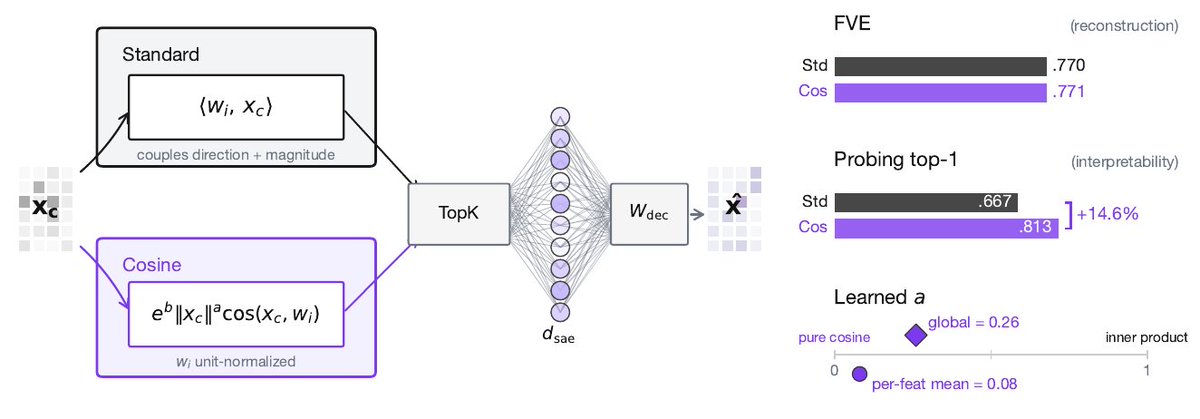
Excited to share that my paper "Size Doesn't Matter: Cosine-Scored Sparse Autoencoders" got accepted as a spotlight at ICML!
We propose cosine sparse auto-encoders (SAEs) which have
- 14.6% better top 1 sparse probing accuracy
- discover ~3x more features
- matched FVE and interpretability
- minimal recipe change
SAEs detect features via inner product, so a feature's activation scales with both its directional alignment and the input's norm
But sublayer normalization discards magnitude entirely, which means the encoder detects a quantity the model does not read!
A learned scalar parameter is free to recover inner product scoring but doesn't, showing that 74% of magnitude is noise
Github and paper below 👇
We just crossed $100M annual run-rate. I know many AI companies are capturing much more $$$ these days, but still proud of the milestone!
Maximizing short-term revenue has never been our priority. In fact, we're proud to manage to store and serve hundreds of petabytes of models and datasets while keeping HF free and open-source for 97% of our users. As a platform, we’re happy to hopefully create orders of magnitude more value for the community than what we capture. To me, that’s the very definition of a platform.
And it has helped us build one of the most loved platform in tech, with network effects, a defensible position and a sustainable business which is quite unique in AI.
Many many thanks to all the community members for building with us, we wouldn't be anywhere without you! Can’t wait for what’s next, especially as more companies start to see the value of open and local AI! Next milestone $1B?
Everyone arguing about whether the Midjourney Scanner can replace an MRI or CT is missing the point.
The reason it's reasonating so broadly, and especially with technologists, is that it could create a beautiful opportunity for The Bitter Lesson to get a foothold in healthcare.
Almost all of our medical data has been totally bastardized by the way we capture and store it. The EHR is supposed to be a medical record, but it is really a billing system. Every patient encounter gets compressed into a lossy template or heuristic just to facilitate billing logic.
The Bitter Lesson is simple. AI gets powerful when you feed it raw, unfiltered data and let learning, search, and compute to the work.
Stop worrying about whether AI can sharpen the resolution of the ultrasonic tomography. If the images get prettier for human interpretation, that will just be a nice bonus.
The actual goal should be to capture as much raw signal of a person's clinical state as possible. Connect that signal to similar measurement of future outcomes. Then let a model learn from that data with minimal imposition of human judgment or measurement.
Start with the assumption that we don't even necessarily know what we're looking for. This is the way to actually do great medical science.
I've watched this play out in endoscopy. As an example, historically we would take 15-20 minute colonoscopy videos of patients with ulcerative colitis and compress it down into a Mayo score of 0, 1, 2, or 3 based on the single worst moment of the entire video. So much data wasted just because we needed a human-digestible heuristic.
It turns out if you instead capture all of that raw data and use it to train a self-supervised model, those embeddings can actually learn far more about a patient's disease state. So much more that they can actually predict treatment outcomes.
This is why I'm personally fired up about the Midjourney Scanner. Don't think about it like an MRI or CT. Think of it as a beautiful fountain of human health data.
One of the most fun things you'll read this week:
A bunch of @iitbombay 20-somethings spent their college year building an actual semiconductor fab of sorts. They're now weeks from their first working transistor.
Technically it's a "hacker fab".
-basically a semiconductor fab you build in a college for not a lot of money (it's hard work though)
-it makes scrappy chips but who's asking state of art
-open source framework that started in the West.
-only some seven such fabs exist
-the IIT-B one is first outside West.
What @hackerfabindia have built:
-lithography machine = an old projector with the optics flipped, printing at 3–4 microns (a human hair is ~100)
-a 1,100°C furnace built by two first-years from cement, ceramic wool and 50m of resistance wire
-a sputter built in-house
-a vacuum chamber
Whole toolkit:
-Rs 15–20 lakh - roughly a campus racing team's annual budget
-First devices (a diode and a MOSCAP) came off their own tools on 12 June
-Full transistor due by end of summer
-2nd in the world to do it on the open HackerFab framework
Tagline:
Why should TSMC have all the fun? 😎 (good one @aryamman_bhatia & team)
@astrokaran's story 👇
https://t.co/EWcBnKDoPv
Officially 1 month since I switched to a flip phone.
- Everyone is more severely addicted to their smartphones than I thought. Once you have a dumbphone, you'll frequently find yourself as the only person in the room not on their phone. It's not just teenagers, it's parents and adults of all ages. It's like everyone is stuck in a trance. 75+ year olds might be the only exception.
- All the objections I previously had for getting a dumbphone have turned out to be overblown and/or solvable. My iPhone addiction had fed my brain excuses to not do this earlier. If you really want to make the switch, you can.
- I've felt embarrassed to pull out my flip phone in public at times, for fear of being different or drawing too much attention to myself. But I have learned to just own up to it. Most people end up saying something like "Oh, I probably should do that too."
- I am using my brain more. Even though my flip phone has Waze, I find myself memorizing maps and roads. I'm more bored and get lost in my thoughts. I'm using paper and pen more. Increased desire for tangible things > digital things.
Overall, it has been a great experience and I plan on never going back.
The breakthrough isn’t the median survival rate doubling, it’s the fact that they’ve finally managed to create a drug that can target the RAS(on) state, rather than selective KRAS mutations. This makes it the first multi selective RAS inhibitor that’s clinically proven to work. The implications are huge. KRAS mutations are found in:
1. 90% of pancreatic cancers
2. 40-50% of colorectal
3. 20-40% lung
4. 19-23% of ALL cancers
I started Oculus while I was living in a trailer working a minimum wage job. I spent years developing the technology and sold it less than 18 months after hiring my first employees. Most of the $2.3B purchase went to them on account of our shared ownership structure.
Wish all you want, but you just aren't correct on this. Individual people create billions of dollars in value all the time.
Big paper coming out soon.
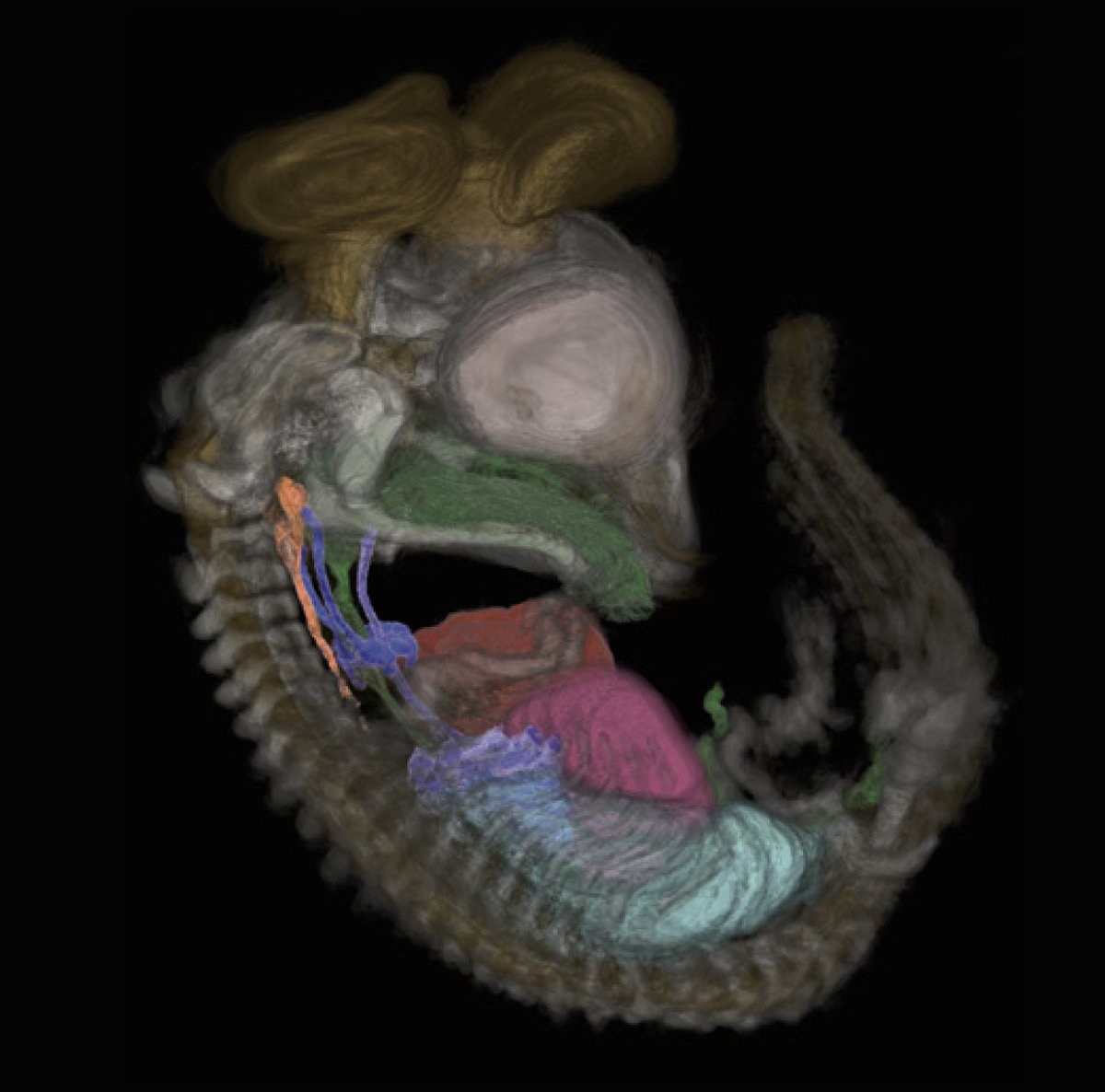
Using AI, we mapped embryos of mice, alligators, turtles, rhesus macaques, and chickens in 3D and at single-cell resolution.
We discovered something truly remarkable...stay tuned!
There must be very few countries in the world, where people fly back to vote even in sub-national elections. Indians do take their democracy seriously.