This exhibition is entirely self-funded via pre-sales of the pieces you can find on my website,- donations and merchandise sales.
If you would like to support my work directly, you can donate here 👇
I’m determined to pull this off and any and every support is greatly appreciated🙏🏼
https://t.co/ZzBhtu5n1F
Dear Ladies,
If a grotesque obsessive twat, who hangs out with convicted sexual offenders, messages you about your children dying of cancer and that you have a rancid cunt, that he knows the names of your children and that even though you have a recording of him talking about using your children to terrorise you, that you've met him, you've spoken to him, you know his voice, even though he's been escorted out of parks by police for harassing you, do not reply to any message with a laughing emoji because the fuckwits in charge of @ASPolice will argue it's not harassment and that you don't know that he was the person calling you as you couldn't possibly identify him on the phone.
Fast forward to 14:44, June 19, 2024. James Blunt ups his trolling and says he will finally announce his favourite cheese at 17:00!
Masterfully done and in true James Blunt style, he keeps me guessing and doesn't tell me!
I know, however, he is paying attention and engaged.
🇨🇴 BREAKING news from Colombia!
Page 247 of the new President’s National Development Plan explicitly calls for “the elimination of surrogacy.”
Not regulation. ELIMINATION.
A strong political signal and another step towards the universal abolition of surrogacy!
https://t.co/2XBO74JkuU
No, gracias.
¿Cómo va a recoger datos pertinentes y significativos quienes no saben que ser mujer no es un sentimiento o una identidad autodeterminada?
A week after a Tenerife footballer died following a collision with another male player, the UN wants girls to risk their lives by playing against boys who claim to be girls. Stop gaslighting women and girls and stop putting their lives in danger!
What people really do not want to accept about women who choose hypersexualised careers, it is almost always because their sense of sexual boundaries were destroyed at a young age. You're not looking at eager consent to that stuff, you're looking at damage done to kids by men.
The best way to ensure everyone is included in sport, is to have everyone participate in the category of sports that corresponds to their own sex. For sport to be truly inclusive it must guarantee the safety, equality and dignity of all those engaged in playing, including women and girls (i.e. females)
I am just returned from a Madrid conference where, yet again, people spoke about their medicalised transition as a something they regret or no longer believe in. They will not appear on any official record of detrans regret. @PeterTatchell you seriously don't know about this clinical area and you grasp onto this 'latest research' figure from the ether. Please stop promoting a wishful lie. If you care about those struggling with their sexed body or sexuality and identity you should be interested to learn about those who are actually afraid to return to their 'abusers' eg the clinics who led them down the transition pathway.
Armengol: "Pero ¿cómo voy a decir que quiero un presidente que sepa sonreír y que sepa amar?"
Jefe de campaña: "Dilo, nuestros votantes son gilipollas".
Armengol: "Es verdad. Siempre se me olvida".
Después de joderles la vida a adolescentes y jóvenes con tratamientos que provocan esterilidad y anorgasmia, les recomiendan usar a una mujer como vientre de alquiler y les ofertan facilidades de financiación.
To all the women caping for the right of men like this to enter women’s single-sex spaces, please explain why you care more about keeping him happy than you do about the women he’s threatening to punch. Extra points for explaining how your position is ‘real feminism.’
🚨 CHINA: NO SUCH THING AS ETHICAL SURROGACY.
China has reaffirmed its prohibition of ALL forms of surrogacy, warning of the serious risks to women and children.
Not just commercial surrogacy, ALL surrogacy.
https://t.co/MHKAQnf59A
Every country that joined consensus on April 8 to nominate Iran must apologize.
This includes Britain, France, Germany, Canada, Spain, Norway, Netherlands, Australia, Switzerland, Austria, and Finland.
Only the U.S spoke out to disassociate itself:
https://t.co/4oE8NIQgEw
I've read the Women's Resource Centre article, and I have to say I'm deeply uncomfortable with its argument.
There is a difference between making sweeping generalisations about an entire population and raising legitimate concerns about patterns of behaviour, cultural attitudes, institutional failures and women's safety.
What concerns me about this article is how quickly it moves from describing a handful of survey responses to making sweeping claims about the political direction of an entire section of the women's movement.
Apparently, if women raise concerns about migrant men, asylum policy, sexual violence or the treatment of women within particular cultural and religious communities, we're now dangerously close to the far right.
Really?
Women have spent decades being told to speak up about male violence. We've been encouraged to name it, challenge it, examine the conditions that enable it and demand that institutions take it seriously. But apparently there are now restrictions on which men we're allowed to talk about, which cultural practices we're allowed to criticise and which questions we're allowed to ask.
Women's safety doesn't become less important because discussing it makes somebody uncomfortable.
And let's talk about the three examples the WRC uses to illustrate what it considers hostility towards migrant men.
• Firstly, concerns about male asylum seekers and women's safety.
Of course women are going to be particularly concerned about male asylum seekers when discussing women's safety. That's hardly surprising, is it?
Women are discussing sexual violence, safeguarding, accommodation and the risks associated with living alongside unfamiliar men. Why would we expect women not to raise those concerns?
Perhaps we should establish exactly who we're talking about here. Are we discussing asylum seekers generally, or are we specifically discussing the men arriving in the UK by small boats?
These are not interchangeable categories, and pretending they are doesn't help anyone have an honest conversation about immigration policy or safeguarding.
The fact that the men in question are migrants doesn't mean women must switch off their safeguarding instincts.
And why does the article seem to treat concern about the safety of migrant women as legitimate, but concern about the safety of women in communities receiving asylum seekers as somehow suspicious?
Both deserve consideration.
And here's the elephant in the room: we know that some of the men arriving in these circumstances come from countries and cultural backgrounds where women have significantly fewer rights, where misogyny is deeply entrenched and where women's freedom and independence are restricted in ways that would be unacceptable here.
The suggestion seems to be that once these men arrive in the UK, those attitudes somehow disappear at the border. That they leave those beliefs behind along with their belongings. But why would we assume that? Cultural attitudes don't automatically change because somebody crosses the Channel.
Of course, not every man from those countries holds the same beliefs, and individuals should be judged on their own actions. But pretending that cultural attitudes have no bearing on how women are treated is just as dishonest as making sweeping assumptions about every individual.
And if anyone thinks I'm making this up, look at the Government's own actions.
In August 2026, the Home Office published a nine-page guide for asylum seekers explaining that rape and sexual assault are crimes, that consent is required every time, that women have equal rights to men and that men cannot control what women wear, where they go or whether they work.
Think about that for a moment.
The Government considers it necessary to explain these basic principles to men arriving in this country. We're talking about having to spell out that you cannot rape women, sexually harass them or control their lives.
So when women raise concerns about the attitudes some men may bring with them, perhaps those concerns aren't quite as unreasonable as the WRC would like us to believe.
Why is the Government recognising the need to communicate these expectations while women who raise the underlying concerns are accused of prejudice?
We should be able to have an honest conversation about why this guidance was considered necessary in the first place, without immediately being accused of racism.
We should be able to talk openly about these differences, ask how they affect women's safety and discuss what expectations we have of people coming to live in this country. That isn't racism. It's a legitimate conversation about women's rights.
• Secondly, concerns about sexual violence against women travelling through irregular migration routes.
The article describes one respondent's claim that women and girls arriving through irregular migration routes face an almost universal risk of rape as a sweeping assertion.
But this isn't some fringe concern invented by an angry respondent on a survey. There are very real, documented cases of women being raped, sexually assaulted and exploited during these journeys.
And these aren't just dangers experienced on migration routes elsewhere in the world. There have been documented cases involving women arriving here in the UK.
One woman had disclosed being repeatedly raped by a people smuggler just five days before leaving France. She was described as suicidal and inconsolable. Another woman disclosed that she had been raped twice during her journey to the UK.
The Home Secretary, Shabana Mahmood, has also recently raised this issue, stating that nearly every woman attempting to reach the UK by small boat from northern France has probably been raped during the journey.
So is the Home Secretary also expressing hostility towards migrant men? Or is it possible that this is a serious safeguarding issue that deserves to be discussed?
You cannot dismiss concerns as racist simply because they overlap with arguments being made by people whose politics you dislike.
If anything, these accounts demonstrate precisely why the safety of women and girls should be central to any discussion about migration.
• Thirdly, the suggestion that refugee protection should prioritise women and children.
Well, yes. Women and feminist organisations have historically advocated for women and children to receive particular protection in situations of war, conflict, displacement and sexual violence.
Why? Because women and children are often particularly vulnerable to sexual violence, exploitation, trafficking and abuse.
That's not a radical concept. It's a fairly fundamental part of safeguarding.
Prioritising women and children doesn't mean that men cannot be victims, that male refugees don't deserve protection or that every individual man is responsible for violence.
Since when did advocating for women and children become evidence of prejudice?
And let's talk about intersectionality, because it's being used here as though it gives some women the authority to decide which concerns are legitimate and which are politically unacceptable.
Intersectionality should mean recognising that women have different experiences. It shouldn't mean creating a hierarchy in which some women's experiences are given greater legitimacy while others are treated with suspicion.
Working-class women, black women, white women, migrant women, lesbian women and women from religious minorities all have the right to speak about their experiences.
None of us should have to qualify our concerns by first demonstrating that we hold the correct political opinions.
Who gets to decide which concerns are acceptable, and whose voices are being dismissed? There's something particularly patronising about women in organisations and institutions telling working-class women what they should be concerned about, how they should interpret their own experiences and which opinions they should hold.
Working-class women are often the ones living with the consequences of decisions made by people who don't share their circumstances.
We're expected to accept those decisions quietly, and if we question them, we're told our concerns are rooted in prejudice. It's another way of telling certain women that they don't know what's best for themselves.
Dose the writer live next door to a HMO? Is there one next to their daughter's school? Do they pass encampments of men on their way to work in the morning? Do they see groups of men hanging around drinking all day in the local park or by their local shop?
Because this is the reality for many women, including myself. These aren't debates happening in a conference room or on a survey.
They're things women encounter in their everyday lives, in their neighbourhoods and on their doorsteps.
It's easy to dismiss women's concerns when you aren't the one living with the consequences.
Just look at Piddington in Oxfordshire. Plans to accommodate up to 1,256 male asylum seekers at a former military site near the village prompted 133 local women to write an open letter to female MPs, raising concerns about their safety and the impact on their community.
And this isn't some political debate for those women. It's their village, their homes, their children and their everyday lives.
It's easy to lecture other women about tolerance and accuse them of prejudice when you aren't the person being asked to live next door to the accommodation, walk past it every day or consider what it might mean for your family.
I also find the suggestion that gender-critical feminism is increasingly converging with the far right particularly lazy? Are we talking about specific individuals, organisations, political alliances or simply women who disagree with the author's interpretation of immigration and women's safety?
If there are examples of racism, name them. If there are examples of far-right political alliances, identify them. But don't use the existence of some unacceptable comments to cast suspicion over an entire movement.
And let's not forget that the article itself acknowledges that there are legitimate debates to be had about sex-based rights. Yet it seems remarkably comfortable drawing political conclusions about the women having those debates.
There is something deeply ironic about an organisation that says it doesn't want to police the women's sector while simultaneously setting out which political positions it considers acceptable and which women need to examine their assumptions.
A women's movement that only welcomes women who arrive at the approved political conclusions isn't much of a movement for women at all.
And then we get to the conclusion, which I think is particularly telling.
The author appears frustrated that, rather than accepting the WRC's position, women have challenged it, raised objections and expressed views that the organisation finds unacceptable.
And what is the proposed response? Apparently, the women's sector must now spend time making sure women aren't racist.
Just stop and think about that for a moment.
Women raise concerns, disagree with an organisation's position and challenge its political framing, and the response is to suggest that those women need educating about racism.
Whatever happened to engaging with the arguments? Whatever happened to taking women's concerns seriously, even when you disagree with them?
You cannot claim to be building a broad women's movement while treating women who disagree with you as a problem that needs correcting.
The problem isn't that women need to be taught not to be racist every time they express an opinion the organisation dislikes.
The problem is an apparent unwillingness to accept that women can arrive at different conclusions, raise uncomfortable questions and disagree without their motives being put on trial.
We should be able to challenge misogyny without making excuses for it when it appears in communities we'd rather not offend.
We should be able to discuss immigration without being branded extremists, and we should be able to defend women's sex-based rights without having our politics defined for us by somebody else.
Truth doesn't become racism because it's politically inconvenient.
And women's rights shouldn't come with a list of subjects we're no longer allowed to discuss.
Women are not a political re-education project.
https://t.co/RwrkMv676F
Men have gathered for a weekend conference in Brussels at the @RadissonHotels Collection Hotel to learn and discuss how they can separate babies from their mothers at birth.
The programme includes “surrogacy options” and advice on “picking providers”.
This “Parenting Options for European Gay Men” conference is run by Men Having Babies, but one thing for sure is, it’s not men having the babies. It’s women.
This is #surrogacy.
In Tasmania, Huon FM presenter Iris Richter was dismissed after interviewing women's rights advocate and WST adviser Isla MacGregor.
WST also faced demands to remove the interview and related material following the threat of legal action.
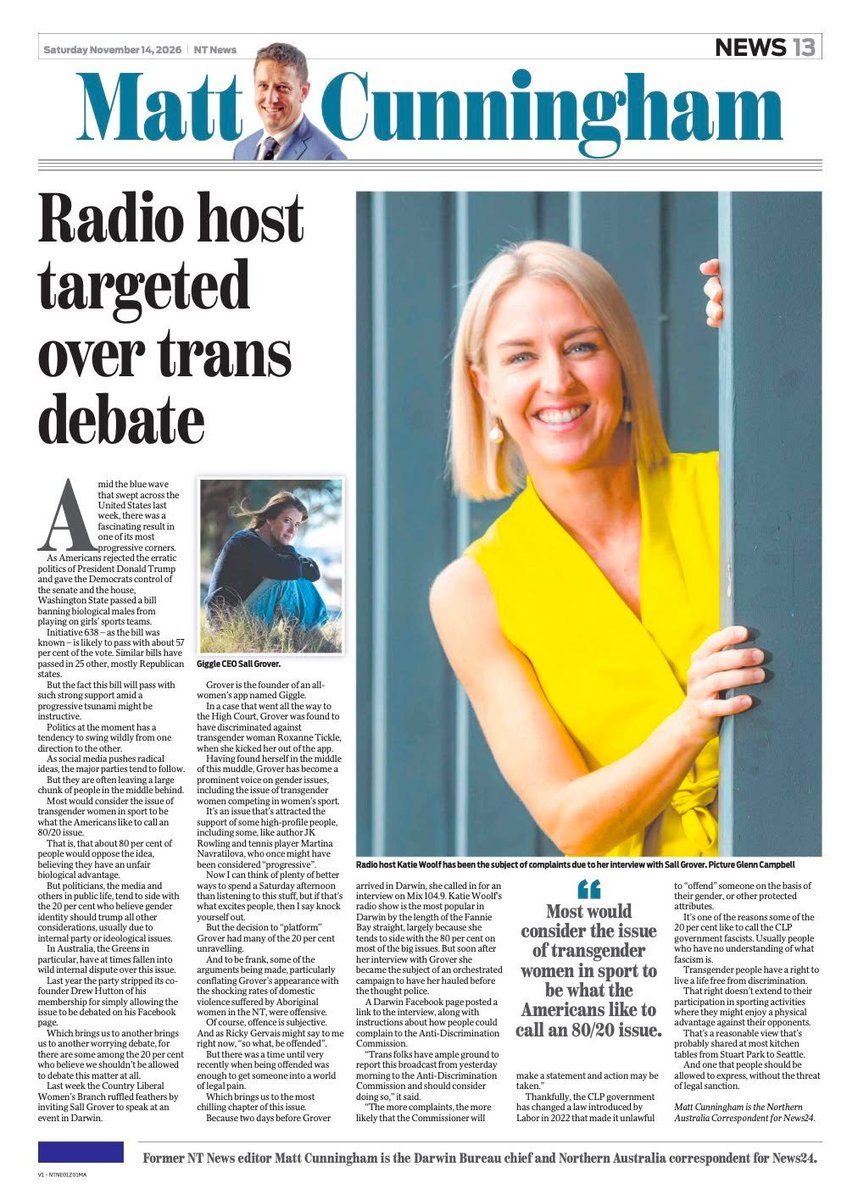
Now, a similar controversy is unfolding in the NT, where a radio presenter is facing calls for complaints after interviewing Sall Grover.
Different states, but the same troubling question: are journalists and broadcasters free to give women a voice in debates about their own rights?
Read WST's report on the Huon FM incident:
https://t.co/joweYwZ9mc
Read the NT News: