Are you facing frequent temperature sensor failures?
Common causes: wrong sensor type, missing thermowell, or poor installation.
Share your application — we’ll help you find a better solution.
#Thermocouple#RTD#TemperatureSensor
Choosing the right temperature sensor matters.
Thermocouple → Best for high temperature & fast response RTD (PT100) → Best for higher accuracy
Tell us your operating temperature range, we’ll suggest the right option.
#Thermocouple#RTD#IndustrialAutomation
Need durable Thermocouples & RTDs for your process?
We manufacture custom temperature sensors as per your exact requirements.Available in different sizes, sheath materials and configurations.
DM for quotation.
#Thermocouple#RTD#TemperatureSensor
What is the highest temperature in your process?
Reply below and I’ll recommend the most suitable sensor type for your application.
#Thermocouple#RTD#TemperatureSensor
Quick tip for longer sensor life:
Always use a proper Thermowell in high-pressure or high-velocity applications. It protects the sensor and improves measurement stability.
Facing frequent sensor failures? Share your application details.
#Thermocouple#RTD#IndustrialAutomation
Looking for reliable Thermocouples & RTD Sensors?
We manufacture custom sensors as per your process requirements.Multiple sizes, sheath materials & fast delivery from Ahmedabad.
DM for quotation.
#Thermocouple#RTD#TemperatureSensor
@Blueskies_CP Carbon buildup acts like an insulator and causes false flame dropouts! Perfect timing before that 32° drop.
Did you clean it with wire wool or light sandpaper to avoid damaging the sensor tip?
@GividenRic78614@FrankBr05713205 That's classic thermocouple failure—it fails to sense the flame and cuts off the gas supply for safety!
Are you using universal replacement thermocouples or OEM parts for those fixes?
@AetherCzar@DavidARFerguson Using an ice bath as a 0°C reference junction is a classic metrology technique for IR calibration!
Are you using a PT100 RTD or a thermocouple probe for the reference bath?
@AetherCzar@DavidARFerguson That setup makes total sense! Using an ice bath as a steady 0°C reference junction is standard for precise IR calibration.
Are you using a RTD or a Type-K thermocouple for your reference probe in the bath?
@packworldusa Switching from thermocouple control to closed-loop resistance heating is a game-changer for thermal accuracy and power efficiency! ⚡
Are you currently using thermal resistance sealing or traditional constant-heat bars in your packaging lines?
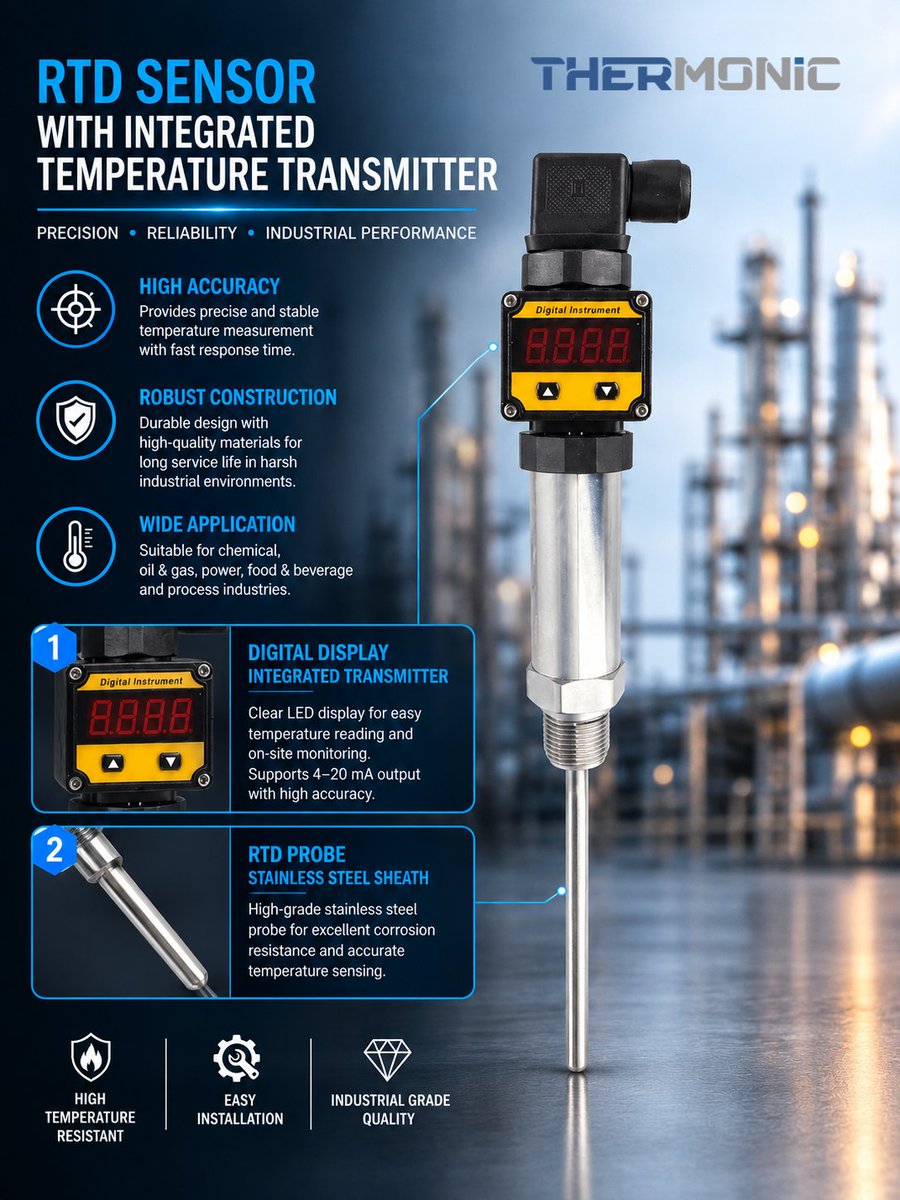
🌡️ Accurate. Reliable. Industrial-ready!
Thermonic RTD Sensor with Integrated Digital Display and 4–20 mA output.
🌐 https://t.co/yFnrjtQhjr
#Thermonic#RTDSensor
"United India is our strength." — Sardar Vallabhbhai Patel ⚡
Honoring the visionary leadership of the Iron Man of India on his Jayanti.Building precision technology for a strong and self-reliant nation.
DM for quotation.
#NationalUnityDay#IronManOfIndia#Thermonic
@eevblog Seebeck effect aur cold junction compensation ko samajhne ke liye EEVblog ka yeh tutorial ekdum perfect hai!
Are you using Type-K thermocouples with a dedicated cold junction compensator in your current measurement setup?
@JasonMac Exposed thermocouple wires touching the housing will easily short out the signal and cause temperature drift!
Are you using grounded or ungrounded thermocouples in this setup?
It actually worked on the first try!
How incredibly lucky is that!
The blue light you see is from the scintillation paper. Electrons are hitting it at very high speed, causing it to fluoresce.
No ionization between the anode and cathode and no melting insulation this time. You can tell by the steady light and solid vacuum level during operation that this time, it’s the real deal.
So, about the setup. All the vacuum equipment is either second hand from my old job or from Ebay. I think I spent less than $3k all said and done. (Old Pfiefer turbo was the worst offender). Thats being water cooled by a literal PC cooler. The roughing pump is an Edward’s E2M2. Mid range gauge is a thermocouple gauge. High range gauge is an inverted magnetron gauge.
For lack of a better power supply, I’m using 2 battery packs to isolate the 2.5V heater power from the 10kV cathode power.
And yes, nothing is grounded but the chamber. I know it’s dangerous. As long as I only touch it with one hand and keep the rest of myself isolated, there is very little risk. That being said, if anyone can recommend a good (and affordable) high voltage power supply that can manage a floating 10kV or higher, I’ll probably upgrade and integrate it into the rig.
@CALVINGINEERING Agree. Many people overlook the importance of proper thermowell design.
Are you using a thermocouple gauge for the rough vacuum range, or what pressure are you pulling down to with the Edwards pump?
@jonoxer True. In process industries, even a small error in temperature measurement can affect the entire batch quality.
What max temperature are you profiling up to in this reflow run?
@rasheedoseni_ Great build! Using a Type-K thermocouple with the MAX6675 amplifier and Arduino Uno is a solid choice for fast response and high-temperature accuracy.
What maximum process temperature are you aiming to measure with this setup?