I love that every time @LukasPakter tweets about AppLovin, it’s in ALL CAPS..
He’s either really excited about the partnership or entering his dictator phase..
Either way, I’m here for it and excited to help @TrybeUGC brands crush it!
🤖 I committed to posting one way I'm using AI every day.
Here's tip #55
56% of this brand's Meta "purchases" came from people who never clicked an ad. The platform took full credit for every one.
A founder showed me his Meta account last week. More than half the purchases Meta was reporting were view-through. Someone saw an ad, scrolled past, bought later for their own reasons, and Meta raised its hand and said that one was me. On click-only, his real ROAS was about 0.4. He was scaling on a number that was mostly fiction.
You can't catch this by staring at the dashboard, because the dashboard is the thing lying to you. So I had him run it through AI properly. Strip out the view-through, separate the purchases that would have happened anyway from the ones the ads actually caused, and show true incremental ROAS by campaign type.
The real picture: only about half of purchases were genuinely incremental. 82% in prospecting, where the ads are finding new people, and just 31% in retargeting, where you're mostly paying to reach buyers already on their way. One single ad was driving half of all purchases. And 40% of the spend produced nothing at all.
Here's the prompt:
"Here's our Meta purchase data with click-through versus view-through, spend, and results by campaign and ad. Separate view-through from click-driven purchases, estimate how many would have happened without the ad, and show me true incremental ROAS by campaign type. Then flag the ads and the spend that are producing no incremental purchases."
If you've never split view-through from click and checked incrementality, you don't know your real ROAS. You know the story the platform wants to tell you.
If you stripped out every purchase that would have happened anyway, how much of your ad spend would still be standing?
Wanna dig into AI stuff? Let's chat 👉 https://t.co/C2GELDVjSs
🤖 I committed to posting one way I'm using AI every day.
Here's tip #54
I was looking through a brand's ad account last week. 124 Meta ads, and 114 of them pointed to basically the same page. That's not a funnel, that's a bottleneck.
The logic made sense. They found the page that converts, a bundle builder, and sent everything to it. But Meta only learns from the paths you give it. When every ad and every angle dumps into the identical pitch, you cap what the algorithm can figure out, and no audience feels like the page was built for them.
So I pulled all 124 ads and had AI group them by the actual promise each one makes. About a dozen distinct promises, all pointing at the same page. Some sold a gift, some sold a routine, some sold a fast result, and every one landed on the same generic bundle builder.
Then I had it draft the page each promise needs. The headline, the angle, the proof that buyer is looking for. A blueprint for the 25 to 35 pages they were missing instead of guessing.
Here's the prompt:
"Here are all 124 of our active Meta ads and our customer personas. Group the ads by the specific promise or angle each one makes. Show me where different promises are all landing on the same page. Then for each distinct promise, draft the landing page it should point to: the headline, the angle, and the proof that audience needs to see."
One page gives the algorithm one thing to learn. Match each promise to its own page and every audience finally gets a reason to buy.
How many different promises are your ads making right now, all pointing at the same page?
Wanna dig into AI stuff? Let's chat 👉 https://t.co/C2GELDVjSs
We tested putting our AI support on autopilot at @my_obvi.
Response times looked great. Dashboards looked great. Then I started looking at reopens.
Different story.
Most brands running AI support are optimizing for the wrong thing from day one. A closed ticket that comes back two days later wasn't resolved, it was just postponed.
Novaalab figured this out early. They hit 45% end-to-end resolution with zero reopens in their first month, and on October 8th, they're sharing their whole paybook for FREE in a live webinar.
Join me, Anna from NovaaLab, and @sachinjaiswal from @kim_cc_official to learn what they changed, what they refused to cut corners on, and the mistakes most brands make before they even get started.
This is going to be a great one. Register for free with the link in the top comment 👇
For years, we made one mistake at @my_obvi without realizing it:
We never actually asked if our customers were ready to reorder.
That one shift is behind one of the best-performing channels we've added to Obvi this year, and we just published the full case study on it with rePete by @bold_commerce.
The results so far:
→ 36X ROI without spending a single dollar on new customer acquisition
→ 28% higher AOV on reorders through rePete vs. our other repeat orders
→ 13% higher revenue per customer from buyers who reorder through this channel
→ 6% of all of Obvi's repeat purchase revenue now flows through rePete (and growing) from a channel that didn't exist for us before
→ 32% of those reorders get upsized by Smart Cart's add-on suggestions
→ Zero impact on our subscription program. rePete never touches our subscribers — every dollar here is additive, not cannibalized
Setup took one call, about 20 minutes. First predictions were live in under 24 hours.
If you're running a repeat-purchase brand and still treating every customer with the same outreach calendar, you're leaving real revenue on the table.
Click the link below for all the receipts 👇
🤖 I committed to posting one way I'm using AI every day.
Here's tip #53
A founder I was talking to told me they push the offer that converts 20% worse. On purpose. It's one of the best decisions they've made all year.
They tested their offers and one-time purchase converted about 20% higher than monthly subscription. Monthly converted about 20% higher than annual. So the front-end math screamed the obvious answer: lead with one-time, make it easy to say yes. Every conversion instinct you have says push the thing that converts best.
Then they looked at what happened after the sale. One-time buyers barely came back. But about 70% of annual buyers stayed past the trial. The offer that converted worst produced the customers worth the most, by a mile.
The reason most brands never see this is that conversion rate shows up today and LTV shows up over the next year. So the worse offer looks smarter every single morning you check the dashboard.
AI settled it. Fed it every offer's take rate, retention curve, and revenue per customer over time, and asked which offer actually makes the most money per visitor once you follow each cohort out a full year, not just to checkout.
Annual won, and it wasn't close. They leaned in and took recurring revenue from 10% to 20% of sales.
Here's the prompt:
"Here's our one-time, monthly, and annual offers with the conversion rate on each and the full retention and revenue history for customers who chose each one. Project total revenue per visitor for each offer over 12 months, not just front-end conversion. Tell me which offer to lead with if I'm optimizing for lifetime value, and what it costs me in day-one conversion to do it."
Judge an offer by the customer it produces, not the conversion rate it posts today. The best one on the dashboard is often the worst one for the business.
If you ranked your offers by the customers they create instead of the conversions they post, would you still be leading with the same one?
Wanna talk AI? Grab time 👉 https://t.co/C2GELDVjSs
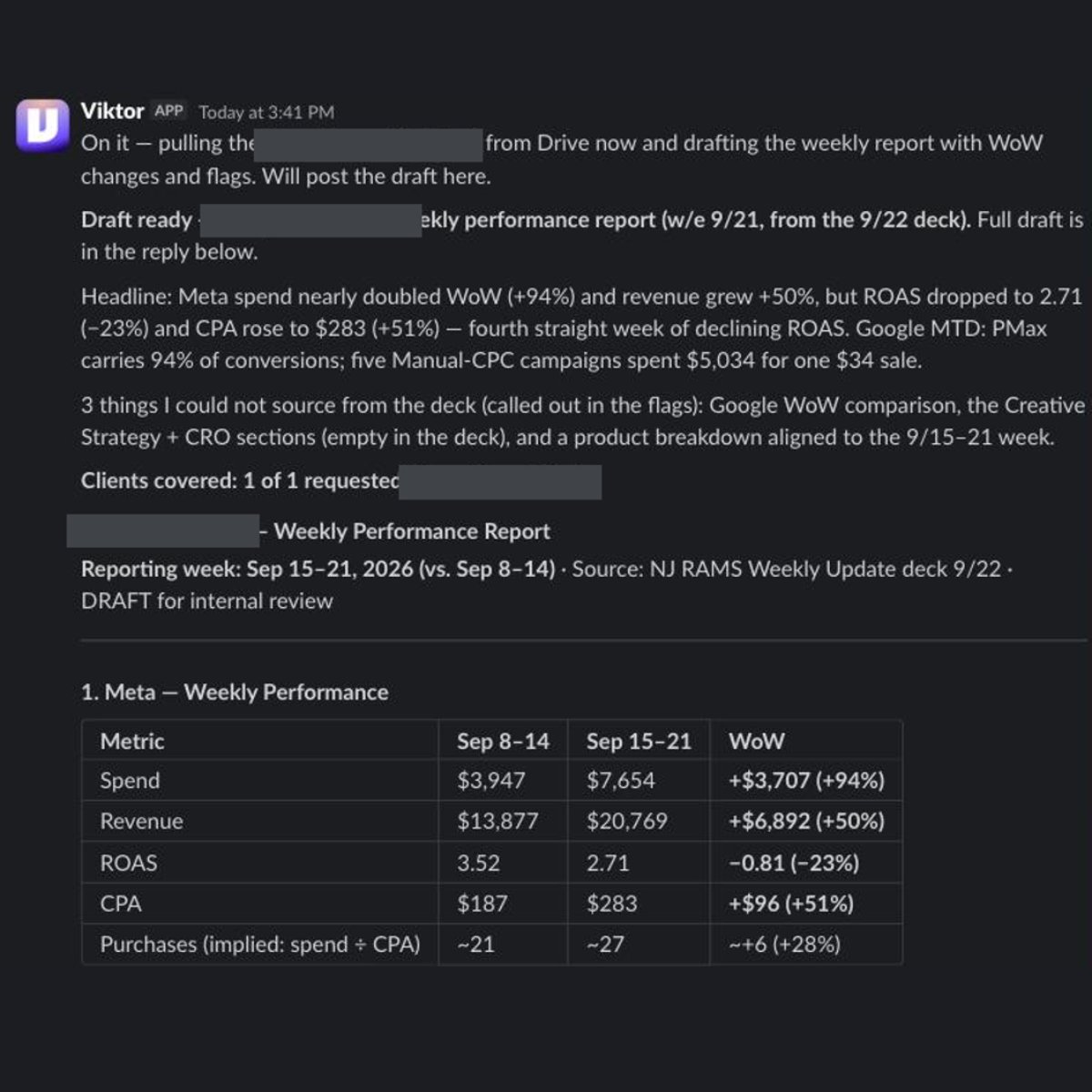
I put our weekly client reporting on an AI employee. His first report flagged five campaigns that had spent $5,034 for one $34 sale.
He read the whole account before any of us opened a dashboard.
We manage paid media across a couple dozen DTC brands. Every Monday someone rebuilds the same client report by hand. Pull the numbers, compare week over week, write the flags. Across every account it eats a full day.
We tried the usual fixes. A shared template, a reporting sheet, an extra analyst pass. It saved minutes, not the job.
So I gave Viktor one standing job in our Slack: read each client's numbers and draft the weekly report before we start.
I figured he would just format numbers we already track. Then the report came back with the real story: Meta spend had nearly doubled week over week at +94% and revenue was up 50%, but ROAS had slipped to 2.71, down 23%, and CPA had climbed to $283, up 51%, the fourth straight week of decline. PMax was carrying 94% of conversions while five manual campaigns had drained $5,034 for a single $34 sale.
He proposes the report. A strategist on our team reviews and sends it. But the catch was his.
Now the flags are already on the table before anyone logs in, so our strategists spend Monday acting on the account instead of hunting for the problem.
A copilot helps you work. An AI employee works when you don't.
Hire @viktor_com for your team. $100 in credits included, no card. Full link in first comment.
#AIemployee #mediabuying #DTC
Paid Partnership
🤖 I committed to posting one way I'm using AI every day.
Here's tip #52
A nine-figure beauty brand shut off every paid ad for 18 months. It was the best growth decision they ever made.
iOS 14 took their ROAS from 4x to under 1 almost overnight. Instead of grinding it out, they turned paid off completely and spent a year and a half building an army of nano and micro creators. When TikTok Shop hit the US in 2023, that creator base was already there, and it became the engine that took them past nine figures and number one in their category. Halo lifted Amazon, DTC, and eventually retail. Not a dollar of paid.
Here's the part nobody talks about: an army of creators means finding hundreds of small accounts that genuinely fit your product. You can't do that by scrolling TikTok. It's why most creator programs stall at 20 people.
So this is what I use AI for. I point it at a category and have it pull nano and micro creators who already post about products like ours, then score them on fit, real engagement, and whether they actually drive sales, not follower count.
Here's the prompt:
"Find nano and micro creators, 1k to 50k followers, who post about [category] and whose audience matches our customer. For each, give me their handle, how often they post product content, their real engagement rate, and a fit score, so I can build a seeding list of the 200 most likely to convert."
The channel that saves you next gets built while the old one is dying, not after. And finding the right people at scale is exactly what AI is built for.
If your top acquisition channel died tomorrow, how long would it take you to stand up the next one?
Wanna nerd out on AI? Grab time 👉 https://t.co/C2GELDVRI0
Here's a number that bothers me: the best subscription programs in the world only convert about 20% of repeat customers.
The other 80% reorder on their own, with no cadence, no nudge, and no one managing the relationship.
We've scaled @my_obvi past $100M, and I used to think subscriptions were the whole retention story.
They're not.
They're just one channel for one type of customer.
So we teamed up with rePete by @bold_commerce to go after the other 80%, and just published a full resource guide breaking down how we - and other leading DTC brands - are doing it.
It’s free, and it will teach you:
→ The truth behind "subscription fatigue" (fewer than 20% of cancellations happen because someone stopped wanting the product)
→ The shift from scheduled commerce to predicted commerce (using AI to know when a specific customer is ready to reorder)
→ How @Built_Bar grew reorder revenue 4x faster than subscription revenue in just 60 days (without cannibalizing a single existing subscriber)
If you're running a repeat-purchase brand and subscriptions are your only retention lever, you're leaving the majority of your repeat revenue unmanaged.
This guide is the playbook we wish we'd had years ago.
Click the link below to access the guide for free - this is worth 10 minutes of your time.
🤖 I committed to posting one way I'm using AI every day.
Here's tip #51
One headline lifted purchase conversion 41%. That same week, a broken add-to-cart button roughly doubled our CAC. Neither had anything to do with the ads.
At a supplement brand we run growth for, we reframed the flagship product page from a hack into a daily habit. Conversion up 41%, revenue per visitor up 29%, subscription add-to-cart up 36%. One headline.
Same week, CAC on the top bundle doubled. Everyone's first instinct was the ads. It wasn't. It was malfunctioning add-to-cart buttons and payment interruptions on brand new product pages. Broken plumbing, not creative.
And in a regulated category, new creative takes 45 to 50 days to clear compliance. Misdiagnose a site problem as an ad problem and you're six weeks from a fix that was never going to work.
So we stopped relying on someone noticing. AI runs the funnel every day, clicks through checkout on desktop and mobile, and flags broken buttons, failed payments, and slow pages before they burn a day of spend.
Here's the prompt:
"Crawl these product and checkout pages daily on mobile and desktop. Test the add-to-cart and payment steps. Flag anything broken, slow, or throwing an error, and rank it by how much traffic and revenue it touches so I know what's actually bleeding money."
The website moves CAC harder and faster than the ad account does. Check the plumbing before you touch a budget.
Next time your CAC jumps, are you sure it's the ads, or have you tested your own checkout today?
Wanna dig into AI stuff? Let's chat 👉 https://t.co/C2GELDVjSs
🤖 I committed to posting one way I'm using AI every day.
Here's tip #50
The product that stops the scroll is almost never the product that gets bought.
I learned this from someone who's signed 176 brands over $50M GMV. In catalog-heavy categories, fashion, jewelry, footwear, you're sitting on 2,000 to 5,000 SKUs. The hero products stop the scroll. But the boring everyday core items are 70% of revenue, and they only show up once someone's already on the site.
So brands feed the ad platform their prettiest hero SKUs and wonder why CAC won't drop. They're advertising the wrong products.
You can't eyeball 3,000 SKUs to find the ones that actually convert. So we let AI do it. Feed it the full catalog with sales, margin, and repeat rate, and it surfaces the real revenue drivers hiding in the middle of the list.
Here's the prompt:
"Here's our full catalog with units sold, revenue, margin, and repeat rate per SKU. Ignore the hero products. Show me the core items that drive the most revenue and repeat purchases but rarely get advertised, ranked by what I should push into the ad feed."
Push those into the feeds and time to purchase drops 3 to 5 days. Feed the algorithm what converts, not what impresses.
If you had to name the 10 SKUs actually carrying your revenue right now, could you, or would you be guessing?
Wanna nerd out on AI for a bit? Grab time 👉 https://t.co/C2GELDVjSs
Excited to be joining @obviceo on Sep 22 to talk about what "AI" as ads channel could mean for DTC brands heading into BFCM. Get practical on how this channel differs from search & social, what brands should be testing now, & how to build a learning advantage. Link below -
Register for “The 9-Week ChatGPT Ads Playbook: How DTC Brands Are Building Their BFCM 2026 Advantage” for FREE before spots fill up → https://t.co/TX10aOwexk
I've spent 9 years and $100M+ figuring out BFCM.
Every year, brands wait until the busiest week on the calendar to test something new.
CPMs spike 300%+. Every mistake costs full price. And by the time they've figured it out, the window's already closed.
This year, there's a new channel opening up: ChatGPT Ads. And almost nobody's testing it yet, which means it's still cheap.
So instead of waiting, I'm doing the opposite. And I want you to join me.
On September 22, I'm sitting down with Satish Polisetti (Co-Founder of MightyAI, scaled Walmart's ad business from $220M to $2B+) in a FREE webinar to break down:
🦄 Why ChatGPT Ads are fundamentally different from search and social
🗺️ The exact 9-week roadmap to get testing and learning before BFCM hits
🔎 How to build visibility organically while layering in a real paid strategy
Don’t fall behind. Save your seat for free now with the link below 👇