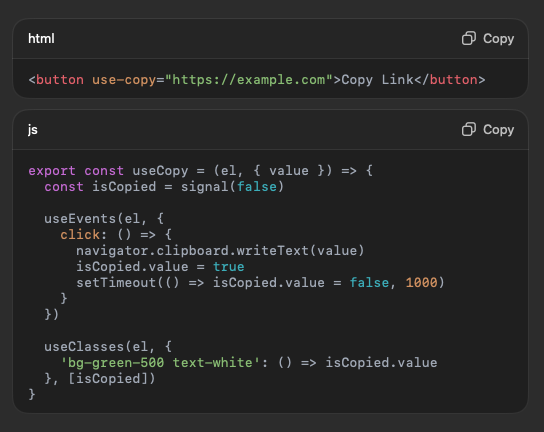
Built a little tool called HookTML.
It’s a Stimulus-style library with React-like ergonomics.
Built it to make it easier to compose behavior with plain JS functions while keeping your HTML in control.
Wrote a short post about why I built it:
https://t.co/gpQmLjvn4g
@jakeonrails The tricky part is getting that risk assessment right. I have a few skills around security and related areas to help with that, though I’m still working it out.
@jakeonrails I’ve been breaking mine into smaller PRs, experimenting with having agents assess risk, and letting low-risk changes merge into a shared branch once CI passes. Higher-risk changes get human review. Then a final round of browser-based click testing to catch integration issues.
@Steve8708 Great breakdown. I’ve been doing something similar for a few months: spec > epic > small issues, with claude spinning up an agent for each and running a verification loop. Waiting 1–3 days for it all to finish hurts, though. Any tips to speeding this up?
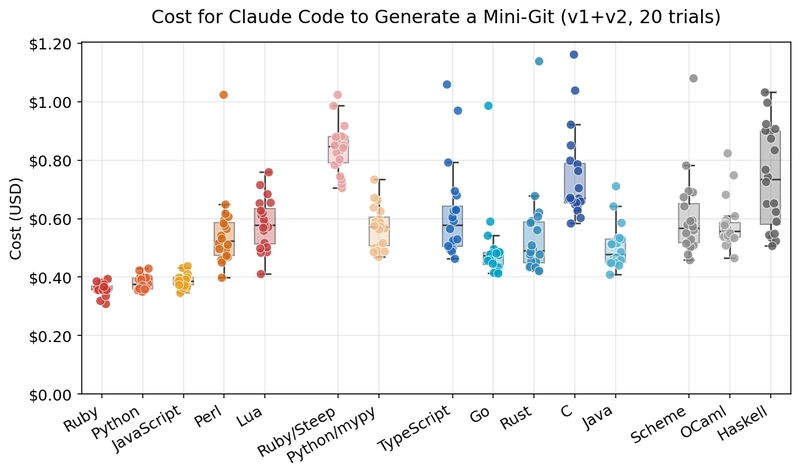
I benchmarked which language works best with Claude Code. Ruby, Python, and JavaScript came out cheapest,
fastest, and most stable!
See my article in detail: https://t.co/yTnIerhjwE
@rushing_andrei I tried to find a balance and built a library that is similar to Stimulus but shares a familiar syntax with React that AI understands. So far it’s done a pretty good job! Works with Hotwire so you get the React ergonomics without the SPA baggage.
https://t.co/0bTVFVxnUO
@ZachSents@kellabyte I felt similar using Hotwire/Turbo, but realized I only miss “some” of React. When I did need to sprinkle JS, the current solutions felt clunky, so I built this: https://t.co/0bTVFVxnUO
@happyrubyist@reactjs@inertiajs@rails I had a similar experience in that React grew on me once I wrapped my head around it. I still prefer the concepts behind the Hotwire and Stimulus combo, but DX is a bit clunky. I created HookTML in an attempt to combine the best of both worlds.
https://t.co/0bTVFVxnUO
I see a lot of love for React here, but sometimes it feels like overkill for what the browser can already handle.
🏴☠️ Made this small HookTML helper for copying text to the clipboard.
⚡ No build step, just simple hooks on plain HTML.
https://t.co/ZqeHkT4nK3
This felt too easy. Made with HookTML, a small library I’ve been hacking on that uses React-style hooks for vanilla HTML. Even an LLM didn’t have a hard time spitting this out.
No build step. Blog: https://t.co/gpQmLjvn4g
Thinking about adding `useText` as an in-house HookTML hook. Code should feel like it belongs there, not bolted on. Feels like it’s always been part of the language.
https://t.co/0bTVFVwQ5g
Thinking about adding `useText` as an in-house HookTML hook. Code should feel like it belongs there, not bolted on. Feels like it’s always been part of the language.
https://t.co/0bTVFVwQ5g
@mjackson I’ve run into the same pain points, but I like the ergonomics of hooks, so I’ve been playing with a version that works straight on the DOM - no render cycles, no virtual DOM, and minimal abstractions.
https://t.co/0bTVFVxnUO
This felt too easy. Made with HookTML, a small library I’ve been hacking on that uses React-style hooks for vanilla HTML. Even an LLM didn’t have a hard time spitting this out.
No build step. Blog: https://t.co/gpQmLjvn4g
@hschnedlitz I’ve noticed the same. Shameless plug: I built a Stimulus-like tool called HookTML that uses React-style hooks, and LLMs pick it up easily since they’re already good at React. Makes it way easier to whip up examples.
https://t.co/0bTVFVxnUO
Hope it’s ok to share a little JS here.
I’ve been building a Rails app with Stimulus, but missed the ease of composing logic like use* hooks in React. So I built HookTML and wrote about it. Would love to hear what you think!
https://t.co/gpQmLjvn4g