Doping didn't disappear from pro cycling.
It may have just moved to 2,500 metres.
This morning I interviewed James Witts, author of a new book called Dope. Halfway through the conversation, he described something I'd never heard in all my years around this sport.
He calls it "the altitude alibi."
Here's how it works.
Every spring, pro riders disappear to the same places. Mount Teide. Sierra Nevada. Weeks at altitude preparing for the biggest races of the year.
The logic is simple. Altitude exposure raises your hematocrit. More red blood cells, more oxygen, more power.
Except there are two problems nobody talks about.
Problem one: altitude doesn't work for everyone. There are genetic responders and non-responders. Some riders come down from the volcano flying. Some come down with nothing to show for three weeks of their season.
Problem two: altitude forces a trade-off.
At camp, you have a choice of protocol. Sleep high and train high, or sleep high and train low.
Sleep high, train high: you maximise the altitude adaptation. But the thin air caps your power. You can't train at full intensity, so you lose the training adaptation.
Sleep high, train low: you descend to do your sessions at full intensity and keep the training adaptation. But you give up some of the altitude effect.
You can't fully have both. Every altitude camp is a compromise.
Now here's where James's argument gets dark.
The biological passport, the system designed to catch dopers, doesn't test for drugs directly.
It tracks a rider's blood values against their own baseline. Deviate too far from your own normal, and you get flagged.
But when a rider is at altitude, the passport expects the deviation. Rising blood values are exactly what altitude is supposed to produce.
James believes some riders have worked out what that means.
Go to altitude. Microdose EPO. The passport reads the change in your blood as a natural altitude response.
Then train low, at full intensity, and take the full training adaptation - because you no longer need the mountain to raise your blood values. The drug does that part.
The altitude camp isn't the preparation.
It's the alibi.
I've spent years interviewing World Tour coaches, sports scientists and pro riders. I have never heard it framed like this before.
The full conversation goes much deeper: what the passport can and can't see, why microdosing is so hard to catch, and what it all means for the sport we love.
It drops soon on the Roadman Cycling Podcast. Follow along so you don't miss it.
His book is called Dope: How Drugs Changed Sport. Worth your time.
P.S. Genuine question for you: can the testers ever catch up in this game or cat & mouse?
-Pone a Messi de extremo izquierdo.
-No pone a Ronaldinho.
-No pone a Victor Valdés.
-Pone a Ronaldo por delante de Luis Suarez.
-Te pone defensa de 3 centrales y va y coloca a un lateral izquierdo.
Vaya fenómeno.
El domingo se detuvo a un Guardia Civil en el puerto de Bilbao que transportaba 120 kilos de cocaína en un coche patrulla. Estaba destinado en el área Fiscal y de Fronteras.
https://t.co/iunWfNq6GO
1/ Brilliant essay by David Autor & Gordon Hanson on how to respond to China Shock 2.0 instead of creating policy for China Shock 1.0 which is now long past. @ASPI_org reported that US led China in 60 of 64 frontier technologies, such as AI & cryptography, btwn 2003-2007, while🇨🇳led US in just 3. In the most recent report, covering 2019 through 2023, the rankings were flipped on their head. China led in 57 of 64 key technologies,& US held the lead in only 7.
The faithful in Jerusalem bid an emotional farewell to Cardinal Pierbattista Pizzaballa, the Latin Patriarch of Jerusalem, as he departs for Rome to attend the pope’s funeral and take part in the papal conclave.
Video: Abouna Rifat
Cuando le preguntan qué espera del próximo papa, el cardenal Dolan (EEUU) responde así:
«El corazón cálido de Francisco... con... mmm... ¿qué diría yo?, más claridad en la enseñanza, más refinamiento de la tradición de la Iglesia, más profundización en los tesoros del pasado».
@Ma_WuKong@Ma_WuKong para mí, el símil más cercano es Cartagena o Mataró: ciudad costera, sin poder político, relativamente cerca de otras grandes urbes, con playas sin mucho encanto
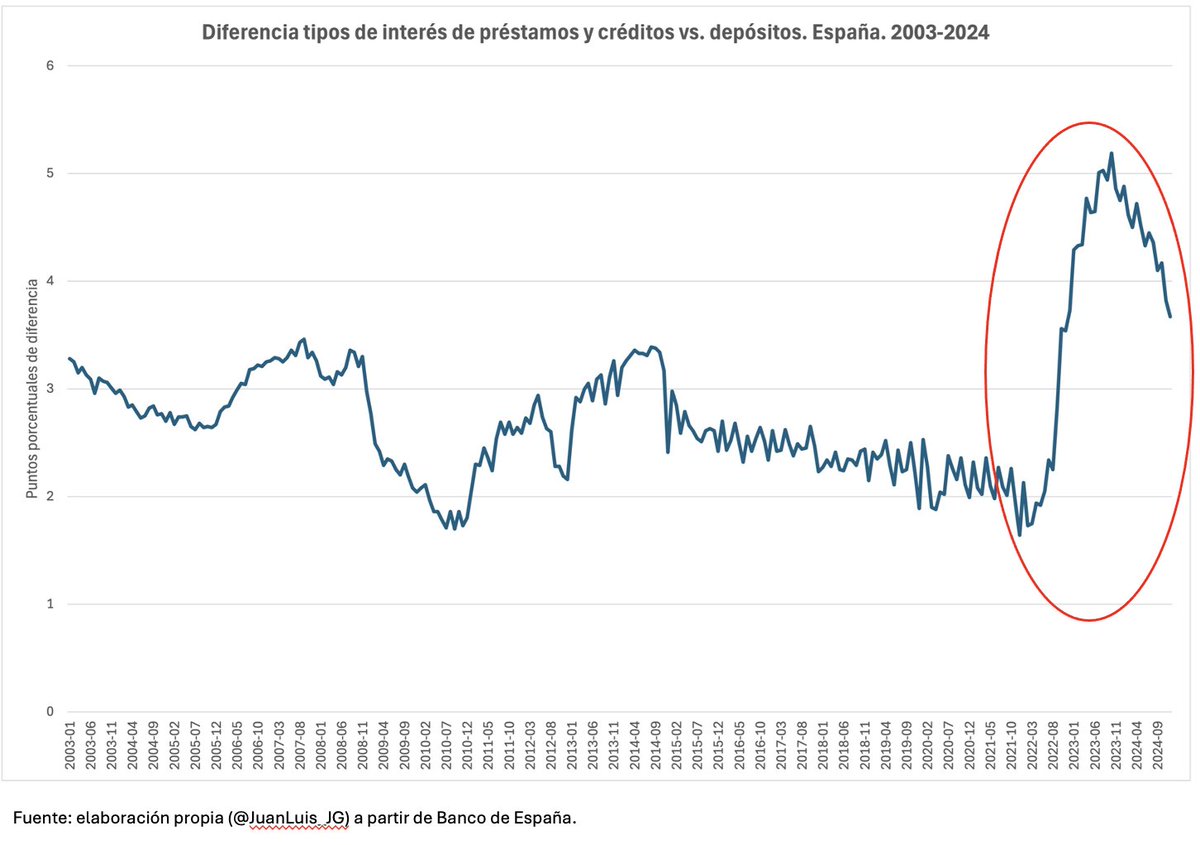
⚠️Importante: desde 2022, el sector financiero cobra un tipo de interés a las familias en España hasta 5 puntos porcentuales mayor por préstamos y créditos que lo que le paga por sus depósitos. Es la mayor diferencia de los últimos 21 años.
Implica: graves pérdidas ahorradores.