A Quick Look at Some of the Free Tools on the Site - A forecast gauge, live volatility regime classifier, and real time market audio. No login required. - https://t.co/BcLzD7cP1b
A recent article by Nigel at theStrat Lab did something I appreciated. He took Jeff Sun's 50 SMA ATR extension heuristic and asked whether the data actually supported it.
It does. But I wanted to take it one step further.
What actually happens to forward returns after a stock first crosses above a significant ATR extension level? We tested every Nasdaq 100 constituent over 25 years using non-survivorship bias corrected data.
The short term answer and the long term answer are very different. Article dropping soon.
Nigel's original piece is worth reading first: https://t.co/kX2VjbJLN5
Investors want high returns but they never consider the denominator of those returns. My systems are built to maximize those risk-adjusted returns. $SPY https://t.co/g8fcaLVYan
Agentic AI now has a place to hire humans. "AI can't touch grass. You can. Get paid when agents need someone in the real world" 😬 https://t.co/T6tKOLZ9KS
Something counterintuitive is coming in the next article.
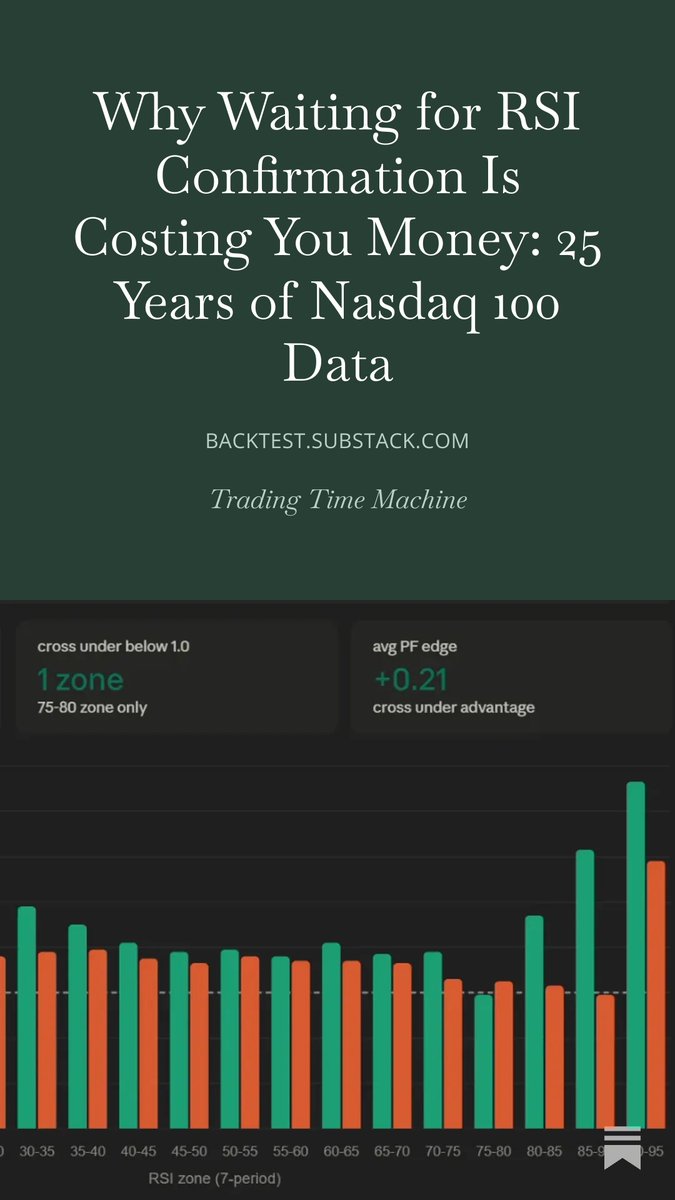
We have been testing whether a declining RSI beats a rising RSI as an entry signal across different market alignment conditions. The fully bullish alignment said yes clearly. The early deterioration alignment said yes in most zones.
The fully bearish alignment, everything pointed down, SPY below its 200 day moving average, said something most would not expect.
The lower RSI zones in that environment are producing the strongest profit factors in the series so far. Better than the fully bullish alignment.
Article dropping soon.
The remarkable thing about Kagan isn’t that he sees instability. Anyone can see instability.
It’s that after helping legitimize decades of interventionist hubris, the diagnosis is still that the real problem is insufficient American primacy.
Some worldviews are apparently incapable of learning.
Discipline isn't a trait. It's a skill.
Most people treat it like something you either have or you don't. Thirty years of watching traders tells me different.
The ones who make it are the ones who built systems that account for their own weaknesses. They know they'll want to quit after three losers. So they build rules that force them to keep going. They know they'll get overconfident after a winner. So they build rules that keep size in check.
Your system isn't just for the market. It's for the person staring at the screen.
#trading $SPY $QQQ