Small Sided Games For Athletic Development Course
Most training relies on controlled drills & predictable patterns. But sport is dynamic, unpredictable, & constantly changing.
This course shows you how to design training environments that behave like sport, activities that look, feel, & act like the game itself.
Through practical video demonstrations & coaching guidance, you’ll learn how to use SSGs to develop movement skill, decision-making, gamespeed, & adaptability.
If you’re a coach, athlete, or parent, this course will give you the tools to build better training environments & unlock true skill transfer to sport.
https://t.co/2ieG8RyRzq
Stop thinking constraints limit athletes. They shape opportunities for learning.
At #uofstrength, we manipulate tasks, environments and interactions to influence:
🔹 Timing & spacing
🔹 Force demands
🔹 COG management
🔹 Perception & decision-making
🔹 Movement adaptability
🔹 Problem-solving
Too much structure creates dependency. Too little intention creates randomness.
The Sweet Spot?
Design environments that guide learning while allowing athletes the freedom to explore, adapt & discover solutions.
Stop scripting movements. Start designing opportunities!
Think isometrics are just static strength work? Think again.
At #uofstrength, we manipulate intent, context & movement demands to develop different athletic qualities.
🔹 Force acceptance & production
🔹 Positional organization & control
🔹 Movement variability & adaptability
🔹 Transitioning from static to dynamic actions
Isometric-Dynamic Method
Using a sled with symmetrical & asymmetrical stances, we blend static tension with explosive movement to explore different horizontal jumping solutions.
The Takeaway?
No visible movement doesn’t mean no adaptation.
Stop thinking of isometrics as just holding positions. Start exploring what happens before, during & after the hold!
Every individual has a personal bubble, roughly an arm’s length of space surrounding their body.
At #uofstrength, we teach youthletes how to PROTECT or BURST the bubble!
Why?
Sport is full of physical interactions where athletes must manage space, accept contact, & solve movement problems inside an opponent’s bubble.
Enter: Roughhousing
1v1s With Back Battling Face-Off:
🔹 Starting Scenario: Back-to-back battling for position.
🔹 Trigger: Coach calls “GO!”
🔹 Task: Turn, locate & secure the ball after one bounce.
🔹 Rule: The ball MUST bounce before being caught.
Roughhousing isn’t just play. It’s an opportunity to explore movement solutions through physical interaction, uncertainty & competition.
Stop avoiding contact. Start creating opportunities to solve problems within it!
Sport isn’t just about speed, strength, or jumping ability. It’s about managing space, physical interactions & solving movement problems!
At #uofstrength, we teach athletes two important concepts👇
🔹 PROTECT The Bubble: Maintain personal space, manage body positioning & prevent opponents from disrupting your intentions.
🔹 BURST The Bubble: Invade an opponent’s space, disrupt their positioning & create opportunities for action.
Why Does It Matter?
Sport requires the continuous interaction of:
▪️ Perception: Recognize an opponent’s positioning, movement & intentions.
▪️ Action: Manage balance, redirect force & reposition effectively.
▪️ Intention: Protect space, gain an advantage & disrupt an opponent’s movement solutions.
We’re bringing these ideas, a fresh perspective on athletic development, & a whole new training experience to Bedford, NH!
Backyard games. Unstructured play. Creative movement.
Too many Youthletes are missing these experiences. At #uofstrength, we bring PLAY back through purposeful gameplay.
New Game: Noodle Trap
What Are We Developing?
▪️ Movement exploration & diversification
▪️ Adaptability & problem-solving
▪️ Awareness & coordination
▪️ Perception-action coupling
▪️ Confidence, competitiveness & FUN!
The Takeaway?
Not every athletic quality needs a drill. Stop scripting every movement. Start creating opportunities to play!
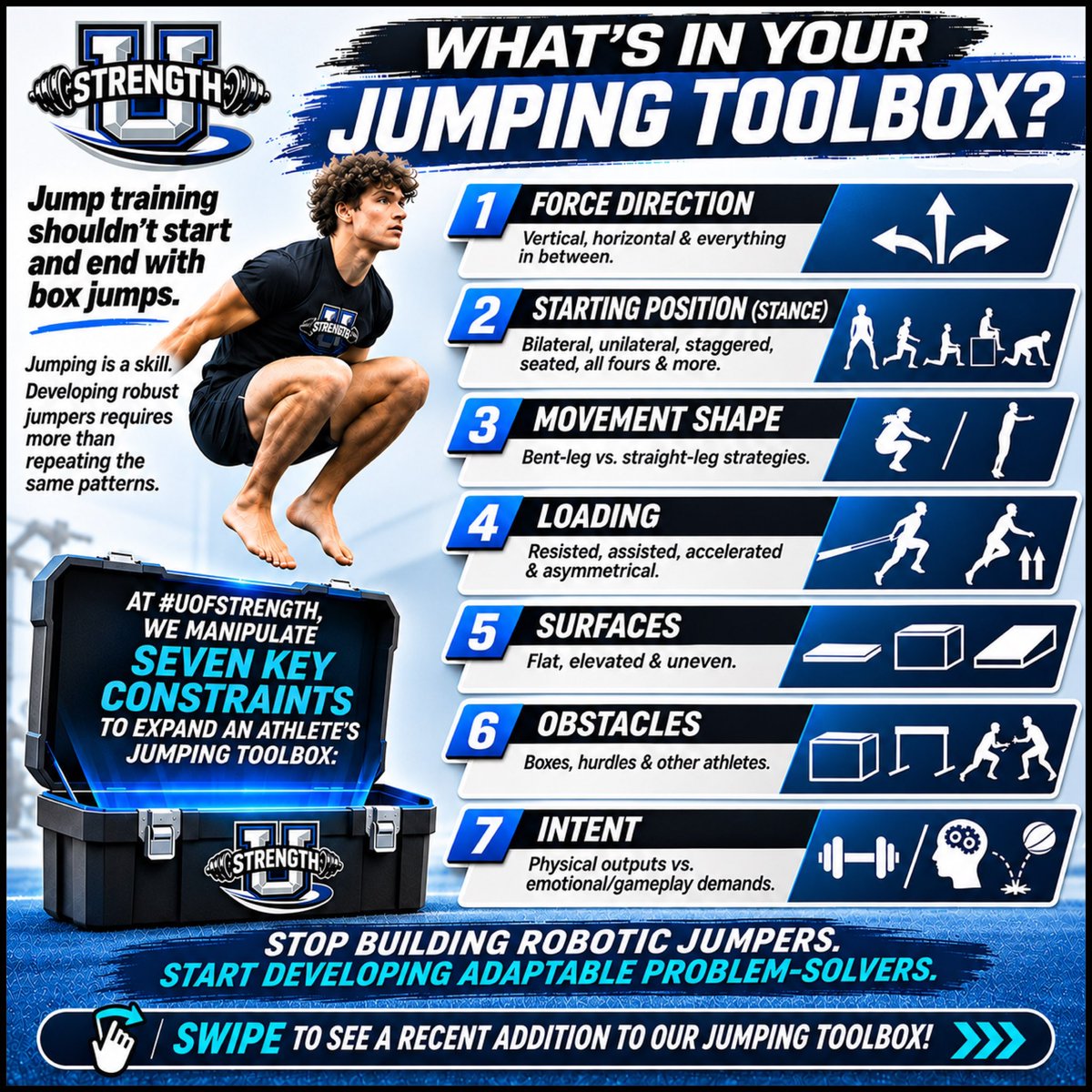
Jump training shouldn’t start & end with box jumps.
Jumping is a skill. Developing robust jumpers requires more than repeating the same patterns.
At #uofstrength, we manipulate seven key constraints to expand an athlete’s jumping toolbox:
🔹 Force Direction: Vertical, horizontal & everything in between
🔹 Starting Position (Stance): Bilateral, unilateral, staggered, seated, all fours & more
🔹 Movement Shape: Bent-leg vs. straight-leg strategies
🔹 Loading: Resisted, assisted, accelerated & asymmetrical
🔹 Surfaces: Flat, elevated & uneven
🔹 Obstacles: Boxes, hurdles & other athletes
🔹 Intent: Physical outputs vs. emotional/gameplay demands
Stop building robotic jumpers. Start developing adaptable problem-solvers.
Want to improve your change of direction but don’t have much space?
Grab a med ball.
At #uofstrength, we use med balls differently. Instead of isolated throws, we blend throwing patterns with jumps, bounds, hops, accelerations & decelerations to create hybrid movement solutions.
One Example👇
🔹 Overhead Crossbody “Fake” Throw
🔹 Rotational Scoop Throw
🔹 Catch Off Wall
🔹 1-Step Acceleration Burst (Opposite Direction)
What Are We Developing?
▪️ Effective weight shifting
▪️ Lower center of gravity
▪️ Steering the foot (edge connectivity)
▪️ Force acceptance & redirection
Change of direction isn’t just about planting a foot & pushing off. It’s about organizing the total body to accept, transfer & express force effectively.
Stop letting limited space limit your training possibilities.
Want to expand your throwing toolbox? Click the link in bio to get access to our complete library of throwing activities!
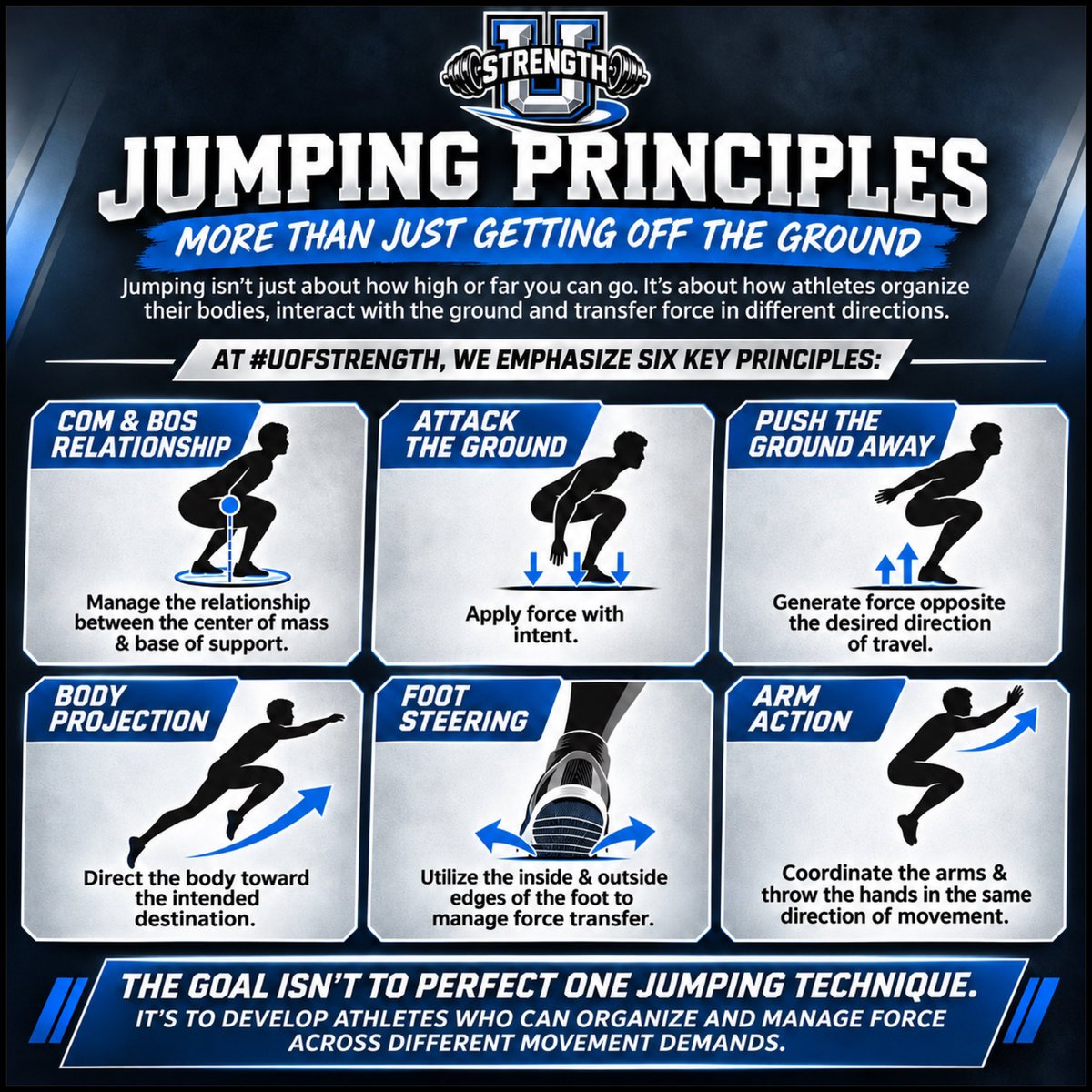
Jumping isn’t just about how high or far you can go. It’s about how athletes organize their entire body, interact with the ground & transfer force in different directions.
At #uofstrength, we emphasize 6 key principles👇
🔹 COM & BOS Relationship: Manage the relationship between the center of mass & base of support.
🔹 Attack the Ground: Apply force with intent.
🔹 Push the Ground Away: Generate force opposite the desired direction of travel.
🔹 Body Projection: Direct the body toward the intended destination.
🔹 Foot Steering: Utilize the inside & outside edges of the foot to manage force transfer.
🔹 Arm Action: Coordinate the arms & throw the hands in the same direction of movement.
The goal isn’t to perfect ONE jumping technique. It’s to develop athletes who can organize & manage force across different movement demands.
Most jump data focuses on linear movement. But sport demands force production in every direction.
At #uofstrength, we look beyond traditional protocols.
One of our KPIs?
Repeated Lateral Jumps for Distance
What are we monitoring?
▪️ Lateral force transfer
▪️ Repeated ground contacts
▪️ Elasticity & rhythm
▪️ Force solutions outside the linear path
The goal isn’t just to measure how high or how quick athletes jump. It’s to understand how they manage different force demands.
Expand what you measure. Expand what you understand.
Too many training activities are “dead” before the first rep even begins.
Closed cone drills & machine-based exercises provide limited sensory information & often remove the context that shapes movement in sport.
At #uofstrength, we emphasize information–movement coupling by designing situations that look, feel, act & behave like the problems individuals encounter in competition.
The goal? Create “alive” repetitions where participants must perceive, decide & adapt.
What information shapes athletic movement?
🔹 Opponents & Teammates
🔹 Playing Area (Size & Shape)
🔹 Equipment (Balls, Flags & Obstacles)
Inside Our 1v1 Scenarios:
🔵 Offensive Trailing (Pursuit)
▪️ Start with possession of the ball
▪️ Exploit space & score in the matching-sized goal (large, medium or small)
🔵 Defensive Hunting (Pursuit)
▪️ Rolling or bouncing ball triggers the action
▪️ Rolling Ball = Rep becomes live when the ball moves
▪️ Bouncing Ball = Ball must bounce once before the defender can steal the opponent’s scarf
Stop designing drills around predetermined movements. Start designing environments that invite athletes to solve problems.
We don’t just jump for the sake of jumping. Plyometrics are a tool for shaping how athletes interact with the ground, organize their total body & develop greater ownership of their unique movement signature.
At #uofstrength, we use plyometrics inside the weight room to develop different speed characteristics.
1️⃣Acceleration
🔹Low RFE Single Leg Horizontal Jump
▪️ Horizontal force application
▪️ Lower COG
▪️ Longer GCTs
2️⃣Max Velocity
🔹Repeated Mini Hurdle Jumps
▪️ Vertical force application
▪️ Upright shapes
▪️ Shorter GCTs
Different speed demands require different force strategies, ground interactions & movement solutions.
Now, combine both of them.
Develop the ability to transition between different force strategies, ground contact demands & movement shapes.
Plyometrics aren’t just about producing force. They’re about developing the ability to apply it in the right direction, at the right time & under different conditions.
Don’t just train the jump. Train the characteristics that shape speed.
@TrackYourLiftAp All of the above. But from my experience, it’s the sequence (eccentric tempo > positional isometrics > touch-&-go concentric emphasis) & anything that slows the movement down (provides extra exposure to yielding strategies).
Too many programs are married to ONE lift, ONE technique & ONE way of developing strength.
But athletic development isn’t about mastering one version of a movement. It’s about expanding the athlete’s force toolbox.
By manipulating setups, positions, ranges of motion & tempos, we can:
🔹 Develop force qualities across different conditions
🔹 Build tissue resilience
🔹 Expand movement solutions
🔹 Challenge positional awareness & ownership
One example? Manipulating the environment.
1️⃣ Squat & Bench Press Onto Box(es):
▪️Disrupt the eccentric-concentric transition, reduce reliance on elastic energy & challenge positional control at specific joint angles.
Stop chasing one perfect lift. Start developing a wider range of force capabilities.
Everyone talks about acceleration and max speed mechanics, but what about step zero?
The 0-step phase sets the stage for:
🔹 Force Direction
🔹 Intent
🔹 Joint Angles
🔹 Movement Effectiveness
At #uofstrength, the beginning isn’t an afterthought. It’s a training tool. We challenge athletes with 5 starting scenarios:
1️⃣ Drop-In — Momentum-based
2️⃣ Static — From stillness
3️⃣ Disadvantageous — Unfavorable positions
4️⃣ Advantageous — Optimized projection
5️⃣ Chaotic — Unpredictable starts
The goal? NOT to memorize perfect mechanics. It’s to challenge athletes to solve movement problems.
Most training programs focus on developing speed, but overlook teaching the gamespeed behaviors that shape movement in sport.
One key offensive behavior? Exploiting space.
Here’s how we challenged it by creating a defensive advantage scenario, then manipulated constraints to encourage the offense to recognize & exploit available space.
Inside the Activity:
▪️ TWO defensive zones
▪️ ONE defender per zone
▪️ Defenders CANNOT leave their territory
▪️ Offense must exploit space to catch the ball or frisbee inside the playing area
The big picture?
Manipulate constraints to shape behaviors & create opportunities for the offense to perceive openings, adjust timing & discover functional movement solutions.
Functional Fitness vs. Functional Movement Solutions
They’re NOT the same. Just because an exercise looks functional doesn’t mean it prepares athletes for the problems of sport.
🔹 Functional Fitness
Develops physical capacities👇
Strength. Power. Coordination.
🔹 Functional Movement Solutions
Develops adaptable problem-solvers👇
Perception. Decisions. Actions. Intentions.
The big difference?
One builds the physical tools. The other challenges athletes to use them when, where, & how the situation demands.
The goal? Not movement that looks like sport, but movement that functions in sport.
Most warmups focus on rehearsing movements. We create opportunities to explore.
At #uofstrength, we have our non-negotiables:
🔹 Foot Sensory Drills
🔹 Eye Movements
🔹 Isometrics
🔹 Crawling & Rolling
🔹 Extensive Plyometrics
But we also design environments that challenge individuals to discover movement solutions.
Inside the Activity: Landing Preparation
▪️ Jump over the obstacle
▪️ Hands can ONLY contact the box
▪️ Land on two feet
The big benefit? Developing adaptable 🤚 & 🦶contact strategies within the same repetition.
Less memorization. More exploration.
Change the constraints. Expand the movement 🧰.
EXPAND Your Coaching Toolbox!
5 Digital Resources. Endless Possibilities.
🔹 Agility 5.0
🔹 Gameplay 7.0
🔹 Speed Toolbox 5.0
🔹 Throwing & Catching Patterns 6.0
🔹 Elastic Solutions 4.0
New ideas. Fresh perspectives. More movement solutions.
Explore The U Academy & take your coaching to the next level!
https://t.co/FHE6pqGs9Z
Hunting vs Trailing: Speed with a Purpose
Same positional disadvantage. Different intentions.
🔹 HUNTING (Defensive Pursuit)
The defender starts BEHIND the opponent & must accelerate to close space, neutralize the disadvantage, or regain positional advantage.
🔹 TRAILING (Offensive Pursuit)
The offensive participant starts BEHIND the opponent & must strategically manipulate speed to create opportunities & gain a positional advantage.
The big difference?
▪️ Hunting: Chase, close space & recover.
▪️ Trailing: Manipulate speed, exploit space & attack.
Speed isn’t just about moving FAST. It’s about knowing WHEN, WHERE & WHY to accelerate.
Different roles. Different intentions. Different movement solutions.