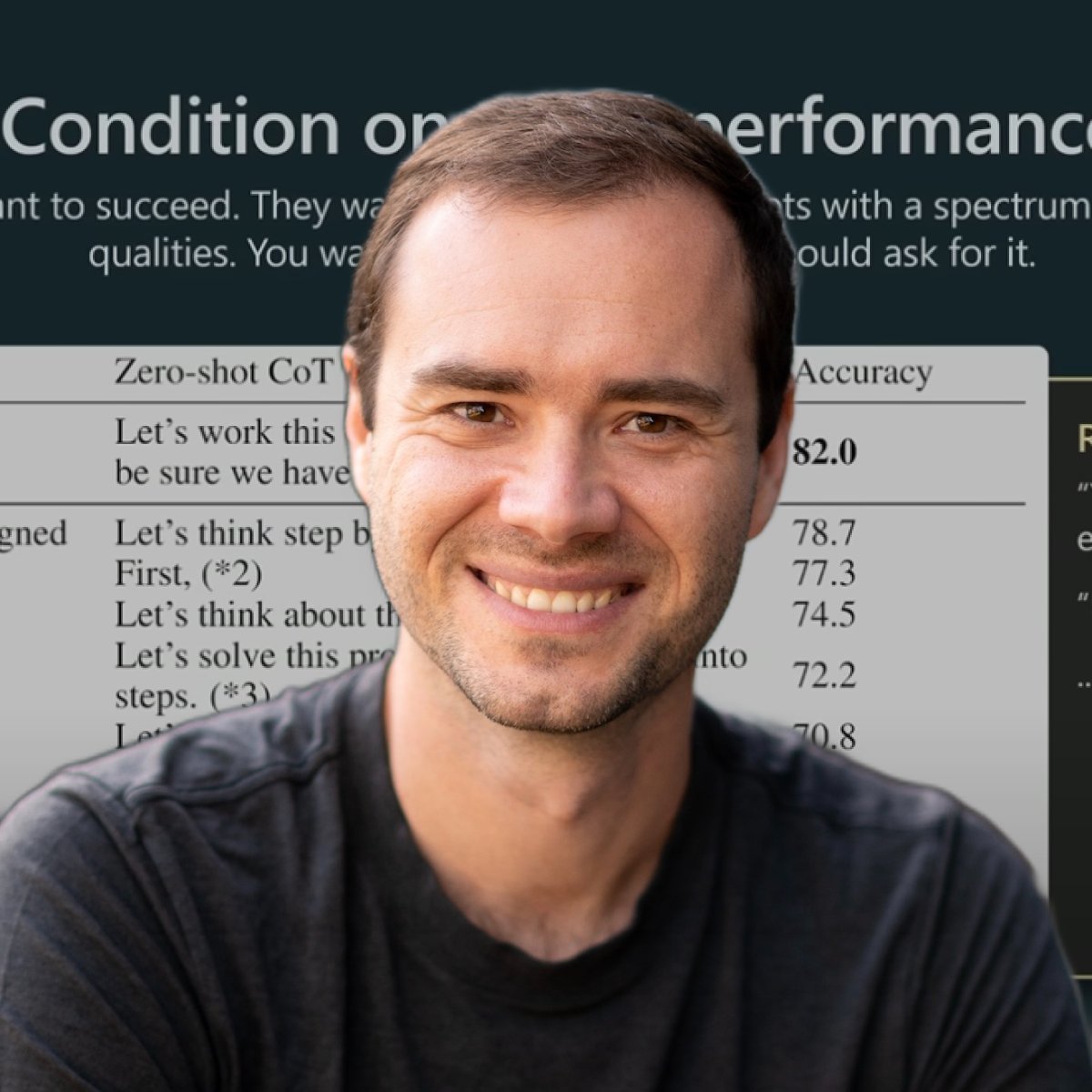
El ingeniero que creó claude code acaba de soltar un video de 28 minutos donde te enseña a escribir prompts que realmente funcionan.
He visto cursos de 300 dólares que no llegan ni a la mitad de lo que explica en los primeros 10 minutos.
Archivos CLAUDE.md, atajos de memoria, sesiones paralelas y patrones de prompting que cambian el juego.
Todo en un solo video y completamente gratis.
Da igual si eres desarrollador, principiante o ya llevas meses usando Claude. Esto te va a volar la cabeza.
Hey @WVFRM, based on user feedback I updated the look and features of the WVFRM Trivia app. New changes: season tabs, player stats cards, tech sounds, and typing stats. For curious devs, built with @shadcn/@nextjs/@CognosysAI/@tan_stack
Check it out - https://t.co/Ej1G6uojrJ
Stop scrolling away your Sunday, find your next business idea instead 😌
this tool generates 6 unique business ideas in 10 seconds based on your interests
Leverage in an organization is not unlike leverage in the markets; you're looking for ways to achieve more with less. At Bridgewater, I typically worked at about 50:1 leverage, meaning that for every hour I spent with each person who worked for me, they spent about fifty hours working to move the project along. At our sessions, we would go over the vision and the deliverables, then they'd work on them, and then we'd review the work, and they'd move forward based on my feedback—and we'd do that over and over again. The people who worked for me typically had similar relationships with those who worked for them, though their ratios were typically between 10:1 and 20:1. I am always eager to find people who can do things nearly as well as (and ideally better than) I can so that I can maximize my output per hour.
Technology is another great tool for providing leverage. To make training as easy to leverage as possible, document the most common questions and answers through audio, video, or written guidelines, and then assign someone to organize them and incorporate them into a manual, which is updated on a regular basis.
Principles themselves are a form of leverage—they're a way to compound your understanding of situations so that you don't need to exert the same effort each time you encounter a problem. #principleoftheday
Google just made learning AI easier than ever with these 10 free new short courses 🔥
🤖 Introduction to Generative AI
🤖 Introduction to Large Language Models
🤖 Introduction to Responsible AI
and many more
Access all the courses here: https://t.co/neP5zQh5DO
Andrej Karpathy is a legendary AI researcher who helped start OpenAI.
He recently gave a talk on how to craft great GPT prompts that almost everyone missed.
I watched the 40 min talk - here's @karpathy's top 5 tips to make AI work better for you:
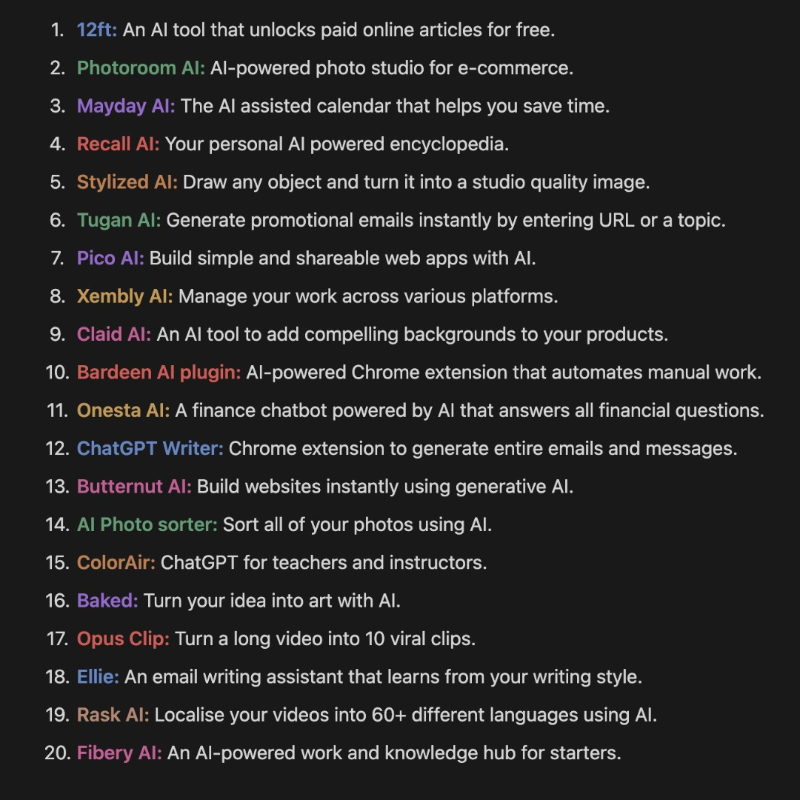
If you're not using AI, you're falling behind.
Here are 20 AI tools to future-proof yourself. Get more tools like this by signing up to Superhuman AI--the world’s biggest AI newsletter.
AI is eating data science 🤯
The newest ChatGPT plugin is the most powerful feature OpenAI has released since GPT-4.
It makes everyone a data analyst.
Here are 15 mind-blowing use cases of the new FREE “Code Interpreter” plugin:
I started my company 16 years, 3 months, and 5 days ago.
Today, it went public.
But let's rewind for a second...
5,939 days ago, I was a barista at a small cafe called @2percentJazz2, in Victoria, Canada.
I made $6.50 an hour.
Two guys, Chris and Jeff, started coming into the cafe.
They'd sit there all day drinking espresso and typing away on their laptops, using the wifi.
After weeks of this, I asked them what they did for a living.
Didn't they have jobs?
They told me they were "web designers" and this — sitting on their laptops — was their job.
As I dug in, they told me how it worked:
They asked local businesses if they needed a website, then charged them a couple thousand bucks to make one.
They could whip a website together in a few days, and each make $1,000.
Simple.
This blew my mind.
And at that moment, I realized something:
I wanted to be the guy drinking the espresso, not the one serving it.
Chris and Jeff were clearly smart, but I knew some basic HTML and figured I could do the same.
I decided to try it out.
When I got off my shift, I took the bus over to a book store downtown and bought a book called 'Bulletproof Web Design' by Dan Cederholm (@simplebits) to hone my skills.
Then, I googled "freelance web design jobs" and found a tech job board called Authentic Jobs made by this guy in Utah, @cameronmoll.
There were hundreds of posts, mostly from startups in San Francisco, looking for freelance web designers.
I decided to try to win one of these contracts, but I had a critical insight:
Nobody wants to hire an 18-year-old barista to build their website.
So, I decided I'd create a fake design agency.
Using tricks from Dan Cederholm's book, I whipped together a slick looking site and called my "agency" MetaLab (after the <meta> tag in HTML).
The website was very vague as to what exactly MetaLab did, who worked there, or where we were located.
It also featured a cringe-inducing tagline "We Help People Make Cool Stuff."
Like an email spammer, I started sending emails to every single web design job post I could find.
I was met with crickets, until I got an email from a guy named Kavin Stewart (@kavinstewart).
He worked at a startup called Offermatica in San Francisco and told me he needed an interface designed for a web app.
I barely understood what a web app was, but I assured him I could do it.
He proposed a $2,000 USD budget and my eyes went wide.
This was more than I earned in a month, and the project was just a few days of work.
I walked into the cafe the next day and quit my job.
I told myself that if I could just make enough money to wake up whenever I wanted and comfortably make rent, I'd be good.
The rest is history.
But I slightly overshot.
I still own MetaLab, but along the way me and my business partner @_Sparling_ started dozens of companies, then began buying wonderful businesses, including one (Dribbble) — amazingly — from Dan Cederholm, the designer whose book I bought when I first started.
Today, Tiny went public, and as of this moment has a market capitalization of just under $800 million.
I can't even begin to explain how mind boggling this is to me.
This has not been a feat of entrepreneurial genius.
My key skill has been choosing incredible people to work with, both internally and externally, and I wanted to say a huge thank you to everyone who has worked at Tiny and our various companies over the years.
And a special thanks to @simplebits, @cameronmoll, and @kavinstewart for helping with my first step😉
Watch for us on the TSX Venture Exchange under the ticker TINY (how cool is that ticker?).
https://t.co/tlpgiEO2MU
No-code enablement:
1. Build a MBP without hiring developers
2. Use the existing templates so you don’t have to think too much about design
3. Communicate your concept/ideas more clearly
4. Pay for only what your need
GPT-4 took the internet by storm.
But it isn't everything.
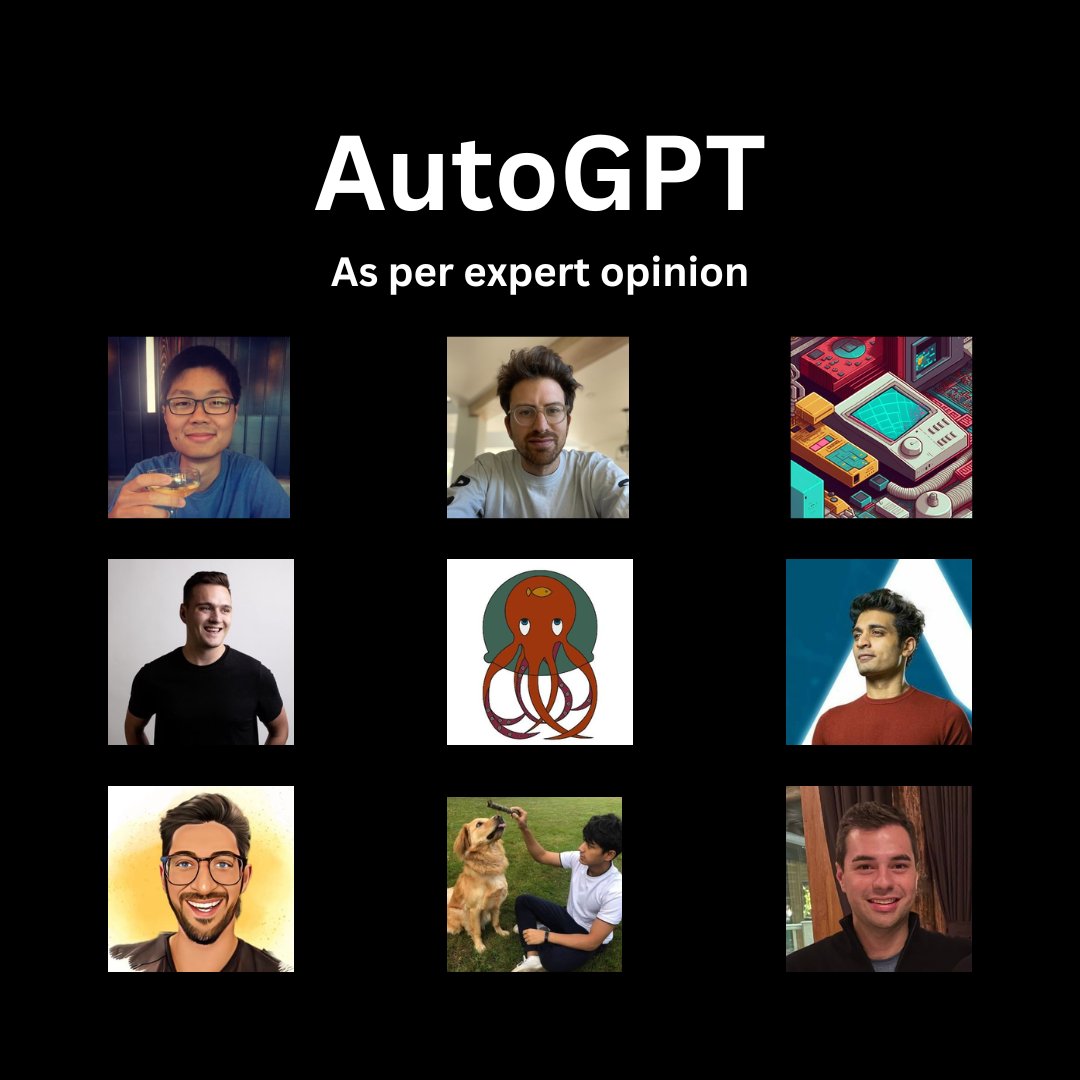
AutoGPT is the game changer.
A summary of what is happening with AutoGPT (with all expert opinions):
Powerful Al Tools for Entrepreneurs ⚡️
ChatGPT - Solves Mental Blocks
FlowGPT - Prompt Ideas
Notion Al- Writing Assistant
texti .app - AI Writer
Rewrite Guru - Al Paraphraser
I Do Not Pay - Al Lawyer
Perplexity AI - Al Search Engine
Tome Al - PPT Content Generator