A reply to Bishop Athanasius Schneider on ‘sedevacantism’
Conservative favourite Bishop Athanasius Schneider launched a salvo at ‘sedevacantism’ in a recent Ad Vaticanum interview.
Here is the reply A.V. declined to run – but which @IntegritasMag did:
https://t.co/PGueXgSA6k
A reply to Bishop Athanasius Schneider on ‘sedevacantism’
Conservative favourite Bishop Athanasius Schneider launched a salvo at ‘sedevacantism’ in a recent Ad Vaticanum interview.
Here is the reply A.V. declined to run – but which @IntegritasMag did:
https://t.co/PGueXgSA6k
This is a great article from S.D. Wright that I am pleased we were able to publish at @IntegritasMag.
For anyone looking to refute the position of Catholics who maintain the vacancy in the Apostolic See since Vatican II, i.e. “sedevacantists,” they are bound by strict justice to accurately characterize the position of their opponents. Of course, this holds true for both sides whether “sedevacantist” or “sedeplenist.”
Bishop Schneider’s argumentation is flawed but this is not unique to him. I see it frequently, even by otherwise intelligent Catholics. It mainly consists of:
1. Begging the question
2. Appealing to irrelevant historical analogies (St. Peter giving bad example, private opinions of John XXII, etc.)
3. Claiming that we believe that every and all papal teaching on matters of faith and morals is infallible
One hopes that Bishop Schneider will consider this respectful reply seriously.
A Genoese chronicler wrote in 1405 that the greatest miracle of St Vincent Ferrer was not his gift of tongues, but to eradicte the abuse of women going to Mass with their heads uncovered.
All Essays & Articles from The WM Review
When carrying out the periodic update to the All Essays and Articles page, Substack informed us that it was now too long.
In order to address that, we have reformatted it. Here it is in an easy to use format:
https://t.co/jjUXnw7Vt7
At his talk at the "Catholic Identity Conference", @DrKwasniewski referred to "sedevacantism" as a "monstrous phenomenon".
Meanwhile, promotes all this.
Disappearing into self-parody, really.
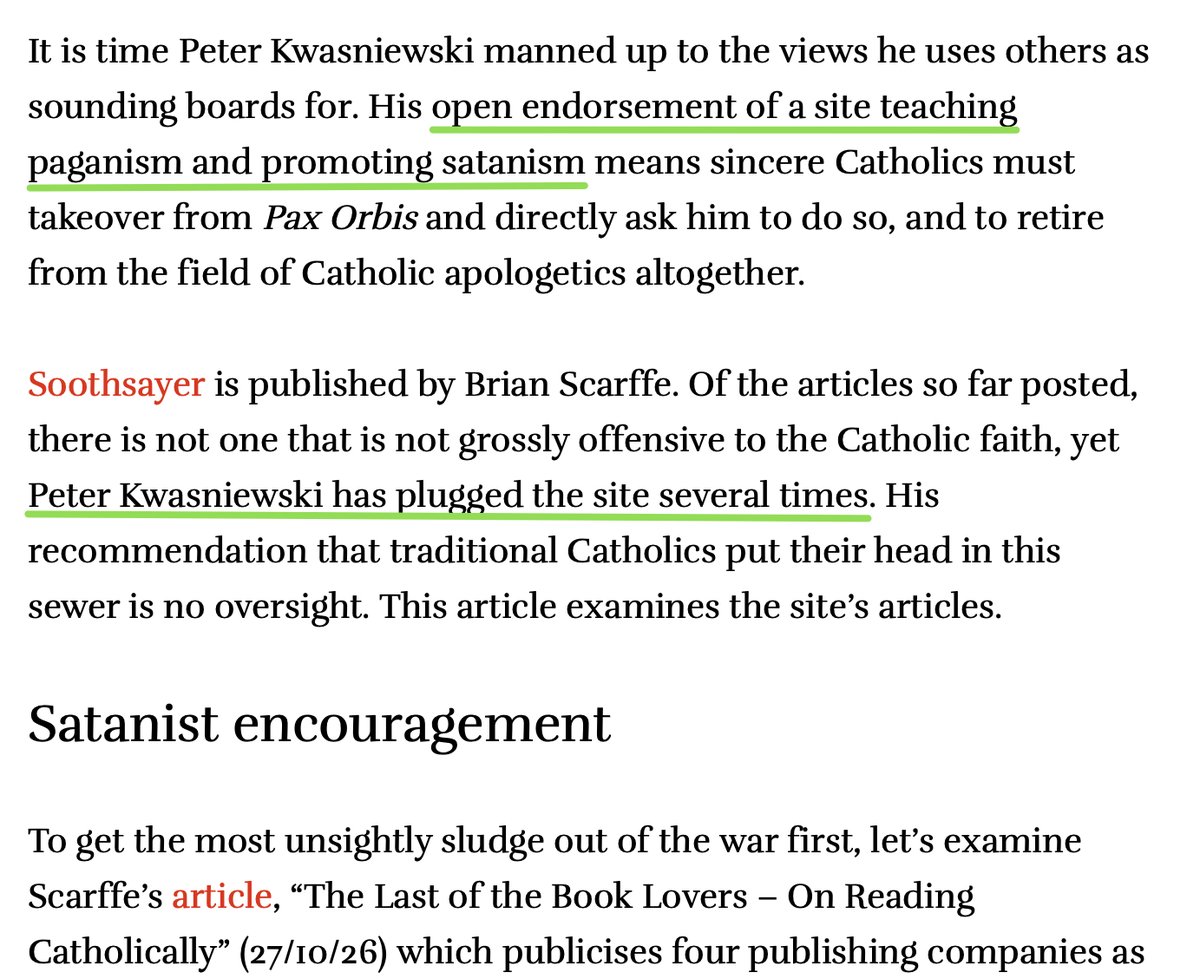
"Time for Kwasniewski to come clean": A Lefebvrist blogger wants to know why Dr. Peter Kwasniewski keeps promoting Brian Scarffe's 'Soothsayer' blog - https://t.co/SVfoDX2ALF
"Time for Kwasniewski to come clean": A Lefebvrist blogger wants to know why Dr. Peter Kwasniewski keeps promoting Brian Scarffe's 'Soothsayer' blog - https://t.co/SVfoDX2ALF
All Essays & Articles from The WM Review
When carrying out the periodic update to the All Essays and Articles page, Substack informed us that it was now too long.
In order to address that, we have reformatted it. Here it is in an easy to use format:
https://t.co/jjUXnw7Vt7
Thoughts on the Thesis of Cassiciacum – From the grave of Mgr Guérard des Lauriers
On the occasion of visiting the late Dominican bishop’s final resting place, the author has something of an ‘announcement’ to make:
https://t.co/Rs2wO0Porr
I've finished the first volume.
This one's actually a pretty big deal and the history of the study of the liturgy and I'm happy to have gotten it out.
PDF available on my telegram
---
Liturgical Institutions, Volume I
By Dom Prosper Guéranger, Abbot of Solesmes
Dom Prosper Guéranger’s Liturgical Institutions is one of the major works behind the nineteenth-century restoration of the Roman liturgy in France. Written by the Abbot of Solesmes and author of The Liturgical Year, it combines historical scholarship, theological argument, and forceful controversy in defense of the Church’s public worship. This first volume traces the history of the liturgy from apostolic times through the first half of the seventeenth century.
Guéranger begins by explaining the nature of liturgy, its relationship to the virtue of religion, and its importance for understanding Catholic doctrine. His governing conviction is that the Church’s worship transmits her faith: its prayers, chants, ceremonies, and sacred books express the tradition she has received and teach it to successive generations. His treatment of liturgical prayer as the voice of the Church gives the historical narrative its theological foundation.
The volume follows the worship of the early Christians, the testimony of the Fathers, the work of Saint Gregory the Great, the spread of Roman worship through the West, and the development of the Mass, Divine Office, chant, and liturgical books. It also examines the Ambrosian, Gallican, Mozarabic, monastic, and Eastern liturgical traditions, the influence of Charlemagne, the contributions of medieval religious orders, and the composition of the Office of Corpus Christi.
Among its most striking sections is the famous chapter on “antiliturgical heresy,” in which Guéranger argues that attacks on Catholic doctrine repeatedly find expression in attacks on the Church’s inherited worship. Alongside this stands his detailed account of legitimate Catholic liturgical reform: the work of Trent and Saint Pius V, the revision of the Breviary and Missal, the publication of the Roman Ritual, and subsequent papal interventions. Together, these discussions make the volume particularly valuable for studying the relationship between tradition, development, ecclesiastical authority, and reform.
The book also contains extensive documentary material, including patristic testimony, papal enactments, historical correspondence, and bibliographical notices of liturgical writers. Readers encounter both Guéranger’s arguments and the sources upon which he builds them.