A fundamental problem with extending Codex/Cowork/Code to all knowledge work is that they remain very "software-brained" where the end result (the software) is what is important & that code serves as a source of truth.
For a lot of other knowledge work, the process is at least as important as the outcome. This includes researching what is known, an exploration of alternatives, failed efforts, prototype branches, experiments, etc. All of those things are valuable, so you cannot use the PowerPoint at the end the way you can use a codebase, nor is progress on a to-do list sufficient context post compaction. You work in learning loops, refining your perspectives as you go.
In some ways, this makes long-running models like Fable hard to use for deep knowledge work, since they are designed to deliver product to you in the end. You can prompt your way around this problem, but everything about the Codex and Code harnesses want you to be a software developer and you have to fight them. There is a real disconnect between how a manager or analyst thinks about problems and how the agentic software tools approach solving them. Addressing this is critical to breaking out of the coding niche for these tools.
Not for like toddler using the phone, but "I have a toddler", so when the little maniacs get ahold of an unlocked phone it's not a infosec crisis. DM for PRD. Thnx
@DavidJacobsLive The only way to create a billion dollar plus ad tech business is to buy or sell ads. The cloud companies never want to do those things.
Fun fact: Oracle for Dummies book in 90s came with CD w/ Oracle server on it. I actually deployed it in production 😬. Oracle clearly allowed this to get people hooked.
@KieranO@DicksonPau That it is easier to hire engineers who know Oracle is a network effect.
That moving to another database consumes resources is a switching cost.
If you change banks, you must notify lots of other accounts. That is a switching cost. MasterCard and VISA have network effects
If you are a product manager in charge of product development, having a POV on which parts of the system need to be well thought out and which ones can be 'just get it working for now' can create huge leverage for your company.
design assumptions are surprisingly easy to add in the early days of a system and surprisingly hard to change later, so generally worth spending extra time iterating before finalizing a design and being willing to one day throw the system away or reimplement it entirely
Folks that haven't done B2B field sales don't realize the shocking regularity of superior sellers winning deals over technically superior competitors. ('Superior sellers' includes the whole GTM motion.)
This series is an absolute mind bender.
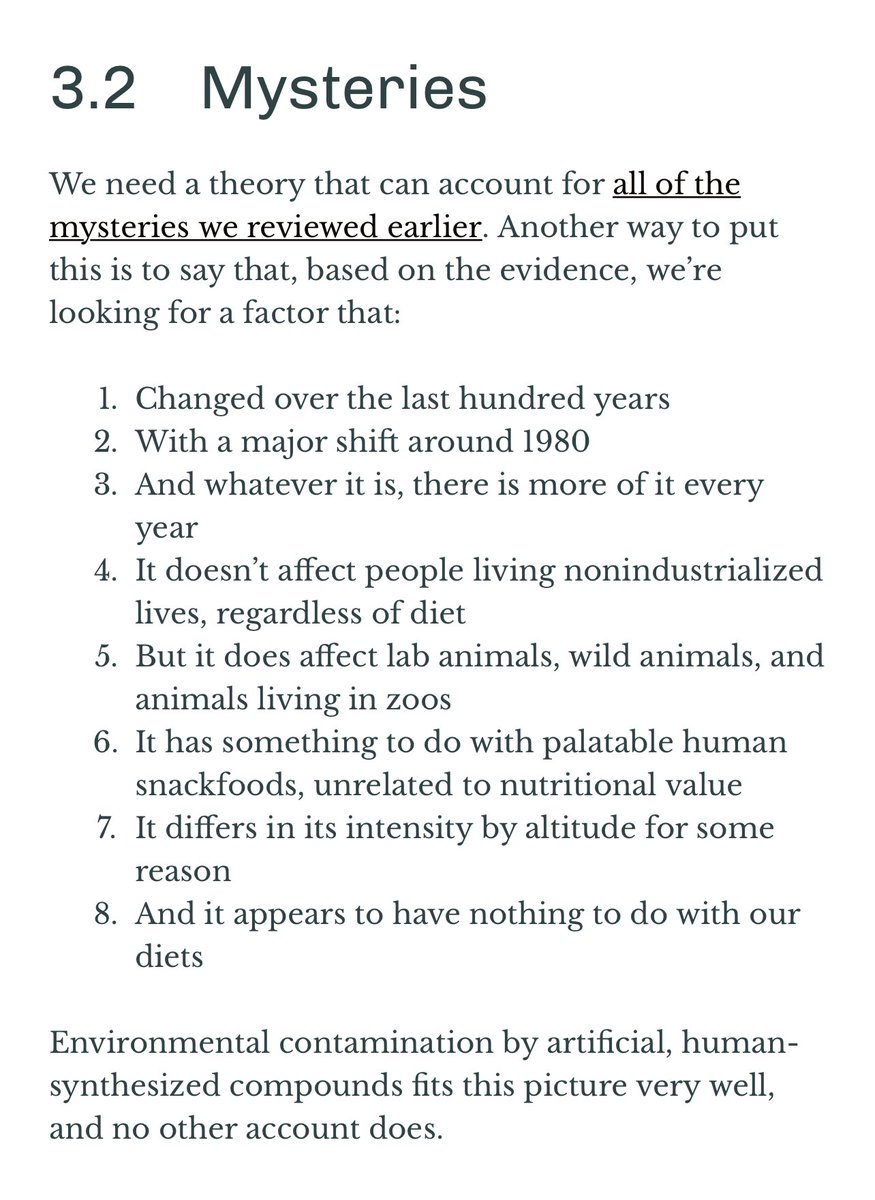
What if the obesity epidemic (which has accelerated) is entirely caused by human synthesized compounds and has nothing to do with diet, carbs, sugar, fat, calories or anything else we turn to for weight loss?
https://t.co/gK98pLV8p4
[New Post] Bottom up pricing and packaging is one of the more common board-level conversations we see these days. So we put together some guideposts to consider when thinking through it, with a bunch of examples that worked (and some that didn't 😬)
https://t.co/PFiqLVrXFI
1/ Ever seen a company where customers loved the product but the company STILL failed? Over 10 years I’ve seen this way too many times. It’s caused me to question whether the importance product market fit is a myth. Check this out 👇 https://t.co/jSkRM8xD2J
So here's my favourite little quirky thing in New York, which to me is a perfect embodiment of New York's attitude, and a direct result of New York's street grid, arguably two of the city's most famous aspects…
In B2B, this is a real challenge for product managers - field teams filling the product backlog with tables-stakes / also ran features. Strategic balancing should be done every quarter! Great post from @ttunguz