Announcing Dagger 1.0 beta.
Replace Jenkins and GitHub Actions with CI that matches the speed and scale of coding agents without wasting compute or tokens.
Featuring: test-native CI, dev shells, local and remote execution, official modules, and more.
https://t.co/HgVwTUAJi3
Now that X provides automatic translation, you can more easily understand why France is in such trouble with its debt situation.
@PorcherThomas is part of those french so-called economists who are given a lot of air time and credibility in the media even though their understanding of economics is simply below par because they are blinded by their political ideology.
As proof, I present you this post without comments 👇
It's a good TL;DR of the apalling level of some french economists that the French population is listening to on a way too regular basis 🤦♂️
There is a french expression to characterize such jokers: We say "il a eu son diplôme dans une pochette surprise" / "he got his diploma in a lucky dip". I am afraid it's the case with this one...
D'ailleurs, la taille du spread franco-allemand à long terme pourrait même devenir un problème pour l'Allemagne pour financer sa dette car, en l'absence de risque, les prêteurs prêtent aux pays avec des meilleurs taux.
Now that X provides automatic translation, you can more easily understand why France is in such trouble with its debt situation.
@PorcherThomas is part of those french so-called economists who are given a lot of air time and credibility in the media even though their understanding of economics is simply below par because they are blinded by their political ideology.
As proof, I present you this post without comments 👇
It's a good TL;DR of the apalling level of some french economists that the French population is listening to on a way too regular basis 🤦♂️
There is a french expression to characterize such jokers: We say "il a eu son diplôme dans une pochette surprise" / "he got his diploma in a lucky dip". I am afraid it's the case with this one...
What's the actual pitch to the companies whose stocks OKXICE wants to tokenize?
so far, most of the benefits seem to be for people trading their stocks, not the companies themselves.
Hard to blame issuers for not being excited about that 🤷♂️
cc @milichab@poteto
As I am increasingly putting a significant amount of time in setting up my grok bots, it recently crossed my mind that I would be very pissed if - somehow - I would lose them. Sadly, what I thought was theorical just arrived to my friend Ouriel :/☝️
On top of making sure this never happens, it could be great to think of a way to backup / export your bots?
@gabriel_zucman For one who stayed & paid, how many left?
Can't wait until we have the full picture.
So far it seems more likely that your tax will end up being a net loss for the State of California 🤷
https://t.co/ms1FRpfdxU
this California wealth tax thing is just incredible.
so in October 2025, a California healthcare union proposed a "one time" 5% tax on any billionaire's wealth. the ballot measure will be voted on next month. In early December 2025, California announced that it would be a retroactive tax if passed, applying to anyone with CA residency as of Jan 1, 2026. The objective is to pay for Medi-Cal, California's incredibly dysfunctional healthcare system. (which also functions as a glorified welfare apparatus, but that's a discussion for another time).
polls reveal that the CA electorate is split around 50/50 on the tax, but prediction markets only give Prop 40 a ~23% chance of passing (there are competing measures on the ballet that would nullify it).
there are 200 billionaires in CA, worth collectively somewhere between $2.3 and $2.6 trillion. 5% of that is around $100b, accounting for a small amount of attrition. proponents of the tax forecasted a significant windfall, assuming only a 10% departure rate.
supporters thought they were being clever with the retroactive concept. no billionares would leave CA in the few short months between the tax being proposed and the residency cutoff date, without the tax even having passed yet, right?
well as it turns out, they did.
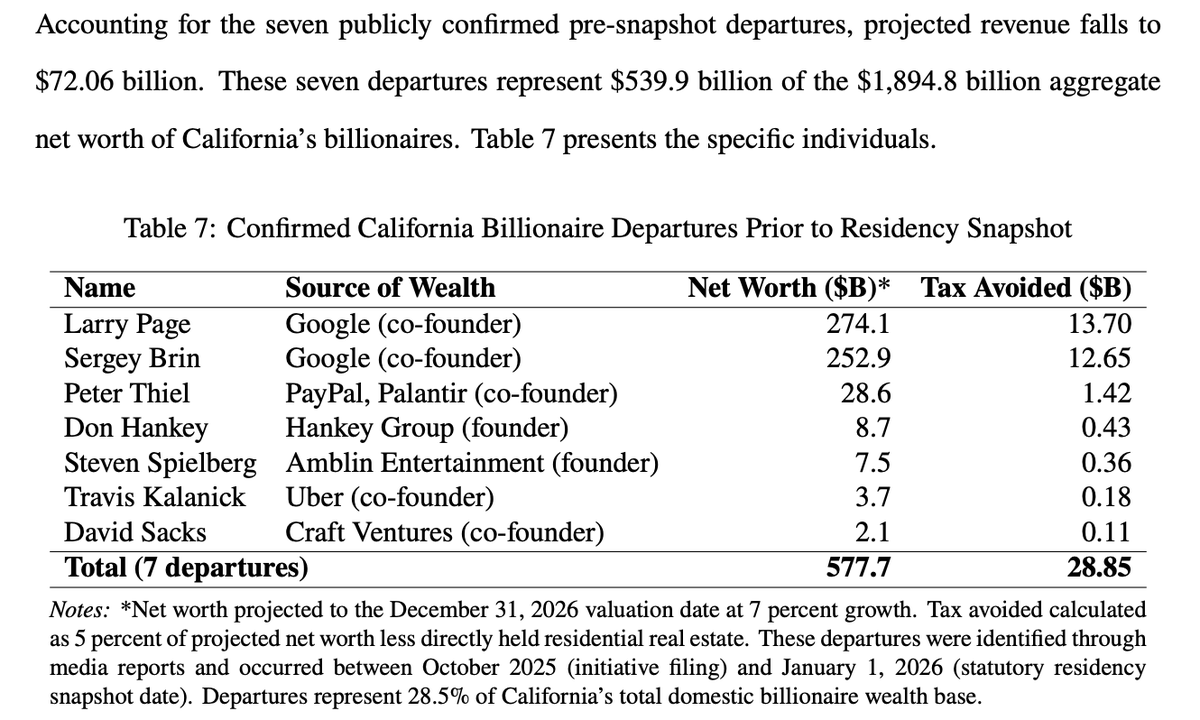
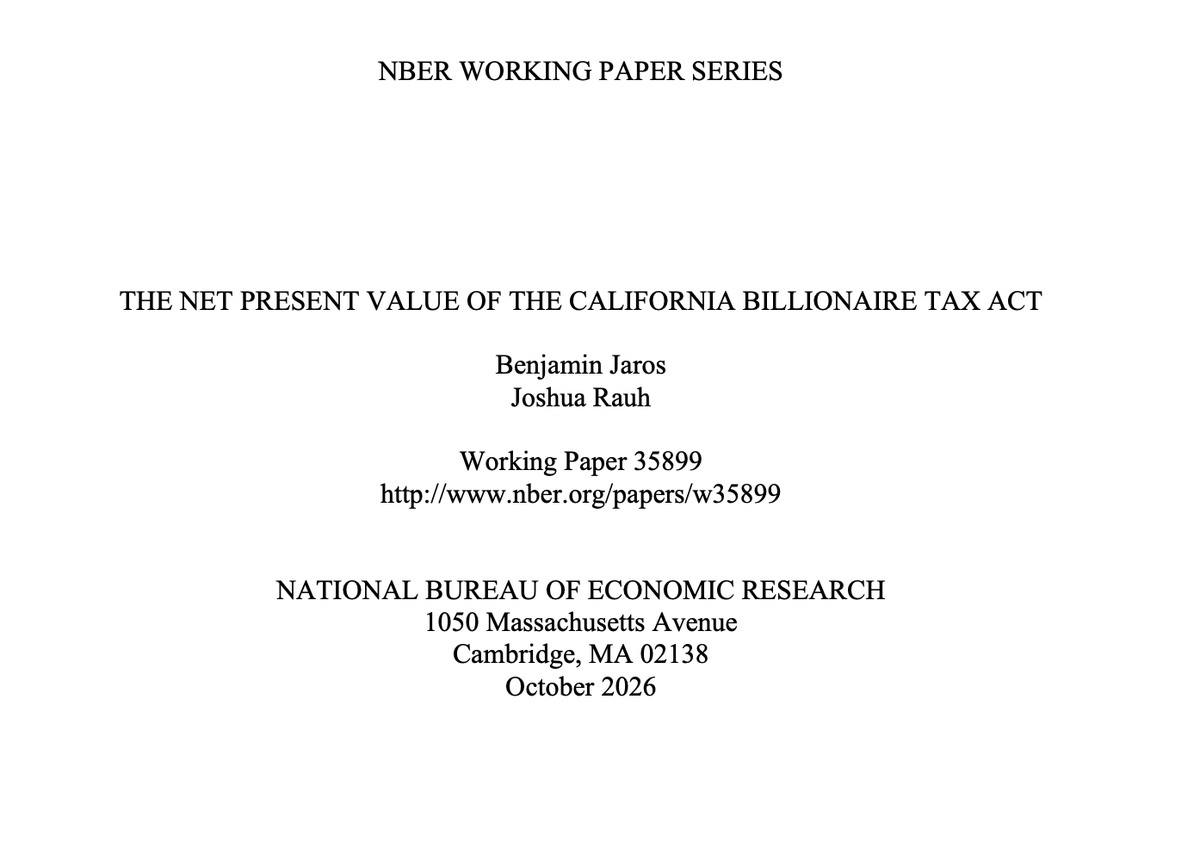
a new paper [1] from two academics at Stanford called "The Net Present Value of the California Billionaire Tax Act", argues that not only did more billionaires leave due to the proposed tax than its proponents expected, but that the value of the tax, if it does pass, is actually negative.
proponents of the tax only assumed 10% avoidance, that is, only 10% of the taxable base of targeted billionaires would leave CA within the very short Oct-Dec 2025 window. Jaros and Rauh, the Stanford academics, find that a lower bound of 28.6% of the taxable base managed to leave.
just based on known departures, those departures total $577b in net worth, or $28.8b in potential tax lost. this of course does not capture everyone (many left without announcing their departure), so the authors normalize to departure rates estimated from other wealth tax events, and apply other discounts for litigation, arriving arrive at a figure of only $28-$36b in forecasted tax revenues.
but this isn't all! all of the income taxes paid by the departed billionaires are also forsaken. the authors estimate that CA billionaires pay $3.3- 5.8b in annual income taxes. they assume a midpoint of $2b lost in annual collections from departed billionaires. the net present value of that lost income stream is -$68.9 billion.
so when you add it all up you get:
+ $30b one-time tax windfall (estimated)
- $69b in present value of lost future income taxes
= - 38.9b overall net present value of the tax
of course, this analysis is highly estimate driven. the authors simulate the parameters 100k times and find a negative NPV of the implemented tax 85 percent of the time.
and if the tax doesn't pass, which it's not looking like it will, California still ended up losing at least $577b in departed net worth, and they have permanently poisoned the well with entrepreneurs who will now worry about future wealth taxes.
[1]: https://t.co/1lbZgnMTG9
@AlexandreJardin Ca fait tellement longtemps qu'on entend plus ce discours que ca fait tout bizarre à entendre. C'est ca qu'on veut et ce dont la France a besoin!
Hey @milichab & @poteto, quick heads up (because I don't know where to report this) but with the merger of everything, it's now very confusing when receiving emails like this 👇
Which account has been accessed? "SpaceXSI account" means nothing to me.
Was it our X account? Cursor account? Grok account? We don't own any rockets so we don't have a SpaceX account... yet! :)
“A token is not equity. But equity can be a token.”
That distinction changes everything about tokenized stocks.
Our CEO @Joris_DLN on why the official shareholder register matters, from yesterday’s webinar with @CantonStrategic 👇
this California wealth tax thing is just incredible.
so in October 2025, a California healthcare union proposed a "one time" 5% tax on any billionaire's wealth. the ballot measure will be voted on next month. In early December 2025, California announced that it would be a retroactive tax if passed, applying to anyone with CA residency as of Jan 1, 2026. The objective is to pay for Medi-Cal, California's incredibly dysfunctional healthcare system. (which also functions as a glorified welfare apparatus, but that's a discussion for another time).
polls reveal that the CA electorate is split around 50/50 on the tax, but prediction markets only give Prop 40 a ~23% chance of passing (there are competing measures on the ballet that would nullify it).
there are 200 billionaires in CA, worth collectively somewhere between $2.3 and $2.6 trillion. 5% of that is around $100b, accounting for a small amount of attrition. proponents of the tax forecasted a significant windfall, assuming only a 10% departure rate.
supporters thought they were being clever with the retroactive concept. no billionares would leave CA in the few short months between the tax being proposed and the residency cutoff date, without the tax even having passed yet, right?
well as it turns out, they did.
a new paper [1] from two academics at Stanford called "The Net Present Value of the California Billionaire Tax Act", argues that not only did more billionaires leave due to the proposed tax than its proponents expected, but that the value of the tax, if it does pass, is actually negative.
proponents of the tax only assumed 10% avoidance, that is, only 10% of the taxable base of targeted billionaires would leave CA within the very short Oct-Dec 2025 window. Jaros and Rauh, the Stanford academics, find that a lower bound of 28.6% of the taxable base managed to leave.
just based on known departures, those departures total $577b in net worth, or $28.8b in potential tax lost. this of course does not capture everyone (many left without announcing their departure), so the authors normalize to departure rates estimated from other wealth tax events, and apply other discounts for litigation, arriving arrive at a figure of only $28-$36b in forecasted tax revenues.
but this isn't all! all of the income taxes paid by the departed billionaires are also forsaken. the authors estimate that CA billionaires pay $3.3- 5.8b in annual income taxes. they assume a midpoint of $2b lost in annual collections from departed billionaires. the net present value of that lost income stream is -$68.9 billion.
so when you add it all up you get:
+ $30b one-time tax windfall (estimated)
- $69b in present value of lost future income taxes
= - 38.9b overall net present value of the tax
of course, this analysis is highly estimate driven. the authors simulate the parameters 100k times and find a negative NPV of the implemented tax 85 percent of the time.
and if the tax doesn't pass, which it's not looking like it will, California still ended up losing at least $577b in departed net worth, and they have permanently poisoned the well with entrepreneurs who will now worry about future wealth taxes.
[1]: https://t.co/1lbZgnMTG9
Everyone wants to tokenize stocks.
Meanwhile, Broadcom, Verizon, CoreWeave and others are objecting to having their shares traded on OKXICE.
Maybe the industry should start building with issuers instead of treating them as an afterthought. 🤷♂️
@poteto Hey there👋Quick feature ask: From a Cursor chat, I'd like to "ask @<botName>" so the IDE agent can use that Grok bot. I already specialized Grok bots. I also want those chats in the IDE, with the bot able to see the files I have open.
Forum: https://t.co/wPqiEFeYxd
Keep up the amazing work!
U.S. digital asset regulation is moving fast. What does that mean for the future of @CantonNetwork? 👀
Our CEO @Joris_DLN is joining Mark Wendland and Mark Toomey from Canton Strategic Holdings tomorrow to share his perspective.
Come join the conversation! 👇