At least 1,148 fish species in the Mekong - around 25% - exist nowhere else on Earth. The world's largest inland fishery sustains 40M people and is valued at $11B. Yet, 19% of assessed species face extinction, including mega and migratory fish. More here: https://t.co/RezBfEVBAp
Military emissions take the lead, with 82 MtCO₂e since 2022, driven by fuel-hungry heavy vehicles, steel, and concrete for fortifications. Rebuilding damaged infrastructure follows with 62 MtCO₂e. A fast-growing third source: fires, which released 25.8 MtCO₂e in 2024.
In three years, the war in Ukraine has generated 230 MtCO₂e - as much as the annual emissions of Austria, Hungary, the Czech Republic, and Slovakia combined
https://t.co/h78cMceXYd
🌱The first global assessment by IUCN’s @redlisteco and partners reveals that over ½ of the world's #mangroves are at risk of collapse.
#Climate change, #deforestation, and pollution are just some the threats to these vital ecosystems.
Read more ➡ https://t.co/f0uk7TCeVT
Last week @NOAA's office of research sent a message to all staff saying that “effective immediately”, the agency’s headquarters will implement a new layer of oversight over its scientists’ email and “virtual meetings” with foreign nationals
https://t.co/f78IUj5D15
January 2025 was the warmest January ever recorded, confirmed our colleagues at @CopernicusECMWF. Last month was 1.75°C above the pre-industrial level and 0.79°C above the 1991-2020 average.
Details: https://t.co/yKz6IaWkSn
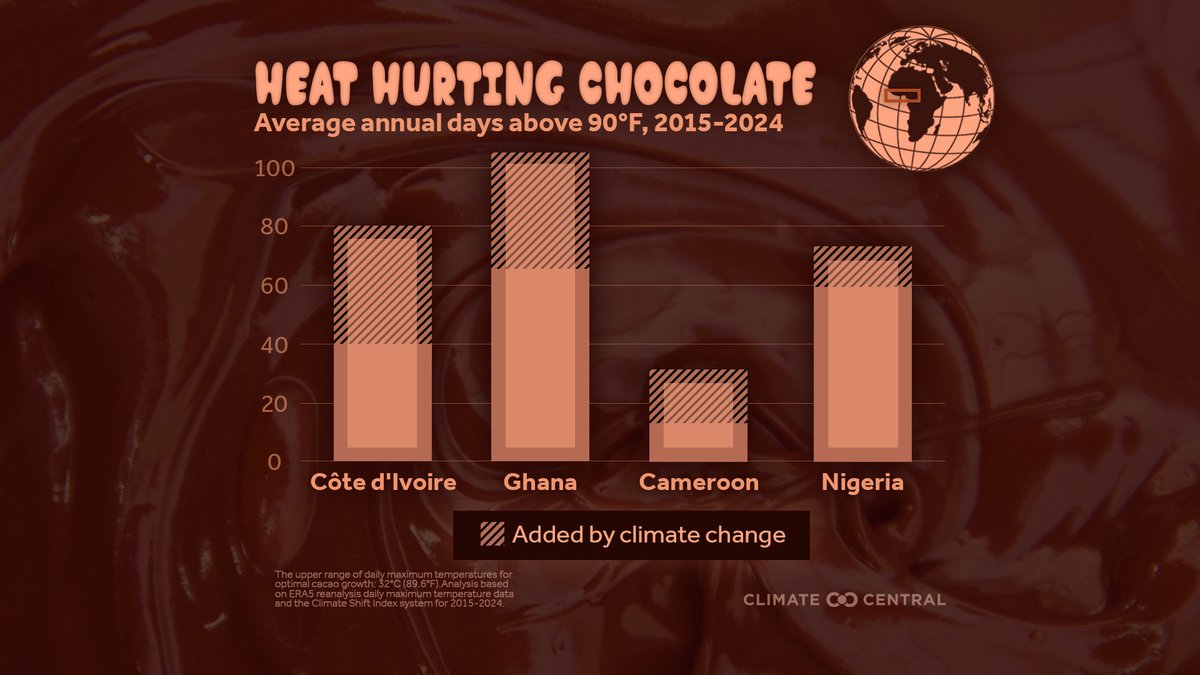
Adaptations can help cocoa farmers respond to changing conditions, but they can't fully prevent disruptions in the production of cocoa. Adaptations include breeding plants that are more resistant to heat and drought, planting taller trees among cacao to create shade.
With Valentine's Day approaching, @ClimateCentral found that human-caused climate change is bringing more extreme heat to West Africa, which is threatening cacao growth and global chocolate supplies.
Link: https://t.co/aX0IOgTZch
Hot days above 90°F limit chocolate production and are also dangerous for cocoa farmworkers and their families. Extreme heat compounds other dangerous and physically-demanding working conditions, including exposure to chemicals, lifting heavy loads, and long hours.
The second study, published Monday in the same journal, found that near-Herculean efforts to achieve emissions cuts would be needed now to avoid exceeding the 1.5-degree goal. Study: https://t.co/ESR3VTN5c6
In the journal Nature Climate Change, Alex Cannon of Environment and Climate Change Canada finds about an 80% chance that the world has already breached the 1.5-degree target when it comes to the long-term warming level. Study: https://t.co/ag78LaqePi
95% of countries miss UN deadline to submit 2035 climate pledges
Just 10 of the 195 parties have published their new emissions-cutting plans, known as “nationally determined contributions” (NDCs), by the 10 February deadline
https://t.co/QFpSOhduZm