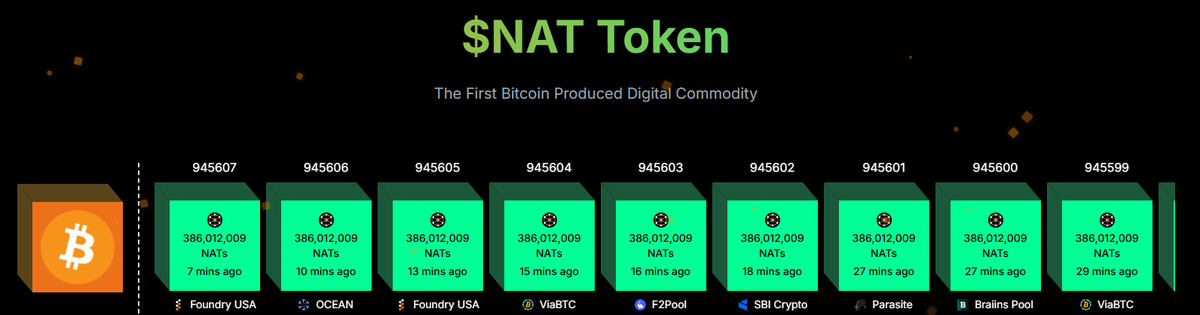
If $NAT reaches a $50B market cap, miners would earn an additional $50,000 in $NAT per block—about 20% of the reward at a $75,000 BTC price, rising to 32% if BTC remains unchanged by the 2028 halving.
If $NAT reaches a $50B market cap, miners would earn an additional $50,000 in $NAT per block—about 20% of the reward at a $75,000 BTC price, rising to 32% if BTC remains unchanged by the 2028 halving.
We’re headed to the Hood Summit next week in hopes to gather some alpha intel for our community.
$PRISM has been rattling a lot of cages and we discuss what L3 ambitions could lead to.
Crypto is looking more and more bullish by the day and we think there couldn’t be a better time to all in on this industry.
In this episode we break down what is in our heads currently and how our conversations with Bitcoin miners has changed our view on @natgmi progression moving forward 👇
NAT 2.0 In The Works | $PRISM L3 Breakthrough | AI Taking Over Biotech | TBR #333
@vladtenev will not stop vague posting about the hood summt. Space chairs, space suits, 'the course is set', the whole Houston bit. We open this one speculating on what @RobinhoodApp is actually about to unveil, why the last summit's tokenized @OpenAI stock giveaway set the bar, and whether we are walking into another iPhone moment or another stress ball.
From there we get into the @Meta glasses unveil and whether any of this AR push passes the iPhone test, then the story that genuinely stopped us: @AnthropicAI 's Claude effectively directed a biology lab and surfaced what might be a new gene-editing mechanism in the CRISPR family. We talk about why curing diseases is becoming the new flex for AI labs now that benchmark wins are invisible to normal people, and what it would actually take, someone walking out of a facility no longer shaking, for us to call it real instead of theater.
We also sat with the big AI debate that is going around, the one arguing the labs are lying and extinction odds are being lowballed. We are less skeptical of the doom case after watching it than before, and we land where we usually land: you cannot steer this, so position for it. That includes talking honestly about why buying an AI lab IPO at two trillion is not our trade, what the bubble popping would mean, and why the Unabomber getting a Russell Crowe movie this same week feels a little on the nose.
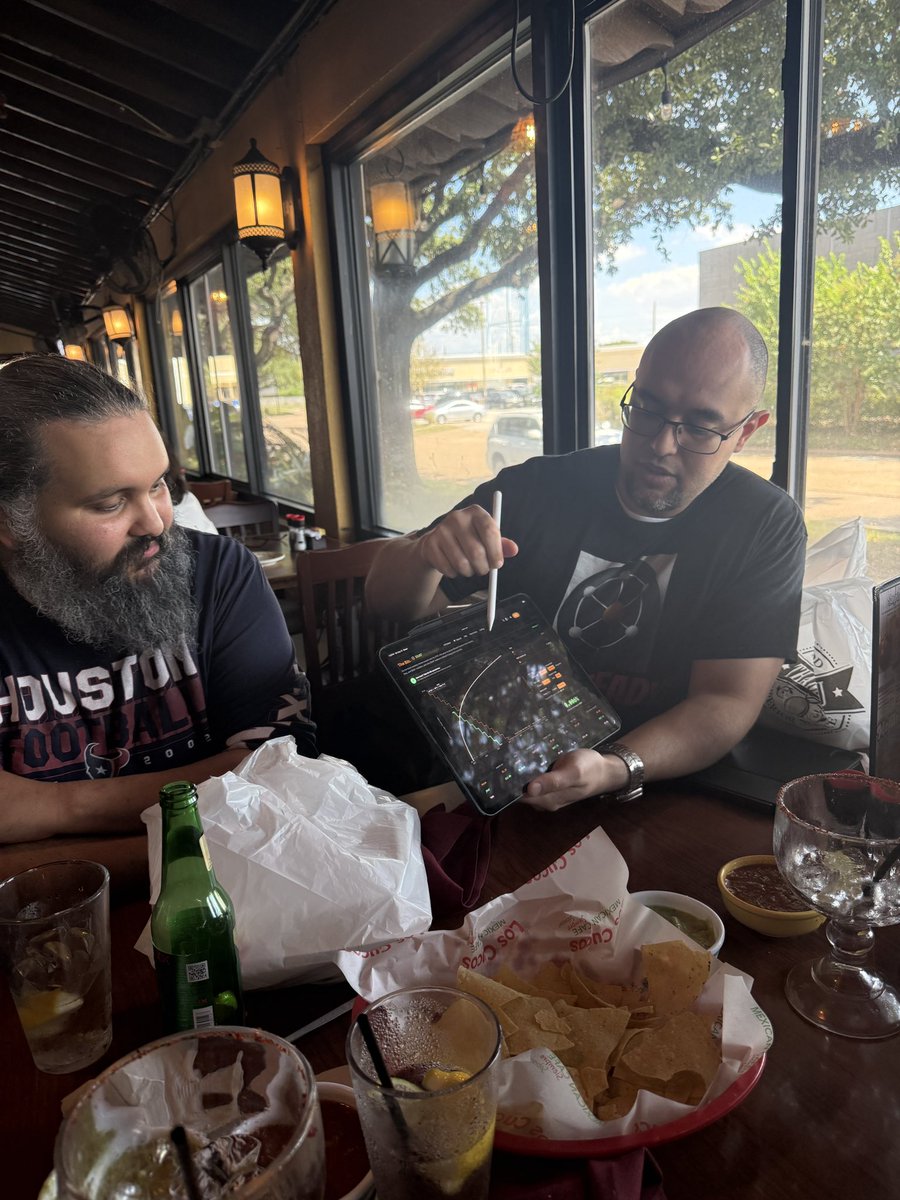
The back half is ethereum:0x249130f5e2dd4cf278180c0df8273f3592ad1247. We just recorded 45 minutes with @NewsAsset , our first big outside interview on Bitcoin's security budget, and we recap what we said and what we would say better. We share what miners keep telling us in private, including a lunch with solo miners who feel the fee problem in their bones, and we walk through the evolution conversation: running your own indexer, quantum-resistant coinbase addresses, who merges protocol updates in the future, and why the Lightning Network is the closest model for how NAT should sit beside Bitcoin without touching its simplicity.
We close on the market itself. @prismassets is building an L3 app chain and we break down what that raises, both ceiling and difficulty. The sharks have arrived in Robinhood season, the countdown-page rug pattern is back, and in the Claude era anyone can look like a legit developer, which makes the one-in-a-billion builders like Hatch more valuable, not less.
And that last part is the real weight of this episode. Satoshi stepped away when Bitcoin was roughly where NAT sits today in market cap, and the network carried on without him. We do not think we get that luxury, and honestly we do not want it. Formalizing NAT's governance so it can outlive us is not an exit plan; it is the only version of this where the thing we keep telling miners, someone has to fund Bitcoin's security, stays true whether or not we are the ones saying it.
YouTube 🔗 https://t.co/Os2V1kM4tW
This gets the security-budget problem exactly backwards.
Bitcoin’s subsidy falls exponentially. The argument assumes Bitcoin’s price can rise exponentially forever to offset it. Nothing can compound exponentially forever. Past price appreciation delayed the problem. It did not solve it.
Even if BTC doubled after every halving, the subsidy’s dollar value would only stay flat while the value of the network doubled. Bitcoin would secure exponentially more wealth with the same security budget.
Bitcoin's security is = Bitcoin miner revenue.
In fact, price cancels out of the equation:
Security budget / network value
= BTC paid to miners / total BTC value
Raise BTC’s price and both sides rise together. Price appreciation cannot repair the declining ratio.
The subsidy decline is guaranteed by code. Exponential price growth is not. Building Bitcoin’s long-term security model on the latter is a fool’s errand.
Bitcoin needs durable miner revenue beyond its declining subsidy. Fees wont solve this either.
ethereum:0x249130f5e2dd4cf278180c0df8273f3592ad1247 creates a Bitcoin-native second subsidy without changing Bitcoin’s consensus or 21 million cap and has over 60% Bitcoin hash power support.
Bitcoin's price can hide the problem. It cannot solve it.
Read the NATpaper: https://t.co/KPTB4LETrc
Security underpins the value of your Bitcoin.
How can I prove it?
How much Bitcoin would you hold if the incentive to mine Bitcoin was just enough for only a few laptops to continue mining it?
You would hold ZERO Bitcoin, that's the correct answer.
This is where Bitcoin is headed, with every halving is exponential decay in miner revenue, which means the security of Bitcoin declines over time.
Even in a "super cycle" scenario, you can not surpass exponential decay.
ethereum:0x249130f5e2dd4cf278180c0df8273f3592ad1247 has over 60% of Bitcoin miner support, 60x more than BIP-110, remember that mess?
Buying $1 worth of NAT increases Bitcoin's security by 6.5x. The more NAT you buy the more security of Bitcoin increases and a higher market cap ceiling for Bitcoin.
This is just the math.
Two different questions about Bitcoin and NAT.
Which is worth more in total? Bitcoin, by a mile.
Of every $1 held, how much reaches miners each year? Bitcoin: ~0.8¢. NAT: ~5.2¢.
Per dollar held, $DMT-NAT is about six times more efficient at paying for Bitcoin's security.
Bitcoin solved money.
It did not finish paying for its own defense.
Every 10 minutes the network still buys an army.
The subsidy keeps getting cut.
Fees have never covered the whole invoice.
The cap does not move.
ethereum:0x249130f5e2dd4cf278180c0df8273f3592ad1247 is the second subsidy.
Read from the block.
Paid to the miner.
No premine.
No founder.
No season.
After Bitcoin, this is the layer that keeps Bitcoin alive.
ethereum:0x249130f5e2dd4cf278180c0df8273f3592ad1247
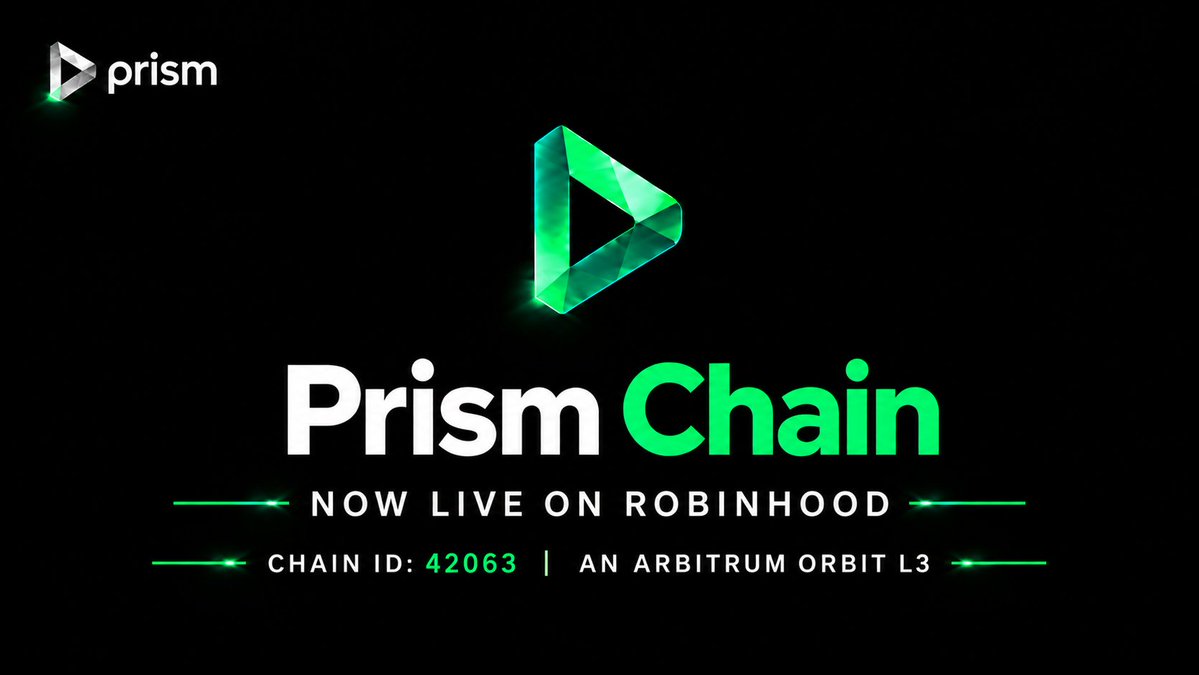
Prism is now its own blockchain.
We built our own child chain, an Orbit L3, that runs on top of Robinhood Chain.
Prism L3, an Arbitrum Orbit L3, chain ID 42063, settling to Robinhood Chain Testnet as its parent.
Over the past months we have built a large range of applications, tools, infrastructure, products, and core protocols. Running our own L3 lets us operate all of it far more efficiently and with far more control, instead of building inside the same shared infrastructure as everyone else. It also means we are no longer constrained to building every dapp within a single protocol we do not control.
Our native token $PRISM (0x20024E485c0B22b42855589700721b28320A7777) will be the gas token on Prism L3, in place of ETH.
You can add the Prism L3 testnet to your wallet here: https://t.co/j5d4D0EbVT
What this gives us:
- Our own gas token: Every transaction on Prism L3 is paid in $PRISM.
- Our own sequencer: Prism controls transaction ordering on its own chain, so we no longer compete with other Robinhood protocols for block space, and we set the ordering rules.
- Dedicated block space: Our throughput is ours alone and is not slowed by congestion from other protocols.
Chain-level compliance and permissioning, which is the essential capability for a real world asset protocol.
- Execution customization, so Prism can build its own infrastructure natively and far more efficiently.
- Sovereign governance and our own choice of data availability model.
This is what takes Prism from an application to a platform, in the way Robinhood is a platform.
Prism Testnet will soon be available to public and Doc will be shared soon.
The world's largest asset manager put Bitcoin's security budget problem in a legal filing.
BlackRock's IBIT 10-K: the halving "could result in less of an incentive for miners… thereby jeopardizing the security of the Bitcoin network."
Their lawyers. 🧵
@BlackRock@iShares
$NAT is not hoping Bitcoin succeeds.
It is priced by Bitcoin succeeding.
Every block that gets mined pays miners a second subsidy from the bits field - with zero dilution of the 21 million.
The bigger Bitcoin gets, the larger the security market has to become.
That’s not a narrative.
That’s structural demand.
Bullish is an understatement.
Perhaps a perfect storm is brewing
robinhood:0xca9c78dd337a67f6e0077f65f5e9218719d30edf and robinhood:0x20024e485c0b22b42855589700721b28320a7777 collab would break Robinhood
Let's hope an integration gets figured out here
Everyone fears quantum.
Look Into Bitcoin's Matt Crosby says the real threat is Bitcoin's decaying security budget.
In this one, we break down why 60% of miners already back @natgmi as a market-driven second subsidy, and what ethereum:0x249130f5e2dd4cf278180c0df8273f3592ad1247 actually is.👇
Bitcoin’s Security Budget Is Trending To ZERO... | Interview w/ Matt Crosby | TBR#331
In this episode, we sit down with @MattCrosbyPro, Research Director at https://t.co/paKHeMdg9x, for one of the most honest conversations we've had about where Bitcoin actually stands. Matt walks us through his path from a 2017 top buyer chasing altcoin gains to going all in on on-chain data analysis, and why the ability to watch every block, every transaction and every address in real time gives Bitcoin a kind of X-ray vision no other asset has. From there we get into what he sees as the strongest evidence that Bitcoin is here to stay, from Wall Street legitimacy to pension funds and sovereigns quietly accumulating, and why that maturity is dampening both the parabolic tops and the brutal drawdowns.
Then we go where most Bitcoiners refuse to. Matt ranks the long-term threats to the network, from the declining security budget he considers the biggest structural risk, to quantum computing as the most immediate, to the slow centralization of mining and the shaky incentives for running nodes. We dig into why miners are already pivoting their infrastructure to AI, what happens when an exponentially more valuable network is defended by a flat and decaying subsidy, and why the usual proposed fixes, an infinite Bitcoin supply or a demurrage tax on holders, are non-starters that break the very thing that makes Bitcoin worth securing.
That is where @natgmi comes in. We introduce Matt to the idea of a market-driven second subsidy, and he pushes back with the best criticism we hear all the time: where does the demand actually come from? We work through the psychological and structural answer: how tokenizing the security of Bitcoin turns awareness into value the same way it did for Bitcoin itself, why a belief-driven asset directed to miners is a genuine first, and how ethereum:0x249130f5e2dd4cf278180c0df8273f3592ad1247 is actually an ordinal inscription built off Bitcoin's bits field through digital matter theory, earned straight from the miner's @coinbase. Matt even walks through the calculator that surprised him, where a relatively small NAT market cap could deliver a million dollars a block to secure a hundred-trillion-dollar network.
What stuck with us most is how the conversation shifted from skepticism to Matt opening @Uniswap and buying a bag on air. Not because anyone sold him a token, but because the underlying problem is real and almost nobody with influence is talking about it. When an ordinals debate with one percent of hash power support can dominate the discourse for a year while a solution with sixty percent miner adoption gets near silence, the gap is not about the technology; it is about awareness.
Our honest read is that Bitcoin does not automatically solve its own security at scale, and pretending it will is the least genuine version of being bullish. Proportional security is not a nice-to-have at a hundred trillion dollars, it is the whole game, and NAT is the first viable, market-driven answer that does not require rewriting Bitcoin's consensus. Whether it grows into that role is still an open question, but this is exactly the conversation the space should be having now, not after the catalyst forces it.
YouTube 🔗 https://t.co/2xfKwWq6jA