Fystack is now live on Stellar mainnet.
For exchanges, payment gateways, merchant checkouts and wallet apps adding Stellar without building their own wallet stack.
→ Deposit and withdraw XLM and USDC
→ One shared address, a memo per user, delivered in the deposit webhook
→ Gas sponsorship: users send USDC without holding XLM
→ MPC cosigner wallets: DKG + threshold signing, the full key never in one place
We chose to support Stellar because its fast settlement, low fees, native USDC and developer-friendly tooling make it well suited for stablecoin payments.
Thank you to @StellarOrg and @VN_Stellar for your support along the way.
Try Fystack on Stellar: https://t.co/WhsFqIUo4F
We’re proud to share that Fystack is now ISO/IEC 27001:2022 certified, the international standard for information security management.
An independent auditor reviewed how we protect our systems and our customers’ data. Security is built into every layer:
- Applications: secure development practices, code review and continuous testing.
- Dependencies: we monitor third-party libraries and patch known vulnerabilities quickly.
- Cloud and containers: hardened infrastructure, least-privilege access, and isolated workloads.
- Internal access: our team works on a zero-trust network and signs in with hardware security keys.
Private keys are never held in one place, thanks to our MPC wallet design. Our MPC engine is open source: https://t.co/GuWaeG8d7t
Security isn’t a one-time milestone. It’s a commitment we renew every day.
See all our security controls on our Trust Center: https://t.co/pDpW3m5PrQ
Thank you to our team and partners for helping us get here!
Binance’s $6.34B hack took 4 hours to pull off and 5 months to plan.
Tampered Homebrew package → fake job interview with 0-day malware → internal AI tool used to spread → signing service taken over.
Source: https://t.co/rfvfs1faM5
Meet Thi Nguyen, Founder of @Fystack, in our next Builder Spotlight! 🚀
With a background spanning blockchain development, smart contracts, backend engineering, and Web3 security, Thi is building secure digital asset custody infrastructure to help fintechs and Web3 businesses move onchain.
Through Fystack, he’s working on MPC-powered wallets, multi-chain asset management, and automated stablecoin payment infrastructure. His work also extends to the Stellar ecosystem, where Fystack is developing an open-source MPC wallet to strengthen wallet security on Stellar.
🎙 Join us to hear Thi’s journey, the challenges of building secure Web3 infrastructure, and his vision for the future of digital asset custody.
📅 TODAY | 5 PM GMT+3
https://t.co/6y8kT2iZCz
@SuperteamVN Excited to support builders and teams with technical insights during the Colosseum Hackathon. Looking forward to helping teams turn their ideas into reality! 🚀
A look back at Hack Seasons Conference Ho Chi Minh City.
The digital asset space is expanding beyond the blockchain-native world. It’s no longer just blockchain-native builders - teams from fintech, financial services, and infrastructure are joining in, each with a different view of where the market is heading.
We saw this firsthand at the @fystack x @securosys booth, with conversations ranging from teams exploring digital assets for the first time to businesses already looking at how to integrate them into their existing operations.
Thank you @thesensedotsol team for the amazing video!
Institutional digital assets need infrastructure that fits the way real teams operate - from wallet management and approvals to security and compliance.
See you at HSC on the 15th!
Fystack has partnered with @securosys to bring HSM-backed deployments to our custody platform for banks and institutional clients.
While MPC remains our default architecture, institutions can now choose between MPC and HSM based on their security, compliance, and operational requirements - all through the same orchestration layer for wallet management, policy controls, approvals, and audit trails.
Together, we're delivering more flexible, institutional-grade digital asset custody.
#DigitalAssetCustody #MPC #HSM
Banks and fintechs in Vietnam don't need an in-house crypto team to launch digital asset products
That's the case Fystack and Securosys will make live at HSC Ho Chi Minh on August 15 — a 20-minute workshop at their booth, with a live transfer demo and the actual security hardware on the table
Who's behind it
▫️ @securosys — Swiss security hardware trusted to protect Switzerland's national interbank payment system
▫️ @fystack — wallet & custody infrastructure for stablecoins and tokenized assets. Financial institutions can build on blockchain without an in-house crypto team
What it gives banks and enterprises
🔑 Private keys are generated, stored, and used entirely inside certified Securosys HSMs — they never leave the hardware
🏠 Self-hosted on-premise, with all keys, data, and operations kept under Vietnam data residency laws
⚙️ Role-based access, multi-sig approval groups, and a policy engine define who can move which assets
📋 Immutable audit trails on every action, automated AML/OFAC screening, and multi-chain support
Both teams will be on-site. If you'd like to meet the teams in person and learn more about their joint custody solution, you can book a meeting in advance by reaching out to https://t.co/YDg3VyK81i
Register for HSC Ho Chi Minh: https://t.co/oAyTGM0owL
Audit Completed for @Fystack
Fystack builds MPC-based stablecoin payment infrastructure for fintechs, neobanks, and payment providers. Self-hosted deployment and flat pricing.
Grateful to work with the Fystack team and help them Ship Safely. 🚀
Public report & testimonial below🧵:
We’ve just wrapped up our journey in the Empower Residency Program at @UnchainedSummit 2026.
Over the past week, @fystack team has also been presenting and connecting with builders across Web3 Builder Summit and Davas 2026. It’s been an incredible opportunity to represent founders from emerging markets who are building innovative solutions for the next generation of onchain applications.
A special thank you to @sqrDAO, @Lisk, Leo, @alxs0x, @Cris7ran, @bytesbybree, @0xDankiii, @harrybui31, @TheVinhNguyen4 and all the mentors, partners, and friends who supported us throughout this journey.
We’ve met amazing people, forged valuable partnerships, and gained insights that will help shape our next chapter.
Now it's time to take @fystack to the next level: building the custody layer that enables fintechs in emerging markets to launch secure onchain applications.
Excited to be speaking at Web3 Builders' Summit: LFBUIDL 2026 (May 25 Danang, Vietnam) co-hosted by @sqrDAO and DAVAS.
I'll be presenting @fystack talking about secure custody infrastructure for the stablecoin era and what it actually takes to bring banks and fintechs on-chain.
If you're going to be in Danang that week, let's connect.
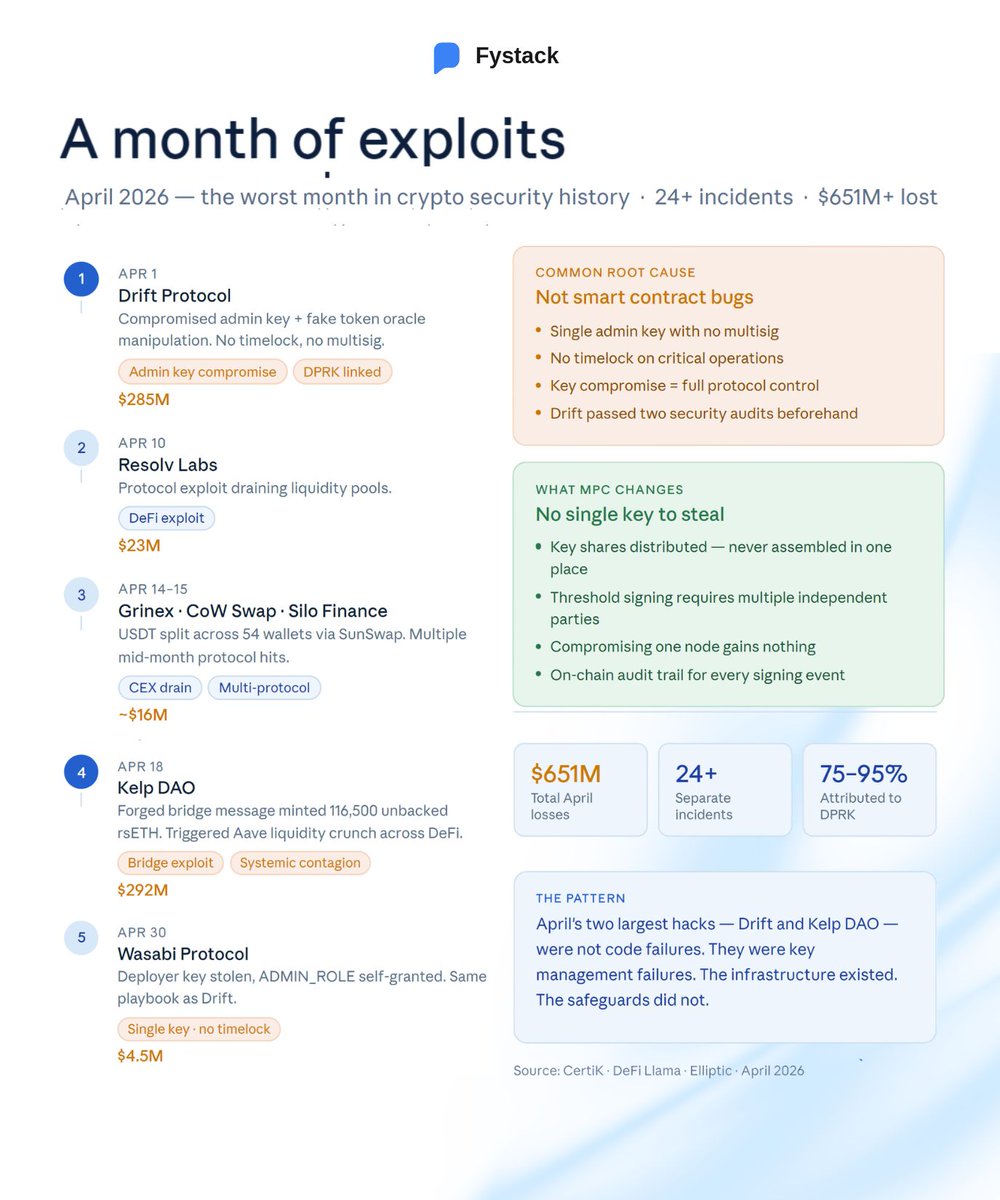
24 exploits. $651M lost. The worst month in crypto history.
Your signing key is your biggest attack surface. April proved it.
This is not a DeFi problem. Any system where a single key authorizes critical operations has the same exposure.
If you are running custody, payment rails, or signing infrastructure, the question is not whether your keys are encrypted. It is what happens the moment one is compromised.
Full breakdown in the image below 👇
480,000 AI agents are already transacting on-chain.
Crypto is the only native payment rail for non-human software, but it creates a massive infrastructure risk: Who holds the key when an autonomous agent signs a transaction? 🧵
Blockchain series: Why Bitcoin is slow (and extremely hard to hack)
We look at Bitcoin and see:
~7 TPS
~10 minute blocks
no smart contracts and conclude it’s outdated.
That’s missing the point.
If you read the architecture instead of the metrics, it becomes clear what Bitcoin is actually optimizing for: making history extremely hard to change
How Bitcoin actually works (and why it feels “slow”)
1. Proof of Work (consensus)
Miners compete to find a hash below a target. No shortcuts, just computation.
Security comes from real-world energy
- Attacks are physically expensive
- 10 min blocks are intentional
Slowness = security.
2. UTXO model (state)
Bitcoin doesn’t track balances. It tracks unspent outputs.
Instead of “you have 0.8 BTC”:
- you own a 0.8 BTC output
- you spend it fully
- you create new outputs (recipient + change)
Implications:
- no shared global state
- parallel validation
- simpler failure model
Tradeoff: wallet logic is harder (UTXO selection, change, etc.)
3. Script (execution)
Bitcoin Script is deliberately limited:
- no loops
- no complex state
- not Turing-complete
This minimizes:
- attack surface
- unexpected behavior
- consensus bugs
No DeFi on L1. Just predictability.
What you get in return:
- ~60 min strong finality
- extremely high cost to rewrite history
- a system that changes very slowly
The mental model:
Bitcoin is not trying to be fast or flexible.
It’s trying to be: a settlement layer you can trust over decades