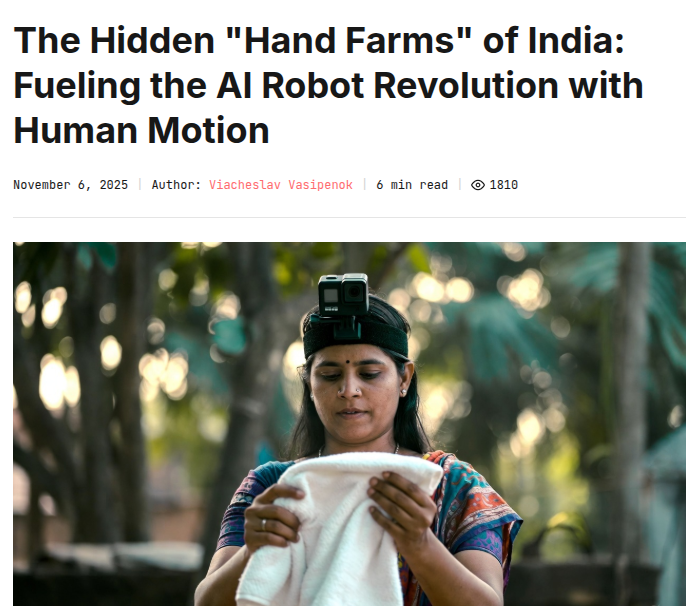
India is quietly becoming a training floor for humanoid robots, with workers filming thousands of first-person hand tasks so AI systems can learn grasping, folding, sorting, and tool use.
This story is really about how the humanoid robot boom still depends on cheap, repetitive human labor to teach machines basic physical skill.
The problem is that robots do not fail on big plans first; they fail on tiny physical details like grip angle, finger timing, slip correction, and object contact.
That kind of knowledge is hard to code and expensive to collect.
These labs capture that missing layer by putting cameras or sensors on people and recording ordinary actions as machine-readable motion examples.
The useful part is not the towel or box itself but the sequence: where the hand starts, how force changes, when fingers adjust, and how the body recovers from small mistakes.
That gives robotics teams supervised data for models that map visual input to physical actions, which is much easier than hand-coding every movement rule.
This is a story about how physical intelligence gets extracted before it gets automated.
---
quasa. io/media/the-hidden-hand-farms-of-india-fueling-the-ai-robot-revolution-with-human-motion
Elon Musk thinks the entire education system is built on a broken assumption.
That every student should learn the same thing. At the same speed. In the same order. At the same time.
Musk: “Everyone goes through from like 5th grade to 6th grade to 7th grade like it’s an assembly line. But people are not objects on an assembly line.”
The model was designed for a factory economy. Standardized inputs. Predictable outputs.
That economy is gone. The assembly line is gone.
But the education system still runs on its logic.
A student who masters algebra in two weeks sits through eight more weeks because the calendar says so. A student who struggles gets dragged forward because the schedule doesn’t wait.
Neither is being served. Both are being processed.
Musk: “Allow people to progress at the fastest pace that they can or are interested in, in each subject.”
AI doesn’t teach a classroom. It teaches a student.
One at a time. Every time.
It skips what a student already knows. It finds where they’re stuck and approaches it from a different angle.
It adjusts in real time. Not at the end of a semester when the damage is already done.
A student obsessed with basketball learns fractions through shooting percentages. A student who builds in Minecraft learns geometry through architecture.
The subject doesn’t change. The entry point does.
No teacher with thirty students can do this. Not because they lack skill.
Because the math doesn’t work.
AI doesn’t have that constraint.
Musk: “You do not need to tell your kid to play video games. They will play video games on autopilot all day. So if you can make it interactive and engaging, then you can make education far more compelling.”
The brain isn’t broken. The format is.
Kids learn complex systems and strategic thinking for hours voluntarily. Then walk into a classroom and can’t focus for twenty minutes.
That’s not a discipline problem. That’s a design problem.
Musk: “A university education is often unnecessary. You probably learn the vast majority of what you’re going to learn there in the first two years. And most of it is from your classmates.”
Four years. Six figures of debt.
And the real value comes from the people sitting next to you. Not the institution charging you.
The degree doesn’t certify knowledge. It certifies endurance.
Musk: “If the goal is to start a company, I would say no point in finishing college.”
The system was built to train employees. If you’re not trying to be one, it has nothing left to offer you.
Every lecture. Every textbook. Every curriculum. Now available instantly. Personalized to any learner. Adapted to any pace.
The question isn’t whether the old model survives.
It’s how long we keep forcing students through it while the replacement already exists.
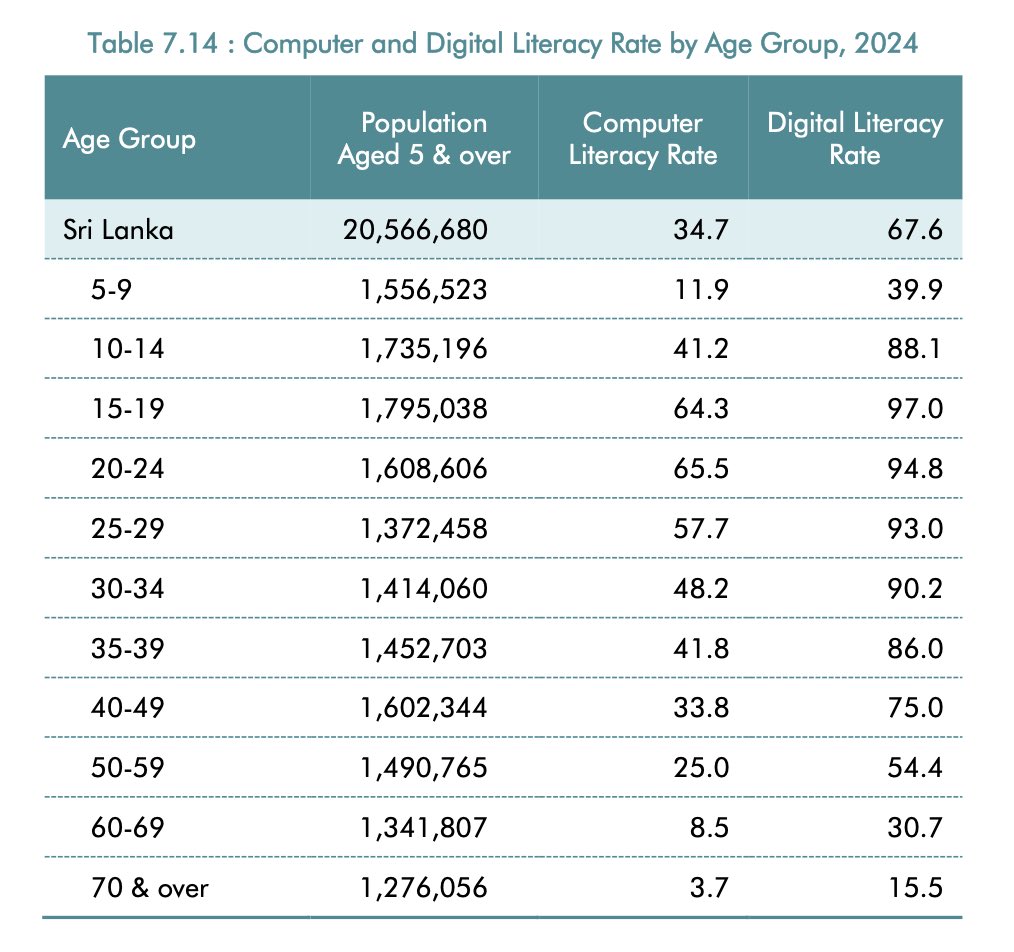
Key insight from 2024 Census 🔎🧑🏾💻👩🏽💻
Sri Lanka is in the middle of a significant digital shift. While traditional computer literacy stagnates at 34.7%, digital literacy has surged to 67.6% in 2024. Among young people aged 15–19, it reaches an impressive 97%.
Colombo, as expected, leads with 78.7%, but what’s more encouraging is the spread beyond urban centers, around two out of every three people in rural areas are now digitally literate.
The widening gap between computer literacy and digital literacy tells an important story: Sri Lankans are, in many ways, leapfrogging the traditional “desktop” era and embracing the digital wave through smartphones and mobile technologies.
Sri Lanka pays penalties for
1. Canceling the CPC hedging deal
2. Canceling the Airbus deal by UL
3. Canceling the LRT project
4. Canceling the organic fertilizer shipment
5. Halting phase 1 of Col Kandy expressway
6. Halting the port city project
7. Canceling Adani (pending)
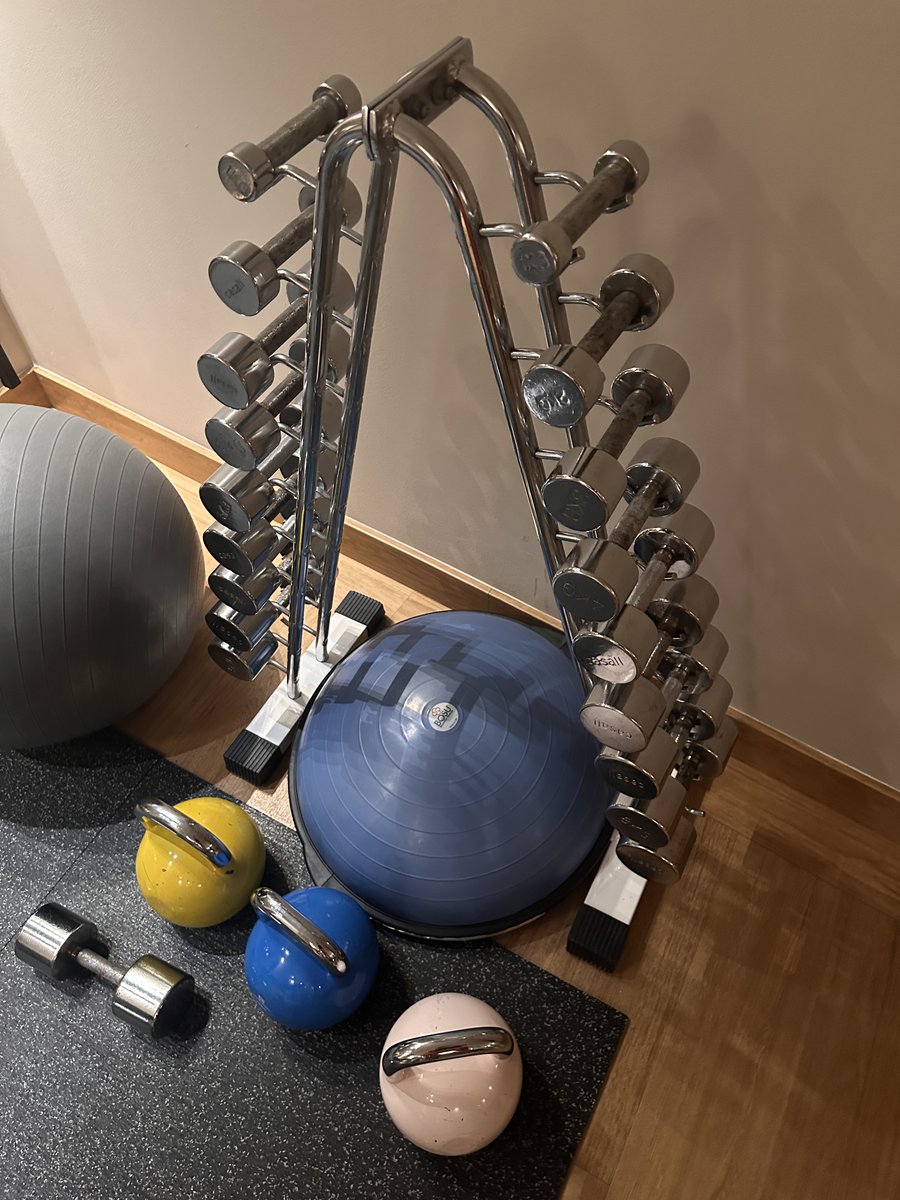
This is what a $500/night 5-star hotel thinks a gym should look like: a closet with $99.99 worth of Temu dumbbells.
Luxury hotels will spend millions on marble fountains but can't spare 100sqm for a proper fitness center.
After 10+ years of global travel, I've seen this pattern everywhere, from Switzerland to the USA. Great rooms, best croissant for breakfast, but a "gym" that feels like an afterthought.
I can't make up my mind why this still happens in 2025.
The market is literally begging for a hotel chain built for modern needs:
- World-class gym facilities
- Healthy food available 24/7
- Proper workspaces with adjustable desks
- Recovery rooms and wellness amenities
Think Continental Hotel from John Wick, minus the assassins, plus squat racks.
I'd be happy to pay membership fees for access to a global network of these facilities. Combine it with medium-term stays and you've got a winning formula.
Who else would support this concept? What would you add to make it perfect for tech pros?
Let's be honest: in 2025, a great gym matters more than a marble fountain in the hall. I'd rather pay for cryo-therapy than an overpriced hotel SPA treatment no one uses.