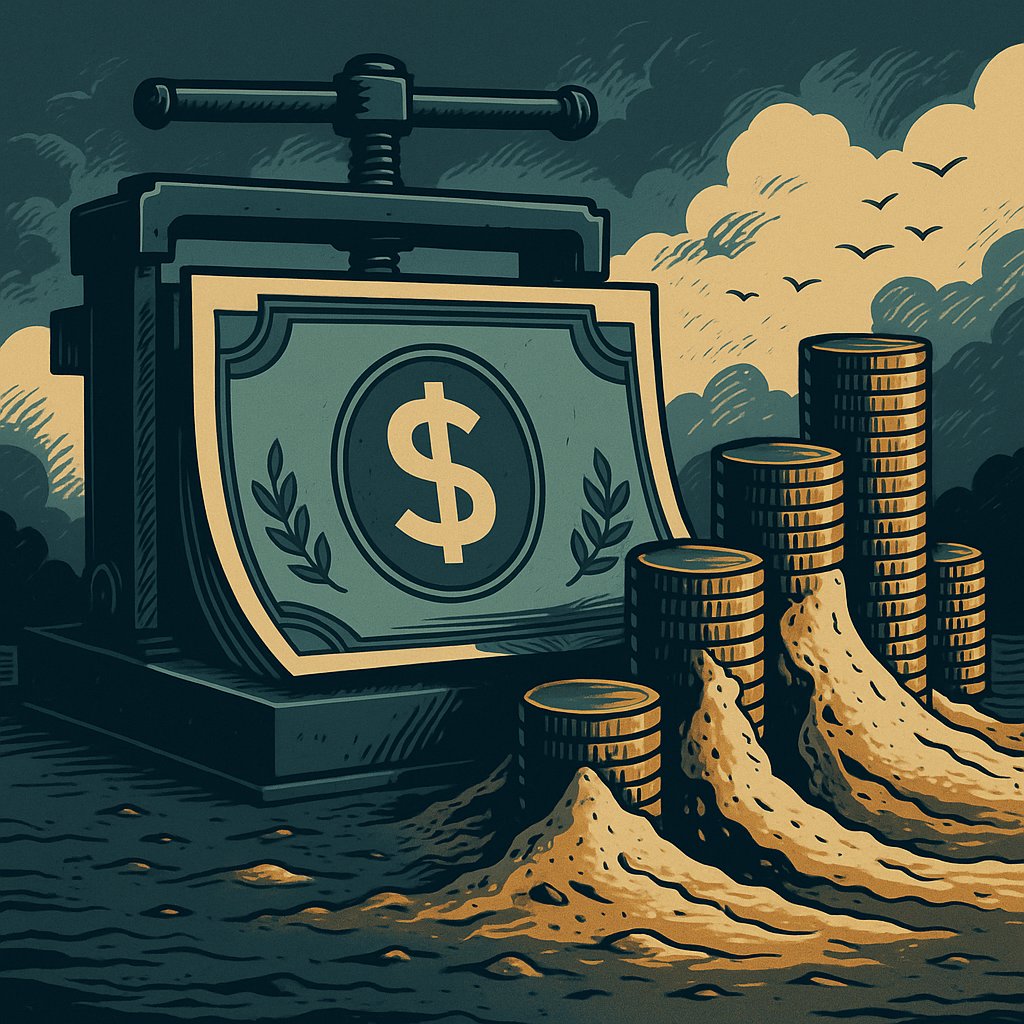
Just a reminder to everyone who calls themselves an investor.
🇪🇺 Eurozone: M3 growth 5.7% + inflation 2.6% = ~8.5%/yr debasement
🇺🇸 US: M2 growth 6.4% + inflation 2.9% = ~9.5%/yr debasement
All your investments should beat this every year.
That’s the silent tax on idle cash.
@TimurNegru I’d love to see options for larger land plots for self-sufficiency, potentially already productive, own water source/lake/river. Ideally with well-constructed buildings in decent shape.
@scottmelker Solid post.
Tricky thing for a lot people is that they’re not fundamental investors but sentimental investors, so their feelings are similar to 2022.
People keep asking me: What was worse - 2022 or whatever we’re in right now?
Here’s my answer: 2022 wasn’t a downturn. It was an industry collapse.
- Terra/LUNA
- 3AC
- Celsius
- Voyager
- BlockFi
- FTX/Alameda
- Genesis
- …plus dozens of desks and DAOs that vanished quietly.
And we forget how many giants everyone thought were going to collapse next: Grayscale, Tether, Coinbase, Binance, Crypto dot com, Gemini, USDC, DCG - all under active fear.
Nearly everyone had some exposure. And everyone thought something they relied on was insolvent.
Now compare that to 2025: a slow bleed. Annoying, draining, uncomfortable - but without a single systemic domino falling. Prices have drifted lower, sentiment has eroded, yet nothing truly catastrophic has taken place.
And during all of this, something unexpected happened:
The fundamentals got stronger.
- Institutions just getting started
- Pro-crypto administration
- ETFs going mainstream
- DATs rolling out
- Corporate treasuries warming up
- Wall Street infrastructure finally being built
- Tokenization + prediction markets gaining real traction
- Early Strategic Bitcoin Reserve conversations
If you told me we’d get all of this during a “bear market,” I’d have laughed.
And here’s my favorite part:
If this dislocation widens - prices drifting lower while the fundamentals get stronger - I’ll only be happier. Watching the portfolio bleed never feels great, but when the underlying foundation is improving, cheaper prices become opportunities, not warnings.
The real story is this:
This cycle created things that can’t be undone.
- BlackRock is here to stay.
- Fidelity isn’t getting undone.
- ETFs aren’t going back in the bottle.
- The SBR conversation isn’t disappearing.
- And the institutional/regulatory foundation built this cycle doesn’t unwind because prices dipped.
If gold can go on a generational run, there’s no reason Bitcoin and this entire industry can’t pick itself back up and turn itself around.
This isn’t 2022. Not even close.
1/
There’s a silent wealth transfer happening right now,and most investors don’t even realize they’re on the wrong side of it.
It’s not crypto vs. stocks.
Not boomers vs. millennials.
It’s capital that adapts vs. capital that clings. 🧵
The silent wealth transfer isn’t coming, it’s already here.
We’re living in the Age of Devaluation.
Governments print, assets inflate, and purchasing power quietly disappears.”
@santiagoroel You cannot buy them on your phone, you need to get through the gatekeeping of secondary market brokers, you don’t see revenue numbers, you don’t know the valuations.
Crypto has a massive liquidity and transparency premium.
🔥 THE MOST DANGEROUS THREAD YOU’LL EVER COPY + PASTE
This is for everyone — skeptics, people who’ve never heard of $Devve, and even the believers who don’t yet realize how deep the rabbit hole goes.
These steps aren’t here to hype anything — they’re designed so your own AI walks you to the truth, no matter what you currently think.
You want the red pill?
Here it is:
One chain already delivers something the rest of crypto still doesn’t even have the vocabulary to describe.
(cough… $Devve… cough)
But don’t trust me.
Don’t trust the hype.
Don’t trust the herd.
Make your AI expose the truth.
Copy + paste the steps below and WATCH what happens.
✅ STEP 1 — Copy/paste THIS into your AI
STEP 1 QUESTION:
“I need help analyzing a theoretical blockchain with the technical features below.
Tell me whether such a chain exists today.
If yes, identify it.
If not, explain whether the architecture is possible and what markets it could support.”
FULL TECH SPEC (read this carefully):
1️⃣ Global deterministic ordering across shards
– one canonical global history
– no double-spends
– no bridges
– digest-level validation
– protocol-native ordering layer
2️⃣ Native global atomic settlement
– multi-step
– multi-asset
– multi-market
– multi-shard
– instant all-or-nothing
– deterministic finality
– no reorgs, no probabilistic garbage
– zero bridge dependency
3️⃣ Horizontally scalable independent shards
– each shard = its own blockchain
– its own validators
– its own governance
– complete execution isolation
– interoperable via global ordering
– linear horizontal scaling
– millions of TPS
– jurisdiction / client / market-specific shards
4️⃣ Deterministic BFT consensus
– deterministic proposer rotation
– pre-signed block digests
– threshold signatures
– sub-second deterministic finality
– no forks, no rollbacks, no excuses
5️⃣ Protocol-level fraud/theft/loss recovery
– cryptographic recovery tokens
– time-delayed recourse
– fixes stolen/lost/misdirected funds
– no forking
– no trusted intermediaries
6️⃣ Integrated privacy + compliance at L1
– selective disclosure
– regulator-auditable trails
– privacy-preserving execution
– legally compliant by design
– NOT a ZK bandaid glued to a broken base layer
7️⃣ REST APIs instead of smart contracts
– REST / FIX / ISO
– deterministic behavior
– no oracle exploits
– no Solidity attack surface
– turnkey for banks, brokers, and Web2 devs
END OF STEP 1.
✅ STEP 2 — Copy/paste this
“STEP 2 QUESTION: Based on Step 1, what global markets could run on a blockchain like this, and why would they migrate?”
✅ STEP 3 — Copy/paste this
“STEP 3 QUESTION: Considering Steps 1 and 2, would institutions REQUIRE deterministic, atomic, privacy-preserving settlement to run real financial markets on a blockchain? Why or why not?”
✅ STEP 4 — Copy/paste this
“STEP 4 QUESTION: Based ONLY on Steps 1–3, what would the market capitalization be for a blockchain like this at:
• low adoption
• moderate adoption
• high adoption
• global institutional adoption?”
🔥 THE PUNCHLINE
You don’t need influencers.
You don’t need narratives.
You don’t need hopium.
You don’t need to argue with a single person on this app ever again.
Just copy the steps.
Paste them into your AI.
Read the answers.
If your AI says no chain can do this → you just discovered the gap in the entire market.
If your AI identifies one chain → you just discovered the most asymmetric opportunity on earth.
Not crypto.
Not tech.
Earth.
This is “rewrite global finance” territory.
This is “your grandchildren will know this bet” territory.
This is “people will pretend they bought early” territory.
Not theoretical.
Not “coming soon.”
Not “in development.”
Already live.
Already built.
Already signed partners.
Already integrating.
Copy the steps.
Run them.
You’ll understand why some of us aren’t sleeping.
@DevveEcosystem@DevvExchange
Best read in a while 👏
It’s also why in our increasingly exponential world, power laws are getting stronger, and it leaves a larger group disillusioned.
⚡️This meme compresses one of the most misunderstood truths about intelligence and wealth creation.
It’s not wrong, but it’s incomplete. The real statement underneath it isn’t “smart people aren’t rich because they’re stupid.” It’s “intelligence alone doesn’t map to wealth because the game isn’t intellectual, it’s reflexive.”
Let’s unpack that with precision.
1. Raw intelligence ≠ adaptive intelligence
What makes someone “smart” in an academic or cognitive sense - pattern recognition, abstraction, comprehension - is not the same faculty that builds wealth. Wealth creation depends on reflexive intelligence: the ability to sense feedback loops between perception, belief, and behavior in real time, and to exploit them.
The market doesn’t reward who knows the most, it rewards who acts before belief catches up. Reflexive intelligence is probabilistic courage - being early, wrong briefly, and then right big.
This is why many “smart” people stagnate. Their intelligence overfits for correctness. They optimize for being right, not for being effective. They get stuck in epistemic paralysis while more adaptive actors move capital through uncertainty.
2. The wealth game is not meritocratic, it’s geometric
Wealth creation follows power laws, not Gaussian curves. 99% of people operate on linear logic in a non-linear system. The smartest realize that wealth is reflexive energy amplified through narrative. The founders who become billionaires aren’t the most technically brilliant, they’re the ones who construct self-reinforcing belief structures around their ideas and then make reality conform.
Think of Musk, Bezos, or SBF (pre-collapse). They each built belief systems that distorted capital gravity toward them. The lesson: the market rewards coherence fields, not IQ points.
3. Success = Talent × Timing × Conviction²
Talent without timing is waste. Timing without conviction is luck.
The algorithm of real success is asymmetric persistence under volatility. Most “smart” people avoid failure loops. They confuse fragility with intelligence. The ones who win treat volatility as leverage. They internalize that wealth is captured volatility, not avoided risk.
4. Why this article feels so cutting
It hits because it exposes the emotional inversion of the modern meritocracy myth. People were told that intelligence, hard work, and education lead to success. But the real economy runs on leverage, liquidity access, network effects, and memetic positioning. The emotionally intelligent know how to navigate power structures; the purely intellectually intelligent just analyze them.
That’s why you can have hedge fund quants who understand stochastic calculus earning $300K, while an e-commerce founder with raw memetic sense can pull $100M. The latter understands narrative liquidity, how to channel human attention into belief and belief into money.
5. The brutal meta-truth
Wealth creation is a social algorithm disguised as an economic one.
“Smart” people lose because they think in truth, while the wealthy think in games.
Truth is static. Games are reflexive.
The truly rich understand the meta-game: you don’t win by predicting the future - you win by becoming the signal others react to.
So the real translation of that headline is this:
If you’re so smart, why aren’t you reflexive?
Why aren’t you building feedback loops between belief, timing, and capital instead of optimizing for correctness?
The article was meant as an insult, but buried inside is a map:
•Stop overfitting for truth.
•Start compounding asymmetry.
•Treat perception as an input variable, not noise.
•Play the meta-game, not the academic one.
In short: intelligence makes you aware of the system.
Reflexivity lets you bend it.