Pretty interesting when Saylor and Bailey come out on the same side of the ledger. Tomorrow talk, the first morbity and mortality conference talk will be given in Prague. I would never be allowed to give this talk by the Fabian’s destroying bitcoin on the stage in Vegas and Nashville
We waste billions each year on Alzheimer's research due to a fraudulent 2006 study. That's why its drugs do nothing—but give 41% of recipients brain damage.
As I show here, proven treatments for dementia and impaired cognition have been buried for decades
https://t.co/KxhUwEJFoR
The biggest marketplace on earth won't be assets humans own. It'll be the data AI needs. And we won't see any of it.
I sat down with @jvisserlabs to map out Reed's Law, the invisible economy, the AI supercycle, and what it all means for capital markets. As ever, please enjoy!
The Sun is the ultimate incandescent light bulb.
Never needs to be changed.
Can't ban it.
Always on when it needs to be and always off when it needs to be.
Two hospitals in London in a space of 1 week added a rooftop sundeck for their ICU patients.
We also discuss the new MiEYE light sensor on this episode of MedCram!
https://t.co/cb4FudfPw7
@KingsCollegeNHS@geshNHS@HealthyLight247@circadian247
Deuterium — a variable almost nobody tracks — regulates cell growth and mitochondrial function.
It sits upstream of cancer and everything downstream.
Your mitochondria maintain a lower deuterium concentration inside their inner membrane than outside.
That gradient is not incidental.
It's a feature of normal mitochondrial function.
Roman Zubarev — professor of medical proteomics at the Karolinska Institute, trained at Moscow's elite physics institute — has spent years studying what happens when you disturb it.
1. Deuterium As A Cell Growth Regulator
Deuterium — heavy hydrogen — regulates cell growth rate in the range of approximately 30–350 ppm.
Earth's normal deuterium concentration is around 150 ppm.
When cells are deprived of this normal amount, their growth slows down.
To test this, Zubarev’s lab used A549 lung cancer cells — currently the most widely used cell line in biology — and exposed them to deuterium-depleted water at about 80 ppm.
The result?
Cancer cell growth rate dropped by 30%.
Once deuterium concentrations step outside of that 30–350 ppm regulatory window, the effects stop being regulatory and start becoming highly detrimental.
For example Mars carries approximately 750–1,050 ppm of deuterium—roughly 5 to 7 times Earth's natural concentration.
When terrestrial organisms are exposed to Martian deuterium levels, they show significant survival decline.
Zubarev’s team conducted a two-year experiment growing small shrimp in isolated environments where the water was modified to contain ~600 ppm of deuterium.
They found that the survival rates of the shrimp significantly declined compared to those grown in normal water.
2. The Mitochondrial Mechanism — How Deuterium Depleted Water (DDW) Actually Works
Alongside the well-known proton gradient, there is also a deuterium gradient across the inner mitochondrial membrane.
Normally, the concentration of deuterium is lower inside the membrane than it is outside.
Mitochondrial lipids are naturally deuterium-depleted.
When cells are placed in 80 ppm deuterium-depleted water — lower than the normal ~150 ppm outside — the gradient reverses.
More deuterium inside the membrane than outside.
So how does this reversal suppress growth?
This reversal upsets reactive oxygen species (ROS) production.
To try and restore equilibrium, the mitochondria rapidly increase their production of ROS.
This sudden spike in ROS induces oxidative stress within the cell, which the researchers identified as the primary molecular mechanism that ultimately suppresses the growth of the cells.
This is the anti-cancer mechanism.
Zubarev: "We have not invented this mechanism — it's very well known."
To prove that DDW suppresses cancer cell growth by inducing oxidative stress they added NAC — N-acetylcysteine, a standard antioxidant — to DDW-treated cancer cells.
If DDW works through ROS, an antioxidant should cancel the effect.
The result?
At approximately 2 millimolar NAC, the DDW anti-cancer effect was statistically eliminated.
Then they tested the reverse.
They combined DDW with auranofin — a drug that induces oxidative stress.
If both work through ROS, combining them should produce synergistic effect.
The result?
At low to medium concentrations, adding the drug to the DDW created a "double whammy effect" where the cell count went down even further.
However, at very high concentrations of the drug, the effect of the DDW diminished, which Zubarev explains makes sense because a cell does not need two overwhelming sources of reactive oxygen species to die.
Three-layer validation.
Published in Molecular and Cellular Proteomics — the top proteomics journal.
3. The Antioxidant Implication
Standard health messaging treats ROS as purely bad.
Antioxidants good. Oxidative stress bad.
Zubarev's data complicates this directly.
DDW works by increasing ROS in cancer cells.
Antioxidants statistically cancelled the therapeutic effect.
Auranofin — an oxidative stress inducer — synergized with DDW against cancer.
Important caveat: this finding is in cancer cells, not in healthy humans.
Zubarev notes that normal human cells react differently, stating that normal human cells are much less sensitive to DDW.
Therefore, the induction of ROS to slow down growth is a therapeutic mechanism specifically observed in fast-growing cancer cells, not a general effect reported for healthy cells.
But the blanket "antioxidants are good" narrative fails here.
Context determines whether ROS is friend or enemy.
4. You Are Not What You Eat
The standard model of nutrition assumes the body passively absorbs its dietary inputs — including isotopic composition.
Zubarev's data shows the opposite.
The body actively resists changes to its internal isotopic composition.
It defends a specific ratio the way it defends pH or temperature.
Isotopes modulate their own fractionation — the biological system selectively processes and separates heavy and light isotopes to maintain equilibrium.
The isotopic quality of what you eat and drink is a regulated biological input — not a passive one.
For example, the deuterium levels found in the proline, hydroxyproline, and collagen of seals are twice as high as the deuterium levels in the surrounding seawater.
Because the isotopic concentration in the seals' biological building blocks is double that of their environment, there is no way to attribute this composition simply to their food.
5. Isotopic Resonance — The Order Underlying Life
Plot the isotopic masses and abundances of the elements that make up biological molecules — hydrogen, carbon, nitrogen, oxygen.
You'd expect random scatter, a scattered "galaxy" of dots.
Instead you find a precise line.
Zubarev calls it isotopic resonance.
At natural isotopic abundances, biological molecules cluster in a specific ratio that produces the simplest, most efficient molecular conformations.
That ratio is the point at which life's chemistry runs fastest.
The probability of this pattern appearing by chance is astronomically small.
Zubarev — a physicist trained in probability — cannot dismiss it:
"This is the line of God, if you want."
Life doesn't exist here just because of liquid water and moderate temperature.
It exists here because Earth's isotopic composition happens to hit the resonance at which life's machinery runs.
Disturb that composition — and the system works to defend it.
The isotopic quality of your water, your food, and your environment is not a background variable.
It is the upstream input everything else depends on.
Gold wasn't always what people call a "store of value" (I don't like that term).
It went through 4 completely different stages before it got here (let me explain):
And too much deuterium bound to singlet oxygen. The O-D is 10 x stronger than the triplet oxygen - H+ bond FYI. This explains why Vitamin D is also low in this disease.
Heart attacks are clotting & flow failures, not "blocked pipes."
In 1856, Rudolf Virchow identified the three conditions that create pathological clotting:
- Damage to the arterial lining
- Stagnant or disrupted blood flow
- Blood that becomes more prone to clot
This triad applies across heart attacks & strokes.
You can have severe narrowing & no heart attack.
You can have clean arteries & die suddenly.
The fatal moment is always the same:
A clot at the wrong place at the wrong time.
Which means blood viscosity — how thick or thin your blood is — is one of the most important variables in cardiovascular health that almost nobody optimizes for.
Dr. Stephen Sinatra — cardiologist of 50+ years, former chief of cardiology at Manchester Memorial Hospital, Connecticut — put it simply:
"We want blood like red wine. Not like red ketchup. Ketchup clots in the brain — that's a stroke. Clots in the heart — that's a heart attack."
Here's what most people don't know:
Grounding thins the blood.
The mechanism:
Red blood cells carry a negative electrical surface charge.
When that charge weakens, cells begin stacking like rolls of coins.
Blood thickens. Flow to capillaries slows.
When grounded, the body absorbs electrons from the earth.
Red blood cells become more negatively charged — repelling each other like negative magnets.
Blood thins.
Flow improves.
Sinatra published a pilot study in 2013.
10 subjects were grounded for 2 hours via conductive patches on palms and soles connected to a ground rod outside.
Blood samples were taken before and after.
Researchers measured zeta potential — the electrical surface charge on red blood cell membranes — and observed red blood cell aggregation/clumping under a darkfield microscope.
The result?
Average zeta potential:
−5.28 mV before grounding.
−14.3 mV after grounding.
A 270% increase in electrical surface charge.
Normal healthy range for RBC zeta potential is roughly −15 mV to −20 mV.
Values closer to zero (like −5 mV) mean weaker repulsion → more clumping → thicker blood.
Grounding shifted the average from suboptimal to healthy territory.
All 10 subjects improved.
Red blood cells stopped stacking.
This directly improved flow to capillaries.
Visual improvements were dramatic under darkfield microscopy — blood appeared visibly thinner and more fluid.
Healthier subjects tended to show smaller gains. Those with more issues showed larger improvements.
Sinatra's warning: anyone on blood-thinning medication should be medically supervised before grounding consistently.
Because grounding shifts blood viscosity that significantly.
The earth isn't just where you stand.
It's the most accessible cardiovascular intervention available.
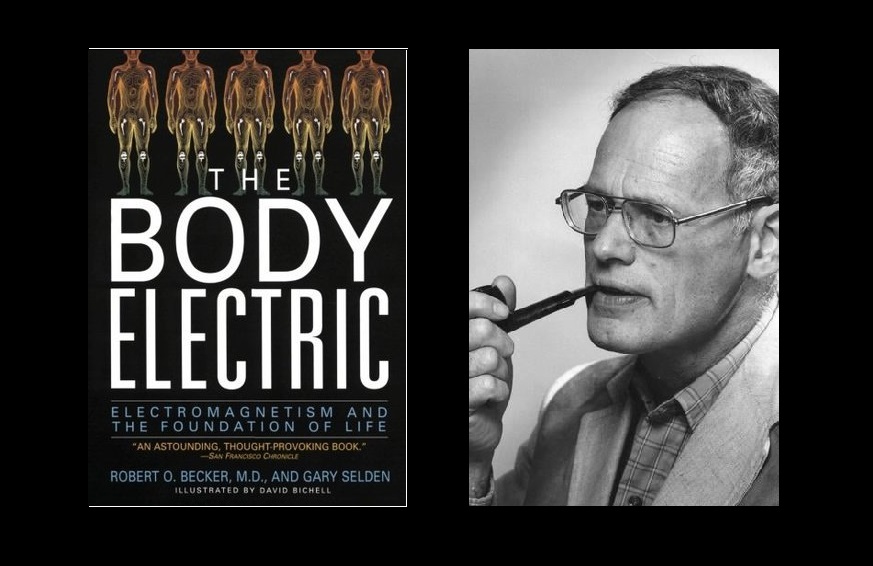
Robert O. Becker discovered a direct current (DC) electrical system in the body that regulates healing, regeneration, and growth.
He speculated that this current ran through semiconductors.
-We now know melanin is one of the most important ones.
My critics have no idea how far in front I am than their experts at centralized Institutions of cancer care..........
And I like it that way.
When you have cancer there is no time for CAUTION. WHY?
Shannon’s Information Theory
Claude Shannon’s 1948 work, A Mathematical Theory of Communication, posits that information is most powerful (has highest entropy) when it’s rare or unexpected. In my theory, pre-GOE cells emitted broad-spectrum light (low information, common “noise” while using a Warburg metabolism), while post-GOE cells shifted to UV-heavy biophotons (high information, “unusual message” while using a TCA cycle). Apoptosis, as a precise cellular decision, would likely rely on this UV biophoton signal, and its rarity in life's prokaryotic past makes it a potent trigger in eukaryotes.
Decentralized Logic:
Anti-apoptotic Bcl-2: By absorbing UV (280 nm) and emitting weakly or not at all (quenched in mitochondria), it “silences” the UV signal, preventing the “unusual message” of death. This aligns with survival in an oxygen rich and UV-rich world, by muting the apoptotic trigger.
Pro-apoptotic Bax/Bak: Activation exposes Trp, enhancing UV emission (~340 nm), amplifying the “message” via ROS/biophotons, signaling cell suicide. This fits the post-GOE shift to UV as a control mechanism.
Carefully look at absorption Spectra of BCL-2
Anti-apoptotic Bcl-2: Absorbs ~275-280 nm (Trp/Tyr), emits weakly ~335 nm (quenched Trp in hydrophobic groove). Minimal UV output to suppress death signals. Remember apoptosis is all or nothing in eukaryotes.
Pro-apoptotic Bax: Absorbs ~275-280 nm, emits ~340-350 nm (stronger if Trp exposed during MOMP). Enhanced UV to promote death signaling and removal of heteroplastic engines. This highlights why UV light is pro-longevity in eukaryotes and goes against modern centralized medicine beliefs.
Pre-GOE Proxy: Broad 200-1100 nm emission (e.g., glycolysis-driven ROS= Warburg), low UV specificity, no apoptosis. This is where cancer in eukaryotes comes from. A loss of UV biophotons is a key feature.
Post-GOE Proxy: UV-focused 200-400 nm (TCA/OXPHOS-driven), high apoptosis relevance. Cancer should be rare if the eukaryote is connected to Nature.
I raise my cup to centralized medicine and say here is one of my ladies with a big cup of shut the fuck up for her oncologist once she tapped decentralized medicine to get rid of her triple negative cancer.
https://t.co/SK29oDDwt1
Why is the study of medicine so important? Because it makes impacts that no other study can.
The physicist Richard Feynman writing to his late wife Arline who died at 25 of TB should be a wakeup call.
She died right before Streptomycin became available in 1945. Although Rollier the Swiss physician was getting 80% cure rates in the Swiss Mountains with sun exposure.
Knowledge is power.
Never forget that.
New blog before I go. https://t.co/ipIOBRXPby
How do African dzila neck rings, Israeli leaders, the Maya, buried Nazi's science, Simi Valley wine business, Russian cosmonauts, MKULTRA, magnetic vortexing, Gavin Newsome, pools of mercury, deep well drilling, AIPAC, UC Davis geology department, astrophysicist Nikolai Kozyrev, Vogel crystals, blood, and pistachio nuts all link to one coherent explanation of how humans capture the magnetic flux of the solar system in cells?
Strap in for an ass kicker.
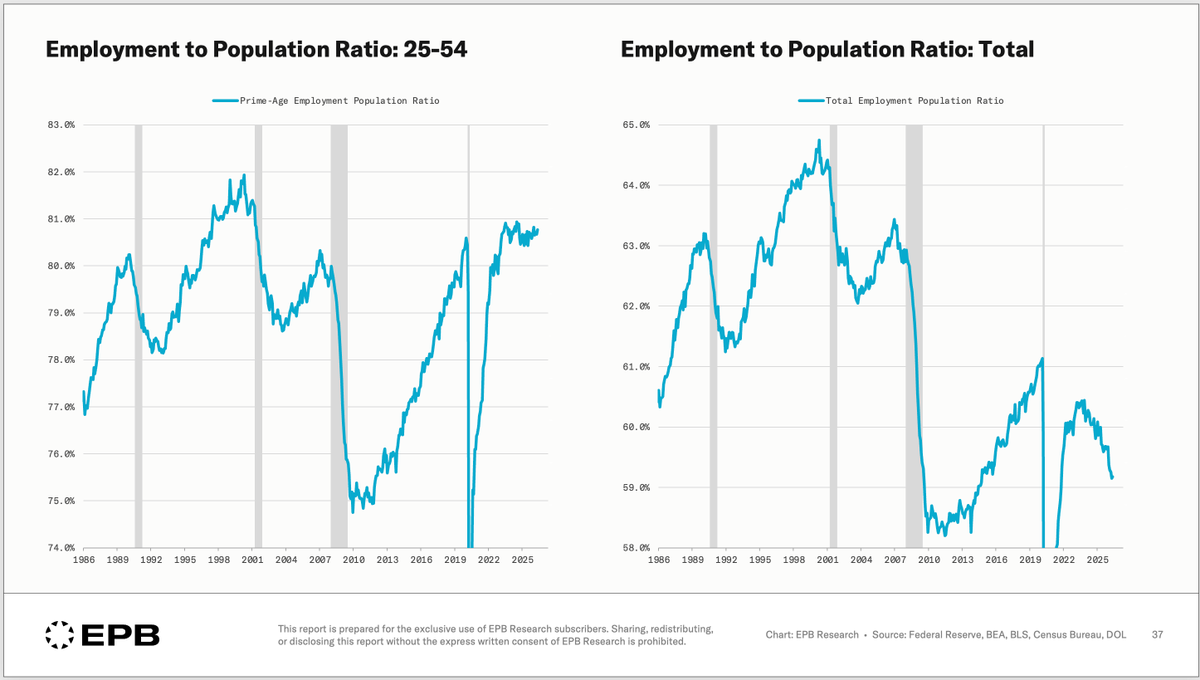
The prime-age labor market is stable, but the total employment-to-population ratio is falling rapidly.
Fewer workers would normally weaken income.
Today, that effect is increasingly offset by government transfer payments, funded by debt.
Redox for detox!
The part most missed, melanin, is the excretory pathway. Add Riley's 2023 paper.
The skin’s constant turnover removes chelated metals from the body.
Appreciate you, brother. 🌞
https://t.co/hKk12XRfmu