The Red Fort blast exposed a disturbing reality: terrorists can be doctors, academics and professionals we trust.
Thinking Right examines white-collar terrorism in India and why we must confront the ideology behind it, not just its operatives.
Read: https://t.co/MyelQJWJUF
Calling terrorists “professionals” doesn’t dilute the crime, it disguises the threat. Thanks @issf_india for flagging this.
Our WCT essay argues the same: the headmaster’s son became the headmaster himself. A job is a disguise, not a defence.
Read: https://t.co/4Vt5E4I6st
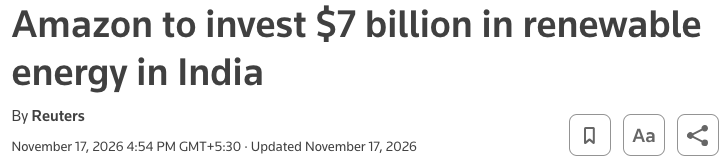
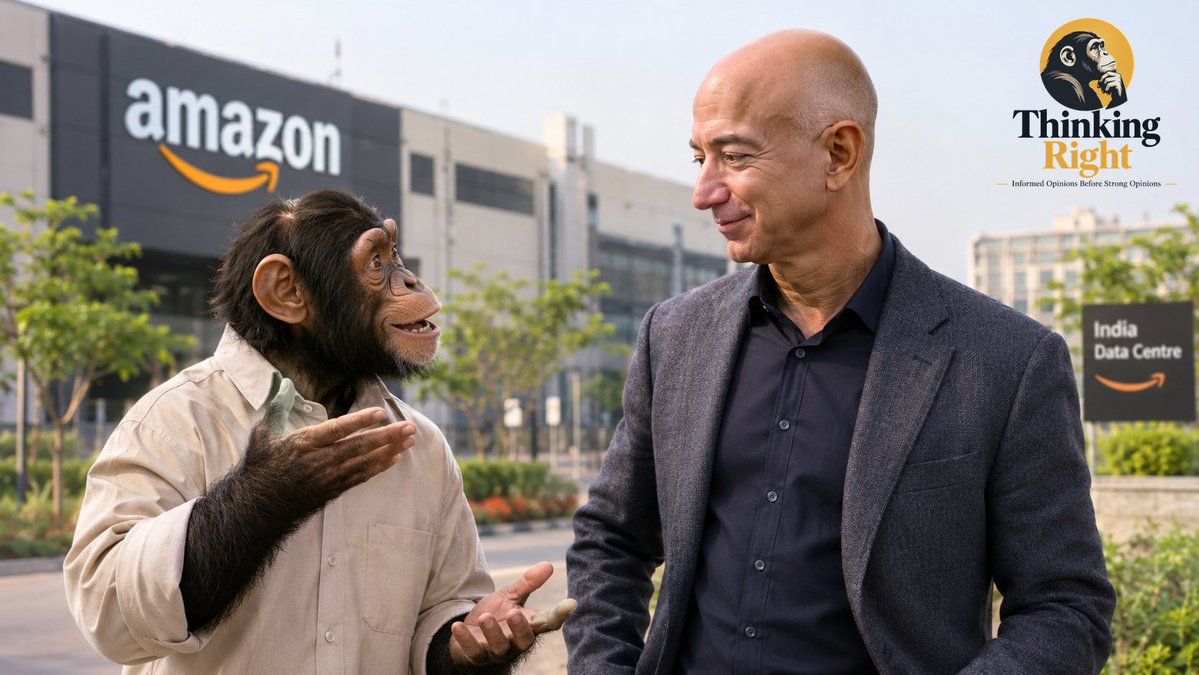
💰 @amazon and @JeffBezos plan to invest $7 billion in renewable energy projects in India by 2030, in addition to the $4 billion already contracted.
⚡ Why does this matter for data centres?
Their expansion will also increase the need for reliable, cleaner electricity.
1/5
BIG BREAKTHROUGH 🚨
India is building a 1,920 MW water battery at Gandhi Sagar, Madhya Pradesh, with an investment of ₹11,500 crore.
No lithium, no cobalt, just water powering India's clean energy future 😍🔥
@indianmatrix We appreciate you taking note of our work on Data Centres.
For a more detailed and exhaustive understanding of Data Centres and concerns related to water, electricity and land, please read our Substack: https://t.co/ZLfYBpiUSv
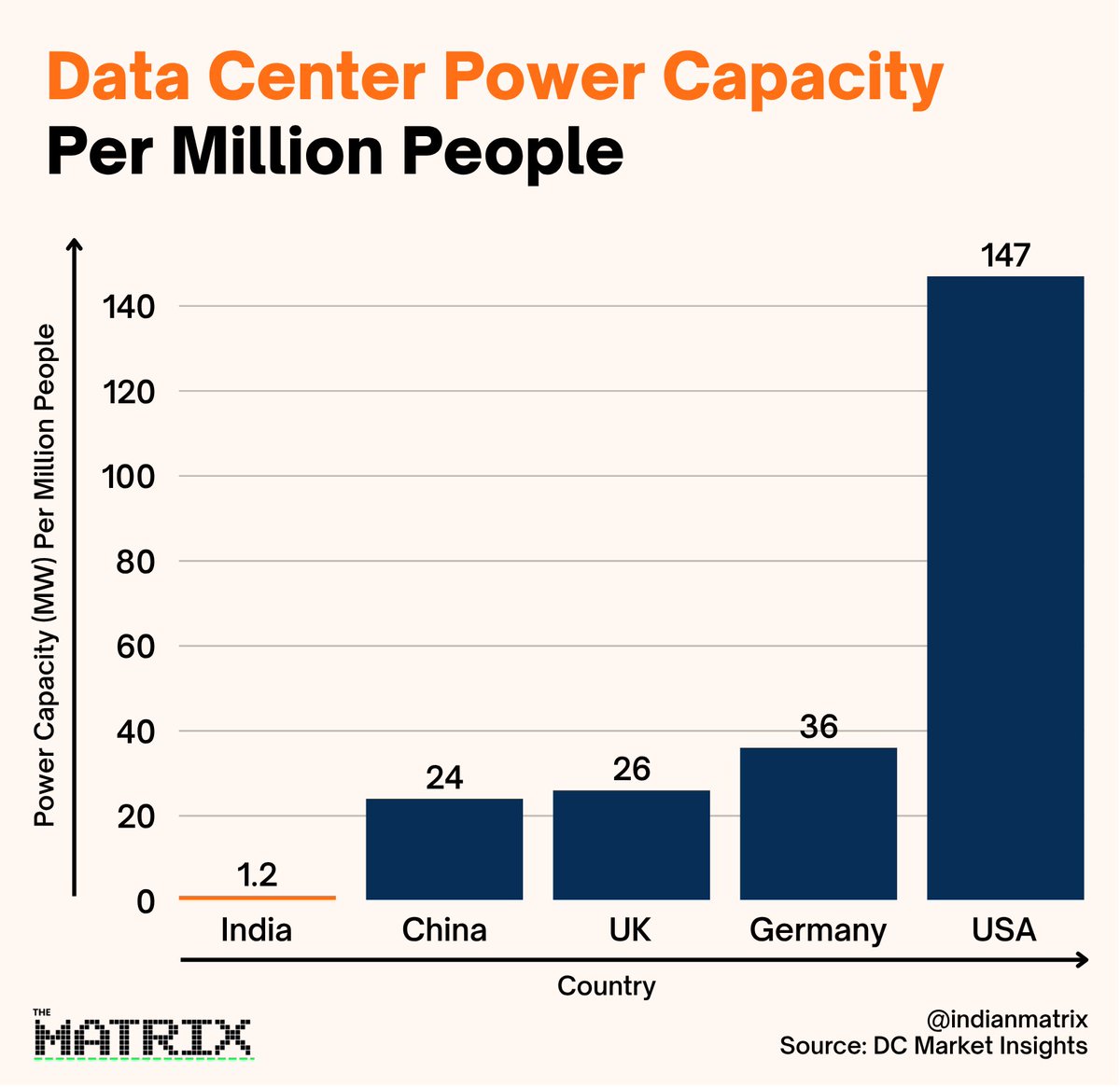
Data centres are a hot topic in India. But look at global leaders, and we aren't even in the same league.
For the world's most populous country, generating nearly a fifth of global data, storing it abroad isn't an option. Building domestic data-centre capacity is an imperative.
CC: @ThinkingRightTR
(1/3)
🔬 The journey towards more efficient data centres is ongoing. With continued research, innovation, and investment, the technology can only get better.
👉Stay tuned for more!
Follow @ThinkingRightTR
5/5
��� @amazon and @JeffBezos plan to invest $7 billion in renewable energy projects in India by 2030, in addition to the $4 billion already contracted.
⚡ Why does this matter for data centres?
Their expansion will also increase the need for reliable, cleaner electricity.
1/5
Can data centres grow without exhausting India's water and electricity resources?
The concerns are real. But so are the solutions.
Amazon Web Services (AWS) offers an example of how technology and smarter resource management can make data centres more sustainable. 🧵
24/n
🔬 Every new technology takes time, research, and capital to improve efficiency.
Data centres are no different.
⚙️ Better engineering
⚙️ More efficient systems
⚙️ Smarter energy use
These steps will make data centres increasingly efficient as digital infrastructure grows.
4/5
🚨India Builds Its Largest Lithium-Free Battery: A Massive 10 Million Units of Energy Storage Without Lithium or Cobalt
India is making a major breakthrough in energy storage with the 1,920 MW Gandhi Sagar Pumped Storage Project in Madhya Pradesh, capable of storing an impressive 10,326 MWh of electricity, equivalent to approximately 10.3 million units.
What makes this development particularly significant is that it does not rely on lithium, cobalt or nickel. Instead, it uses something far simpler: water.
Developed around the Gandhi Sagar reservoir in Neemuch, the ₹11,000 crore project uses pumped hydro storage technology, effectively turning two reservoirs into a giant rechargeable battery.
The mechanism is straightforward but ingenious. Surplus electricity generated through solar and wind power is used to pump water from a lower reservoir to an upper reservoir. When electricity demand rises, the stored water is released downhill through turbines to generate electricity.
This allows India to store surplus renewable energy and use it when solar generation declines, particularly during evening and night-time demand peaks.
The project will have an installed generation capacity of 1,920 MW, making it a major addition to India's renewable energy storage infrastructure.
Its strategic importance goes beyond electricity generation. By using water instead of electrochemical batteries, India can reduce its exposure to imported critical minerals, strengthen energy security and establish long-lasting storage infrastructure.
At a time when global energy storage supply chains remain heavily concentrated around lithium-ion technology, India is demonstrating that large-scale energy storage does not necessarily have to depend on critical minerals.
This is more than a power project. It is a major step towards India's energy independence, renewable energy ambitions and technological self-reliance.
🚨 BIG: 🇮🇳 INDIA'S SEMICONDUCTOR BOOM TO CREATE 1 LAKH JOBS IN 3 YEARS
India's semiconductor workforce is projected to quadruple from 25,000 to over 1 lakh as the country expands its chip manufacturing ecosystem.
@aditya_kondawar We appreciate this. And on renewables, India makes a promising case to have more Data Centres. Our non-fossil capacity is at 54% today. In fact, we are in surplus. The market, the resources are all at best suited for India to become a Data Centre champion & be part of this boom.
54% of India’s power generation now comes from clean energy sources. And that’s for 1.4 billion people.
‘Sustainable’ ‘development’ aren’t just two words, for India, it is a living reality.
So you say Data Centres; we say bring them here to India. 🇮🇳
The 400 largest data centers in the U.S. put more heat-trapping gas in the air in one year than the entire nation of Denmark did, and that was before the AI boom really got going, according to the study. https://t.co/9oK3VqMXLh
@JamesMelville 54% of India’s power generation now comes from clean energy sources. And that’s for 1.4 billion people.
‘Sustainable’ ‘development’ aren’t just two words, for India, it is a living reality.
So you say Data Centres; we say bring them here in India.
In our WCT series, we traced how DOCTORS & TEACHERS have played a role operating TERROR NETWORKS. Their ‘White-Collar’ is often used to romanticise stories of Terrorism.
A prominent outlet like @ThePrintIndia engaging in this lowly reporting of mellowing terrorism is shameful!
@drvetmhj Bail is not acquittal. Be informed before forming opinions.
Follow us for Thinking Right. Because “Informed Opinions Before Strong Opinions”. 🙌
🤔Remember the TCS Nashik case?
It offers a glimpse into how extremist ideology can operate through ordinary workplaces and WhatsApp groups.
But the larger question is: does terrorism really grow out of poverty, or is ideology the deeper cause? 🧵
33/n
Would you trust a stranger with your personal data?
India doesn’t store 85% data it produces. Let that sink in.
In the times of information warfare, how can we rely on another country controlling our data? It’s not just an economic imperative, but a strategic necessity.
No land, no water, no grid—three major data-centre constraints potentially addressed!
For a country that hosts less than 15% of the data it generates, taking data centres to space is BIG!
Congratulations @AgnikulCosmos@AndhraPradeshCM
Read our take: https://t.co/Wp8gdS6YFT
@ildivino_42 While working through our research on Data Centres, we realised how disproportionately absurd arguments were given to wholly reject their installation in India, rather, than focusing on duly addressing them. We need a pysche overhaul in India for this systematic problem.