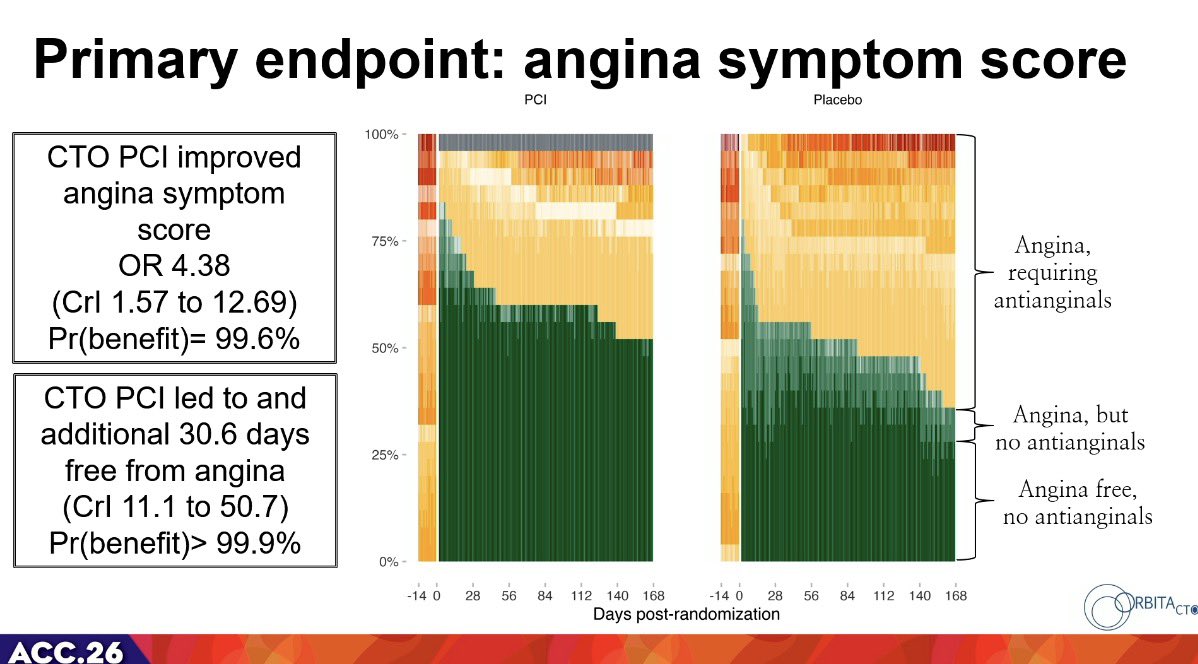
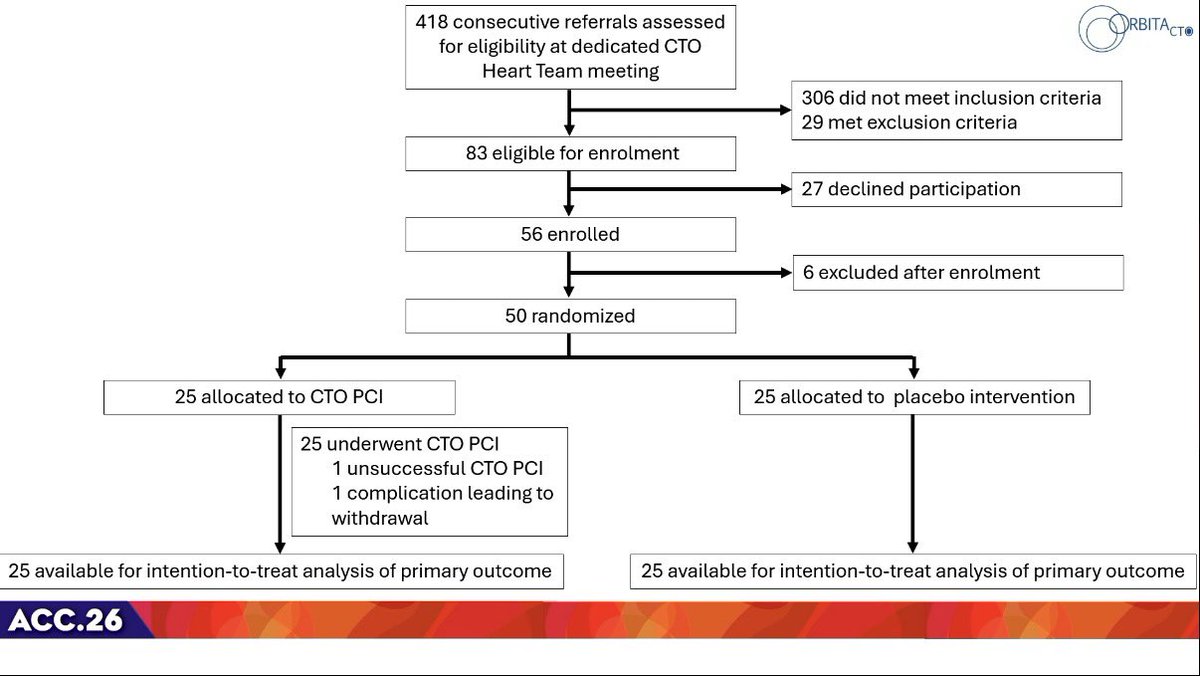
The placebo-controlled PCI debate returns this time with the 1st RCT blinded sham PCI trial for CTO 👏🏽👏🏽
#ORBITA-CTO evaluates PCI vs placebo in chronic total occlusions
➡️ Key results:
🎷CTO PCI ⤵️ angina frequency: immediate, sustained & consistent with OR=4.38 of improved angina symptoms & led to ~30 days angina free days
50 patients randomized, daily recording of angina episodes with app
#ACC26 #CTO #Cardiotwitter #LBCT @JACCJournals #orbitacto
🤔 These results, coupled with the recent INVEST-CTO findings, suggest that we should refrain from liberally pursuing risky strategies (e.g., retro via epicardials), and give priority to investment procedures.
@DrPrimeroNg@sudhirtho@RezMasoomi@JTiwanaMD@thinkmdkane
"If I can't do it, that doesn't mean it can't be done."
How do you balance confidence with humility in medicine?
@thinkmdkane opens up about the psychological challenges of pushing boundaries in interventional cardiology and finding community when things go wrong.
#MedTwitter
🎉 Congratulations to this year's 30 in Their 30s awardees! We’re excited to watch these rising stars shape the future of #InterventionalCardiology ➡️ https://t.co/8zprKlSZ5h #SCAI2025
There has been significant evolution over the past decade with regard to CTO technique, dedicated algorithms, and approaches. Drs. Anna Subramaniam & Jasleen Tiwana (@JTiwanaMD), share how these techniques can also be applied in non-CTO lesions.
https://t.co/kzmhpcavaH
Audrey Ready, DO; Jesse Kane, MD (@thinkmdkane); and Kevin J. Croce, MD (@kevinjamescroce), discuss an algorithmic, target-driven approach to in-stent restenosis management and provide practical insights into managing this unique patient subset.
https://t.co/OwMVYejjPF
Jarrod D. Frizzell, MD (@cardiofrizz), shares his experiences in dealing with the learning curve and aiming for lifelong improvement when developing a complex PCI skill set in clinical practice.
https://t.co/pZbX8pnUid
In our latest issue, introduced by Dr. Jesse A. Kane (@thinkmdkane), we explore evolving technologies and innovative techniques in some of the most challenging scenarios in the PCI field.
https://t.co/SOpA0xa6qj
Check out the latest issue of @cardiacinterv on challenging PCI. Thank you to all of the great authors!
-AI in cardiac intervention
-complex disease in the geriatric patient
-ISR management
-delivering equipment and cto techniques in non cto cases
-growing in clinical practice
Management of cardiogenic shock is a labor intensive team sport. Grateful to my colleagues @UVMDeptMed @UVMMedCenter for the gift of sending these patients home to their families.
Congratulations to Dr. Nikolaos Diakos heart failure specialist who was just awarded the prestigious Roderick D. MacDonald Research Grant to study #cardiogenicshock—a severe heart condition with a high mortality rate. @DiakosNikos
Read more: https://t.co/8Mhy71kkRX
A big thank you to @esbrilakis for taking the time to talk with me on his #senseipodcast. We discuss adjusting to a new attending role and the place art and creativity in the #complexpci space.
https://t.co/fZ8TsFgTwN
Congrats to Team Vermont for winning this year's @NNewEnglandACC FIT Jeopardy Tournament! They will represent the Chapter at ACC.25 in Chicago. Way to go @uvmcards competitors!!!
Invasive Versus Conservative Strategy in Older Adults ≥75 Years of Age With Non–ST‐segment–Elevation Acute Coronary Syndrome: A Systematic Review and Meta‐Analysis of Randomized Controlled Trials: @JAHA_AHA
🥸 What evidence for PCI in Older Adults? @MichaelGNanna
😱 Summary