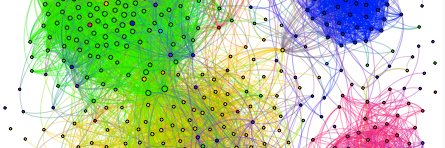
@sp_monte_carlo It is an interesting but important change of perspective. Developing generative models for weighted graphs can be challenging too. I’ve worked some in this space for weighted edge weights and correlation “networks.” See
https://t.co/rEXCzTtdZB
https://t.co/ZJqEsUO68U
@TattedMiscreant I’ve heard the dry erase marker over top trick but never tried it. But I do know that acetone (primary agent in finger nail polish remover) will take it right off
I’d like to use my skills as a statistician, network scientist, and ML methodologist to help tackle big environmental and climate issues. Does anyone have good references or problems to look into?
@tiagopeixoto This brings me back to a key question of when, in general, a graph (and hence graph tools/analyses) is needed/useful for observed data. Of course some data are inherently graph-based (friendships, followers, etc.) but for those that are not, I feel a statistical test is needed
Check out our new paper investigating sex differences in functional connectivity response to antidepressant treatment for those in late-life. The findings here may greatly reduce the time needed to assess pharmacological treatment efficacy for those with late-life depression
@roydanroy Anyway, some cool work is being done in the statistical network analysis area. See this as a fun example where the focus is on identifying anomalous subgraphs: https://t.co/NPl1QrHnAc
@roydanroy I’m used to thinking about anomalies as data points (or vectors / networks) that are outside of a predictive interval for a new value given “normative” data. So something like anything outside 3 standard deviations from the mean.
I’m so proud of our new work led by Elisabeth Salisbury of @PittPsychiatry. Personally as a dad of 3, I’m particularly excited about the potential for helping newborns in need. I am looking forward to our next work, and also I hope to see these findings put into practice.
Study of hospitalized newborns with prenatal opioid exposure showed that a novel crib mattress that provided gentle stochastic (random) vibration helped reduce medication treatment in some infants. https://t.co/cKq0oPX6f8
Excited to share that our work lead by Ahmad Mayeli on alterations in RAR and negative symptoms in SSD was published today on @molpsychiatry. Thanks to @AliceLaGoy, @ThisIsJDWilson, @armandagostino, and the DIAPASON group. For more info, here is the link: https://t.co/dh9XrH1OBn
Excited to see some of our recent work mentioned in a great piece on @NBCNightlyNews about predicting political leaning with fMRI (see time 1:43). Thank you for the mention @byjacobward . I look forward to seeing where AI and brain imaging goes from here.
Researchers are developing artificial intelligence technology they say generate the very images in our brains.
@byjacobward shares more on the extraordinary research and the concerns about what mind reading technology could mean for the future.
This was a really fun project where we explored a testing-based community extraction method for heterogeneous networks. Despite the fact that many networks can (and should) be modeled as heterogeneous, methods for these data are still relatively sparse.
I've got some exciting news! I recently collaborated with @baileyfosdick and @ThisIsJDWilson to develop a hypothesis testing framework to extract of communities from heterogeneous networks (ECoHeN). A preprint of the article and software is available. 🧵
https://t.co/dIjgM8gajl