Controversial blogger Cameron Slater is recording episodes of The Good Oil Podcast through a commercial production setup linked to PodLab, an Auckland-based studio business tied to established radio broadcasters. https://t.co/U5sL5EtuIk
The fresh images show high-profile journalist Maiki Sherman celebrating a career milestone serving as a reminder that, despite a recent attempt by fringe micro-blogger Ani O’Brien to tarnish her reputation through a bias one-sided Substack smear article later amplified by Deputy Prime Minister David Seymour, she remains one of the country’s most recognised political reporters. https://t.co/xiNXMTdjOF
WATCH: Political Commentator and Māori Broadcaster Matthew Tukaki accused the Government of becoming embroiled in what he described as "dirty, filthy politics" amid ongoing scrutiny over the use of private email accounts and the handling of sensitive documents. https://t.co/OMSSnISQKM
OPINION: The Government was quick to celebrate new investments in ambulance services and Customs. Minister Casey Costello described it as a “big day” for frontline workers. But for firefighters, it was just another reminder that they remain at the bottom of the Government’s priority list.
https://t.co/ychGiCsymN
OPINION: As the next general election approaches, New Zealand voters are watching a coalition government that promised discipline and delivery but has too often become bogged down. That is why Chris Hipkins and Barbara Edmonds have increasingly become my choice for Labour's leadership team heading into the next election. One of clearest strengths both have shown in opposition is their willingness to hold the government to account on decisions affecting ordinary hard working New Zealanders. https://t.co/cqMviZqC2G
OPINION: For a politician who constantly speaks about leadership, confidence, and delivering results, Christopher Luxon often seems remarkably disconnected from the people expected to live with the consequences of his poor decisions. So if Luxon expects me to answer the phone tomorrow, my question is simple: Why should ordinary New Zealanders feel compelled to listen when they increasingly feel unheard themselves? https://t.co/VTX8Two1j4
OPINION: There is something deeply telling about the timing of Maiki Sherman’s latest award. After a wave of smear attacks, political pile-ons and online commentary aimed at Sherman’s credibility as a high profile journalist, she has emerged with one thing her critics could not strip away. Professional recognition from her peers. https://t.co/fB9NBvpvzu
OPINION: If New Zealand First and the coalition truly stood for putting New Zealanders first, firefighters would not still be waiting for modern frontline equipment while ministers celebrate selective spending announcements as the election approaches. https://t.co/cvNx3E2TLB
In “When the ‘lone blogger’ amplifies the far right,” academic Mohan Dutta focuses heavily on fringe micro-blogger Ani O’Brien, accusing her of legitimising and amplifying narratives linked to figures such as Tommy Robinson and wider Islamophobic networks.
Dutta frames his latest article as documentation of how online influence operates in practice, particularly how individual commentators can act as bridges between fringe extremist narratives and mainstream political discourse in Aotearoa. He argues these amplification patterns are part of a recognisable ecosystem seen internationally that is being imported into Aotearoa.
What makes the blog compelling is the amount of detail packed into it. Dutta references screenshots, timelines, repost chains, political actors, and recurring rhetorical tactics to support his argument. Even critics of his politics would struggle to dismiss the piece as unserious as it is clearly researched and intentionally constructed to build a cumulative case.
The argument succeeds at forcing attention onto a question many of the fringe micro-bloggers deliberately avoid telling the public: how online outrage networks form, who benefits from them, and where the line sits between political commentary and amplification of extremist narratives.
READ: https://t.co/1T5crPvMc5
@mjdutt
#nzpol
When the "lone blogger" Ani O'Brien amplifies the ideology of the criminal far-right extremist promoting Islamophobia, we must interrogate the consequences.
Never forget the Christchurch terror attack
Full analysis below:
https://t.co/berSDkpqId
Massey University Dean’s Chair Professor of Communication and Director of the Center for Culture-Centered Approach to Research and Evaluation (CARE) Mohan Dutta says coordinated harassment campaigns targeting his research and public opinions on social media are intensifying, raising serious concerns about academic freedom and scholar safety. https://t.co/GRpt82HM0K
Special article: I asked Mohan Dutta why far-right networks are targeting him despite academic freedom protections within legislation covering the research he carries out at Massey University. Full story soon @thisqualitynews. #nzpol
The “free speech” defence falls apart the moment intimidation and mob harassment enter the picture
New Zealand has seen a growing wave of conspiracy-driven extremism since the pandemic, much of it imported from American QAnon and far-right online circles. It started as anti-mandate rhetoric and evolved into something far darker, with public figures, journalists, academics and politicians increasingly targeted by coordinated abuse campaigns.
When academics like Mohan Dutta are subjected to sustained online pile-ons, threats and harassment simply for expressing views from research that some groups dislike, that is no longer a debate about free expression. It is an attempt to silence, intimidate and create fear through mob behaviour.
The same culture is now visible across social media platforms in Aotearoa. Violent language, misogynistic abuse and dehumanising rhetoric are becoming normalised in comment sections, particularly around political topics. Calls for imprisonment, execution or harm against political opponents are not “opinions” they are signs of escalating extremism.
New Zealand cannot pretend this is harmless online venting as the free speech clowns would claim. Overseas this has already shown where conspiracy radicalisation and sustained political hatred can lead if it is left unchecked.
Free speech matters. Extremist intimidation does not.
#nzpol
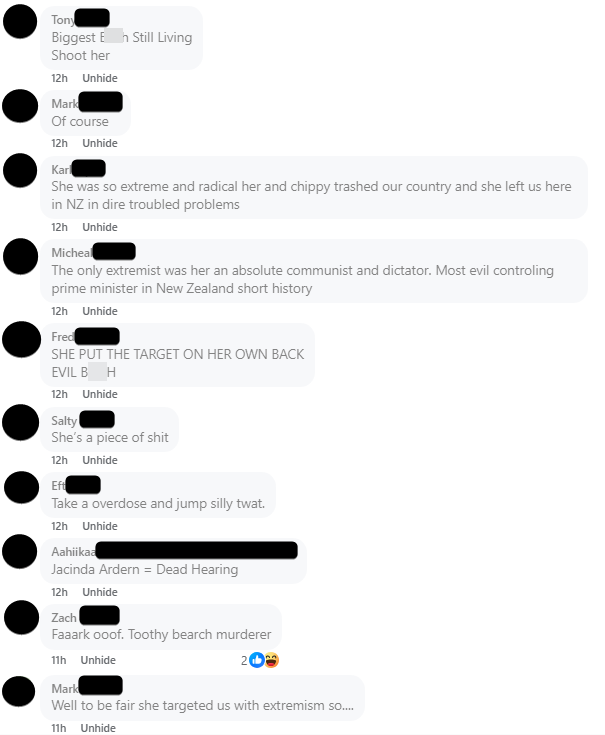
Extremist rhetoric is on the rise in Aotearoa. We have removed a wave of comments from our Facebook post about Dame Jacinda Ardern, including violent threats, abuse and misogynistic slurs.
Among the most serious were comments appearing to encourage shooting the former PM, suicide, calls for imprisonment, and remarks referencing murder and death. Many other commenters described Ardern as “evil”, a “dictator” and a “tyrant” all of which are not true, while several blamed her for supposed social division and COVID-19 mandates despite uncertainty at the time during a global pandemic.
Much of the language mirrors conspiracy-driven rhetoric imported from American QAnon and far-right online circles, narratives that gained traction in New Zealand during the pandemic and continue to fuel real-world incited hostility and dangerous extremism online.
The volume and severity of the abuse show there are growing levels of online hostility and extremism across social media platforms. It needs to be dealt with.
#nzpol