If you can’t tax billionaires and trillionaire because “its unrealized gains until they cash out,” then stop letting them leverage that wealth for loans, as collateral, or as equity.
If it’s not real enough to tax, it shouldn’t be real enough to leverage.
This is why we say the system is rigged in favor of the super wealthy. Abolish billionaires, tax them out of existence, protect working people.
Yaxley Lennon, Farage, Lowe and others, hang your heads in shame.
An immigrant nurse talking about fleeing her home after saved her uniform so she could still work.
Do you feel proud?
Three more Far Right Thugs involved in Farage Riot in Southampton sentenced.
Taylor Grundy, 22, of Gosport, jailed for 2 and a half years
Andrew Summerhayes, 38, of Romsey, jailed for 3 years and 2 months.
Dillon Crawford, 29, of Southampton, jailed for 3 years.
I am horrified by the disorder and racist violence in Belfast last night.
Far too often now, we see extremists exploiting people’s anger and grief to spread hatred and violence – with the help of divisive algorithms on social media.
This has to stop.
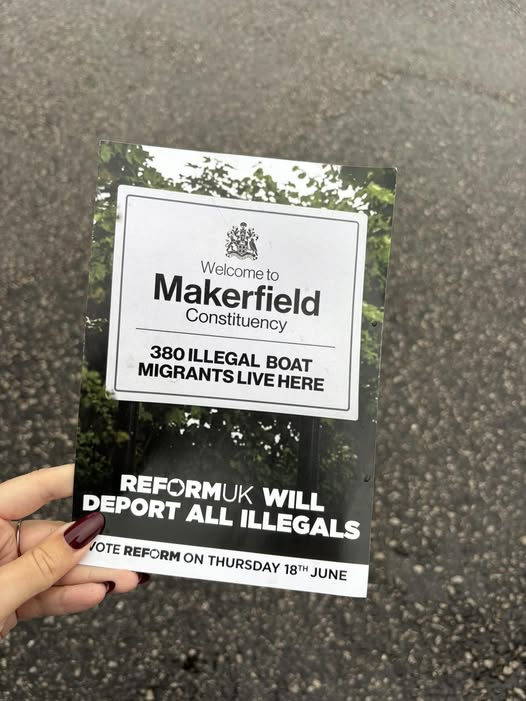
Your regular reminder that a refugee or asylum seeker is not an "illegal migrant".
This is hideously racist disinformation in Makerfield.
Never Vote Reform
Amazon UK pulled in £8.2bn revenue and even reported £355m in profit.
But they didn't pay ANY tax.
The reason you have to pay so much, is because they don't pay any.
Hearing about Sikh harassment.
A murderer does not define a community.
Sikhs have served Britain with distinction, created jobs and always contributed.
We’re lucky to have them.
Call you old fashioned? Alright, old-fashioned, @PatrickChristys, let us go through the decades you prefer.
The 1960s: Ian Brady and Myra Hindley tortured and murdered five children, buried them on Saddleworth Moor, and recorded their screams on tape.
The 1970s: Peter Sutcliffe murdered 13 women with hammers and screwdrivers across Yorkshire.
Dennis Nilsen began strangling young men in his London flat, dismembering them, boiling their skulls on his stove, and flushing the remains down the drains.
The 1980s: Michael Ryan shot 16 people dead in Hungerford. Fred and Rose West were raping, torturing, and dismembering women and girls and burying them under their house in Gloucester. Their own daughter among them.
The 1990s: Two 10-year-old boys abducted a toddler from a shopping centre in Liverpool, tortured him, and bludgeoned him to death with bricks and an iron bar.
Thomas Hamilton walked into a primary school in Dunblane and shot 16 five-year-olds and their teacher. Harold Shipman was murdering his patients by the hundred.
The 2000s: James Watt and his family enslaved a man for a decade, tortured him with baseball bats, air pistols, boiling water, and pit bull attacks, then decapitated him and dumped his body in a lake.
Mathew Hardman, 17, murdered a 90-year-old woman, cut out her heart, placed it on a silver platter, and drank her blood.
The 2010s: Derrick Bird shot 12 people dead across Cumbria.
Thomas Mair shot and stabbed an MP in the street while shouting "Britain first".
The 2020s: Jemma Mitchell decapitated her friend, stored the body for two weeks, and drove 200 miles to dump it.
Those are the decades you prefer. And for each decade there are 20 other equally horrific incidents.
And here is the thing, old fashioned Patrick. According to the Crime Survey for England and Wales, violence, burglary, and car crime have fallen by close to 90% since the mid-1990s. The ONS confirms that violent crime is two-thirds lower now than in the 1990s.
The country you live in today is measurably, statistically, dramatically safer than the one you are nostalgic for. That's not an opinion, it's a fact.
And I am not even touching Glasgow and its past knife crime epidemic.
So, which decade was better, Patrick? Tell us.
To every British person who has ever:
☕ Accepted a cup of chai and asked for another.
🍛 Tried our food and said “this is incredible”.
🎉 Watched our festivals with genuine wonder.
💬 Tried to pronounce our names properly and meant it.
🤝 Stood next to us when others told us to go home.
Thank you. 🙏🏻
Sincerely. ☺️
From every British Indian family.
You are the Britain
our grandparents chose.
You are the Britain
we are proud to call home.
You are the reason
we stayed. 🙏
🇮🇳🇬🇧 #BritishIndians
November 1971. Chiswick, West London.
Erin Pizzey is 32 years old. She is not a lawyer. Not a politician. Not a doctor.
She is a woman who talked Hounslow Council into lending her a cold, rundown building on Belmont Road — a former community hall — for almost nothing. Her original plan was modest. A warm room. A cup of tea. Somewhere for mothers with young children to simply get out of the house.
Then the door opened.
A woman stood in the entrance. She was covered, head to foot, in bruises. She was holding two small children. She was shaking.
She didn't want tea.
She needed somewhere to hide.
Erin let her in. She didn't turn her away. She didn't tell her to call the police.
Because Erin had already called the police. They told her the same thing they told every woman in Britain at the time: they could not enter a private home over a "domestic dispute." That was the law. The home was private. What happened inside it was a family matter.
When Erin contacted a female civil servant to report what she was seeing, the response was astonishing. The woman told her flatly: "There wasn't a problem of battered wives until you made one."
Erin put down the phone. Then she went back to her residents and made sure they were fed.
Within weeks, 40 mothers and children were sleeping in four tiny rooms. No funding. No staff. No legal authority.
She didn't stop.
By 1973, word had spread through quiet whisper networks — one woman telling another, "There is a place. Go to Chiswick. She won't turn you away." That same year, Erin hosted the first National Women's Aid Conference in the UK. Women from across Britain arrived, and they all recognized the same thing at once: what she had built needed to exist everywhere.
In 1974, the council set a maximum of 36 residents. At peak times, 150 women and children were living inside those walls — sleeping on floors, on chairs, in hallways. The building smelled of cooking, fear, and something else entirely: relief.
Erin was taken to court for overcrowding. She appealed all the way to the House of Lords.
She kept the doors open the entire time.
That same year, she wrote a book. Scream Quietly or the Neighbours Will Hear. It was the first published account of domestic violence in British history. It used real stories from real women inside the shelter. Overnight, a problem that had no official name was on front pages from London to New York.
The movement spread. Refuges opened across the UK. Then Australia. Then Canada. Then the United States. The pattern she created in four small rooms in West London — no blueprint, no permission, no funding — had been replicated in hundreds of shelters across the Western world.
MP Jack Ashley stood up in Parliament and said: "It was she who first identified the problem, who first recognised the seriousness of the situation and who first did something practical."
She was ranked 14th in a poll of the 100 women who shook the world. She was awarded the Italian Peace Prize. She received a CBE. The charity she founded — Chiswick Women's Aid, which became Refuge — grew into the largest domestic violence charity in the United Kingdom, with over 460 employees and an annual income of more than £33 million.
Erin Pizzey passed away on October 4, 2025, aged 86.
She never stopped.
It all began with one woman, one borrowed building, and an absolute refusal to say no.
Forty women and children showed up with nowhere to go.
She made room.
Share this if you believe one ordinary person, refusing to look away, can build a shelter that holds the whole world.
Follow us Lost in Yesterday
🔴 Énorme DINGUERIE encore des États-Unis...
L'arbitre somalien Omar Artan 🇸🇴 s'est vu refuser son entrée aux États-Unis, alors qu'il est sensé officier pendant la Coupe du Monde ! 🙄
Malgré l'aide appuyée de l'ambassade somalienne de Nairobi, qui lui a fourni un PASSEPORT DIPLOMATIQUE, M. Artan a dû faire demi tour à son arrivée aux USA.
On parle d'une personne qui a été élue MEILLEUR ARBITRE AFRICAIN EN 2025 ! 🤦♂️
(@Romain_Molina)
Some songs seem destined to outgrow the bands that wrote them. First released in 2008, “Sweet Disposition” steadily gathered momentum through film soundtracks, television and festival appearances, turning The Temper Trap into one of the most recognisable indie acts of the era.