Introducing GPT-Live, a new generation of voice models for natural human-AI interaction.
Rolling out in ChatGPT starting today.
You’ll want to turn the sound on for this one.
We taught a brand-new mini-series this year at @SCSatCMU on Modern GPU Programming for ML Systems, as part of the ML Systems course, touching on fun questions like what data layout swizzling is, how to use 3D TMA, and state-of-the-art Blackwell programming. We released a curated online book based on the materials: https://t.co/5ZJg2lySNO check it out
Recently met @srush_nlp and he started giving me an impromptu lecture on how targeted on-policy self-distillation works.
I asked him if I could record it on my iPhone.
The basic idea is this: if the model made a mistake at some point in the rollout (for example, calling a tool that doesn't exist), we want to discourage this specific error, but we don't want to just learn from the final reward, because it's a very noisy signal spread out over the whole trajectory.
So we have another model read this trajectory and figure where the error was made. It simply inserts some hint tokens to the part of the trajectory right above where the mistake was made.
Now with these injected hint tokens, have the model run a forward pass. You're not having to regenerate a new rollout - aka no new decode required.
The hint causes the model to assign lower probabilities to the error tokens. You then trains the original model to match these new probabilities, teaching it to downweight that specific mistake.
Introducing DiffusionBlocks: Block-wise Neural Network Training via Diffusion Interpretation
https://t.co/c9AvsRKybj
What if we didn’t have to hold an entire neural network in memory to train it?
Standard neural net training optimizes all parameters jointly. As a result, the memory required during training grows linearly with the depth of the network.
In our #ICLR2026 paper, we propose DiffusionBlocks, a principled framework to train networks one block at a time, drastically reducing memory requirements while matching end-to-end performance.
With DiffusionBlocks, we split the network into blocks and train them one at a time, so you only need memory for a single block.
How? We explicitly assign each block a role: to move the representation a little closer to the target than the block before it did. That role turns out to be precisely what a diffusion model does, step by step. Each block only needs to optimize its own objective and can be trained independently.
We validated this across five different architectures:
• ViT
• DiT
• Masked diffusion
• Autoregressive transformers
• Recurrent-depth transformers
In each case, performance is competitive with end-to-end training while using a fraction of the memory.
This perspective also extends naturally to recurrent-depth (Looped) transformers, which apply the same network iteratively and normally require expensive backpropagation through time (BPTT). Viewed through DiffusionBlocks, we can replace those multiple iterations with a single forward pass during training.
Read our paper and code, to learn more.
Paper: https://t.co/CRj96VGYQn
GitHub: https://t.co/eNW0K9Xh8E
🐟
RLVR has become the recipe for agentic post-training. But for Computer-Use Agents, the bottleneck is not the algorithm, it is the data. 🐌
🚀 We introduce CUA-Gym: a scalable, lightweight synthesis engine that turns arbitrary task queries into verifiable RLVR data for computer-use agents. The largest open CUA RLVR dataset to date:
🎯 32,122 verifiable RLVR tasks with programmatic setup scripts + rewards
🌐 110 environments: 16 desktop apps + 94 synthesized mock web apps
🏆 Qwen3.5-based CUA models trained with GSPO reach 72.6% on OSWorld-Verified and 56.6% on WebArena
📄 Paper: https://t.co/cdvHJPzgb1
🏠 Homepage: https://t.co/kvhaOQxNx7
🤗 Dataset: https://t.co/w5vOIRdchR
💻 Codebase: https://t.co/CcRlNTlS1c
🧩 Environments: https://t.co/fNZ6YAI8LD
🧵[1/6]
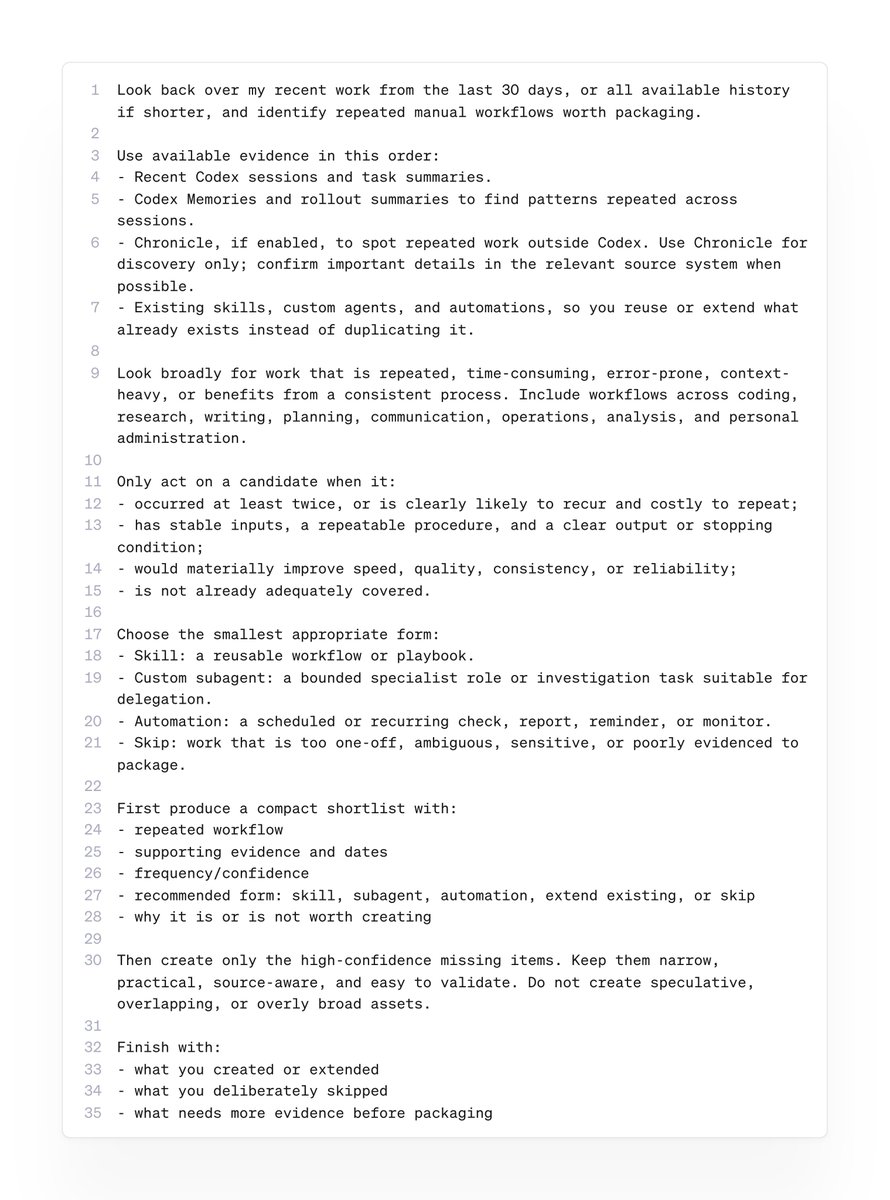
UPDATE: Came up with an even better version of this prompt after the feedback
Ask Codex to look across your sessions, Memories, and Chronicle, identify patterns, reuse what already exists, and only create the smallest useful skill, subagent, or automation.
"Look back over my recent work from the last 30 days, or all available history if shorter, and identify repeated manual workflows worth packaging.
Use available evidence in this order:
- Recent Codex sessions and task summaries.
- Codex Memories and rollout summaries to find patterns repeated across sessions.
- Chronicle, if enabled, to spot repeated work outside Codex. Use Chronicle for discovery only; confirm important details in the relevant source system when possible.
- Existing skills, custom agents, and automations, so you reuse or extend what already exists instead of duplicating it.
Look broadly for work that is repeated, time-consuming, error-prone, context-heavy, or benefits from a consistent process. Include workflows across coding, research, writing, planning, communication, operations, analysis, and personal administration.
Only act on a candidate when it:
- occurred at least twice, or is clearly likely to recur and costly to repeat;
- has stable inputs, a repeatable procedure, and a clear output or stopping condition;
- would materially improve speed, quality, consistency, or reliability;
- is not already adequately covered.
Choose the smallest appropriate form:
- Skill: a reusable workflow or playbook.
- Custom subagent: a bounded specialist role or investigation task suitable for delegation.
- Automation: a scheduled or recurring check, report, reminder, or monitor.
- Skip: work that is too one-off, ambiguous, sensitive, or poorly evidenced to package.
First produce a compact shortlist with:
- repeated workflow
- supporting evidence and dates
- frequency/confidence
- recommended form: skill, subagent, automation, extend existing, or skip
- why it is or is not worth creating
Then create only the high-confidence missing items. Keep them narrow, practical, source-aware, and easy to validate. Do not create speculative, overlapping, or overly broad assets.
Finish with:
- what you created or extended
- what you deliberately skipped
- what needs more evidence before packaging"
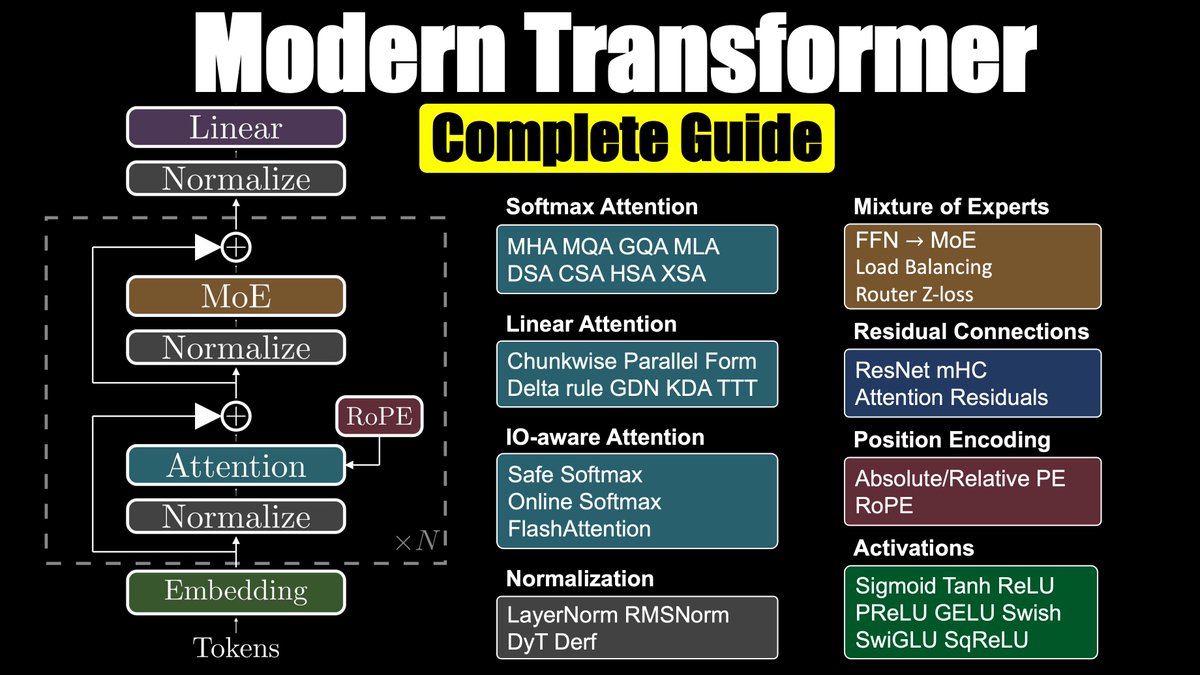
Modern Transformer - Complete Guide
Interested in learning the recent advances in transformers?
After 13 videos, I've finally completed this series!
🥳🥳🥳
Check out the course here:
https://t.co/CsujxlWigC
Today we release Token Superposition Training (TST), a modification to the standard LLM pretraining loop that produces a 2-3× wall-clock speedup at matched FLOPs without changing the model architecture, optimizer, tokenizer, or training data.
During the first third of training, the model reads and predicts contiguous bags of tokens, averaging their embeddings on the input side and predicting the next bag with a modified cross-entropy on the output side. For the remainder of the run, it trains normally on next-token prediction. The inference-time model is identical to one produced by conventional pretraining.
Validated at 270M, 600M, and 3B dense scales, and at 10B-A1B MoE.
The work on TST was led by @bloc97_, @gigant_theo, and @theemozilla.
How do we make LLMs faster and lighter? Don’t force the GPU to adapt to sparsity. Reshape the sparsity to fit the GPU! ⚡️
Excited to share our new #ICML2026 paper in collaboration with @NVIDIA: "Sparser, Faster, Lighter Transformer Language Models". This work introduces new open-source GPU kernels and data formats for faster inference and training of sparse transformer language models:
Paper: https://t.co/3Avj8N8iYO
Blog: https://t.co/SqFkkKvkbd
Code: https://t.co/PHSzMq8pg0
While LLMs are undoubtedly powerful, they are increasingly expensive to train and deploy, with a large part of this cost coming from their feedforward layers. Yet, an interesting phenomenon occurs inside these layers: For any given token, only a small fraction of the hidden activations actually matter. The rest approximate zero, wasting computation. With ReLU and very mild L1 regularization, this sparsity can exceed 95% with little to no impact on downstream performance.
So, can we leverage this sparsity to make LLMs faster? The challenge is hardware. Modern GPUs are optimized for dense matrix multiplications. Traditional sparse formats introduce irregular memory access and overheads that cancel out their theoretical savings for GEMM operations.
Our contribution is twofold:
1/ We introduce TwELL (Tile-wise ELLPACK), a new sparse packing format designed to integrate directly in the same optimized tiled matmul kernels without disrupting execution.
2/ We develop custom CUDA kernels that fuse multiple sparse matmuls to maximize throughput and compress TwELL to a hybrid representation that minimizes activation sizes.
We used our kernels to train and benchmark sparse LLMs at billion-parameter scales, demonstrating >20% speedups and even higher savings in peak memory and energy.
This work will be presented at #ICML2026. Please check out our blog and technical paper for a deep dive!
I promise this will be the best 20 min you spend today! Robotics: Endgame, the sequel to my last year's Sequoia AI Ascent talk, "Physical Turing Test". I laid out the roadmap for solving Physical AGI as a simple parallel to the LLM success story. Be a good scientist, copy homework ;)
And stay till the end, more easter eggs and predictions for your polymarket!
00:30 DGX-1 origin story at OpenAI, I was there in 2016 signing with Jensen and Elon. Heading to the Computer History Museum!
01:42 The Great Parallel
03:31 Robotics, the Endgame
03:39 Why VLAs fall short
04:32 Video world models as the 2nd pretraining paradigm
06:09 World Action Models (WAM)
07:46 Strategies for robot data collection and the FSD equivalent to physical data flywheel for robot manipulation
11:06 EgoScale and the Dexterity Scaling Law we discovered recently
14:00 Physical RL: bridging the last mile
15:39 DreamDojo: an end-to-end neural physics engine for scaling RL in silico
17:00 Civilizational Technology Tree and my predictions for the near future. Spoiler: it's closer than you think.
Thanks to my friends at Sequoia for inviting me back to AI Ascent this year! I had a blast! Last year's talk is attached in the thread if you missed it.
Introducing GPT-Realtime-2 in the API: our most intelligent voice model yet, bringing GPT-5-class reasoning to voice agents.
Voice agents are now real-time collaborators that can listen, reason, and solve complex problems as conversations unfold.
Now available in the API alongside streaming models GPT-Realtime-Translate and GPT-Realtime-Whisper — a new set of audio capabilities for the next generation of voice interfaces.
I gave a talk at ICLR 2026 about how we are scaling RL on frontier LLMs with 1T+ parameters, on experimental data from our physical lab at Periodic!
Here's a rough recording of the talk: